
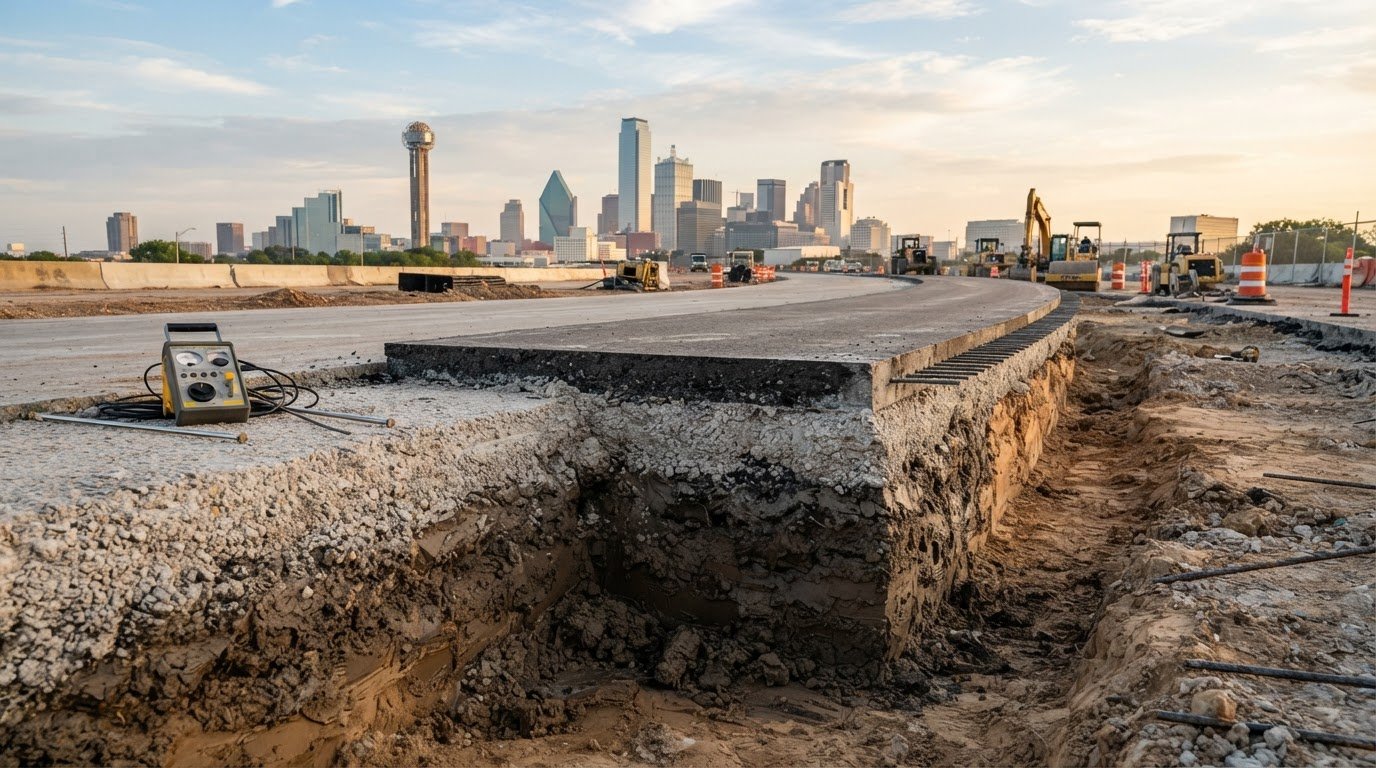
A road base’s service life depends in part on what supports the pavement. Cement stabilization for road base in Dallas can strengthen suitable existing soil or aggregate with additives, rather than removing and replacing the entire base layer. Cement-treated base typically combines aggregate with Portland cement. Whether it suits a site depends on soil properties, moisture, and the demands of the finished pavement.
It’s reasonable to focus on pavement strength, but the condition and compatibility of the material beneath it also matter. This article explains how cement-treated base supports pavement, which soil and moisture conditions affect suitability, and how treatment choices influence durability. It also examines what coverage and service-life findings can, and cannot, tell you when assessing a road base project.
Key Takeaways
- Cement-treated base can support concrete pavement, but its suitability depends on the existing soil and the pavement design.
- Moisture can affect soil strength and movement; stabilization changes how susceptible treated soil is to those effects.
- Plasticity, organic content, and sulfate levels are important factors when assessing whether cement or another stabilizing additive is appropriate.
- Coverage and service life depend on treatment depth, compaction, site conditions, and the demands placed on the finished pavement.
- For projects that include concrete paving, Born Integrated Construction can help establish the pavement as part of the broader construction work.
Cement-treated base as concrete pavement underlayment
Cement-treated base forms a stabilized layer between the subgrade and concrete pavement. For projects around Dallas, suitability depends on the existing soil, pavement design, and how materials are prepared and compacted.
Dallas-Area Road Applications
The Dallas District has adopted increased use of cement-treated base as a preferred underlayment for concrete pavement. The base layer supports the slab, and stabilization can strengthen existing material instead of requiring removal and replacement of the entire base. Road traffic demands and subgrade conditions help determine whether this approach suits a project.
Site Assessment and Treatment Depth
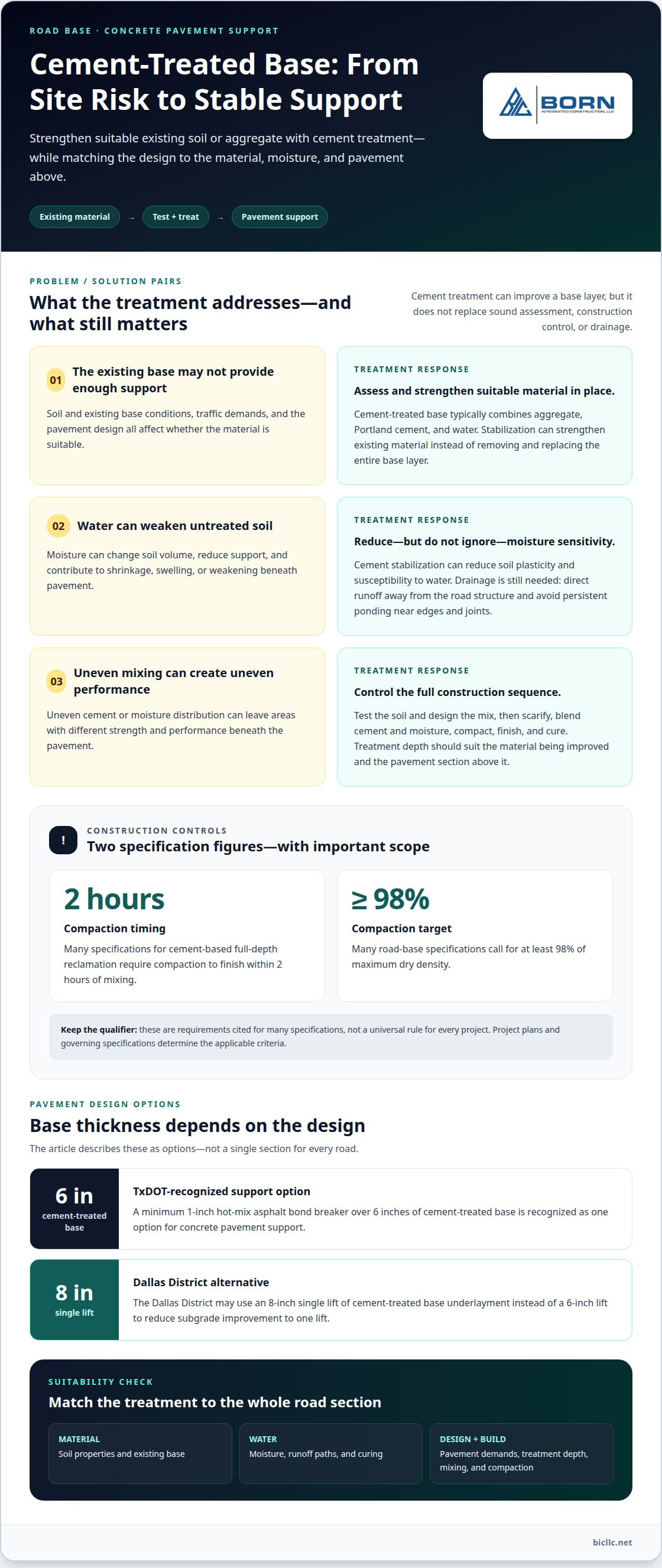
Site assessment examines the soil and existing base before treatment depth and mix are selected. The sequence runs from soil testing and mix design through scarifying, blending cement and moisture, compacting, finishing, and curing. Treatment depth must suit the material being improved and the pavement section above it. For cement-based full-depth reclamation, many specifications require compaction to finish within 2 hours of mixing; many road-base specifications call for at least 98% of maximum dry density.
Base Composition
Cement-treated base typically combines aggregate with Portland cement, mixed with water and compacted to form a stable layer. Aggregate provides the base material, while cement binds particles as the mixture cures. Existing granular material may also be incorporated when the design allows. Uniform mixing is essential: uneven cement or moisture distribution can create areas with different strength and performance beneath the pavement.
Specifications and Local Requirements
For concrete pavement support, TxDOT recognizes a minimum 1-inch hot-mix asphalt bond breaker over 6 inches of cement-treated base as one option. The Dallas District may use an 8-inch single lift of cement-treated base underlayment instead of a 6-inch lift to reduce subgrade improvement to one lift. These are pavement design options, not a universal section for every road.
Dallas County requirements depend on the roadway owner and the project’s governing plans and specifications, so there is no single countywide permit rule for every site. Identify the authority responsible for the road to determine applicable approvals. The stabilization sequence includes soil testing, mix design, in-place mixing, timely compaction, finishing, and curing. Curing maintains conditions that allow cement to harden and form a coherent layer.
Moisture-related soil performance
Water can weaken untreated soil, change its volume, and reduce the support beneath pavement. Cement stabilization can reduce soil plasticity and susceptibility to water, making treated material less likely to shrink, swell, or weaken when moisture changes. For Dallas-area roads, that difference matters because moisture can enter the base through rainfall, surface runoff, or poorly drained edges. Stabilization changes how the soil responds, but it doesn’t remove the need to manage water around the pavement.
Think of the road section as a connected system: pavement sheds water, the base supports the pavement, and the subgrade carries the load below. Runoff that collects beside the road or enters through cracks can reach the supporting layers. A stabilized base may be less moisture-sensitive than untreated soil, but standing water can still stress pavement edges and joints. Drainage design should direct runoff away from the road structure and prevent persistent ponding.
Moisture matters during construction, too. Before cement and soil are blended, the material’s water content affects how evenly the stabilizer can be distributed and how well the mixture compacts. Too much or too little water can prevent a uniform layer. The construction sequence should account for site moisture, weather exposure, mixing, compaction, and surface protection. These steps help maintain consistent support across the treated area instead of leaving wet or dry pockets beneath the pavement.
Curing is the period after placement when the cement-treated layer needs suitable moisture conditions to harden. In North Texas, the project design and specifications establish drainage and curing requirements, and the treatment must be protected from drying or water damage during curing. No single drainage detail suits every road. Road geometry, soil, runoff paths, and the specified cement treatment all affect how the finished base should be protected.
Texas roadways offer an example of moisture performance: cement-treated base underlayment on Houston and Beaumont District roadways maintained resilience during flooding caused by Hurricane Harvey. This illustrates the value of a stable supporting layer in severe wet conditions, but not every site faces the same exposure. A Dallas road with concentrated runoff at an entrance, for example, has different drainage demands from a level stretch with clear outlets.
For a North Texas project, assess where water enters, flows, and exits before selecting treatment details. Include road edges, low points, pavement joints, and adjacent slopes. Then coordinate drainage, mixing, compaction, and curing so the treated base and surface work together. This system-level approach helps reveal moisture risks that soil treatment alone cannot address.
Soil plasticity, organic content, and sulfate compatibility
Soil chemistry and particle behavior help determine whether cement is suitable for a road base. Plasticity index (PI) describes how much fine-grained soil changes consistency with moisture. Cement is identified as suitable for granular and sandy soils with a PI below 20 and sulfate levels below 3,000 ppm. These thresholds help frame soil testing before a stabilizer is selected.
A PI result also helps distinguish soils that may respond better to lime. Lime is best suited to fine-grained soils with a PI above 20 and more than 25% passing the No. 200 sieve. This does not make lime appropriate for every high-plasticity soil. Sulfate content must also be considered, because calcium-based additives can react with sulfates and cause heave.
For that reason, avoid lime stabilization when sulfate levels exceed 3,000 ppm. Sulfate-induced heave can raise or distort treated ground, affecting the pavement above it. A laboratory sulfate result is therefore important alongside PI and soil gradation. For example, a fine-grained sample with a PI above 20 may appear suited to lime, but elevated sulfates change that assessment.
Organic content is another constraint for cement treatment. Organic content above 2% can prevent cement from hardening. Organic matter can interfere with the binding process, leaving a treated layer that does not develop as intended. Testing for organic content helps identify that risk before mixing begins, rather than discovering weak or inconsistent material after placement.
Interpret these indicators together, not as separate pass-or-fail labels. A granular soil with low PI may align with cement treatment, while fine-grained soil with higher PI may point toward evaluating lime. Sulfate levels can rule out lime, and organic content above 2% raises concern for cement. The combined profile directs mix selection and helps prevent an additive from being chosen on soil texture alone.
Application rates also depend on the stabilizer and project design. For full-depth reclamation, Iowa SUDAS lists Portland cement rates of 3-6%, hydrated lime rates of 2-6%, and Class C fly ash rates of 8-14%. These figures are guidance for those applications, not a substitute for testing Dallas-area soils. Laboratory results, material characteristics, and the intended pavement section should inform the treatment design.
For a Dallas road base, assess gradation and PI, measure sulfate and organic content, then match the soil profile to a suitable stabilizer. One favorable test result cannot make up for an incompatible chemical condition. Considering the findings together helps determine whether cement treatment can form a reliable layer or whether the soil needs another design approach.
Stabilization limitations and project suitability
Cement treatment is not a universal substitute for every road-base material. Suitability depends on soil behavior, chemical compatibility, drainage, construction control, and pavement demands. For example, granular material paired with an incompatible mix design can still produce uneven support. Assess these conditions together before choosing cement, lime, or untreated aggregate base.
Cement-stabilized base binds suitable soil or aggregate into a firmer layer. Lime treatment changes fine-grained soils through chemical reactions, while aggregate base relies on compacted particles for support. Each approach suits different material conditions and design needs. Compare them using test results and the layer’s intended role, rather than relying on a blanket ranking.
Untreated aggregate base avoids cement-related curing and chemical compatibility concerns, but it does not bind particles in the same way. Cement treatment can strengthen compatible material in place, reducing the need to remove and replace the full base. Lime suits some fine-grained soils, but sulfate content affects its suitability. These differences help identify the method that fits the site’s soil and pavement design.
Failure risks arise when the treatment and site conditions do not align. Shrinkage cracking can develop as cement-treated material dries and contracts; cracks can provide paths for water into the pavement structure. Poorly controlled mixing, moisture, or compaction can also create nonuniform support. At the chemical level, sulfate-related heave is a concern with calcium-based additives, particularly lime when sulfate levels exceed 3,000 ppm.
Organic matter presents another limit: content above 2% can prevent cement from hardening. A soil sample that appears workable based on texture alone can therefore prove unsuitable after chemical testing. Assessing plasticity, organic content, and sulfate levels together helps distinguish a mix-design issue from a fundamental incompatibility. Treatment depth and drainage conditions also affect whether the stabilized layer performs as intended.
Project suitability also depends on the work area and its function. Stabilization is used for highways and local roads, parking lots, industrial yards, airports, runways, building pads, large commercial sites, and temporary construction or energy-project haul roads. Each use brings different support and surface demands. A haul road serves construction traffic, for example, while a permanent roadway must support its pavement structure over time.
Use a staged decision process: define the pavement’s role, test the existing material, evaluate additive compatibility, and match the treatment to the site. Select cement when the soil and design support cement treatment; use lime only when soil and sulfate conditions are suitable. Aggregate base remains an option when in-place stabilization does not fit the material or project requirements. This screening helps prevent an unsuitable method from being treated as a simple construction choice.
Road base coverage and service life
Coverage figures are useful for estimating material needs, but they depend on compacted depth. Supplier estimates put road base coverage at 50 to 60 square feet per ton at 4 inches compacted depth. A deeper layer covers less area per ton, while a thinner layer covers more. The estimate helps frame quantities, but site dimensions and specified depth determine the actual requirement.
Compacted depth is not interchangeable with loose material depth. Compaction reduces the placed material to its finished thickness, so estimating from an uncompressed volume can misstate coverage. For example, a plan specifying 4 inches means the coverage estimate applies after compaction, not before. Confirming the design depth and surface area first gives a more meaningful basis for material planning.
Service-life evidence offers a separate measure of performance. A Portland Cement Association study evaluated more than 75 cement-stabilized full-depth reclamation projects. Their average age was 9 years, and the oldest was 26 years. The study found no evidence of premature structural failure in the evaluated sections, including the 26-year-old project. Those findings describe the studied projects, not a guaranteed lifespan for every road.
Full-depth stabilization can provide up to 25 years of life extension, but the figure is an upper potential, not a standard outcome. Pavement condition, traffic demands, drainage, treatment depth, and construction quality influence how long a road remains serviceable. A sound assessment distinguishes the life of the stabilized base from the maintenance needs of the pavement surface above it.
Maintenance comparisons also require context. A Federal Highway Administration example reports that recycled pavement sections needed crack maintenance approximately every 8 years, compared with every 4 years for standard mill-and-overlay work. This example suggests longer intervals between crack maintenance in those sections. It does not establish that every stabilized road will follow the same schedule or avoid other maintenance.
For a Dallas project, use coverage and service-life figures as planning references, then relate them to the design. Begin with the road’s measured area and specified compacted depth. Assess the existing materials and the finished pavement’s demands. Finally, account for drainage and construction controls: projected service life depends on the whole pavement system, not tonnage alone.
The central takeaway is to separate material coverage from long-term performance. The 50 to 60 square feet per ton estimate applies at 4 inches compacted depth; the PCA and FHWA findings describe specific evaluated projects and examples. Together, these details help frame quantities and durability expectations without treating a single coverage rate or service-life figure as universal.
Born Integrated Construction: Concrete Paving
Born Integrated Construction provides concrete paving for projects where a prepared, suitable base must support a concrete surface. Once soil conditions, treatment limits, and pavement requirements are understood, concrete paving becomes the next construction consideration. Coordinate the base and pavement within the project design so the finished road section functions as an integrated system.
For projects that also involve building work, Born Integrated Construction provides Slab on Grade, Podium Slabs, and CIP Garages. The appropriate scope depends on the development and its structural requirements. To discuss a concrete paving project, contact Born Integrated Construction.
Plan the Next Stage with Confidence
Use the soil assessment to coordinate the road’s design, construction sequence, and long-term maintenance approach. For cement stabilization for a Dallas road base, bring site findings and pavement objectives into the broader project plan. This alignment keeps decisions about the supporting layer connected to the finished surface and how the road will serve its users.
Born Integrated Construction can be part of the discussion when concrete construction is in scope. Share the project context and intended use to start a practical conversation about the work ahead. A clear understanding of the project’s needs provides a sound basis for planning and coordination.
Contact Born Integrated Construction to discuss your project and take the next step with confidence.
Frequently Asked Questions
What is base stabilization?
Base stabilization improves existing soil or aggregate so it can provide more dependable support beneath a road or paved area. Rather than removing the full layer, a stabilizing agent is blended into suitable material and compacted. For example, a site assessment may show that an existing road base can be reused after treatment. The decision depends on material properties, pavement demands, and whether the existing layer can be prepared uniformly.
What materials are used in the stabilization process?
Stabilization may use Portland cement, lime, fly ash, liquid chloride, foamed asphalt cement, or emulsion. The appropriate additive depends on soil properties and intended pavement use. Cement can suit certain granular materials, for example, while lime is associated with some fine-grained soils. These agents are not interchangeable: soil testing and mix design help determine which material suits the site’s composition.
What is cement stabilization for road base, and how does it work?
Cement stabilization for road base in Dallas mixes Portland cement into suitable soil or aggregate to create a bound layer that supports pavement. The material is blended with water, shaped, compacted, and allowed to cure. Treating an existing granular base, for example, can make it part of the pavement support structure instead of replacing it entirely. Consistent mixing and compaction help create a more uniform layer across the planned road area.
What soil types in the Dallas area are suitable for cement stabilization?
Soil suitability for cement stabilization for road base in Dallas depends on test results, not appearance alone. Granular and sandy soils may suit treatment when their plasticity index is below 20 and sulfate levels are below 3,000 ppm. Organic content also matters: levels above 2% can prevent cement from hardening. Assessing gradation, plasticity, sulfates, and organic matter together helps establish whether the soil is compatible.
What cement content and mixing depth are typical for Dallas road base stabilization?
For full-depth reclamation, Iowa SUDAS lists Portland cement application rates of 3-6%; its guidance gives a typical treatment depth of 6 to 12 inches. These are reference values, not a universal Dallas design. The selected content and depth depend on soil test results, the existing layer, pavement loading, and project specifications. Mix design connects those conditions to the required support, while construction controls help achieve consistent treatment.
Which Dallas-area contractors provide soil cement stabilization for roads and parking lots?
Born Integrated Construction offers Paving Stabilization for projects in Texas, including Dallas and Fort Worth. Its service area also includes Houston, Austin, San Antonio, San Marcos, New Braunfels, Boerne, Beaumont, Conroe, The Woodlands, and Arlington. The appropriate scope for a road or parking project depends on the site and pavement requirements. Born Integrated Construction also offers Concrete Paving.