Concrete vs Asphalt Parking Lot Maintenance in Texas: The 2026 Guide
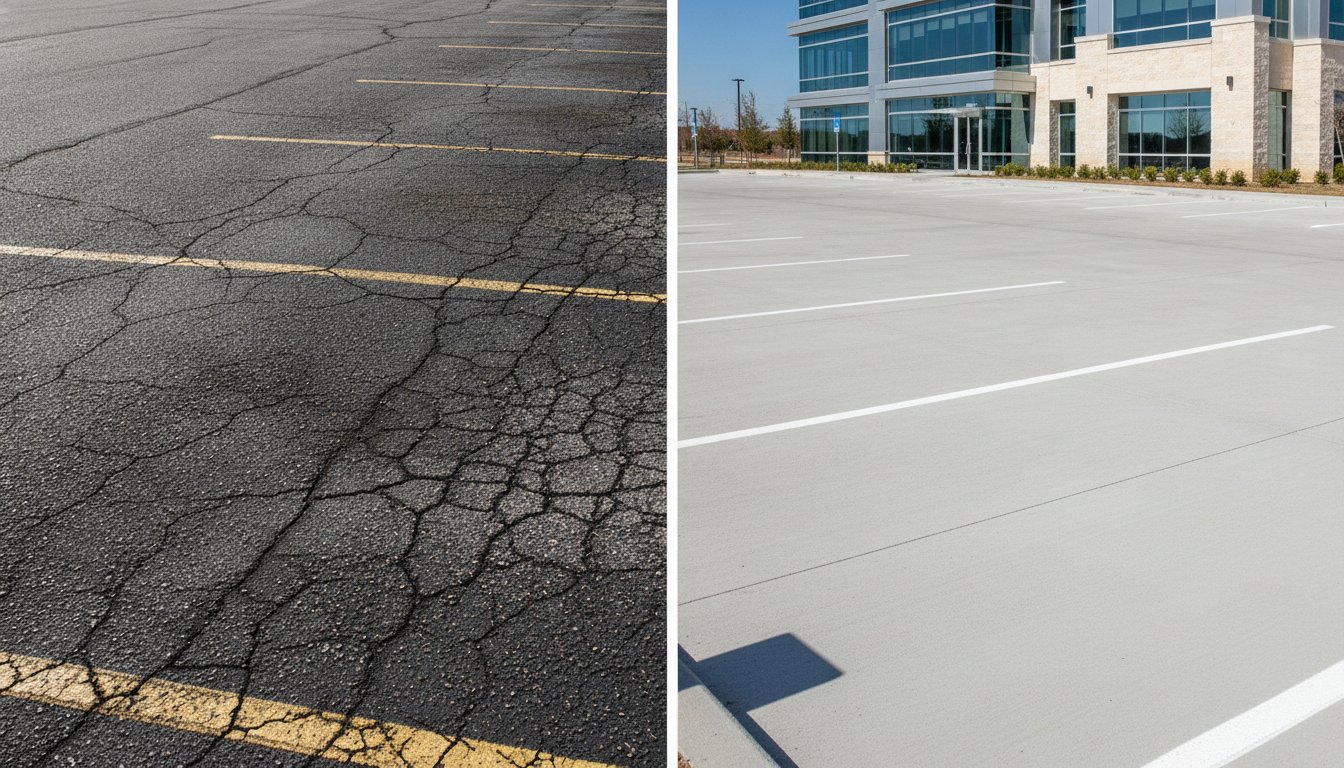
The "affordable" asphalt parking lot often ends up costing twice as much as a concrete one before its first decade of service is complete. In the Texas heat, where temperatures regularly exceed 100°F, petroleum-based surfaces soften and succumb to rutting under heavy commercial traffic. When you factor in the constant movement of expansive clay soils, the debate over concrete vs asphalt parking lot maintenance Texas property managers face becomes a matter of structural integrity rather than just aesthetics. You've likely experienced the frustration of seeing a relatively new surface crack or shift after a single season of extreme weather.
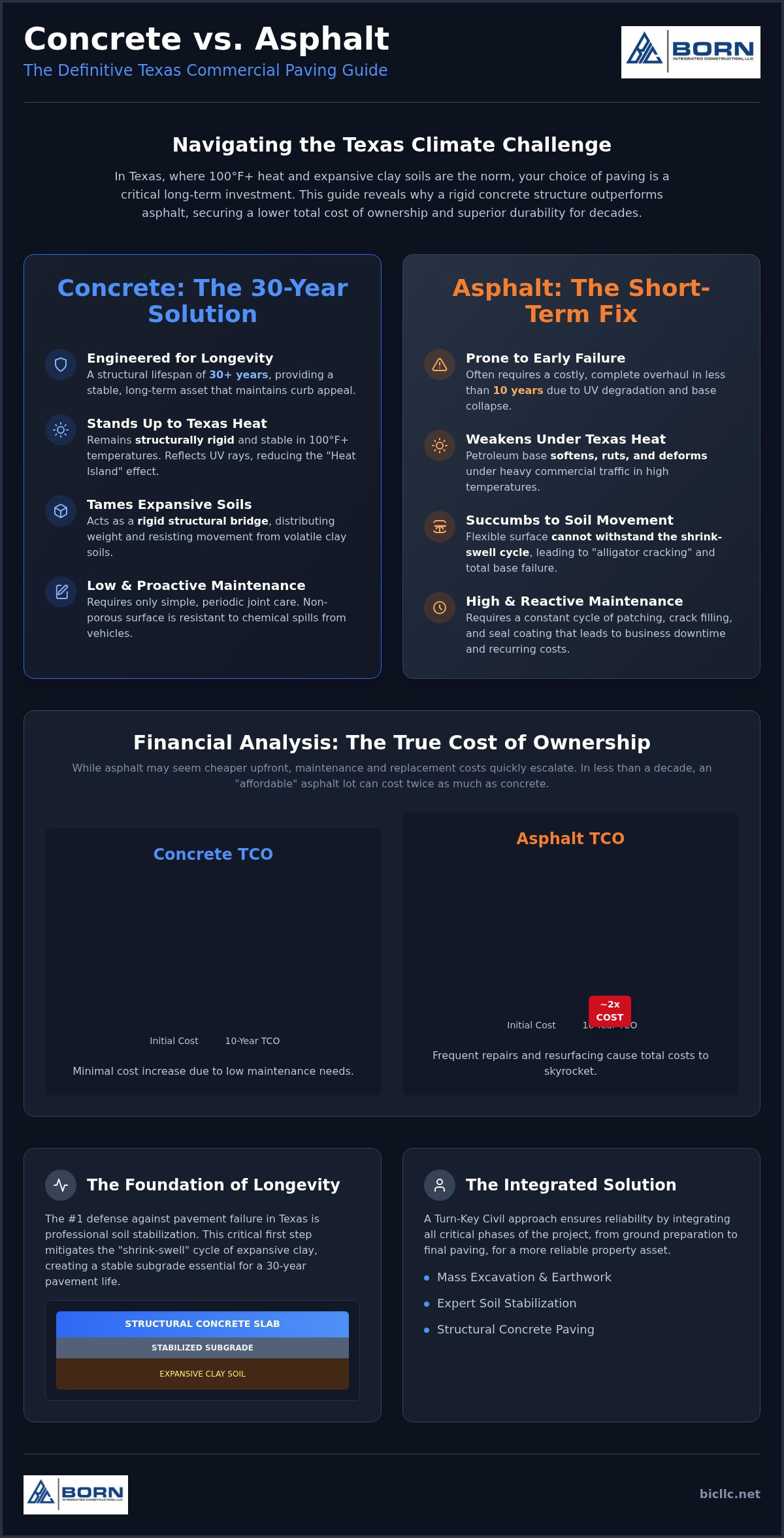
This 2026 guide demonstrates why a rigid concrete structure, supported by professional soil stabilization, provides the most reliable foundation for your commercial assets. We'll examine how concrete offers a 30-year paving solution that minimizes business downtime and reduces liability from surface degradation. By prioritizing long-term durability over initial savings, you can secure a lower total cost of ownership while maintaining superior curb appeal for decades. We'll explore the technical advantages of cast-in-place solutions and how they withstand the unique environmental pressures of the Lone Star State.
Key Takeaways
- Understand why concrete's rigid structure resists the extreme thermal expansion and 100°F heat that typically causes asphalt to soften and rut.
- Compare the long-term financial impacts of concrete vs asphalt parking lot maintenance Texas owners face, specifically regarding seal coating cycles versus simple joint care.
- Learn why professional soil stabilization is the critical first step to prevent cracking in expansive Texas clay and ensure a 30-year pavement life.
- Discover how it's possible to calculate the true Total Cost of Ownership by factoring in the hidden expense of business downtime during frequent resurfacing projects.
- Identify the advantages of a Turn Key Civil approach that integrates mass excavation, earthwork, and structural concrete for a more reliable property asset.
The Texas Climate Challenge: Why Paving Surface Selection Matters
Texas weather presents a structural antagonist to commercial infrastructure. In major hubs like Dallas and Houston, the extreme thermal cycles force paving materials to expand and contract with a frequency that many standard designs cannot withstand. Asphalt is a flexible, petroleum-based product that naturally absorbs a high percentage of UV radiation. This creates a "Heat Island" effect, where surface temperatures often soar far above the ambient air temperature. When the thermometer hits 100°F, asphalt can soften enough that heavy-duty commercial loads create permanent ruts and depressions.
This environmental reality dictates the long-term concrete vs asphalt parking lot maintenance Texas property owners must manage. In coastal regions like Beaumont or Houston, high humidity and intense seasonal rainfall further complicate the issue. Excess water can penetrate the porous surface of asphalt, eroding the base layer and leading to premature failure. Selecting a material that remains structurally rigid under these specific conditions is a critical operational decision for any commercial asset.
Expansive Clay Soils: The Silent Pavement Killer
Much of Texas is characterized by expansive clay soils that undergo a volatile "shrink-swell" cycle. These soils expand significantly when saturated and contract during the inevitable periods of drought. Flexible asphalt surfaces struggle to adapt to this constant ground movement, which often results in alligator cracking or total base failure. Proper paving stabilization is the only reliable way to mitigate this movement. Rigid concrete slabs act as a structural bridge, distributing heavy loads across a wider surface area. This reduces the localized pressure on the volatile subgrade, preventing the shifting that typically destroys less durable surfaces. The structural integrity of concrete vs asphalt parking lot maintenance Texas requirements often hinges on this ability to resist soil volatility.
UV Degradation and Surface Oxidation
The relentless Texas sun actively degrades the chemical bond of asphalt through a process called oxidation. UV rays strip away the binding oils that maintain the surface's flexibility, causing it to turn from deep black to a brittle gray. Once oxidized, the pavement loses its ability to flex under load, leading to widespread cracking and water infiltration. In contrast, concrete is a chemically inert material that does not "dry out" or lose its structural mass under high UV exposure. While asphalt requires frequent seal coating to replace these lost oils, concrete remains stable and reflective, which also helps lower the ambient temperature of the property during peak summer months.
Maintenance Requirements: Asphalt Upkeep vs. Concrete Durability
While the Texas climate sets the stage for surface degradation, the specific maintenance routine you adopt determines the long-term viability of your property. Asphalt requires a perpetual cycle of intervention to remain functional. Because it is a petroleum-based material, it's highly susceptible to damage from common chemical spills. Oil and fuel leaks from parked vehicles act as solvents, dissolving the binders and creating soft spots that quickly transition into potholes. This reactive repair model often leads to a frustrating "pothole season," where temporary patches fail to address the underlying structural decay. Property managers frequently find themselves in a loop of short-term fixes that never truly resolve the surface's instability.
The contrast in concrete vs asphalt parking lot maintenance Texas owners experience is most evident in the frequency of professional visits. Concrete is a rigid, non-porous material that doesn't react to petroleum leaks or oxidize under the sun. Maintenance is proactive rather than reactive. It focuses on preserving the integrity of the structure rather than rebuilding a failing surface. This stability ensures that your commercial lot remains a reliable asset rather than a recurring line item in your repair budget.
The Asphalt Maintenance Timeline
Property owners choosing asphalt must prepare for a rigorous schedule of repairs to prevent total surface failure. Neglecting these milestones often leads to a complete base collapse within a decade. Typical requirements include:
- Years 1-2: Initial crack filling and minor patching are necessary to prevent water from reaching the base layer.
- Years 3-5: The first comprehensive seal coating application is required to combat UV oxidation and restore the surface binder.
- Years 10-15: Most lots require milling and a structural overlay as the material reaches its fatigue limit.
The Concrete Maintenance Advantage
Concrete offers a more predictable and stable profile for commercial properties. The primary task involves periodic joint cleaning and resealing. This ensures the expansion joints function correctly and prevents moisture from infiltrating the subgrade. Industry data indicates that concrete paving requires approximately 60-80% less intervention over its lifespan compared to asphalt. Beyond the functional benefits, concrete maintains a professional, clean aesthetic without the need for frequent resurfacing projects that disrupt business operations. Routine inspections of drainage flow and joint integrity are usually sufficient to ensure the lot remains safe and reliable for thirty years or more, providing a sense of security for property owners who value long-term standards.
Financial Analysis: Total Cost of Ownership (TCO) in Texas
The decision to invest in commercial paving requires a shift in perspective from initial capital expenditure to long-term operational viability. While asphalt often presents a lower entry price, the recurring maintenance obligations quickly erode those early savings. The financial implications of concrete vs asphalt parking lot maintenance Texas developers manage involve more than just material costs. One must account for the indirect expenses of business disruption during frequent resurfacing cycles. Every time a lot is closed for seal coating or an overlay, the property loses accessibility. Concrete is different. It provides a stable, high-performance surface that ensures the property remains fully operational for decades.
Beyond surface repairs, concrete offers secondary financial benefits through its natural reflectivity. Its lighter color reflects significantly more light than dark asphalt; this creates a safer environment with fewer lighting fixtures. This reduces monthly electricity expenditures for outdoor illumination. High-quality concrete paving is viewed as a permanent infrastructure asset rather than a consumable surface. This directly impacts the residual value and appraisal of a commercial property during a sale or refinancing event.
30-Year Cost Comparison Framework
Total Cost of Ownership is the sum of all purchase and operation costs over 30 years. When evaluating this period, the cumulative costs of asphalt are substantial. Owners must fund seal coating every 3 to 5 years and a structural overlay every 10 to 15 years to prevent total failure. Conversely, concrete requires minimal intervention. Maintenance is primarily limited to periodic joint cleaning and resealing. This predictable cost structure allows for more accurate long-term budgeting. It protects the property's cash flow from the unexpected repair spikes common with flexible pavements.
ROI for Developers and Property Managers
A well-maintained exterior is a primary driver for attracting high-tier commercial tenants who value professional standards. Concrete’s structural reliability reduces the risk of trip-and-fall incidents caused by potholes or rutting. This can lead to lower liability insurance premiums over time. From a tax perspective, concrete is often classified as a long-term infrastructure asset, providing different depreciation advantages compared to temporary surfaces. For those focused on high-value commercial projects, concrete serves as a foundational investment that enhances the overall marketability of the site. It's a choice that prioritizes substance and long-term fiscal health.
Engineering for Longevity: The Role of Soil Stabilization
The longevity of a commercial parking lot isn't determined by the final pour or the last layer of sealant. It's decided during the earthwork phase. In Texas, where expansive clay is the standard, the subgrade serves as the literal and figurative foundation of your investment. Without professional intervention, the shifting ground will eventually compromise any surface, regardless of its thickness. This reality is a central factor in the concrete vs asphalt parking lot maintenance Texas developers must consider. A rigid surface requires a stable base to prevent joint failure and maintain its structural profile over thirty years of heavy use.
Mechanical compaction alone is often insufficient for the volatile soil conditions found in regions like Conroe or Houston. Engineering for longevity requires a deeper understanding of how the subgrade reacts to moisture. When the foundation is neglected, the cost of future repairs grows exponentially. By addressing soil stability during the initial construction, you're not just building a road; you're establishing a permanent asset that resists the natural tendencies of the Texas landscape.
Stabilization Techniques for Commercial Paving
Chemical stabilization represents a more sophisticated approach than simple mechanical compaction. For high-plasticity clays common in the region, lime or cement stabilization is standard practice. These agents alter the soil's chemical properties, reducing its capacity to absorb water and swell. This process, often following mass soil excavation, ensures a level and unyielding foundation. It prevents the vertical movement that often destroys concrete joints or causes asphalt to wavy. Understanding why paving stabilization is critical for Texas soil helps property owners move beyond surface-level repairs toward permanent engineering solutions.
Drainage and Detention Pond Integration
Water is the primary catalyst for subgrade failure. If moisture saturates the soil beneath the pavement, the load-bearing capacity of the lot vanishes. This is why integrating detention ponds and robust drainage systems is vital for commercial site work. Texas storm surges can overwhelm poorly planned lots, leading to erosion and base instability. By managing runoff through engineered ponds and integrated underground utilities, we protect the integrity of the paving structure from the bottom up. This integrated approach to civil site work ensures that the surface remains flat and functional regardless of the season. For developers seeking a comprehensive solution, our paving stabilization services ensure your project is engineered for long-term stability from the first excavation.
Choosing Born Integrated Construction for Texas Concrete Paving
Selecting a partner for commercial infrastructure requires more than a simple bid comparison. It demands a commitment to professional stability and technical precision. At Born Integrated Construction, our philosophy is rooted in efficiency, safety, and unwavering integrity. We understand that the long-term success of a property depends on the quality of its foundation. This perspective is particularly relevant when evaluating the concrete vs asphalt parking lot maintenance Texas owners must manage over a thirty-year horizon. We don't just provide a surface; we deliver a structural asset designed to withstand the environmental pressures of the Houston, Dallas, and San Antonio markets.
Our expertise extends across the full spectrum of concrete construction. Whether your project requires complex CIP garages, podium slabs, or heavy-duty industrial roads, our team applies the same meticulous attention to detail. We prioritize substance over style, focusing on the enduring nature of our work. This disciplined approach ensures that every project meets our high standards for durability and long-term viability. By focusing on execution and safety, we act as a dependable partner for developers who can't afford the risks associated with inferior paving solutions.
A Turn-Key Approach to Commercial Infrastructure
Project delays and communication friction often stem from a fragmented supply chain. Our Turn-Key Civil approach eliminates these obstacles by integrating every phase of the process. We manage everything from mass soil excavation and earthwork to the final concrete pour and site stabilization. This integration ensures that the engineering requirements discussed in previous sections, such as proper subgrade preparation, are executed without compromise. You can review our recent work on the BIC Projects page to see how this integrated model translates into high-quality results for diverse commercial developments.
Contact BIC for Your Next Texas Paving Project
The first step toward a 30-year paving solution is a comprehensive site evaluation. We analyze the specific soil conditions and drainage requirements of your property to develop a paving plan that prioritizes long-term stability. Our team avoids the short-term shortcuts that often lead to premature failure in Texas clay. We invite you to learn more about our values on the BIC About Us page and discover how our commitment to craftsmanship can protect your commercial investment. Contact us today to discuss your project specifications and establish a foundation built on proven results and unwavering consistency.
Securing Your Property’s Long-Term Infrastructure
The choice between paving materials ultimately defines the financial and structural health of your commercial asset. As we've explored, the specific challenges of concrete vs asphalt parking lot maintenance Texas owners face are dictated by extreme heat and volatile clay soils. While asphalt offers a lower initial entry point, the requirement for frequent seal coating and structural overlays creates a cycle of disruption and expense. Concrete, reinforced by professional soil stabilization, provides a rigid foundation that resists rutting and ground movement for over thirty years.
Born Integrated Construction remains a steadfast partner for developers seeking reliability. We specialize in CIP and structural concrete, offering integrated civil site work and utility services that ensure every project is engineered for long-term stability. With a proven track record across major Texas metro areas, we prioritize substance and operational precision in every pour. We invite you to partner with Born Integrated Construction for durable concrete paving that protects your capital and enhances your property's value. Your investment deserves a foundation built on proven craftsmanship and unwavering consistency.
Frequently Asked Questions
Is concrete or asphalt better for heavy truck traffic in Texas?
Concrete is the professional choice for heavy-duty commercial loads. Unlike asphalt, which is a flexible pavement that softens in the Texas sun, concrete acts as a rigid slab. It distributes weight across a broad area, preventing the deep ruts and surface imprints caused by delivery trucks. This structural stability is essential for high-traffic zones, ensuring the concrete vs asphalt parking lot maintenance Texas owners manage remains focused on longevity rather than constant structural repair.
How much more does a concrete parking lot cost upfront compared to asphalt?
Concrete requires a higher initial capital investment compared to asphalt. This premium reflects the durability of the material and the complexity of the installation process. While the upfront cost is higher, the total cost of ownership is lower over time. You won't face the recurring expenses of seal coating every three years or structural overlays every decade. Most commercial property owners find that concrete pays for itself through reduced long-term maintenance requirements.
How long does a concrete parking lot last in the Houston climate?
In the Houston climate, a well-engineered concrete parking lot can maintain its structural integrity for 30 to 50 years. This lifespan is roughly double that of asphalt, which often succumbs to the region's heat and moisture within 15 years. Concrete's inert chemical composition doesn't oxidize or become brittle under intense UV exposure. When combined with professional site work and drainage, it remains a stable asset that provides consistent value for decades without major intervention.
Can you pour concrete over an existing asphalt parking lot?
Pouring concrete over existing asphalt is a proven engineering technique called whitetopping. This method utilizes the old asphalt as a stable base for a new, rigid concrete surface. It's an efficient way to upgrade a property without the expense of a total mass excavation. However, its success depends on the condition of the underlying subgrade. A professional site evaluation is required to ensure the base can support the new structural load without shifting.
What is soil stabilization and why is it necessary for Texas paving?
Soil stabilization is the process of chemically or mechanically treating the subgrade to improve its structural performance. In Texas, we often use lime or cement to neutralize the shrink-swell behavior of expansive clay. This creates a permanent, uniform foundation for the paving. It's necessary because even the thickest concrete will fail if the ground beneath it is volatile. Stabilization ensures your infrastructure remains level and intact regardless of seasonal moisture changes.
How often does a concrete parking lot need to be resealed?
Concrete doesn't require the frequent surface sealants that petroleum-based pavements do. The primary maintenance task involves the expansion joints. These should be inspected every year and typically require professional cleaning and resealing every 5 to 10 years. This prevents moisture from reaching the stabilized subgrade and ensures the slabs can expand and contract safely. This predictable schedule is a key advantage in the concrete vs asphalt parking lot maintenance Texas property managers oversee.
Does concrete reflectivity really lower my energy bills?
Concrete's high reflectivity, or albedo, significantly reduces the heat island effect around a building. By reflecting more sunlight and absorbing less heat, it helps maintain lower ambient temperatures, which can decrease cooling costs for adjacent structures. Additionally, the lighter surface enhances the efficiency of site lighting. This allows property owners to achieve necessary safety illumination with fewer fixtures or lower-wattage bulbs, providing a direct and measurable reduction in monthly utility expenditures.
What happens if my parking lot is built on expansive clay without stabilization?
Building on expansive clay without stabilization leads to a high risk of structural failure. As the clay swells with moisture and shrinks during drought, the pavement is forced to move with the soil. This movement causes slabs to shift, joints to widen, and cracks to form throughout the surface. Eventually, this leads to an uneven lot with standing water and significant trip hazards. Without a stabilized foundation, the property faces a shortened lifespan and expensive repairs.