
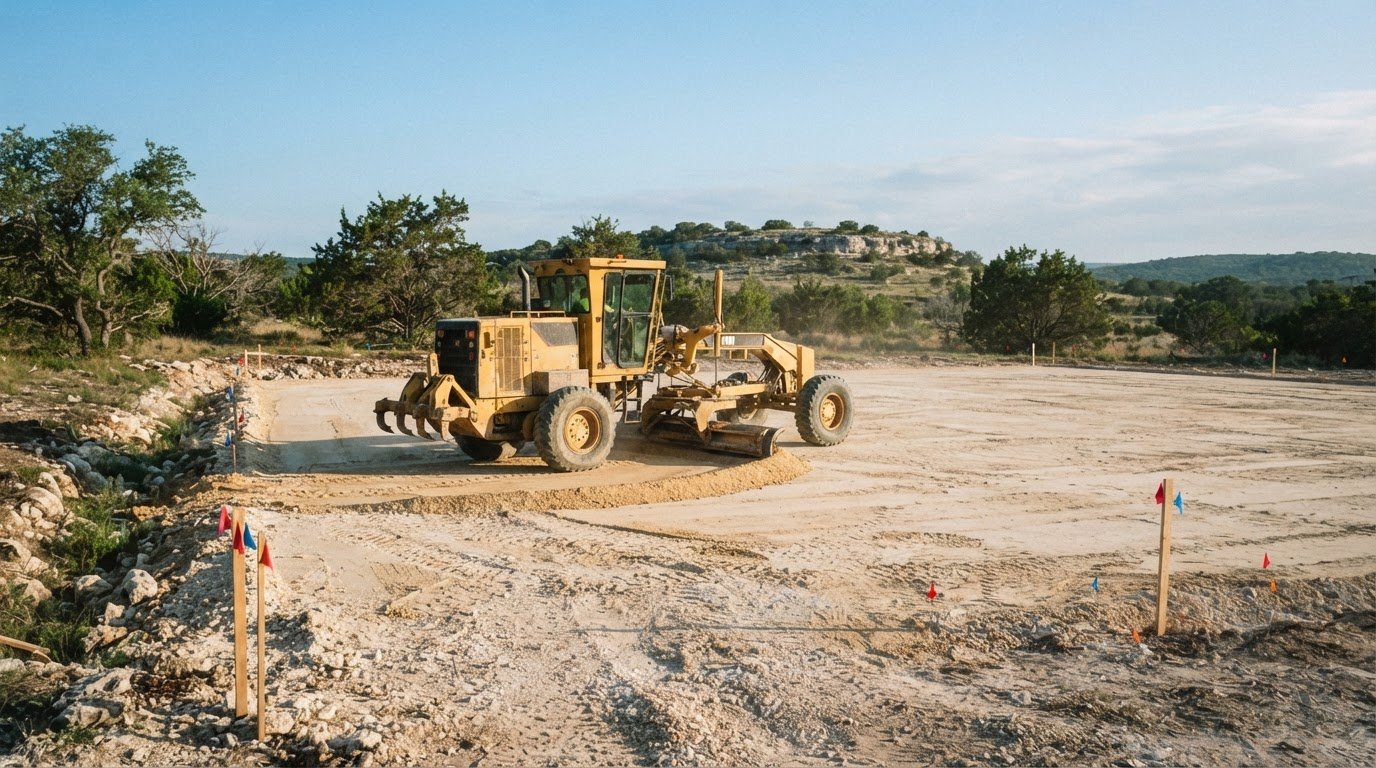
A listing reports 271 earthwork contractors in San Antonio, so finding the right fit starts with the work your site requires. Earthwork contractors in San Antonio may handle different parts of site preparation, from clearing and grading to excavation and building pad preparation. The specific scope matters when planning a commercial project.
It’s reasonable to look for an earthwork contractor whose capabilities match the site and the construction ahead. This guide explains earthwork services in San Antonio and the Hill Country, how the stages of site preparation differ, and how commercial projects move from initial grading toward a build-ready pad.
You’ll also find an overview of local service areas and the factors that shape earthwork planning, including site conditions and permit needs. With that context, you can identify the work your project calls for and see how earthwork fits into a broader civil and concrete construction scope.
Key Takeaways
- Define the project’s service area by the site’s location and the scope of work needed, from San Antonio into the Hill Country.
- Account for site constraints and demolition review early when planning land clearing.
- Understand how grading, drainage planning, and site conditions shape preparation for construction.
- See how building pad preparation connects earthwork to the next stage of a commercial project.
- Use contractor listings to compare specializations, then match the required earthwork scope to the project.
Service areas around San Antonio and the Hill Country
Service coverage depends on project location, haul routes, and the work required. Listings for earthwork contractors in San Antonio cover a 25-mile radius, while reported customer interest extends an average of 36 miles. These figures measure different things, not a guaranteed service boundary. For a Hill Country site outside the metro area, define the address, access route, and work scope when planning bids from earthwork contractors serving San Antonio.
Specializations also shape the fit. Site work may involve clearing, excavation, grading, or building pad preparation; a broader civil scope may include mass soil excavation or paving stabilization. Listings identify 271 contractors in San Antonio, but a directory count does not show which firm performs each trade. Match the requested work to the contractor’s stated scope, such as bulk soil removal rather than finish grading.
Compare bids using the same work boundaries, quantities, material assumptions, hauling and disposal responsibilities, schedule, and exclusions. Excavation alone is a different scope from excavation that also includes off-site hauling or fill placement. Ask each bidder to define the finished condition and where its work hands off to the next construction phase.
Dumpsite and gravel-pit coordination can affect material supply and hauling plans. Specify whether the work includes removing excavated soil, bringing in suitable fill, or both. For example, a site may need soil removed from a cut area and fill placed elsewhere. Access, haul distance, and material suitability affect the sequence and equipment needed.
What permits are required for grading and excavation in San Antonio or Bexar County? In San Antonio, grading, trenching in the right-of-way, and demolition often require permits. Identify the work location and jurisdiction early: right-of-way activity may involve a different review from work within private site boundaries.
Which earthwork contractors in San Antonio handle site preparation, grading, and excavation? Review each scope for clearing, cut-and-fill, finish grading, and hauling. Soil conditions, including limestone or caliche, can affect excavation methods and removal pace. Variable ground may call for changes to equipment and sequencing.
Hiring typically starts with defining site limits and deliverables, then requesting comparable bids and coordinating permits and utility locating before excavation. Clarify which tasks are included, how soil and fill will be handled, and what conditions could change the sequence. Common risks include mismatched bid scopes, permit delays, utility conflicts, difficult excavation, and restricted truck access. Across San Antonio and the Hill Country, clear scope definitions help keep each earthwork phase aligned.
Land clearing and demolition
Land clearing creates safe, workable access before construction begins. The scope may include removing brush, small trees, debris, or existing pavement. A roadway project, for example, may need a cleared corridor for equipment and material delivery, while a building site may require vegetation removal only within its planned footprint. Define the limits to distinguish necessary clearing from areas that should remain undisturbed.
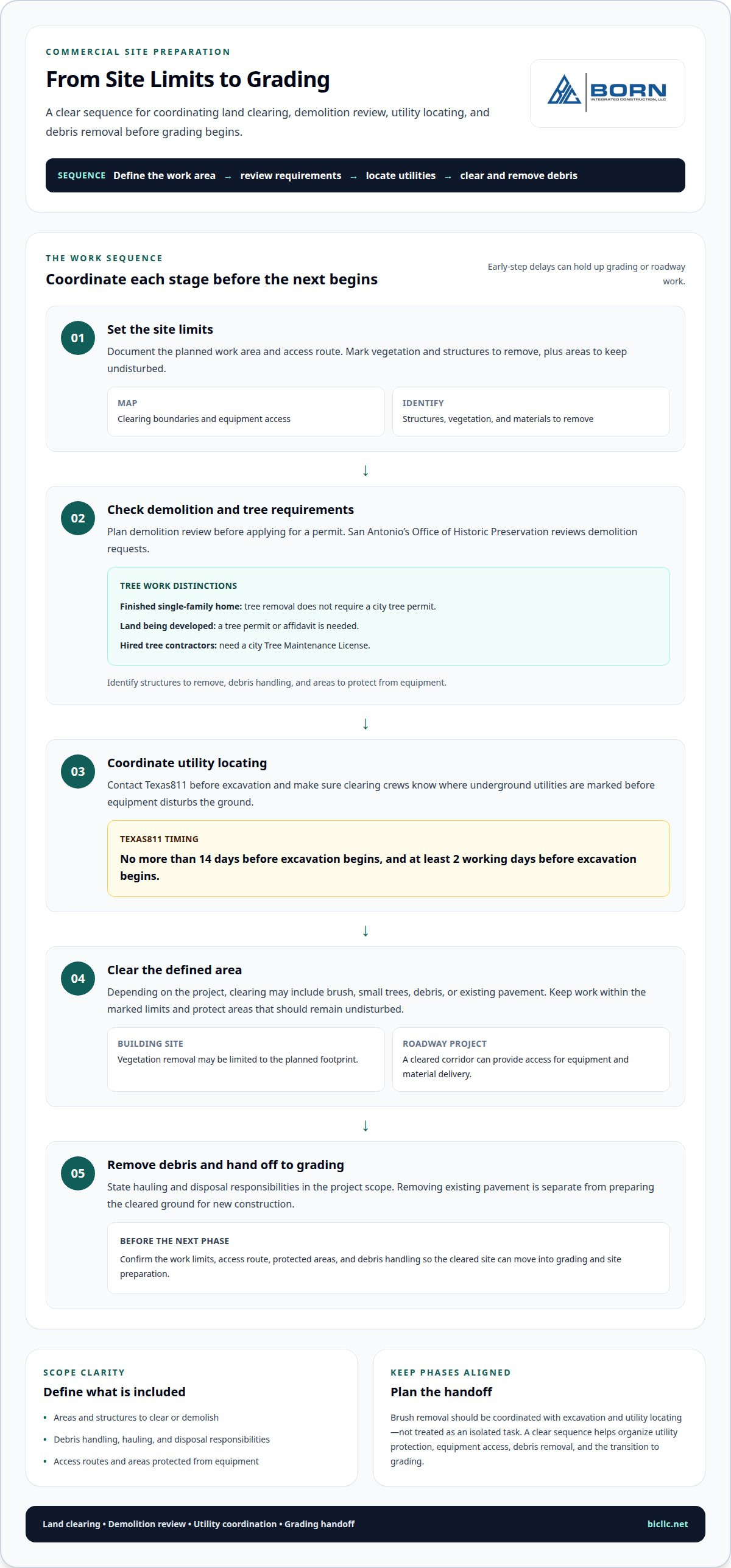
Demolition adds another sequence. In San Antonio, the Office of Historic Preservation reviews demolition requests, so plan that review before applying for a permit. The demolition scope should identify structures to remove, debris handling, and areas protected from equipment. A site plan that marks the structure, access route, and clearing boundaries gives the field team a clear work area and reduces conflicts with later grading.
Tree work has separate requirements. On a lot with a finished single-family home, tree removal does not require a city tree permit; land being developed needs a tree permit or affidavit. Hired tree contractors need a city Tree Maintenance License. These distinctions matter when a parcel changes from an occupied residential lot to a construction site. Include tree locations and proposed removals in early site planning.
Brush removal should be coordinated with excavation and utility locating, not treated as an isolated task. Texas811 should be contacted no more than 14 days before excavation begins and at least two working days before excavation begins. Clearing crews need to know where underground utilities are marked before equipment disturbs the ground. For a roadway corridor, this sequence helps organize brush removal, utility protection, and access for excavation equipment.
Roadway construction can combine clearing with demolition of existing pavement or other site features. Define the work limits: identify the access path, areas for temporary equipment movement, and materials to be removed. An existing roadway may include asphalt, but removing it is separate from preparing the cleared ground for new construction. State disposal and hauling responsibilities in the project scope.
Before work begins, organize the sequence: document site limits, identify structures and vegetation, plan demolition review, coordinate utility locating, then schedule clearing and debris removal. A delay in an early step can hold up grading or roadway work. Reviewing Born Integrated Construction's past commercial construction projects can help clarify how site preparation connects with the next construction phase.
Site preparation and grading
Site preparation turns an undeveloped or cleared parcel into a workable construction area. Grading reshapes the ground to support planned access, building locations, and drainage. A commercial site, for example, may need a level building area, sloped drive approaches, and an equipment route. These elements must work together: grading one area without considering nearby elevations can redirect runoff elsewhere on the site.
Start with the intended finished layout. Site plans establish building footprints, roadways, parking areas, and drainage paths. The grading plan coordinates existing ground levels with those features. For instance, a low area near a planned entrance may require coordinated earth movement so access and runoff patterns suit the project. The cut-and-fill sequence also affects where excavated material can be reused.
In San Antonio, grading, trenching in the right-of-way, and demolition often require permits. Work that reaches a public right-of-way should be considered separately from grading within private site boundaries. Requirements depend on the activity and location. Include this review in site preparation before scheduling crews, particularly when a project combines grading, utility work, and roadway access.
Consider drainage from the first layout review. For excavation over the Edwards Aquifer recharge zone, runoff control is included in the plan from the start. Runoff management is therefore part of initial site work, not an adjustment to make after grading begins. On other sites, account for how changed elevations direct water and how drainage features connect with finished areas.
In practical terms, a grading sequence can include:
- Establishing the limits of disturbance and identifying planned building and access areas.
- Coordinating excavation and fill placement with proposed elevations.
- Shaping the ground around entrances, roadways, and drainage paths.
- Reviewing the completed grades against the intended site layout.
Each step affects the next. If excavation removes material needed for fill, or grading changes the intended drainage direction, crews may need to revise the sequence. A clear scope identifies areas requiring cut, fill, compaction, or finish grading, and explains how earthwork connects to later construction. It also helps align bids by ensuring contractors price the same work rather than making different assumptions.
Ground conditions and runoff planning influence equipment, material movement, and the order of operations. On a sloped parcel, for example, access routes and finished elevations shape where grading can proceed safely and efficiently. Coordinated site preparation gives developers a defined starting point for building pad work, pavement, and subsequent construction.
Building pad preparation
A building pad is prepared ground that supports a planned structure’s foundation. Its location, elevation, and boundaries should align with the project plans before earthwork begins. For a commercial building, the pad must also relate to nearby access routes, drainage paths, and utility corridors. Clear limits help coordinate excavation and prevent work from extending into areas reserved for other uses.
Preparation starts by establishing the pad’s footprint and planned finished elevation. The earthwork sequence then addresses existing material, excavation, and placement of suitable fill. A sloped parcel, for example, may require cutting material from a higher area and placing fill within the building footprint. The work plan should show where material will move and how the pad connects with surrounding grades.
Ground conditions influence the sequence. Limestone or caliche can affect excavation methods, while variable soil may change how material is handled. Construction documents guide the preparation required for the specific foundation. A useful scope identifies excavation boundaries, fill areas, and the intended finished pad elevation instead of describing the work only as “building pad prep.”
Underground utilities need coordination before excavation. Texas811 should be contacted at least two working days before excavation begins. Utility markings help the team plan excavation around identified lines and organize equipment access. Include the pad, nearby trenches, and access routes in the work sequence so utility coordination supports the full area of ground disturbance.
Access and transitions matter, too. A driveway connecting to a pad can affect equipment movement and the final relationship between the building and site grades. For example, a delivery route may cross an area scheduled for fill placement. Coordinating that route with pad work can reduce conflicts between hauling, compaction, and later construction.
A clear building-pad scope can identify:
- The footprint, boundaries, and planned finished elevation.
- Areas requiring excavation, fill placement, or material removal.
- Underground utility locations and excavation coordination.
- Connections to drainage routes, driveways, and adjacent grades.
Before foundation work proceeds, review the prepared area against the project plans. This comparison can identify discrepancies in pad limits, elevation, or access while earthwork equipment remains on site. It also establishes a clear handoff between ground preparation and the next construction phase. On a project with several structures, mark each pad’s footprint and sequence separately so crews do not treat distinct foundation areas as one continuous work zone.
Commercial earthwork contractor listings
Commercial listings can help identify contractors by location, specialization, and ownership category. A San Antonio listing reports 30 minority-owned earthwork businesses and 12 women-owned businesses. Those figures describe categories in the listing, not a measure of each firm’s capacity or fit for a specific project. Treat directory details as a starting point for organizing potential bidders.
Next, divide the project into defined work packages. A commercial development may require mass excavation, grading, paving preparation, or finish work around structures. These tasks have different boundaries and handoffs. For example, an excavation bid should make clear where soil removal ends and later concrete or paving work begins. Defined limits help prevent comparisons based on different assumptions.
Use a consistent scope to review bids. Include site limits, planned sequence, material handling, and required coordination. Compare each proposal’s inclusions, exclusions, and description of the finished condition. A bid covering only bulk earth movement differs from one that also includes final grading and paving preparation. That distinction affects how the work connects to later construction.
Commercial projects also require attention to interfaces. Earthwork may precede concrete foundations, parking structures, or paved access areas. If a project includes several structures, note which areas and phases each proposal covers. A contractor’s stated specialty is only part of the picture; the written scope should show whether the experience aligns with the specific site package.
When assessing listings, consider these practical points:
- Specialization: Match listed services to excavation, grading, or paving-related needs.
- Project boundaries: Separate each work area and phase in the bid documents.
- Material handling: Clarify which proposal includes moving, reusing, or removing excavated material.
- Construction interfaces: Identify handoffs between earthwork, concrete, paving, and structures.
Ownership categories can support a procurement process when project requirements call for tracking supplier diversity. The listed 30 minority-owned and 12 women-owned businesses are useful directory filters, but they should not replace a scope review. Keep eligibility records and bid comparisons distinct from technical assessment so the project team can evaluate each requirement clearly.
Finally, record the basis for selection. A comparison matrix can capture each bidder’s scope, schedule assumptions, exclusions, and relevant specialization. Separate columns for excavation, finish grading, and paving preparation, for example, can expose gaps before award. The record gives the project team a clear reference during coordination and helps align earthwork with the next construction phase.
Born Integrated Construction: Earthwork
Born Integrated Construction provides Earthwork for commercial projects that need coordinated site preparation before construction advances. When grading and excavation connect with concrete work, a coordinated project plan can define the handoff between prepared ground and the next phase.
Related capabilities include Concrete Paving, Foundation Slabs, and Podium Slabs. These services are relevant when site work needs to align with paved areas or structural concrete components. Clear project boundaries and sequencing establish how earthwork supports those later construction elements.
For commercial work in San Antonio and the Hill Country, consider Born Integrated Construction when earthwork is part of a broader construction scope. Review commercial project examples to see how site and construction work relate. To discuss an earthwork project, contact Born Integrated Construction as your trusted choice for earthwork contractors San Antonio.
Move from site planning to a defined project scope
The next step is to define a scope that coordinates earthwork with the construction that follows. Clear responsibilities, sequencing, and handoffs help keep ground work aligned with the broader project plan. When choosing among earthwork contractors in San Antonio, consider how each scope fits the full project, not just the initial site work.
Born Integrated Construction provides Earthwork alongside Concrete Paving, Slab on Grade, and Podium Slabs. This combination can suit commercial site preparation that connects directly to concrete work or paved areas. A defined scope gives the project team a practical basis for coordinating these phases.
Bring your project requirements forward and discuss the work with Born Integrated Construction. A clear conversation about the site and construction scope is a steady place to begin.
Frequently Asked Questions
Looking for an earthwork subcontractor with a specific specialization?
Match the stated scope to your project’s work package. Bulk soil removal differs from a detention pond or paving stabilization. Divide the requested work into clear deliverables, such as excavation, material handling, or site restoration. This makes specialization easier to assess and helps prevent a bid from seeming comparable when it covers a different portion of the project.
What certifications do earthwork contractors hold?
Certifications vary with the work, the individuals performing it, and the project’s procurement requirements. A bid package may specify particular qualifications or safety documentation, but no single credential describes every earthwork contractor’s capabilities. For a commercial project, distinguish personal credentials from company-level certifications, and identify which documents apply to the actual scope rather than relying on a general qualification claim.
What construction sectors are earthwork projects in?
Earthwork supports residential, commercial, and infrastructure development. A residential project may need ground preparation for a building, while a commercial site may involve excavation coordinated with structural work. Infrastructure scopes may include civil site work and related site improvements. Born Integrated Construction serves a wide range of clients, so the appropriate scope depends on the project’s purpose and planned construction.
What project types are earthwork contractors bidding on?
Earthwork bid packages can cover distinct scopes, including Mass Soil Excavation, Detention Ponds, and Paving Stabilization. Some packages cover part of a larger commercial development; others group several civil tasks together. Review boundaries, material handling, and interfaces with follow-on construction. These distinctions show whether proposals cover the same deliverables, even when their project titles sound similar.
What earthwork contractors serve San Antonio, Texas?
Born Integrated Construction provides Earthwork in Texas, including San Antonio and nearby markets such as San Marcos, New Braunfels, and Boerne. Its Texas locations also include Houston, Austin, Dallas, Fort Worth, Beaumont, Conroe, The Woodlands, and Arlington. For a project seeking earthwork contractors in San Antonio, the right fit depends on the site location and the scope being procured.
What earthwork services do contractors in San Antonio offer?
Service scopes can include Earthwork, Mass Soil Excavation, Detention Ponds, and Paving Stabilization. Related construction needs may involve Concrete Paving, Slab on Grade, or Podium Slabs. These are distinct offerings, not interchangeable labels: excavation moves soil, while paving and slab work serve later construction needs. Defining the deliverables helps connect site work with planned structures and civil improvements.
Are earthwork contractors in San Antonio licensed, insured, or bonded?
Licensing, insurance, and bonding are separate matters, and requirements can depend on the contract, project owner, and scope. Commercial bid documents may specify qualifications, insurance documentation, or bonding conditions for an award. Review those provisions during procurement, including which entities must be covered and which project phase each requirement applies to. Do not treat one status as proof of the others.