Post Tension Concrete Slab Design in Austin: Engineering for Texas Soil

In the eastern and central corridors of Austin, the ground beneath a building isn't a static platform; it's a powerful force of nature capable of shifting with enough pressure to compromise traditional foundations. You likely recognize that the region's expansive clay soils present a constant threat of structural movement and unsightly cracking. Because of these geological conditions, professional post tension concrete slab design Austin services have become a technical necessity for any project requiring long-term stability and structural integrity.
This article provides the technical and practical requirements needed to master post-tensioned slab design tailored specifically for the unique challenges of Central Texas. We'll explore the critical local amendments to the 2021 International Building Code that took effect on July 10, 2025, and the latest ACI/PTI CODE-320-25 standards released in April 2025. By understanding these engineering benchmarks and the rigorous field execution required to prevent tendon failure, you can ensure your project achieves both code compliance and the enduring reliability that Austin's volatile soil demands.
Key Takeaways
- Identify how to navigate the geological challenges of Austin’s Blackland Prairie by implementing "rigid raft" strategies that resist differential soil heave.
- Master the technical nuances of post tension concrete slab design Austin, specifically focusing on load-balancing techniques and optimal parabolic tendon profiles.
- Learn the essential field protocols for maintaining design integrity, including precise tendon placement and meticulous anchorage management during the concrete pour.
- Understand the implications of the latest ACI/PTI standards and local building codes to ensure your project meets rigorous safety and durability benchmarks.
- Gain insight into selecting a construction partner that emphasizes technical proficiency and long-term structural stability for complex Central Texas developments.
Understanding Post-Tensioned Concrete Slab Design in Austin
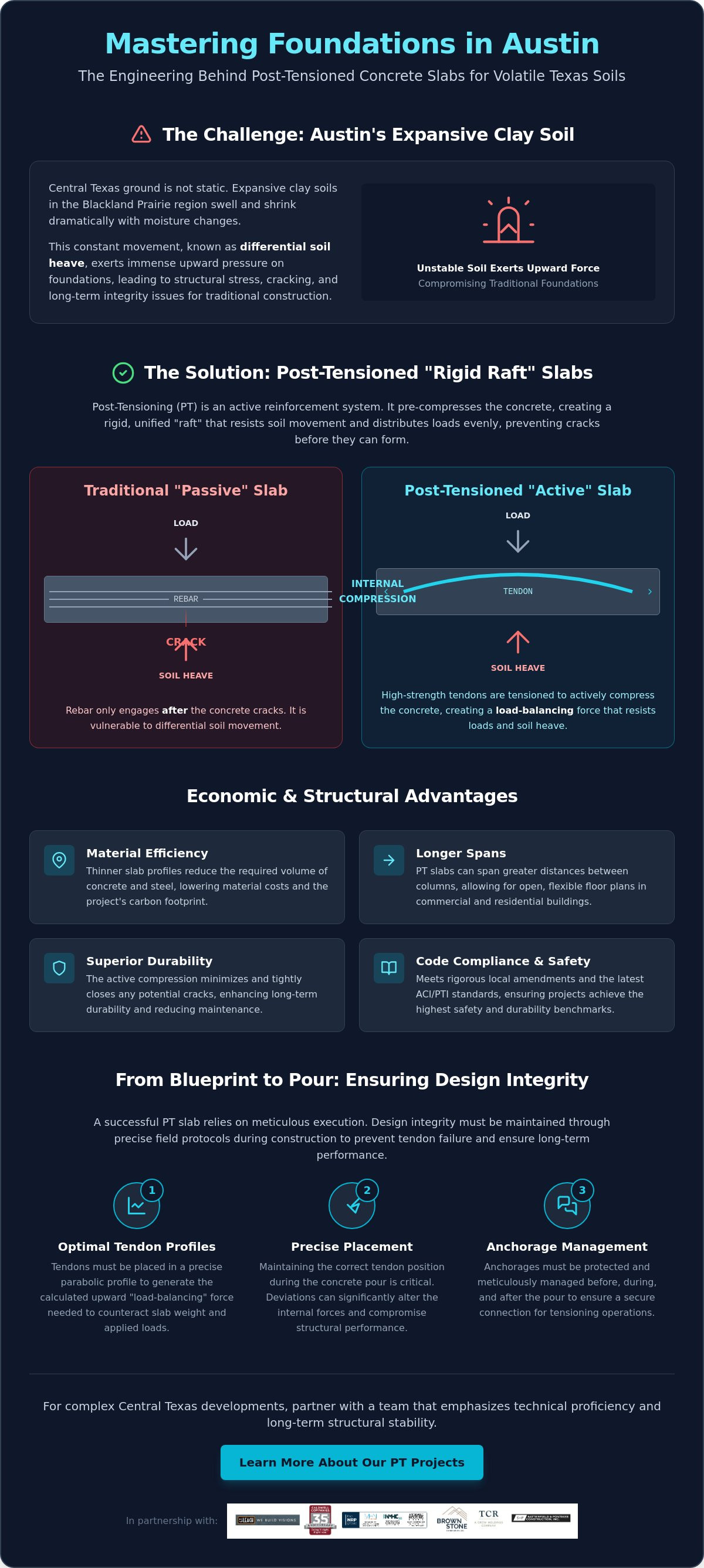
In the construction of high-density developments across Central Texas, post tension concrete slab design Austin has emerged as the standard for ensuring long-term structural integrity. This engineering method involves the use of high-strength steel tendons that are tensioned only after the concrete has reached a specific compressive strength on the job site. Unlike pre-tensioned concrete, which is manufactured in a factory setting, post-tensioning allows for on-site adjustments and the creation of complex geometries. This flexibility is exactly why local developers prioritize PT for commercial mid-rise, high-rise, and multi-family residential foundations. Understanding Post-Tensioned Concrete is essential for recognizing how these systems manage the immense forces exerted by Austin's shifting terrain. Most Texas projects utilize unbonded systems, where tendons are protected by a corrosion-inhibiting grease and a durable plastic sheath. Bonded systems, which involve grouting the tendons into ducts, are typically reserved for heavy civil structures or specific bridge designs.
The Mechanics of Internal Compression
Active reinforcement represents a fundamental shift from traditional passive methods like standard rebar. Standard reinforcement is passive, meaning it only begins to resist loads once the concrete has already started to stretch or crack. In contrast, post-tensioning is an active system that "pre-compresses" the slab, effectively neutralizing tensile forces before they can cause structural distress. Post-tensioning is a structural engineering method that introduces internal compression to the concrete, allowing for significantly thinner slab profiles without sacrificing load-bearing capacity. This state of constant compression ensures that the foundation acts as a rigid, unified raft, which is vital when dealing with the soil variations found in the Austin area.
Economic and Structural Advantages in 2026
The economic case for utilizing post tension concrete slab design Austin in 2026 is driven by material efficiency and long-term durability. By maximizing the compressive strength of the concrete, engineers can significantly reduce the overall volume of concrete and the total weight of steel reinforcement required for a project. This reduction leads to lower material costs and a smaller carbon footprint, supporting the industry's shift toward more sustainable building practices. Structurally, PT slabs offer superior crack control and the ability to support longer spans between supports. This capability allows for open floor plans with fewer interior columns, providing greater architectural flexibility and increasing the usable square footage of commercial and residential units alike. The result is a more resilient structure that maintains its value even in the face of Central Texas's challenging geological conditions.
The Structural Engineering Behind PT Slab Load Balancing
Load balancing is the primary design philosophy used in post tension concrete slab design Austin projects. This approach views the post-tensioning tendons as an active force that physically "lifts" the slab to counteract a portion of its own weight and the superimposed dead loads. By carefully calculating the upward force exerted by the tendons, engineers can design a structure that remains essentially flat under its intended service conditions. It's a precise calculation that requires balancing the downward force of gravity with the upward component of the tendon's tension. This methodology allows for thinner slabs and longer spans, which are essential for modern commercial developments where open floor plans are a priority.
Determining the optimal tendon profile is a critical step in this process. For slabs with uniform loads, a parabolic profile is typically employed because it provides a constant upward force along the length of the span. Engineers must account for both initial losses, such as friction and anchorage set, and long-term losses including concrete creep and tendon relaxation. Adhering to strict technical specifications for post-tensioned concrete ensures that the final effective force meets the P/A (force per unit area) requirements necessary for crack prevention. A typical target for P/A in Austin foundations ranges from 125 to 250 psi, providing enough pre-compression to keep the concrete in a state that resists tensile stress.
Tendon Layout and Geometry
In two-way slabs, designers often utilize a banded and distributed tendon layout. This pattern concentrates tendons in one direction over column lines (banded) while spacing them evenly in the perpendicular direction (distributed). Managing the "drapes," or the vertical placement of the tendons within the slab, is vital to maximizing structural efficiency. High points occur over supports, while low points are situated at mid-spans. It's also necessary to coordinate these layouts with MEP penetrations early in the design phase. Accurate coordination prevents the need for field adjustments that could compromise the tendon's geometry or, worse, lead to accidental strikes during installation. For developers managing complex vertical builds, partnering with an expert podium slab contractor in Houston can provide additional perspective on scaling these systems for multi-story requirements.
Serviceability and Deflection Limits
The serviceability of a structure is often defined by its deflection limits and crack control. Post-tensioned slabs significantly reduce long-term deflection compared to traditional reinforced concrete (RC) slabs. Because the concrete is kept in compression, the entire cross-section of the slab remains effective, which increases its stiffness. Engineers check for cracking moments under various service loads to ensure the slab stays within the "un-cracked" range. This high level of control is why PT is the preferred choice for high-end residential and commercial projects where floor levelness and finishes are sensitive to movement. If you're planning a project that requires this level of precision, consulting with a specialist in structural concrete can help align your engineering goals with practical field execution.
Overcoming Austin’s Expansive Clay: Design Strategies for Foundation Longevity
Austin’s geological profile, particularly the eastern Blackland Prairie, is dominated by clay with a high Plasticity Index (PI). These soils undergo significant volume changes during the extreme wet and dry cycles typical of Central Texas. This movement exerts immense pressure on foundations, often leading to structural failure in under-engineered buildings. In this environment, post tension concrete slab design Austin serves as a specialized solution. The design allows the foundation to function as a "rigid raft." Instead of bending and cracking when the soil heaves or settles, the entire slab moves as a single, unified unit, maintaining the integrity of the structure above it.
Integrating geotechnical reports into the structural design phase is mandatory for long-term success. These reports provide the Potential Vertical Rise (PVR) and soil moisture parameters that dictate the required stiffness of the slab. Whether designing a standard slab on grade or a more complex structural slab, the engineering must account for these specific soil movements. According to the Post-Tensioning Institute, the ability of PT to span across localized soft spots or areas of high heave makes it the most reliable choice for the region’s volatile geology. This reliability is why the method remains the preferred standard for both residential and commercial developments throughout the corridor.
Designing for Differential Heave
Differential heave occurs when moisture levels vary between the center and the edges of a slab, causing uneven lifting. Engineers must calculate the expected edge moisture variation distance and the corresponding lift or drop to determine the necessary reinforcement. Traditional rebar-reinforced slabs often fail in the Austin-San Antonio corridor because they lack the tensile strength to resist these bending moments without becoming excessively thick and costly. To combat this, post tension concrete slab design Austin often incorporates stiffening beams or "ribs." These beams increase the moment of inertia of the slab, providing the necessary rigidity to resist the soil's upward force without the material waste of a thicker uniform slab.
Soil Stabilization and Site Prep
Designing the slab is only half of the equation; the ground must be properly prepared to receive it. Mass soil excavation and replacement with select fill is a common practice to reduce the PVR to manageable levels before construction begins. Understanding why paving stabilization is critical for Texas soil highlights the importance of creating a stable subgrade before any concrete is poured. Chemical stabilization methods, such as injecting lime or cement into the clay, further reduce the soil's expansion potential. This multi-layered approach ensures that the post-tensioned foundation rests on a predictable base, extending the lifespan of the structure and minimizing the risk of future maintenance issues.
From Blueprint to Pour: Ensuring Design Integrity During Construction
Translating a complex post tension concrete slab design Austin blueprint into a physical structure requires meticulous attention to detail during the pre-pour phase. Field crews must verify that every tendon is placed at the exact height specified by the engineering drapes. Using the correct chair heights is non-negotiable; even a half-inch deviation can significantly alter the load-balancing characteristics of the slab. During the concrete pour, workers must ensure proper consolidation, particularly around the anchorage zones. Voids or honeycombing near the anchors can lead to structural failure when the tendons are later tensioned to their full capacity. This phase demands a high level of coordination between the engineering team and the site crew to ensure the design's intent isn't lost during the chaos of a major pour.
Once the concrete is placed, the project enters the critical window where the design’s theoretical strength becomes a reality. Stressing cannot begin until cylinder tests confirm the concrete has reached its target compressive strength, typically 3,000 to 3,500 PSI. Applying over 30,000 pounds of force to a single tendon requires precision and steady execution. After the hydraulic jacks have applied the specified tension, the field team records the elongation of each tendon. These measurements are compared against the engineer's calculations to confirm that the internal forces are distributed exactly as the design intended. Any discrepancies must be addressed immediately to ensure the long-term stability of the foundation.
The Stressing Process and Safety
Safety is the highest priority during the tensioning phase due to the immense energy stored within the tendons. Standard protocols require all non-essential personnel to clear the area behind the jacks to mitigate the risk of injury. A tendon "blowout" usually occurs because of poor concrete consolidation or improper anchorage alignment, both of which can be prevented through rigorous pre-pour inspections. Formal elongation reports must be submitted to the Engineer of Record within 72 hours of the stressing operation to ensure immediate verification of structural integrity. Following approval, the excess tendon tails are cut, and the pockets are filled with high-strength grout to protect against corrosion and maintain the aesthetic finish of the slab edge.
Quality Control and Third-Party Inspections
The City of Austin maintains strict documentation requirements for building permits, necessitating a clear trail of quality control data. Before any concrete is ordered, the Engineer of Record (EOR) or a qualified third-party inspector must perform a comprehensive walk-through to sign off on the tendon layout and reinforcement. This inspection verifies that the field installation matches the approved post tension concrete slab design Austin documents. Cylinder testing provides the empirical proof needed to proceed with stressing, ensuring the concrete matrix can withstand the localized pressure at the anchors. Maintaining these records is a matter of professional duty and regulatory compliance, ensuring the safety of the future occupants. For developers who prioritize precision and safety in their foundations, partnering with a specialist in concrete construction ensures that every detail of the engineering plan is executed without compromise.
Partnering with Born Integrated Construction for Austin PT Projects
Born Integrated Construction offers the technical proficiency and operational stability required for successful post tension concrete slab design Austin projects. We recognize that a foundation's reliability depends entirely on the disciplined execution of the engineering plan. Our firm prioritizes professional integrity and meticulous detail in every Austin development, ensuring that structural concrete components are built to endure the region's unique geological pressures. By maintaining rigorous standards for safety and precision, we serve as a steadfast partner for developers who value substance and long-term viability. Our team manages every phase with a serious and composed delivery, instilling confidence that the structural outcome will meet the highest industry benchmarks.
Comprehensive Civil and Concrete Solutions
Our integrated service model combines mass soil excavation, earthwork, and specialized concrete construction into a single, streamlined workflow. This synergy significantly reduces project friction by ensuring that the subgrade preparation aligns perfectly with the technical requirements of the PT slab-on-grade design. We possess extensive experience delivering complex structures, including podium slabs, CIP garages, and high-rise foundations across the Austin-San Antonio corridor. This breadth of capability allows our team to manage the transition from initial earthwork to final PT stressing with unwavering consistency. We take pride in our grounded methodology, which focuses on building lasting foundations through a mastery of structural concrete and civil engineering principles. Our portfolio includes thin shell cast-in-place concrete residential buildings and cast in place concrete hotel structures, demonstrating our ability to scale expertise to meet diverse project demands.
Get a Professional Consultation for Your Austin Project
Initiating a project with Born Integrated Construction begins with a comprehensive review of your specific engineering requirements and site conditions. Our team leverages an established local network of trusted vendors and professional partners in Central Texas to provide reliable structural solutions. We invite developers and general contractors to engage in a transparent bidding process that reflects our commitment to operational precision and ethical conduct. Whether your project involves a multi-family mid-rise or a structured concrete parking garage, our expertise ensures that the final product adheres to all local building codes and performance standards. We maintain a professional distance that reinforces our authority while remaining a dependable partner in achieving your development goals. To begin your next development, Contact Born Integrated Construction for your Austin PT Slab project and experience a professional partnership defined by proven results and disciplined execution.
Securing Your Development’s Structural Legacy
Austin’s geological landscape demands more than standard foundation methods. A successful project relies on the precise integration of geotechnical data and advanced engineering principles to counteract the volatility of expansive clay. By prioritizing a meticulous post tension concrete slab design Austin, you ensure that your structure remains resilient against differential heave and environmental stress. This methodical approach to load balancing and field execution isn't just about code compliance; it's about establishing a permanent standard of stability for your investment.
Born Integrated Construction brings specialized expertise in CIP Garages and Podium Slabs to every project. We provide a comprehensive site-to-slab service that encompasses everything from mass soil excavation to final PT stressing, all managed within a safety-first culture. Our focus remains on structural integrity and professional reliability throughout the Austin-San Antonio corridor. Partner with Austin’s Reliable Concrete Experts at Born Integrated Construction to ensure your next project is built on a foundation of proven results. We look forward to establishing a steadfast partnership that secures the long-term viability of your development.
Frequently Asked Questions
What is the average cost difference between a PT slab and a rebar slab in Austin?
Post-tensioned systems typically require a higher upfront investment for specialized materials and labor, but they often reduce overall project costs by requiring less total concrete and steel reinforcement. The post-tensioning system itself adds a premium of approximately $1.50 to $3.00 per square foot over conventional slabs. However, the ability to design thinner slabs and longer spans often offsets these material expenses in large-scale commercial developments.
Can a post-tensioned slab be repaired if a tendon is accidentally cut?
A post-tensioned slab can be repaired if a tendon is accidentally severed during subsequent construction or renovation activities. The repair process involves excavating the concrete around the damaged section, installing a specialized coupler or splice, and re-tensioning the tendon to its original design force. This is a technical procedure that must be overseen by a structural engineer to ensure the slab's integrity is fully restored.
How long does the stressing process take after the concrete is poured?
The stressing process typically occurs three to seven days after the concrete pour, depending on how quickly the material reaches its target compressive strength. Engineers rely on field-cured cylinder tests to verify that the concrete has achieved approximately 75% to 80% of its design PSI before applying hydraulic force. This timeline ensures the concrete matrix is stable enough to withstand the immense pressure exerted at the anchorage points.
Is post-tensioning suitable for residential foundations in Austin?
Post-tensioning is highly suitable and frequently utilized for residential foundations throughout Central Texas. Because of the expansive clay soils found in the region, post tension concrete slab design Austin services provide a reliable method for preventing the foundation movement and cracking that often plague traditional rebar slabs. This approach offers a superior level of protection for high-density residential investments on volatile terrain.
What are the maintenance requirements for a post-tensioned commercial slab?
Maintenance for a post-tensioned commercial slab is generally minimal but focuses on protecting the integrity of the anchorage pockets. Building owners should ensure that the grout caps covering the tendon ends remain intact to prevent moisture from entering and causing corrosion. Routine inspections for significant structural cracking or signs of moisture intrusion near the slab edges are standard practices for ensuring the long-term durability of the foundation.
How does Austin’s climate affect the curing and stressing of PT concrete?
Austin’s high summer temperatures accelerate the curing process, which requires careful moisture management to prevent premature drying and shrinkage cracks. High heat can lead to faster strength gain, potentially allowing for earlier stressing, but it also increases the risk of thermal distress if the slab isn't properly cured. Conversely, heavy rain events can saturate the subgrade, requiring site stabilization efforts before the concrete pour can proceed.
What is the difference between bonded and unbonded post-tensioning?
Unbonded post-tensioning is the standard choice for most post tension concrete slab design Austin projects, utilizing tendons coated in grease and encased in a plastic sheath. This system allows the tendons to move independently of the concrete. Bonded systems involve pumping cementitious grout into ducts containing the tendons, creating a permanent bond between the steel and the concrete, which is typically reserved for heavy civil structures or bridges.
Do I need a special permit for PT construction in Austin?
The City of Austin doesn't require a separate permit exclusively for PT, but the standard building permit process involves rigorous engineering documentation and specific inspection milestones. The 2021 International Building Code, with local amendments effective as of July 10, 2025, dictates that all PT designs must be sealed by a licensed engineer. Additionally, third-party inspections and elongation reports are mandatory components of the permitting and approval workflow.