
Houston’s excavation market looks different depending on how a directory defines its search. One Houston contractor list displays 12 of 28 matched companies, while a separate excavation-and-fill search returns 1,524 results within 25 miles. Those figures describe different listings, not a single count of every contractor in the area.
For site excavation and grading services in Houston, the right scope depends on the property and the work required. A project may involve cutting and filling, preparing a building pad, or correcting areas where water collects, with service coverage varying by contractor.
This guide explains what the directory counts do and don’t show, how to understand the areas contractors serve, and how grading and earthwork can help direct water and limit erosion. It also outlines the practical considerations behind excavation and grading work, so you can understand how site preparation connects to drainage and the stability of the finished ground.
Key Takeaways
- Directory counts describe different search results, so interpret contractor totals in light of each listing’s coverage and matching criteria.
- Service areas vary across contractors; the directory’s 25-mile search radius provides one reference point for understanding local listings.
- Drainage planning should direct water away from structures and low-lying areas to help limit flooding and erosion concerns.
- Grading work can include cutting and filling, preparing building pads, and addressing areas where water collects.
- Mass soil excavation can support larger site-preparation needs, with concrete paving, slab on grade, and podium slabs relevant to some projects.
How many excavation and grading contractors are there based in Houston, United States?
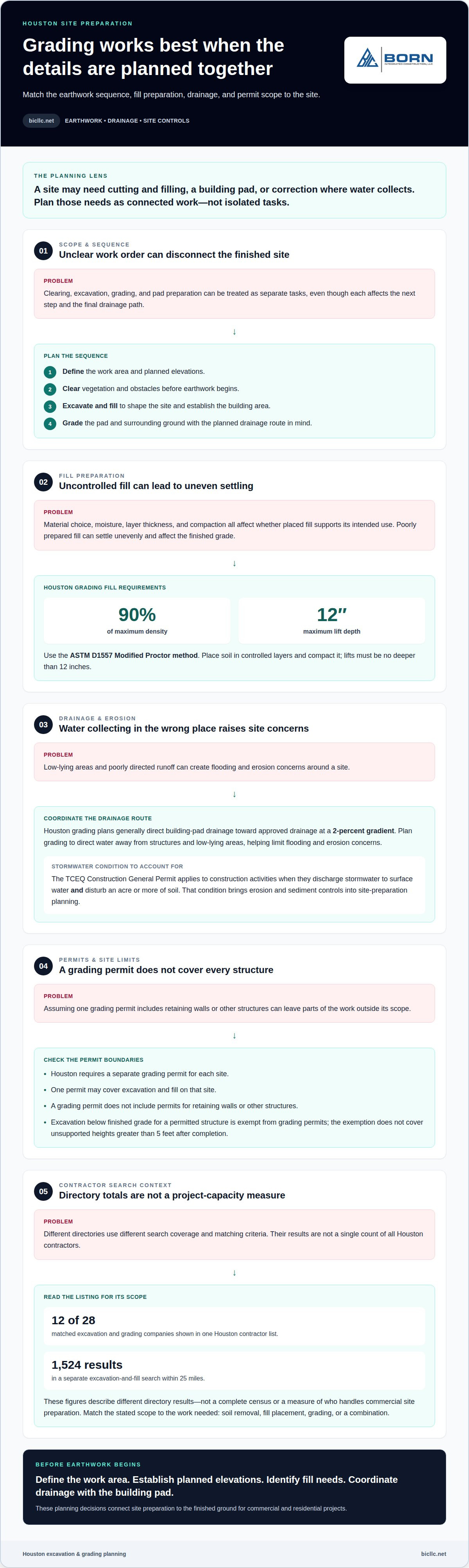
A displayed Houston contractor list contains 12 of 28 matched excavation and grading companies. A separate excavation-and-fill search shows 1,524 results within 25 miles, a broader count that can include different businesses and services. These figures describe directory results, not a complete census of contractors or a measure of how many handle commercial site preparation.
Excavation removes or relocates soil to establish site elevations, trenches, or building areas. Grading shapes the ground to planned elevations and drainage paths, while land clearing removes vegetation and obstacles before earthwork begins. For example, a site may need clearing first, excavation for a building pad next, then grading to direct runoff.
Commercial site preparation coordinates these steps across the planned work area. A project may require cutting high areas, placing fill in low areas, and preparing a pad for a building. The scope depends on the site plan, existing grades, soil conditions, and where excavated material can be used. These decisions affect the earthwork sequence and how the finished pad connects to access and drainage areas.
Residential excavation and site preparation follow similar principles at a smaller scale. Work may include clearing a house footprint, preparing a building pad, or reshaping ground where water collects. The sequence matters: establish the planned limits, remove unsuitable surface material where required, shape the site, then prepare the building area. Each step should account for nearby structures and the route water will take after grading.
Fill preparation includes placing soil in controlled layers and compacting it to support the intended use. Houston grading fill must reach 90 percent of maximum density using the ASTM D1557 Modified Proctor method, with lifts no deeper than 12 inches. This requirement makes material selection, moisture, layer thickness, and compaction part of a coordinated process. Poorly prepared fill can settle unevenly and affect the finished grade.
Houston requires a separate grading permit for each site, although one permit may cover excavation and fill on that site. A grading permit does not include permits for retaining walls or other structures. Excavation below finished grade for a permitted structure is exempt from grading permits, but the exemption does not cover unsupported heights greater than 5 feet after completion.
For stormwater, the Texas Commission on Environmental Quality states that construction activities fall under the CGP when they discharge stormwater to surface water and disturb an acre or more of soil. That condition brings erosion and sediment controls into site preparation planning. In Houston, grading plans also generally direct building-pad drainage toward approved drainage at a 2-percent gradient.
Before earthwork begins, define the work area, establish planned elevations, identify fill needs, and coordinate drainage with the building pad. These steps connect site preparation to the finished ground, whether the project serves a commercial building or a residence.
Houston excavation and grading contractor directory
Houston directories group businesses by listed services, search area, and business details. Treat each result as a starting point for understanding contractor categories, not as a uniform measure of project capacity.
Excavation and Fill Contractors
The Houston excavation-and-fill search displays 1,524 results within 25 miles. That broad result set can include businesses with different scopes, from moving soil to preparing ground for construction. A listing labeled “excavation and fill” identifies a service category, but does not by itself describe the contractor’s role on a commercial project.
Read each listing for its stated work and business classification. A directory may distinguish excavation contractors from general contractors or broader sitework businesses. Those labels help organize results, but they do not establish that every business performs the same tasks. Start by matching the described scope to the project: bulk earth removal, fill placement, grading, or a combination.
Directory records also vary in the amount of business information they display. The matched Houston contractor list averaged 5.2 tracked contacts per company, while its median employee-size band was 11-50 employees. These figures describe the directory’s entries, not the crew assigned to a particular site or the amount of equipment available for a project.
Contractors Within the Service Radius
A 25-mile search radius offers a defined way to view contractor results around Houston. It does not mean every listed business works throughout that radius, or that a company outside the boundary cannot serve a Houston project. Use the location shown in each listing as a reference point, then compare it with the project’s location and scope.
For a site near the edge of a search area, distance can affect mobilization and coordination. A general contractor arranging excavation subcontracting may also need to align earthwork with building schedules, access routes, and drainage work. A directory count alone cannot show those arrangements. Review the listed scope and business details to understand whether a firm handles excavation or coordinates broader construction work.
Contractor classifications describe how a business is categorized, not necessarily its full range of work. An excavation company may focus on soil removal, while a sitework contractor may list several preparation tasks. A project requiring both cut-and-fill work and a building pad needs a scope that accounts for both stages.
For general contractors, directory research can organize an initial subcontracting search. Sort results by location and listed service, then compare the described work with the project’s earthwork requirements. Consider needs such as ground shaping, fill placement, and drainage coordination. This approach makes a broad directory useful without treating every result as interchangeable.
Houston Excavation and Fill Contractor Service Areas
Service areas matter because a Houston project’s location affects access, coordination, and the work plan. When comparing scopes, examine the proposed work, relevant residential or commercial project experience, geotechnical information, and how estimates define earthwork, drainage, and site limits.
A geotechnical report describes subsurface conditions that can inform excavation and grading plans. Soil findings may affect decisions about cut areas, fill, and building-pad preparation. Review how the proposed scope relates to the report’s recommendations and whether the estimate identifies assumptions about material, access, and site conditions.
Residential and commercial site work share a sequence: assess the site, clear the required area, excavate or place fill, then grade to planned elevations. A residential building pad may have a different footprint and access arrangement from a commercial site. The project plan should show how those differences affect equipment access, earthwork limits, and drainage paths.
The typical excavation and grading process starts by defining the work area and planned elevations, followed by clearing, earthwork, compaction, and finish grading. The timeline depends on scope, soil conditions, site access, weather, and coordination with other construction work. No single duration applies to every Houston project.
Before excavation, property owners should account for risks such as unexpected soil conditions, unsuitable fill, restricted access, or changes to the planned work area. These conditions can alter the amount of material moved or require additional site preparation. A clearly defined estimate helps distinguish included tasks from assumptions and identifies how scope changes affect project coordination.
Concrete, sod, and landscaping may follow grading, but each depends on the finished elevations and drainage plan. Concrete paving, for example, needs a prepared base and appropriate ground transitions. Sod and planting areas also depend on the final surface shape, so sequencing them after earthwork helps prevent later disturbance.
Project reviews can describe communication, schedule coordination, and how completed work matched the stated scope. Read them as context, not as a substitute for project details. An estimate should identify the work limits, excavation and fill tasks, material handling assumptions, and grading outcomes. That level of detail makes residential and commercial proposals easier to compare on scope.
For a Houston project, connect the geotechnical report, site plan, and estimate before work begins. A commercial site with concrete areas needs coordinated elevations and drainage, while residential land clearing may follow a different sequence. Clear documents help align earthwork with the next construction stage.
Drainage, culverts, and erosion prevention
Drainage planning connects grading, water movement, and the protection of developed ground. In Houston, clay soils and site elevations make drainage routes an important part of excavation decisions.
Clay Soils and Drainage
Houston-area soils are predominantly heavy clay, with high shrink-swell potential and drainage challenges. Clay can change volume as moisture conditions shift, so a development plan must account for water movement and nearby foundations. Review the grading plan for where runoff will travel, where it will leave the site, and whether low areas could hold water. These details help coordinate earthwork with the finished site.
Drainage-Related Excavation
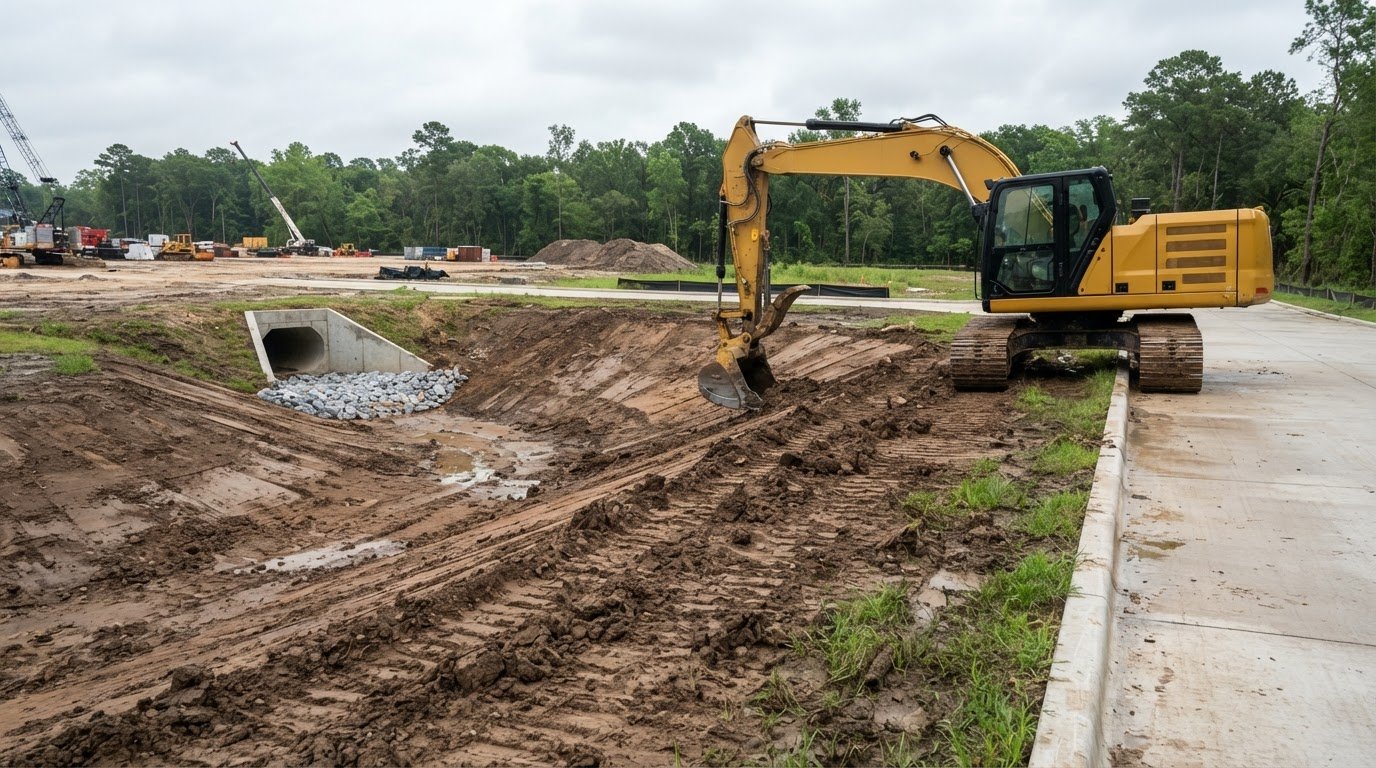
Drainage-related excavation shapes swales, ditches, and channels that carry water away from structures and low-lying areas. A Houston terrace swale or ditch must be at least 12 inches deep and 5 feet wide. A single swale or ditch may not collect runoff from a tributary area exceeding 13,500 square feet without discharging into a down drain. These dimensions affect both excavation limits and the drainage layout.
Culverts can carry water beneath an access route or other site crossing, connecting drainage paths that would otherwise be interrupted. Their placement should align with the intended water route and surrounding ground elevations. For example, a driveway crossing over a drainage channel needs an opening that preserves the planned flow path. Shape the approach and outlet areas to avoid abrupt changes that obstruct runoff.
Erosion prevention begins with controlling exposed soil and directing runoff through planned routes. On cut or fill slopes, Houston requires terraces at vertical intervals no greater than 30 feet, subject to code exceptions. Houston terraces must be at least 6 feet wide. These requirements make slope geometry part of the earthwork plan, not a finishing detail added after soil removal.
When construction disturbs an acre or more and discharges stormwater to surface water, the Texas Commission on Environmental Quality says the state construction stormwater permit applies. Coordinate erosion and sediment controls with site clearing and excavation. For example, controlling exposed soil around a new drainage channel helps limit sediment movement during development.
Before grading begins, map the foundation areas, low points, drainage outlets, and any culvert crossings. Then coordinate excavation and slope terraces with those features. A continuous route from the site’s high ground to its discharge point helps keep runoff from collecting beside structures or eroding unprotected soil.
Grading and excavation services
Houston earthwork transforms existing ground into a site ready for construction. A complete scope can include cutting high areas, placing fill, shaping slopes, and coordinating drainage. For example, grading plans generally direct building-pad drainage toward approved drainage at a 2-percent gradient. That relationship connects the pad’s finished elevation with the surrounding site.
Fill preparation requires controlled placement and compaction. Houston grading fill must reach 90 percent of maximum density using the ASTM D1557 Modified Proctor method. Place fill in lifts no deeper than 12 inches. Material selection matters too: rock or similar irreducible material greater than 12 inches in any dimension is generally barred from grading fills, unless the building official permits it.
Slopes can require additional preparation. Benching is required when existing grade exceeds a 20-percent slope and fill depth exceeds 5 feet. Where that benching requirement applies, grading fills need a key at least 10 feet wide and 2 feet deep. Houston cut or fill slopes also require terraces at intervals no greater than 30 feet vertically, subject to code exceptions.
Site geometry affects the plan. Houston grading plans must identify structures on the work site and nearby structures within 15 feet of the property, along with structures that grading may affect. This information helps define work limits around buildings and coordinate changes in ground elevation. If grading requires more than two terraces, one terrace near mid-height must be at least 12 feet wide.
Location can change the governing requirements. Earthwork in a Houston floodway or special flood hazard area must comply with Chapter 19 of the City Code and the Infrastructure Design Manual. That connection makes site designation relevant before excavation and fill begin. A plan for a site in those areas must account for the applicable requirements alongside its grading scope.
Underground utilities also shape excavation planning. For work that may disturb utilities, Houston homeowners are responsible for calling 811 before digging. A trencher may cut trenches from 4 inches wide to 4 feet wide, depending on equipment and task. Marked utility routes, excavation limits, and debris handling should be coordinated before ground disturbance starts.
A practical sequence is to establish site limits, confirm elevations, locate utilities, prepare fill, and shape the finished grade. Each step affects the next: for example, changing a cut area can alter fill quantities and drainage paths. For coordinated earthwork planning, discuss your grading and excavation requirements.
Born Integrated Construction: Mass Soil Excavation
Born Integrated Construction provides Mass Soil Excavation for projects that require substantial earthwork before construction can proceed. This work can help establish site elevations and prepare the ground for the next phase. It is a relevant service when a project’s scope includes significant soil removal or site preparation.
Where a project also includes concrete construction, related offerings include Concrete Paving, Slab on Grade, and Podium Slabs. Coordinating earthwork with these services helps align site preparation with the planned build.
For a project involving Mass Soil Excavation, contact Born Integrated Construction to discuss the work.
Set the Groundwork for Your Next Project
The next step is to align the earthwork scope with the construction that follows. Clear project boundaries, intended use, and site plans provide a practical basis for coordination. For developments that combine excavation with concrete construction, consider early how site preparation connects to the finished structure.
Born Integrated Construction provides Concrete Paving, Slab on Grade, and Podium Slabs. These services can suit projects where site work connects to concrete surfaces or building components. The right scope depends on the project plans and construction requirements.
If you’re planning site excavation and grading services in Houston, bring the project scope and relevant plans to a discussion with Born Integrated Construction. This can help clarify how Mass Soil Excavation relates to the construction work ahead.
Contact Born Integrated Construction to discuss your project and its site preparation needs. A well-defined next step can help move your plans forward with clarity.
Frequently Asked Questions
Are you licensed and insured to work in Houston?
Licensing and insurance are separate from a contractor’s listed construction services. The available company information does not establish a yes-or-no answer about Born Integrated Construction’s licensing or insurance status. For a Houston project, make sure the contracting entity and the work scope are clearly identified in project documents. Do not infer licensing or insurance from a service list or project portfolio.
Do you serve the entire Greater Houston area?
Born Integrated Construction lists Houston among its Texas markets, along with communities such as Conroe, The Woodlands, and Beaumont. The listed locations do not establish coverage for every address across Greater Houston. Project location and scope determine whether the work aligns with the company’s geographic focus. Include the site address and project type when discussing a prospective job.
How do I get a quote for excavation work in Houston?
Contact Born Integrated Construction with the project location, site plans, and a clear description of the excavation scope. Include relevant geotechnical information and identify planned building areas, access routes, and earthwork requirements. These details help define the project and how excavation connects to later construction. If plans are still developing, describe the intended use and the decisions already established.
What site excavation and grading services are available in Houston, Texas?
Houston projects may require Mass Soil Excavation, earthwork, Detention Ponds, or Paving Stabilization. Born Integrated Construction also provides Concrete Paving, Slab on Grade, and Podium Slabs for projects where site work connects to concrete construction. The appropriate scope depends on the development plan and construction sequence. A commercial site, for example, may coordinate soil removal with planned concrete areas and building work.
How much does site excavation and grading cost in Houston?
The price depends on the project and is provided after a quote request. Cost factors include the amount of material to move, whether excavated soil can be balanced on site or needs hauling, and the project’s defined work limits. A clear scope distinguishes excavation tasks from later construction work. Provide plans and site information when requesting a project-specific quote.
What factors affect excavation and grading estimates in Houston?
Estimates depend on the volume and type of earthwork, material handling, site access, and the relationship between planned elevations and existing ground. Whether soil can be reused on site or must be hauled also affects the scope. Drainage features, utility locations, and construction sequencing can change the required work. A defined site plan helps identify these factors before an estimate is prepared.
Which Houston contractors specialize in commercial site excavation and grading?
Born Integrated Construction provides Mass Soil Excavation and Earthwork for projects in Houston and across Texas. Related concrete offerings include Concrete Paving, Slab on Grade, and Podium Slabs, which may suit projects where site preparation connects to planned construction. The project scope determines which services apply. Share the intended development and site plans to discuss the required work.
What are Houston's rules for stormwater drainage, erosion control, and land grading?
Houston requires a separate grading permit for each site, though one permit may cover excavation and fill there; it does not cover retaining walls or other structures. Grading plans generally drain building pads toward approved drainage at a 2-percent gradient. According to the Texas Commission on Environmental Quality, construction activities fall under the CGP when they discharge stormwater to surface water and disturb an acre or more of soil. Earthwork in floodways or special flood hazard areas must comply with Chapter 19 of the City Code and the Infrastructure Design Manual.