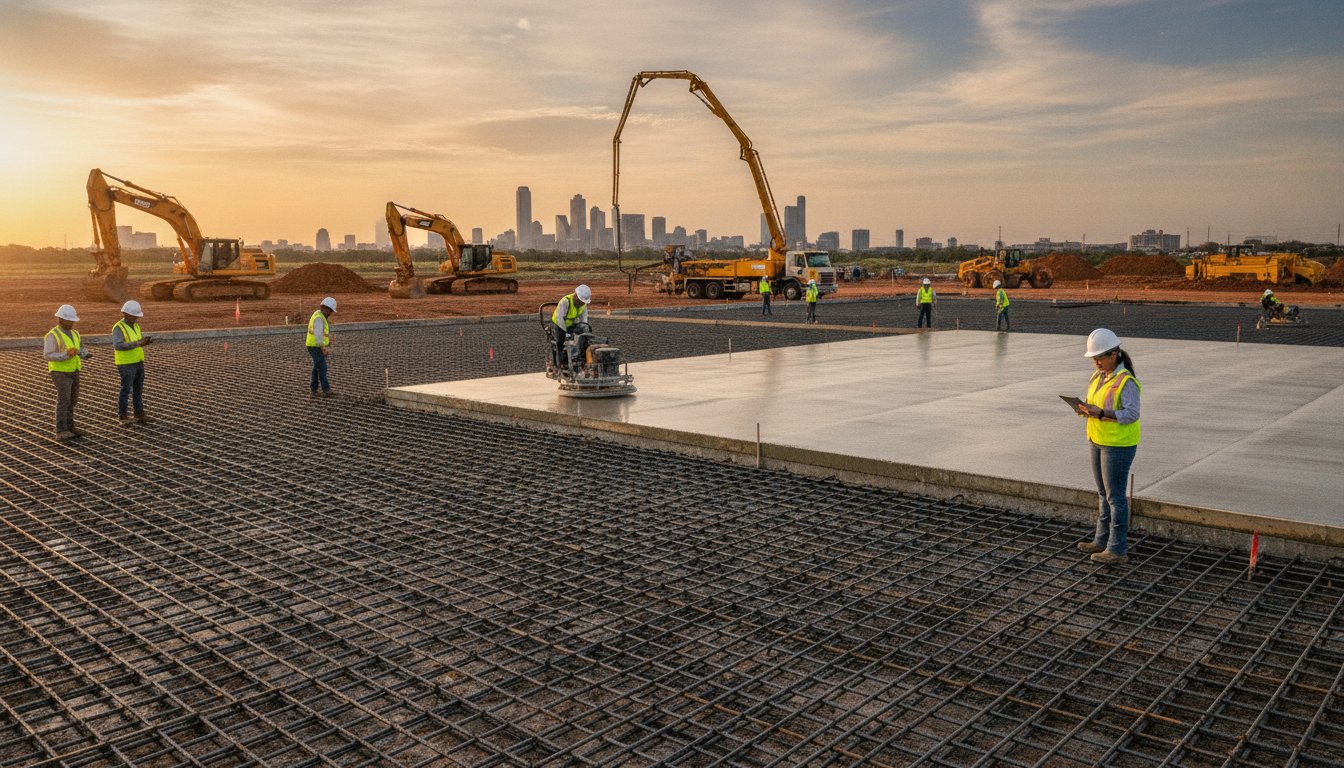
A commercial slab's durability depends entirely on the integrated civil engineering and soil stabilization supporting it. When you're selecting a concrete slab contractor commercial projects require, looking at the finished surface isn't enough. In Texas, where expansive clay soils are a constant threat to structural integrity, the difference between a long-term asset and a foundation failure often lies in the site preparation phase. You likely understand the frustration when civil and concrete phases aren't coordinated, or the serious liability that follows an on-site safety incident.
It's vital to prioritize reliability, but a steadfast commitment to technical standards like ACI 318-19 and ACI 301-20 is what truly ensures your investment lasts. This guide will teach you how to evaluate partners based on their technical capability, earthwork expertise, and safety records. We'll explore the benchmarks for structural integrity and the necessity of seamless coordination between site prep and the final pour. By the end, you'll have a clear framework for selecting a partner who delivers a slab meeting strict 2026 specifications while maintaining a disciplined, safe job site.
Key Takeaways
- Understand why commercial slabs require specialized reinforcement and higher PSI ratings to meet strict 2026 structural specifications.
- Identify whether your project requires a standard slab on grade or a complex podium slab based on your building's vertical complexity and parking needs.
- Learn why managing Texas soil through mass excavation and stabilization is the most critical step in preventing long-term foundation failure.
- Discover the essential criteria for selecting a concrete slab contractor commercial firms can trust, including bonding capacity and proven safety records.
- Recognize the operational efficiency gained by partnering with a contractor that integrates turnkey civil work with structural concrete construction.
What Defines a Professional Concrete Slab Contractor for Commercial Projects?
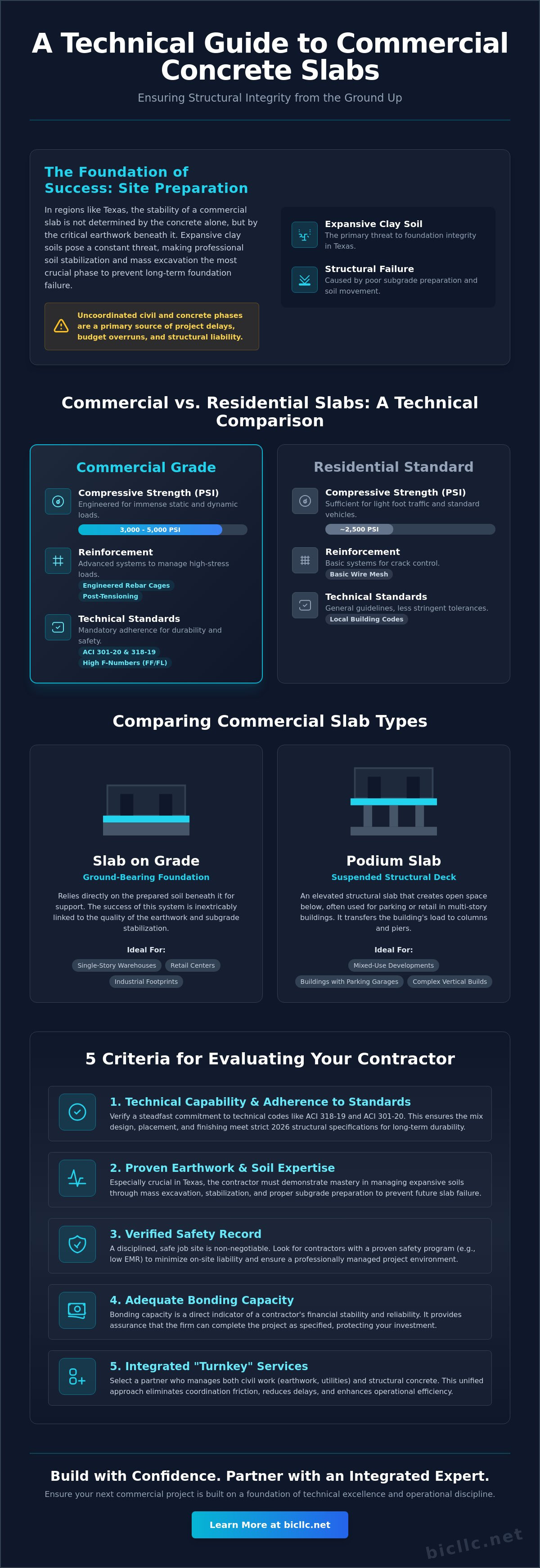
A professional concrete slab contractor commercial firms rely on must possess the technical discipline to bridge the gap between complex engineering specifications and physical execution. Unlike residential work, commercial projects demand a rigorous adherence to structural standards, often requiring concrete with compressive strengths ranging from 3,000 to 5,000 psi. The slab serves as a common structural element that must withstand immense static and dynamic loads over decades of use. Achieving this level of durability requires a contractor who manages the intersection of structural engineering and architectural design with meticulous operational precision.
The concept of integrated construction is central to a successful project. By managing both the civil phases and the concrete pour, a seasoned contractor reduces the friction typically found between separate trade phases. This unified approach ensures that subgrade preparation, vapor barrier installation, and reinforcement placement align perfectly with the final finishing schedule. It's a method that prioritizes professional stability and minimizes the risk of uncoordinated delays that often inflate project budgets.
The Scope of Commercial Concrete Services
Professional commercial services extend far beyond the act of pouring concrete. A dependable partner provides a comprehensive technical scope that includes:
- Structural Foundations: Engineering robust bases for retail centers, industrial warehouses, and complex mixed-use developments.
- Specialized Flatwork: Delivering heavy-duty paving and sidewalks designed to meet Texas Accessibility Standards (TAS).
- Utility Coordination: Managing the precise placement of slab penetrations for underground utilities in multi-story vertical builds.
- Earthwork Integration: Ensuring mass soil excavation and detention pond construction support the slab's long-term stability.
Commercial vs. Residential Slab Standards
Commercial slabs are distinguished by their thicker profiles and the necessity of advanced reinforcement systems. While a residential drive might use basic mesh, a commercial build often requires engineered rebar cages or post-tensioning to manage the stresses of heavy machinery or high-traffic volumes. Adherence to ACI 301-20 specifications is mandatory to ensure the mix design and placement meet the required durability benchmarks. To achieve the necessary precision, professionals utilize laser screeds and power trowels that can maintain tight tolerances across thousands of square feet.
Floor flatness (FF) and floor levelness (FL) values, known as F-numbers, represent a statistical measurement of a slab's surface profile used to verify that industrial floors meet the exacting tolerances required for high-lift racking and specialized machinery. This level of accuracy is only possible through a disciplined commitment to craftsmanship and the use of high-register professional equipment.
Comparing Commercial Slab Types: Slab on Grade vs. Podium Slabs
Selecting the correct foundation type is a fundamental step in ensuring the long-term viability of any commercial development. A seasoned concrete slab contractor commercial developers trust will evaluate the building's vertical complexity and intended use before recommending a specific system. Whether your project requires a ground-bearing slab or a suspended structural deck depends on building height, soil load-bearing capacity, and overall budget constraints. Each system demands a disciplined approach to execution to avoid the safety liabilities and structural failures that plague poorly managed sites.
Slab on grade remains the standard for single-story warehouses, retail centers, and expansive industrial footprints. This method relies on the soil directly beneath the concrete to support the structure's weight. Because of this, the success of the slab is inextricably linked to the quality of the earthwork and subgrade preparation. Adhering to an industry-standard guide for placement ensures that the slab can handle heavy equipment loads without cracking or settling over time.
When to Choose Slab on Grade
Industrial environments with high-traffic floors require the robust support that only a well-engineered slab on grade provides. These systems are ideal for facilities housing heavy machinery or high-density racking where floor levelness is critical. To achieve maximum durability, the process must include meticulous mass soil excavation and paving stabilization to create a uniform, non-expansive base. Detailed insights on these procedures are available in The Definitive Guide to Commercial Concrete Construction Services in Texas (2026).
The Complexity of Podium and Elevated Slabs
Podium slabs are essential for midrise developments and multi-family structures that feature parking levels beneath residential or office space. These "transfer slabs" must safely manage the transition between heavy concrete parking structures and the lighter wood or steel frames above. Constructing these requires advanced technical expertise in CIP midrise and highrise structural framing to maintain safety and precision. If you're planning a multi-level project, consulting a specialized podium slab contractor in Conroe TX ensures the structural integrity of these complex elevated decks.
In many large-scale footprints, post-tension (PT) slabs offer a superior solution for maximizing span while reducing material costs. By using high-strength steel tendons to compress the concrete, PT slabs allow for thinner profiles and fewer support columns. This provides more usable interior space, which is a significant advantage in retail and office environments. For developers seeking a partner capable of executing both earthwork and structural concrete, Born Integrated Construction provides the professional stability required for these complex commercial builds.
The Texas Factor: Why Site Prep is the Foundation of Every Slab
Texas developers face a unique set of geological challenges that can compromise even the most precisely poured concrete. A competent concrete slab contractor commercial projects require must prioritize what happens beneath the surface long before the first truck arrives. In regions like Houston and Austin, expansive clay soils are the primary cause of foundation movement and slab failure. These soils swell when wet and shrink when dry; they create a volatile environment for structural foundations. Without professional earthwork and soil management, the enduring nature of your professional output is at risk.
The ACI Guide to Concrete Floor and Slab Construction emphasizes that the subgrade must be uniform and stable. In Texas, this stability is rarely natural; it must be engineered. This involves a methodical progression from mass soil excavation to the construction of detention ponds and storm sewers. Managing water runoff isn't a separate concern. It's a prerequisite for slab integrity. If the civil phase isn't coordinated with the concrete phase, moisture will eventually infiltrate the subbase, leading to the foundation failure you're working to avoid.
Soil Stabilization and Earthwork
Soil stabilization is the technical process of altering soil properties to improve load-bearing capacity. By utilizing lime or cement stabilization, a contractor creates a moisture-resistant subbase that acts as a rigid platform for the slab. This is particularly critical in high-rise foundations, where mass excavation must reach stable strata to support immense vertical loads. Professional paving stabilization extends the life of commercial concrete by neutralizing the chemical and physical volatility of the underlying Texas clay. This disciplined approach ensures the foundation remains steadfast regardless of seasonal moisture shifts.
Integrating Civil and Structural Phases
Project delays frequently stem from the friction between independent civil and concrete teams. A concrete slab contractor commercial firms trust often differentiates themselves by managing the entire site lifecycle. This integration ensures that underground utilities are perfectly aligned with slab penetrations before the pour begins, preventing costly core drilling later. Developers can maintain a steady and predictable construction rhythm by following an underground utility installation contractor checklist to verify that all civil infrastructure is ready for the structural phase. This level of organization projects the image of a seasoned expert who values substance over style.
Buying Guide: 5 Criteria for Evaluating a Commercial Slab Contractor
Selecting a concrete slab contractor commercial developers can depend on requires a methodical evaluation of operational stability and technical capacity. A contractor's ability to deliver a high-quality result isn't just about the finish; it's about the management of risk and the meticulous attention to detail during the preconstruction phase. You should begin by verifying the firm's bonding capacity and insurance coverage. These are foundational indicators of a company's financial health and its ability to handle large-scale commercial developments without compromising the project's security.
A thorough review of a contractor's portfolio provides insight into their specific expertise. Look for past performance in structural projects such as CIP garages and midrise work. This experience suggests a familiarity with the complex coordination required for multi-level builds. Additionally, assess the value they add during preconstruction. A partner who offers constructability reviews and proactive risk identification can prevent costly uncoordinated trade phases before they occur. This disciplined approach ensures the project remains on schedule and within the specified technical parameters.
Safety records are a non-negotiable metric for any professional build. A low Experience Modification Rate (EMR) reflects a steadfast commitment to site safety and operational precision. High-quality equipment ownership is another key differentiator. Contractors who own their laser screeds and excavation fleets maintain better control over project timelines compared to those who rely on third-party rentals. This ownership suggests a deep-rooted commitment to the craft and the ability to maintain a steady and predictable construction rhythm.
Technical Proficiency and Equipment
Specialized equipment like Total Station Layout is essential for achieving the accuracy required in modern commercial construction. This technology ensures that every anchor bolt and slab penetration aligns perfectly with the structural plans. There's a significant difference between a labor-only crew and a turnkey civil partner who manages everything from mass soil excavation to the final pour. You should also evaluate their proficiency in specialized techniques, such as handling thin-shell cast-in-place concrete, which requires a high degree of craftsmanship and technical oversight. These capabilities define a partner who values substance over style.
Safety and Integrity in the Contract
Safety protocols aren't merely a formality; they directly impact your project's insurance costs and overall liability. A disciplined professional prioritizes safety to ensure the enduring nature of the project. Be wary of red flags like vague timelines or a lack of focus on site preparation. Low-ball bids often suggest a contractor might cut corners on essential stabilization or safety measures. Attentive service and a transparent contract are hallmarks of a partner focused on long-term viability and professional stability. To ensure your next development is built on a foundation of reliability, partner with Born Integrated Construction for your structural requirements.
Born Integrated Construction: Your Texas Commercial Concrete Partner
Born Integrated Construction operates with a steadfast commitment to delivering foundational stability for the most demanding 2026 developments. As a concrete slab contractor commercial developers trust, we provide turnkey solutions that bridge the gap between initial earthwork and final structural completion. Our presence in Houston, Austin, and Dallas allows us to support regional infrastructure with a grounded approach that prioritizes reliability over hyperbole. We've built our reputation on the enduring nature of our work; we ensure every project meets the highest professional standards through a disciplined focus on execution.
Our "Integrated" philosophy is designed to eliminate the friction often found in uncoordinated trade phases. By managing mass soil excavation, detention ponds, and underground utility installation alongside structural concrete construction, we maintain total control over the project's timeline and quality. This unified management model provides a steady and predictable rhythm for the project's progress, instilling confidence in developers who value substance and operational precision. We don't just pour concrete; we establish the long-term viability of the entire site infrastructure.
Serving Texas Infrastructure and Development
Reliable performance is the cornerstone of our operations across the state. From the high-density requirements of CIP parking structures in San Antonio to the intricate demands of podium decks in Conroe, our team delivers consistent value. We specialize in a broad technical scope, including:
- Slab on Grade and Post Tension Slabs: Engineered for industrial durability and optimized material usage.
- CIP Midrise and Highrise Structural Framing: Providing the skeletal strength for Texas's vertical growth.
- Turn Key Civil Services: Managing earthwork and paving stabilization to secure the foundation against volatile soils.
- Specialized Structures: Expert execution of CIP garages, retaining walls, and thin shell cast-in-place concrete.
We cultivate lasting professional relationships through transparency and a meticulous approach to every phase of construction. Our persona is that of a seasoned expert who acts as a dependable partner throughout the building lifecycle. We lead through proven results, ensuring that every foundation we lay serves as a testament to our commitment to safety and high standards.
Get a Project-Based Fee Quote
Planning a commercial development requires precise data and reliable cost estimation. Our estimators are prepared to provide detailed project-based fee quotes for structural concrete and turnkey civil site work. Whether your 2026 project involves a complex multi-family podium slab or a massive industrial warehouse foundation, we offer the technical proficiency required for success. We invite you to partner with Born Integrated Construction for your next commercial project and experience the security that comes with unwavering professional consistency.
Securing the Structural Integrity of Your Next Development
A successful commercial project in 2026 depends on more than just a smooth finish. It requires a disciplined focus on the underlying civil infrastructure and a steadfast commitment to technical precision. By prioritizing integrated construction, you ensure that mass soil excavation and paving stabilization work in perfect harmony with the final structural pour. Selecting a concrete slab contractor commercial developers trust means finding a partner who manages these complex trade phases with unwavering consistency. This holistic approach reduces project friction and secures the long-term viability of your investment.
Born Integrated Construction brings this level of professional stability to every job site. We specialize in CIP garages and high-rise foundations; we provide the technical expertise necessary for the most ambitious builds in Texas. Serving Houston, Austin, and San Antonio since our founding, our team bridges the gap between civil site work and structural concrete with meticulous attention to detail. We invite you to Request a Turnkey Concrete Quote from Born Integrated Construction today. It’s time to build a foundation that stands the test of time.
Frequently Asked Questions
What is the difference between a slab on grade and a podium slab?
A slab on grade rests directly on the prepared subgrade and is supported by the earth below. In contrast, a podium slab is a suspended structural deck that transfers the weight of the building to a system of columns and walls. A concrete slab contractor commercial developers hire for multi-use projects often utilizes podium slabs to separate lower-level parking structures from residential or office spaces above.
How much does soil stabilization affect the cost of a commercial concrete slab?
Soil stabilization is a necessary upfront investment that protects the long-term structural viability of the project. While it increases the initial site preparation scope, it mitigates the high costs associated with foundation movement and slab failure in expansive Texas clay. This process ensures a moisture-resistant subbase that prevents the settlement issues often seen in poorly prepared commercial sites.
Why should a commercial concrete contractor also handle underground utilities?
Managing underground utilities alongside the concrete pour ensures that every penetration and conduit aligns perfectly with the structural layout. This integrated approach eliminates the need for core drilling and reduces the friction typically found between uncoordinated civil and structural phases. It allows the project to maintain a steady and predictable construction rhythm from the ground up.
What are the benefits of cast-in-place (CIP) concrete for parking garages?
Cast-in-place concrete provides monolithic strength and superior fire resistance compared to other building materials. This method allows for greater design flexibility and reduces the number of structural joints where moisture and chemicals could penetrate. It's a choice that prioritizes durability and projects an image of professional stability for high-traffic parking structures.
What is an F-number in commercial concrete finishing?
F-numbers are statistical measurements used to verify floor flatness (FF) and floor levelness (FL) according to ACI standards. High FF numbers are essential in industrial warehouses where high-lift forklifts require a perfectly smooth surface to operate safely and efficiently. Achieving these precise tolerances requires a disciplined commitment to craftsmanship and the use of advanced laser screed technology.
How long does a commercial concrete slab take to cure before building can begin?
Standard commercial concrete typically reaches its specified design strength after a 28-day curing period. While light foot traffic or certain construction activities may be permitted sooner depending on the mix design, the structural integrity of the slab depends on following the engineer's curing schedule. It's vital to allow the concrete to establish its internal bonds before subjecting it to heavy vertical loads.
What is the standard thickness for a commercial warehouse slab?
Standard thickness for a commercial warehouse slab typically ranges from 6 to 10 inches depending on the anticipated machinery and racking loads. Structural engineers determine the final depth and reinforcement requirements to ensure the foundation can withstand decades of heavy-duty industrial use. This methodical design process prevents the cracking and settlement that lead to operational delays.
Can a slab contractor handle mass soil excavation and site prep?
An integrated concrete slab contractor commercial firms trust can manage both mass soil excavation and structural concrete under one contract. This unified management model ensures that the site preparation phase is perfectly coordinated with the foundation requirements. It provides a level of thoroughness and transparency that is often missing when civil and concrete phases are handled by separate, uncoordinated teams.