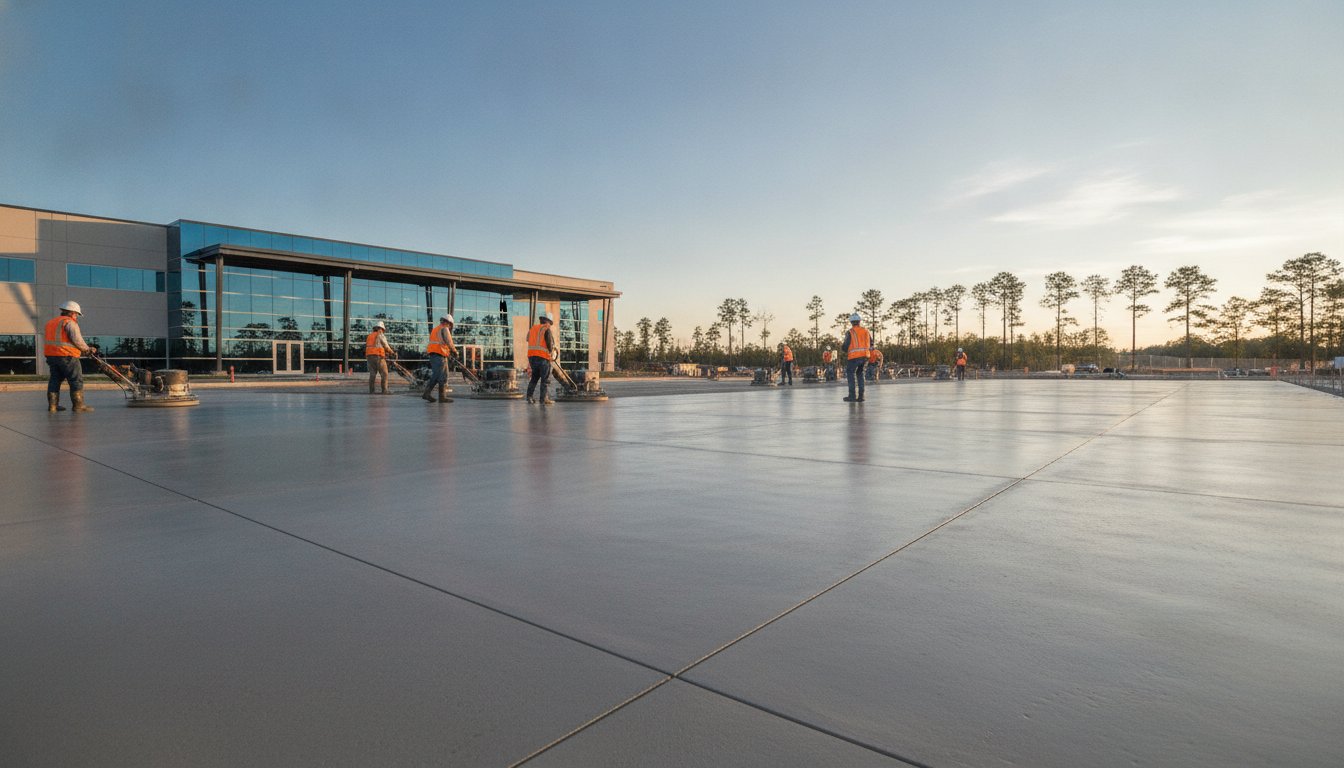
The structural integrity of a commercial surface in Southeast Texas is determined long before the first yard of concrete leaves the truck. In an environment defined by expansive clay soils, the difference between a lasting asset and a costly liability rests on the engineering beneath the finish. You likely recognize that the ground in our region is constantly in motion, creating a persistent threat of shifting and cracking for any paved surface. This guide offers a steadfast perspective on the design, installation, and maintenance of high-standard commercial concrete flatwork Montgomery County TX, ensuring your project remains a durable foundation for your operations.
We'll examine the technical specifications that separate commercial grade work from residential standards, focusing on the rigorous subgrade stabilization required to combat soil expansion. You'll also find a clear breakdown of the 2024 International Building Code requirements and the essential Texas Accessibility Standards needed to maintain full ADA compliance. From drainage plans to precision finishing, this reference establishes a clear path toward professional stability and long-term viability for your facility's infrastructure.
Key Takeaways
- Distinguish between standard residential pours and the high-register engineering specifications required for heavy-duty commercial infrastructure.
- Understand the critical role of subgrade stabilization in protecting commercial concrete flatwork Montgomery County TX from the region's expansive clay soils.
- Explore the specific structural applications of slab on grade and podium slabs within the context of Montgomery County’s commercial and midrise developments.
- Ensure project legality and safety by reviewing the latest 2024 building codes and Texas Accessibility Standards for public flatwork.
- Learn how a commitment to technical proficiency and integrated civil services establishes a foundation for long-term operational success.
Understanding Commercial Concrete Flatwork in Montgomery County TX
Commercial concrete flatwork Montgomery County TX encompasses the engineering and installation of horizontal surfaces designed to withstand the rigorous demands of industrial and retail environments. Unlike vertical structures, flatwork focuses on the integrity of surfaces like parking lots, loading docks, and warehouse floors. In high-growth corridors such as Conroe and The Woodlands, these surfaces must provide a stable platform for heavy machinery and constant logistical traffic. A professionally installed Concrete slab serves as the primary structural component for most of these projects, requiring a deep understanding of both material science and local environmental variables.
The success of these installations depends heavily on managing the Southeast Texas climate. High humidity levels and intense heat during the summer months significantly alter the hydration process of the concrete. If the curing process isn't managed with precision, the surface may suffer from premature drying, leading to scaling or structural weakness. Our approach prioritizes technical proficiency to ensure that every pour achieves its intended durability and long-term viability.
Commercial vs. Residential Flatwork Standards
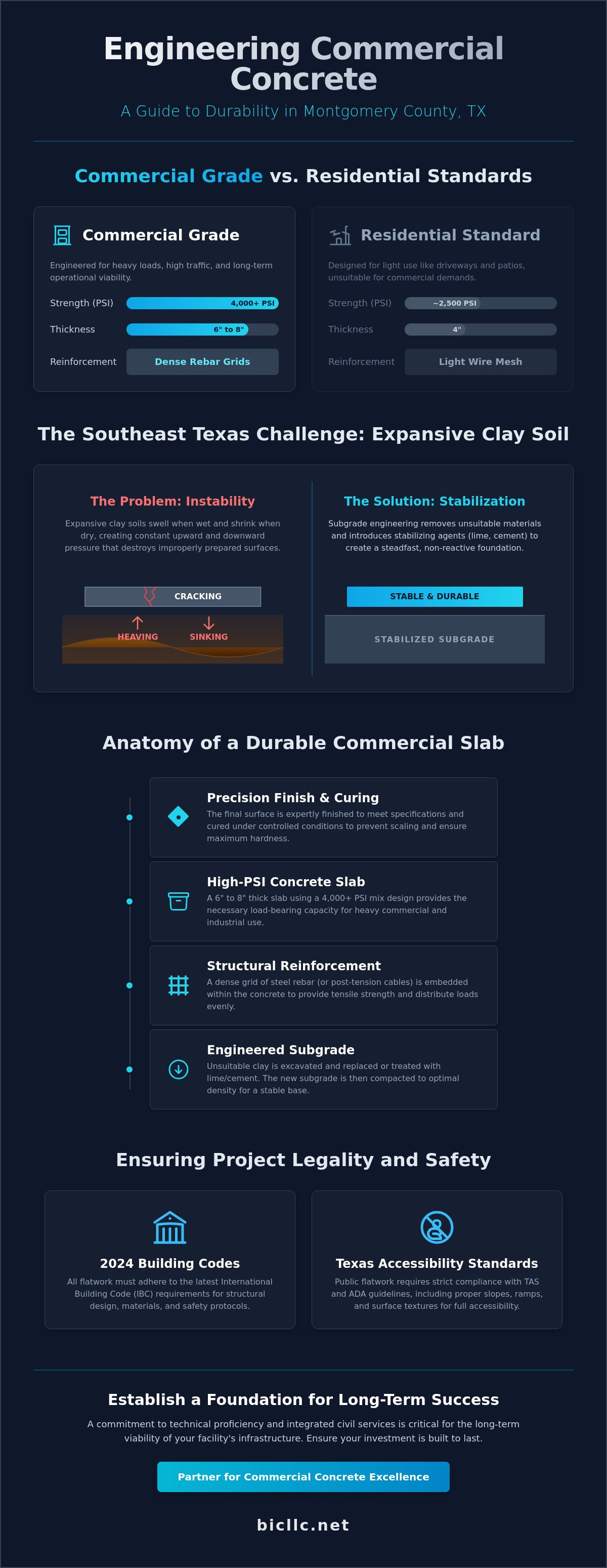
The distinction between residential and commercial specifications is fundamental to project longevity. Residential pours, such as driveways or patios, typically utilize a lower PSI (pounds per square inch) rating and minimal reinforcement. Commercial grade projects require a higher standard of execution. Most commercial applications demand a minimum of 4,000 PSI to support the weight of delivery trucks and heavy equipment. We utilize dense rebar grids rather than the lighter wire mesh often seen in residential work. This increased reinforcement provides the structural rigidity necessary to distribute heavy loads across the surface without localized failure. Thickness also varies greatly; while a residential sidewalk might only be four inches thick, commercial paving often requires six to eight inches of reinforced concrete to meet industrial load-bearing requirements.
The Montgomery County Geological Context
The geological profile of Montgomery County presents specific challenges for concrete durability. The region is characterized by expansive clay soils that swell when wet and shrink during dry periods. This constant movement creates significant upward and downward pressure on concrete surfaces. Without proper mitigation, this soil behavior leads to "heaving" or deep structural cracking. Soil stabilization is not an option. It's a requirement. A thorough site assessment is the first step in our process. We evaluate the plasticity of the soil to determine the necessary depth of the subgrade and the type of stabilization required, such as lime or cement treatment. By establishing a stable foundation before the pour begins, we ensure the concrete remains steadfast despite the volatile nature of the Texas ground.
The Anatomy of Durable Commercial Concrete Surfaces
Reliability in commercial concrete flatwork Montgomery County TX starts with a precise understanding of structural layers. A slab isn't a single unit. It's a system. This system includes the subgrade, the reinforcement, the mix design, and the jointing pattern. Each component must be engineered to withstand the specific environmental stresses of Southeast Texas. Our approach prioritizes the enduring nature of these layers, ensuring that the finished product serves as a stable foundation for years of heavy-duty operation.
Paving Stabilization and Subgrade Engineering
Paving stabilization is the first line of defense against the region's volatile soil conditions. In Montgomery County, the high plasticity of the clay requires more than just a cursory leveling. We often perform mass soil excavation to remove unsuitable materials before introducing stabilizing agents like lime or cement. This process creates a steadfast foundation that resists the volume changes typical of local clay. Proper compaction is then executed to achieve the required density, which prevents future sinking or heaving of the slab. When the subgrade is engineered correctly, the risk of structural failure is significantly mitigated before the first yard of concrete is ever poured.
Reinforcement and Structural Integrity
Structural integrity is further established through deliberate material choices and reinforcement strategies. For large commercial footprints or facilities expecting extreme weight loads, we often utilize post tension slabs. These systems use high-strength steel tendons to compress the concrete, which increases its load-bearing capacity and reduces the likelihood of shrinkage cracks. For interior commercial slabs, the installation of high-quality vapor barriers is essential. These barriers prevent moisture from migrating through the concrete, protecting floor finishes and maintaining the slab's long-term viability.
Compliance with federal and local standards is another pillar of professional execution. Every horizontal surface must meet the ADA Standards for Floor and Ground Surfaces to ensure safety and accessibility for all users. Beyond accessibility, we manage thermal movement through strategic joint placement. The intense Texas heat causes significant expansion and contraction. Properly spaced expansion joints and saw-cut control joints direct this movement to specific, controlled areas. This prevents the uncontrolled cracking that often plagues high-traffic retail or industrial sites. If you're currently planning a development, choosing a partner focused on comprehensive concrete construction ensures these technical details are managed with operational precision and a deep-rooted commitment to quality.
Types of Commercial Flatwork and Their Applications
Commercial development across the Conroe and Woodlands regions demands a diverse range of horizontal concrete solutions. Each application for commercial concrete flatwork Montgomery County TX must be engineered for its specific operational role. Whether the project is a high-traffic retail plaza or a heavy-duty industrial facility, the technical requirements vary significantly based on the intended use and the expected weight loads. A disciplined approach to these variations ensures that each surface performs reliably throughout its intended lifecycle.
Slab on Grade and Structural Foundations
Slab on grade construction serves as the primary foundation for warehouses, retail centers, and distribution hubs. These surfaces aren't merely floors. They're structural components that must support high-point loads from industrial racking systems and constant vibration from heavy machinery. The integration of underground utilities is a critical phase of this process. It requires meticulous coordination to ensure that plumbing and electrical conduits are perfectly positioned before the pour begins. For projects involving extensive external surfaces, Commercial Concrete Paving in Conroe provides the necessary durability for heavy-duty roads and logistics hubs that must withstand the weight of frequent freight traffic.
Podium Slabs and Multi-Story Integration
As midrise developments become more frequent in Montgomery County, the use of podium slabs has become essential for mixed-use projects. These structures act as a structural transfer level, typically separating a concrete parking garage or retail space from residential or office units located above. Precision in midrise concrete construction is paramount because the podium slab must manage complex weight distributions while providing a perfectly level finish. These slabs often incorporate sophisticated waterproofing and drainage systems, requiring an authoritative level of craftsmanship to prevent water infiltration and ensure the long-term viability of the entire building structure.
Pedestrian flatwork and sidewalks in master-planned communities require a different focus. While they don't carry the weight of a freight truck, they must prioritize safety and full compliance with accessibility standards. These surfaces are designed to resist the environmental stresses of the Texas climate while providing a consistent, slip-resistant finish for public use. For logistics hubs and industrial parks, heavy-duty concrete paving remains the standard. These areas are engineered with specific thickness and reinforced rebar patterns to prevent the rutting and surface failure often seen with asphalt or inferior concrete pours. Establishing these lasting foundations requires a partner who understands the distinct requirements of each commercial application and delivers consistent value through proven results.
Compliance, ADA Standards, and Local Regulations
Compliance is a core pillar of operational precision in commercial development. Adhering to the 2024 International Building Code (IBC) and local amendments ensures that your facility is built on a foundation of legal and structural safety. In Montgomery County, any commercial project exceeding 15,000 square feet of impervious cover, which includes buildings and paved areas, must submit a comprehensive drainage plan for engineering approval. This requirement highlights the interconnected nature of commercial concrete flatwork Montgomery County TX and the broader civil infrastructure. Failure to meet these standards doesn't just result in failed inspections; it compromises the long-term viability of the site.
ADA Compliance for Public Flatwork
Maintaining strict adherence to the Americans with Disabilities Act (ADA) and the Texas Accessibility Standards (TAS) is a non-negotiable aspect of public infrastructure. Precision in the slope and grade of sidewalks and ramps is essential. A ramp that exceeds the maximum allowable slope or lacks the necessary landing dimensions creates a significant liability. Tactile warning surfaces must be installed at transitions to provide a safe environment for all users. The financial consequences of non-compliance are substantial, as federal law permits fines up to $75,000 for a first offense. Our commitment to high standards ensures that every pedestrian surface is engineered to meet these rigorous requirements, preventing legal hurdles and ensuring accessibility for the community.
Stormwater Management and Detention Ponds
Effective site design requires the seamless integration of flatwork with detention ponds and drainage systems. Because concrete surfaces increase the amount of impervious cover on a site, runoff calculations must be exact to prevent flooding and erosion. We approach this through turn-key civil services, managing the mass soil excavation and the construction of detention ponds alongside the primary paving. This holistic view of the project ensures that water is directed away from building foundations and into managed areas efficiently. When the civil site work and concrete construction are handled with a unified strategy, the risk of drainage failure is significantly reduced.
The role of professional inspections throughout the concrete lifecycle can't be overlooked. From the initial Fire Marshal permit to the final walk-through, each step verifies that the work meets the established safety and quality benchmarks. In the City of Montgomery, for instance, re-inspection fees of $75 for failed assessments reflect the importance of getting the engineering right the first time. By prioritizing substance over style and following a methodical progression of work, we deliver results that stand up to both regulatory scrutiny and the test of time. If you require a partner who values ethical conduct and technical proficiency, our team provides turn-key civil solutions designed for long-term stability.
Partnering for Commercial Concrete Excellence
Selecting a partner for commercial concrete flatwork Montgomery County TX requires more than a review of past projects. It demands an alignment of values and a shared commitment to structural excellence. While general contractors manage a broad scope of trades, a specialized concrete and civil partner provides the technical depth necessary to navigate the complexities of Southeast Texas soil and regulatory environments. Our approach is rooted in the belief that substance must always precede style. By prioritizing safety, integrity, and efficiency, we establish a foundation for professional stability that extends far beyond the final pour.
The Integrated Construction Advantage
The integration of mass soil excavation, earthwork, and concrete construction under a single management structure offers a distinct advantage for large-scale developments. When the same team that stabilizes the subgrade is also responsible for the slab on grade or podium slabs, project timelines become more predictable. This unified workflow eliminates the communication gaps that often occur between separate earthwork and concrete vendors. It allows for a more methodical progression of work, ensuring that the critical transition from paving stabilization to the structural pour is managed with unwavering consistency. This efficiency doesn't just save time; it protects the structural quality of the asset by ensuring every layer meets high standards of execution. We focus on providing cost-effective solutions that never compromise the enduring nature of the finished surface.
Ensuring Safety and Precision on the Job Site
Technical proficiency is the most reliable path to safety on a job site. Whether we're executing CIP garages or complex midrise foundations, our teams follow disciplined protocols designed to manage the inherent risks of industrial construction. This focus on meticulous management of details ensures that the end result is both safe for the workforce and structurally sound for the client. We take pride in the enduring nature of our professional output, viewing every detention pond and retaining wall as a testament to our deep-rooted commitment to quality.
A seasoned and authoritative expert acts as a dependable partner throughout the construction lifecycle. By maintaining a professional distance and focusing on proven results, we instill a sense of security and confidence in every developer we serve. For those planning new infrastructure or large-scale developments in the Conroe area, choosing a partner dedicated to operational precision is the first step toward long-term success. We remain committed to building lasting foundations that support the growth and stability of our community through high-standard commercial concrete flatwork Montgomery County TX.
Establishing a Foundation for Long-Term Operational Success
The durability of your facility depends on a disciplined approach to engineering and execution. We've explored how proper subgrade preparation and soil stabilization address the unique challenges of Southeast Texas clay. We also examined the necessity of meeting 2024 building codes and Texas Accessibility Standards to ensure full compliance. These technical elements define the quality of commercial concrete flatwork Montgomery County TX and protect the long-term viability of your investment.
Born Integrated Construction brings a proven track record in Houston and Montgomery County infrastructure to every project. Our expertise in mass soil excavation and paving stabilization ensures a steadfast foundation before the first yard of concrete is poured. We specialize in complex structures including CIP and precast garage foundations, delivering technical proficiency and consistent results. Managing these critical civil and concrete phases under one roof provides the operational precision necessary for large-scale developments.
Contact Born Integrated Construction for your next Montgomery County commercial project to ensure your development is built with the integrity and durability it deserves. We look forward to establishing a lasting partnership rooted in professional excellence and proven results.
Frequently Asked Questions
What is the standard thickness for commercial concrete flatwork in Texas?
Standard thickness for commercial concrete flatwork Montgomery County TX typically ranges from six to eight inches depending on the expected load. While residential sidewalks may only require four inches, industrial applications demand a thicker profile to prevent structural failure. We also specify a higher compressive strength, often exceeding 4,000 PSI, to ensure the slab withstands the weight of freight vehicles and heavy machinery over a long-term period.
How does Montgomery County soil affect concrete slab longevity?
The high-plasticity clay soil in Montgomery County expands and contracts significantly based on moisture levels. This movement exerts substantial pressure on concrete slabs, leading to heaving or deep structural cracks if the subgrade isn't properly prepared. Longevity is directly tied to how well the soil is stabilized before the pour. Without mitigation, even a thick slab will eventually succumb to the volatile nature of the Texas ground.
What is the difference between slab on grade and a podium slab?
A slab on grade is a concrete foundation poured directly onto the prepared subgrade, serving as the primary floor for warehouses or retail centers. In contrast, a podium slab is a structural transfer level that supports multiple stories above it. Podium slabs are essential for midrise developments and mixed-use projects where a concrete parking garage or retail space must support lighter wood-frame or steel-frame structures on top.
Is soil stabilization necessary for all commercial paving projects in Montgomery County?
Soil stabilization is considered an essential requirement for nearly all commercial paving projects in this region. The expansive clay soils prevalent in Southeast Texas don't provide a reliable foundation on their own. We utilize lime or cement treatment during the earthwork phase to chemically alter the soil's properties. This process creates a steadfast base that resists volume changes, ensuring the finished concrete remains stable and durable despite local weather cycles.
How long does commercial concrete flatwork take to cure before it can support heavy vehicles?
Commercial concrete typically requires seven days of curing before it can support light vehicle traffic and a full 28 days to reach its specified design strength. While the surface might appear hard within hours, the internal hydration process takes time to establish structural integrity. Rushing the introduction of heavy freight or machinery can lead to permanent damage. We monitor the curing process closely to ensure the slab achieves its intended durability.
What are the common causes of commercial flatwork failure in the Woodlands area?
Failure in the Woodlands area often stems from inadequate subgrade preparation or a lack of proper drainage. When water is allowed to pool near the edges of a slab, it saturates the clay soil, causing uneven movement. Other common causes include improper joint placement and the use of residential-grade specifications for commercial loads. These technical oversights lead to uncontrolled cracking and premature surface degradation that compromises the facility's operational efficiency.
Do you provide turn-key civil site work alongside concrete construction?
We provide comprehensive turn-key civil services that integrate earthwork with concrete construction. This approach includes mass soil excavation, the construction of detention ponds, and paving stabilization. By managing both the site preparation and the final pour, we ensure that the infrastructure is cohesive and meets all local engineering standards. This integrated model improves project timelines and establishes a clear hierarchy of accountability for the structural success of the development.
How often should commercial concrete surfaces be inspected for maintenance?
Professional inspections for commercial concrete surfaces should occur at least once per year. These assessments focus on identifying joint sealant failure, signs of subgrade erosion, and any new cracking that might indicate soil movement. Early detection of these issues allows for targeted maintenance that prevents more costly structural repairs. Regular inspections are a fundamental part of maintaining the enduring nature of your facility's horizontal infrastructure and ensuring long-term safety.