
A single oversight in underground drainage can result in TCEQ fines of up to $32,500 per violation, per day, yet the true risk to your investment often lies in the structural failure of the surface paving above it. For Texas developers, the complexity of managing TPDES Construction General Permits alongside local municipal ordinances creates a high-stakes environment where there's little room for error. Securing a dependable storm sewer installation contractor Texas developers can trust is essential to ensure that your site's underground infrastructure provides the steadfast support your project requires.
You likely recognize that your site's long-term viability depends on more than just moving water; it requires a seamless integration of earthwork and utility installation. This guide provides a comprehensive look at the engineering standards and regulatory factors that define a successful installation. You'll gain a clear understanding of the TCEQ compliance process, from filing your Notice of Intent to achieving final stabilization. We'll also outline the technical criteria used to vet a partner who can provide the operational precision and professional stability your commercial development demands.
Key Takeaways
- Understand the strategic role of storm sewer systems as the foundational drainage layer required to prevent structural flooding and soil erosion.
- Learn how to address Texas-specific challenges, such as expansive clay movement, to maintain the long-term integrity of pipe joints and site stability.
- Identify the technical requirements for a storm sewer installation contractor Texas projects demand, focusing on GPS-guided grading and comprehensive fleet capabilities.
- Discover the advantages of an integrated "Turn-Key Civil" approach that aligns mass soil excavation with underground utility installation for a seamless paving hand-off.
The Strategic Importance of Storm Sewer Infrastructure in Texas
The resilience of a commercial development in Texas is determined by the systems buried beneath the surface long before the first slab is poured. Storm sewers serve as the foundational drainage layer for any commercial site, acting as the primary mechanism for managing heavy runoff. Selecting an experienced storm sewer installation contractor Texas developers can rely on ensures that these systems are engineered to handle the state's unique environmental pressures. Without a robust underground network, even the most expertly finished surface paving is vulnerable to the destructive forces of uncontrolled water.
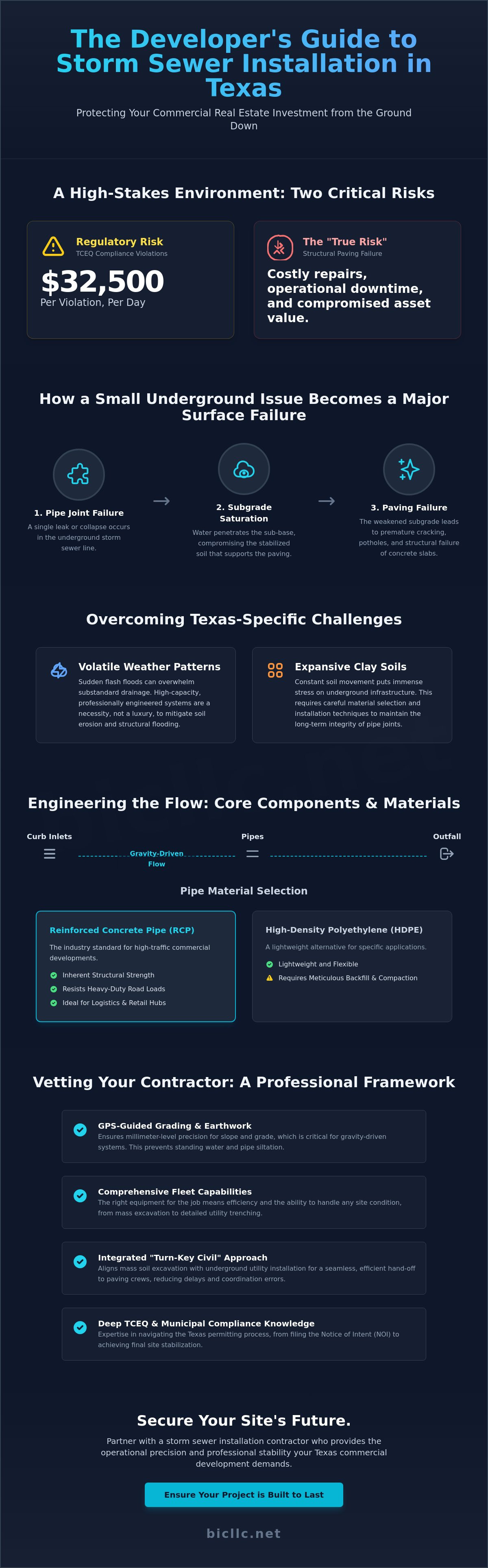
Texas weather patterns are notoriously volatile. The region frequently experiences sudden flash floods that can overwhelm substandard drainage in minutes. High-capacity systems are a necessity, not a luxury. These systems must be designed to mitigate the risk of soil erosion and structural flooding, which can compromise the integrity of building foundations and parking structures. A storm sewer system is a network of drains and pipes designed to divert excess rain to detention areas. By effectively managing this volume, the storm sewer infrastructure preserves the structural health of the entire development.
Why Infrastructure Integrity Starts Underground
The cost-to-repair ratio for underground utility failures is significantly higher than that of surface-level issues. When a pipe joint fails or a line collapses, the resulting excavation often requires the removal and replacement of expensive concrete paving or sidewalks. Infrastructure failures are expensive. Beyond the immediate repair costs, poor drainage allows water to penetrate the subgrade. This moisture compromises the soil stabilization that supports heavy concrete paving, leading to premature cracking and structural failure of the slab-on-grade. A properly installed system protects your investment by keeping the sub-base dry and stable.
The Economic Impact of Proper Drainage
Efficient drainage systems provide a clear path toward reducing long-term maintenance costs. Property owners who prioritize high-quality underground utilities face fewer emergency repairs and enjoy a longer lifespan for their surface assets. This long-term viability is often tied to the seamless integration of these lines with professional detention pond construction Texas projects require for regulatory compliance. Beyond physical durability, a functional storm sewer system is vital for maintaining property values and ensuring insurance compliance. A seasoned storm sewer installation contractor Texas businesses trust will ensure that every component, from the curb inlets to the outfalls, meets the rigorous standards necessary to protect the site's financial and physical future.
Engineering the Flow: Core Components of Commercial Storm Sewers
Gravity drives every successful drainage project. For a commercial site, the storm sewer hierarchy begins with curb inlets and ends at the outfall. Between these points, the system relies on precise engineering to maintain the necessary slope. Even a minor deviation in grading can lead to standing water or pipe siltation. A professional storm sewer installation contractor Texas developers trust will prioritize this level of precision during the initial earthwork phase to ensure the system functions as designed. Reliability is built into the grade.
Regulatory compliance is equally critical to the engineering process. Understanding Texas permitting requirements ensures that the physical installation matches the engineered plans approved by the TCEQ. This alignment prevents costly delays and ensures the underground network functions as intended for decades. It's about more than just moving water; it's about adhering to a disciplined framework of environmental and structural standards.
Structural Materials and Pipe Selection
Material choice is a primary factor in the longevity of underground utilities. Reinforced Concrete Pipe (RCP) remains the standard for high-traffic commercial developments due to its inherent structural strength and resistance to the heavy-duty road loads found in logistics centers and retail hubs. While HDPE (High-Density Polyethylene) offers a lightweight alternative, it requires meticulous backfilling and stabilization to prevent deformation under pressure. In the demanding environments of Texas, RCP is often preferred for its enduring nature and proven performance under load.
Precast concrete structures, such as junction boxes and headwalls, are frequently utilized to maintain tight construction schedules. These components are manufactured in controlled environments, ensuring consistent quality and structural integrity. Using precast elements allows for a faster installation timeline without compromising the steadfast reliability required for commercial infrastructure. This methodical approach to material selection ensures that the foundation of your site remains secure.
Inlets, Catch Basins, and Manholes
The collection process begins at the surface. Curb inlets are strategically placed along the perimeter of parking areas to capture runoff before it can pool. These inlets feed into catch basins, which are engineered to trap heavy debris and sediment before they enter the main trunk line. This simple mechanical filtration is vital for reducing long-term maintenance needs. It protects the main line from blockages that could lead to surface flooding.
Junction boxes and manholes provide the necessary access points for system inspection and cleaning. In a large-scale commercial development, these access points are placed at every change in pipe direction or diameter. This methodical layout ensures that any future blockages can be addressed without disturbing the surface concrete. A seasoned storm sewer installation contractor Texas teams rely on will ensure these structures are set to the exact elevation to match the final paving grade.
Overcoming Texas-Specific Challenges in Utility Construction
It's a common misconception that utility construction is a uniform process regardless of geography. In reality, a storm sewer installation contractor Texas must account for some of the most volatile geological conditions in the country. The high plasticity of Texas clay means that the ground is in a constant state of movement. When soil expands and contracts with moisture changes, it exerts significant pressure on buried infrastructure. Without precise engineering, these forces lead to pipe displacement or joint separation, which eventually causes subgrade erosion and surface paving failure. A disciplined contractor understands that digging a trench is only the beginning; protecting the pipe from the soil is the true challenge.
Operational safety and efficiency require meticulous site coordination. On complex commercial developments, the proximity of various utility lines necessitates a clear plan to avoid strikes and service interruptions. Integrating storm drainage schedules with domestic water line installation Texas protocols prevents the costly delays associated with damaged infrastructure. This integrated approach ensures that all underground utilities are placed with sufficient clearance and stability to support the long-term viability of the development. It's about maintaining a clear hierarchy of importance for every buried asset.
Navigating Expansive Clay and Soil Stabilization
Expansive clay requires more than just a standard trench. To maintain joint integrity, contractors must utilize specific bedding materials like sand or crushed stone. These materials create a stable envelope around the pipe, allowing for minor soil shifts without compromising the seal. Soil stabilization techniques, often used for surface paving, are equally important for utility backfilling to ensure the trench doesn't become a weak point in the site's foundation. Using the correct backfill density is a non-negotiable standard for any project designed to last.
Regulatory Compliance and Environmental Standards
Compliance is a matter of professional duty. The Texas Commission on Environmental Quality (TCEQ) enforces strict Stormwater Pollution Prevention Plan (SWPPP) standards for any project disturbing one acre or more. Failure to manage erosion control can lead to fines of up to $32,500 per violation, per day. A professional storm sewer installation contractor Texas developers trust manages these environmental standards by implementing silt fences, inlet protection, and stabilized construction exits. This commitment to regulatory detail protects the developer from liability and ensures the project remains on schedule, adhering to both local municipal codes and regional watershed management plans.
Vetting a Storm Sewer Installation Contractor: A Professional Framework
Selecting a storm sewer installation contractor Texas developers can rely on involves evaluating more than just a list of services. It requires a disciplined assessment of their professional framework, technical proficiency, and historical performance on complex sites. Underground construction is a high-risk endeavor that demands strict adherence to safety protocols and a deep understanding of geological stability. A dependable partner must also demonstrate the financial capacity to bond substantial infrastructure projects, providing the security needed for long-term commercial investments.
Past performance serves as the most reliable indicator of future results. When reviewing a contractor's portfolio, look for projects with similar geological profiles, particularly those involving the expansive clays discussed earlier. A seasoned expert will have a proven track record of managing these conditions without compromising the integrity of the pipe joints or the final surface grade. This experience translates into a more predictable construction schedule and a finished product that stands the test of time. Professionalism is found in the meticulous management of these details.
Equipment and Technical Proficiency
Modern excavation requires more than just heavy machinery; it demands technology that ensures accuracy. Laser-guided precision and GPS-guided grading are non-negotiable for gravity-fed systems where even a minor deviation can lead to standing water. A contractor who owns and maintains their own fleet of heavy equipment demonstrates a level of operational stability that rental-dependent firms cannot match. This ownership ensures that the right tools are available at the right time, reducing the risk of project delays. A professional contractor should provide a clear project timeline and safety plan before breaking ground.
The Value of an Integrated Civil Partner
The most critical phase of site development is the transition from underground utilities to surface structures. Using a single partner for both the storm sewer system and commercial concrete paving Conroe projects require eliminates the communication gaps that often lead to site coordination failures. When one firm manages the entire scope, they take full responsibility for the subgrade integrity and the precise placement of curb inlets. This integrated approach ensures that the underground infrastructure and the surface paving function as a single, cohesive unit. To ensure your next development is built on a steadfast foundation, partner with a Turn-Key Civil expert who prioritizes reliability and professional stability.
Born Integrated: Why Your Site Prep and Utility Strategy Must Align
Site development is a sequential discipline where the success of the surface depends entirely on the precision of the subsurface. At Born Integrated Construction, we operate under a philosophy of steadfast reliability, ensuring that every project is built on a foundation of professional stability. This integrated mindset is what distinguishes us as a storm sewer installation contractor Texas developers choose for high-stakes projects. We don't just install pipes; we manage the critical transition from underground infrastructure to surface concrete construction. It's a level of oversight that protects the long-term viability of the entire development.
The hand-off between utility installation and paving is often where projects lose momentum or quality. By maintaining control over both the underground storm sewers and the final slab on grade, we eliminate the friction that typically occurs between separate trades. This alignment ensures that the structural integrity of the site is preserved from the first excavation to the final joint. Our teams focus on the enduring nature of our work, providing a sense of security that the underground assets will support the surface paving without compromise or future failure.
The Advantage of Integrated Civil Solutions
Our deep expertise in mass soil excavation and paving stabilization informs every utility trench we dig. We recognize that soil movement in Texas is a constant threat. Our integrated approach allows us to apply stabilization techniques that protect both the utilities and the future concrete structures simultaneously. This methodical scheduling minimizes site disruption and keeps the development on a predictable path. Safety is a core value of our operation. By managing the entire civil scope, we reduce the risk of utility strikes and protect the developer's liability through disciplined execution and clear, authoritative communication.
Building Foundations That Endure
Quality isn't a variable in our work; it's a constant. We take pride in the craftsmanship of every inlet, junction box, and catch basin we install. These components are vital to the long-term health of Texas developments, and we treat them with the seriousness they deserve. As a storm sewer installation contractor Texas can rely on for consistent value, we are committed to building infrastructure that facilitates regional growth and stands the test of time. For developers who prioritize substance over style and require a partner focused on meticulous management, Born Integrated Construction is ready to deliver. Contact us today to discuss the requirements for your next commercial or infrastructure development.
Securing the Future of Your Commercial Development
A successful commercial development in Texas requires a disciplined approach to underground infrastructure. The long-term viability of your surface paving depends on the precision of the storm sewer system buried beneath it. Managing the volatile nature of expansive clay and adhering to strict TCEQ regulatory standards are tasks that demand operational precision. Selecting a qualified storm sewer installation contractor Texas developers can trust ensures that your site is built to withstand both environmental pressures and heavy-duty operational loads.
Born Integrated Construction provides the steadfast reliability necessary for complex civil projects. Our turn-key civil and concrete solutions eliminate the communication gaps between trades, ensuring a seamless hand-off from utility installation to final paving. We bring specialized expertise in Texas soil conditions and a deep understanding of the local regulatory environment to every project. This unwavering commitment to safety and integrity serves as the bedrock of our professional output.
Partner with Born Integrated Construction for your next Texas infrastructure project to secure a foundation that endures. We look forward to delivering the consistent value and technical proficiency your development deserves.
Frequently Asked Questions
How long does a typical commercial storm sewer installation take?
A standard commercial installation generally requires between two and six weeks to complete, depending on the site's total acreage and the complexity of the utility network. Factors such as soil stability and the presence of existing lines influence the specific timeline. A professional storm sewer installation contractor Texas developers rely on will provide a detailed schedule that accounts for excavation, pipe bedding, and backfilling phases to ensure a predictable hand-off to paving crews.
What is the most durable pipe material for Texas storm sewers?
Reinforced Concrete Pipe (RCP) is widely considered the most durable material for commercial developments in Texas due to its inherent structural strength. It withstands the heavy-duty road loads found in logistics centers and retail hubs far more effectively than flexible alternatives. While HDPE is used in specific scenarios, RCP remains the steadfast choice for developers who prioritize long-term infrastructure stability and resistance to soil movement.
Do I need a separate contractor for storm sewers and detention ponds?
You don't need separate contractors; hiring an integrated civil partner ensures better site coordination and a more efficient schedule. Managing both the storm sewer network and detention pond construction through a single firm reduces communication gaps and ensures the entire drainage system functions as a cohesive unit. This integrated approach allows for better management of the transition from underground collection to final detention.
What permits are required for storm sewer installation in Texas?
Projects disturbing one acre or more require a TPDES Construction General Permit (TXR150000) from the TCEQ. Additionally, developers must secure local municipal permits, such as excavation or utility tap permits, which vary by city. For sites over five acres, a Notice of Intent (NOI) must be filed with the state at least 48 hours before construction begins to ensure environmental compliance.
How does expansive clay soil affect my underground utilities?
Expansive clay soil shifts significantly during moisture changes, which can exert immense pressure on buried pipes and lead to joint separation. This movement often results in subgrade erosion if the system isn't properly bedded with stable materials like sand or gravel. A disciplined storm sewer installation contractor Texas projects demand will utilize specific backfilling and stabilization techniques to mitigate these geological risks and protect the pipe's integrity.
Can a storm sewer system be installed under an existing parking lot?
Systems can be installed under existing lots, though it typically requires strategic trenching and the subsequent replacement of the concrete paving. This process involves precise saw-cutting and excavation to minimize disruption to the surrounding subgrade and existing utilities. While it's a complex undertaking, a methodical approach ensures that the new drainage lines are set to the correct gravity-fed slope while maintaining the lot's structural capacity.
What is the difference between a storm sewer and a sanitary sewer?
A storm sewer is designed exclusively to manage rainwater and surface runoff, diverting it directly to detention ponds or natural waterways. In contrast, a sanitary sewer carries wastewater from buildings to a treatment plant for chemical or biological processing. These two systems are kept entirely separate to prevent the contamination of local water sources and the accidental overloading of municipal treatment facilities during heavy rain events.
How often should a commercial storm sewer system be inspected?
Commercial systems should undergo a thorough inspection at least once per year or following any major storm event that exceeds local drainage capacity. Regular checks of curb inlets and catch basins help identify sediment buildup or debris blockages before they cause surface flooding or subgrade saturation. Maintaining a methodical inspection schedule preserves the structural integrity of the underground infrastructure and prevents the need for costly emergency repairs.