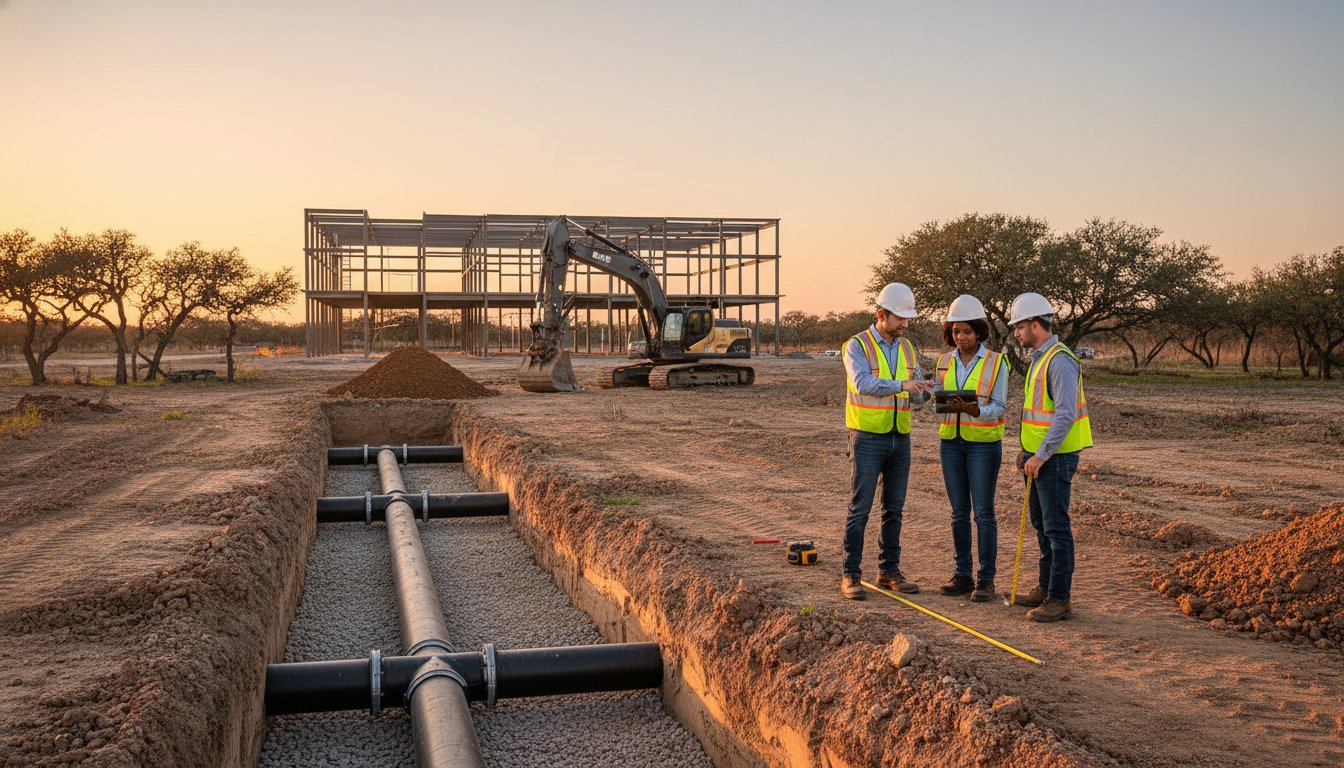
In the first half of 2026, one-third of pipeline strikes in Texas occurred because excavators failed to notify the state's One-Call center before digging. These avoidable errors highlight the thin margin for error when managing subsurface infrastructure in our rapidly expanding state. You recognize that a single unforeseen obstruction or a coordination lapse between excavation and utility teams can derail a project's timeline and budget. Selecting a qualified underground utility installation contractor is the most critical decision for ensuring your site's long-term infrastructure reliability and regulatory compliance.
We understand that developers in Houston, Dallas, and Austin face a complex web of municipal standards and evolving state regulations. This article provides an expert checklist designed to help you master these subsurface complexities. We'll examine how to vet for technical proficiency, ensure adherence to the March 2026 TxDOT ROW Utilities Manual, and achieve a seamless integration of site preparation with utility delivery. This methodical approach ensures your project meets the highest standards for durability and operational precision from the initial trench to the final connection.
Key Takeaways
- Understand the critical role a specialized underground utility installation contractor plays in establishing a reliable subsurface network for water, sewer, and power lines.
- Learn how to integrate site preparation by verifying mass soil excavation and assessing paving stabilization to prevent future utility shifts.
- Identify the technical standards required for storm and sanitary systems, including gravity flow integrity and domestic water pressure testing.
- Establish rigorous risk mitigation strategies through OSHA-compliant trench shoring and standardized utility strike prevention protocols.
- Discover the operational efficiencies and cost savings gained by partnering with a single-source provider for turnkey civil services.
What is an Underground Utility Installation Contractor?
An underground utility installation contractor is a specialized firm responsible for the subsurface network of water, sewer, and power lines that sustain a development's long-term viability. These professionals operate at the intersection of civil engineering and physical execution, transforming complex blueprints into a functional reality. During the pre-construction and civil phases, their role involves identifying potential utility conflicts and ensuring that proposed depths align with local municipal standards. For Texas developers, this work represents the critical path of the project. A delay in laying wet utilities or electrical conduits puts the entire schedule at risk, as subsequent phases like paving and structural foundations can't safely begin until the subsurface work is verified and tested.
The complexity of Texas soil conditions, from the expansive clays of the north to the coastal sands of the south, requires a contractor who prioritizes professional stability and technical proficiency. They don't just dig trenches; they manage the lifeblood of the site. This involves a deep-rooted commitment to high standards, ensuring that every pipe and conduit is placed with the operational precision necessary for decades of service. By establishing a reliable foundation early, these contractors mitigate the risk of future infrastructure failure and costly repairs.
The Core Systems of Subsurface Infrastructure
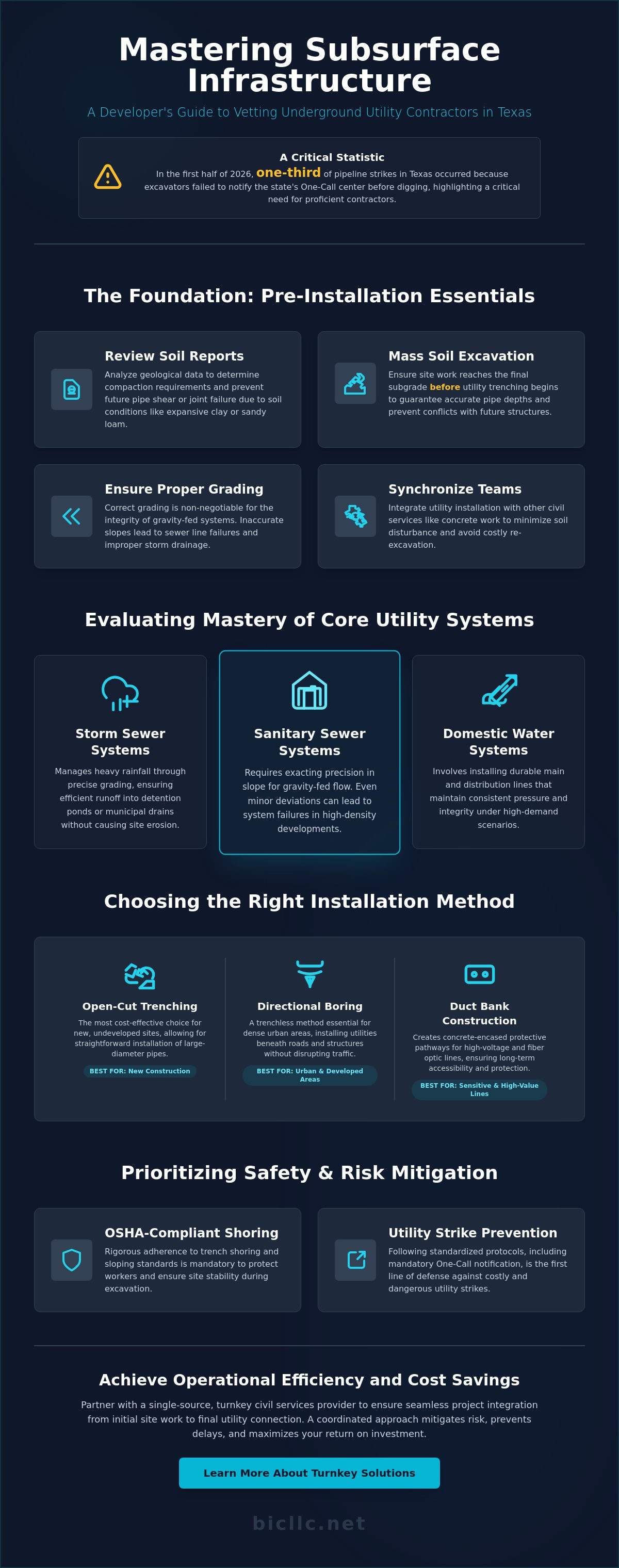
Technical proficiency is best measured by the mastery of three primary systems. Storm sewer systems are designed to manage the sudden, heavy rainfall common across Texas. Proper installation requires precise grading to ensure runoff moves efficiently into detention ponds or municipal drains without causing site erosion. Sanitary sewer lines demand a different kind of precision because they rely on gravity-fed flow. Even a minor deviation in slope can lead to system failures in high-density commercial hubs. Finally, domestic water systems require the installation of durable main lines and distribution networks that maintain pressure and integrity under high-demand scenarios.
Traditional vs. Trenchless Methods
Operational precision dictates whether a contractor employs open-cut or trenchless methods. Open-cut trenching is often the most cost-effective choice for new Texas sites where the ground is clear of existing structures. It allows for a straightforward installation of large-diameter pipes. Conversely, directional boring is essential in dense urban centers like Houston or Dallas. This trenchless method permits the installation of utilities beneath active roadways without disrupting traffic. For high-voltage and fiber optic lines, contractors utilize duct bank construction to create concrete-encased protective paths. These systems are often designed with future maintenance in mind, occasionally mirroring the organized structure of utility tunnels to ensure long-term accessibility and protection.
The Integrated Site Work Checklist: Pre-Installation Essentials
Site preparation isn't a separate phase from utility installation; it's the foundation of it. Before any pipes are laid, a developer must ensure the site is prepared to receive them. This starts with a thorough review of site-specific soil reports. Texas clay, particularly in the northern regions, is notorious for its expansive properties. Conversely, the sandy loam found in East Texas presents different stability challenges. A seasoned underground utility installation contractor knows these reports dictate the compaction requirements and bedding materials needed to prevent pipe shear or joint failure. Ignoring these geological nuances often leads to infrastructure shifts that compromise the system's long-term viability.
Mass soil excavation must reach final subgrade before utility trenches are cut. If the site isn't graded correctly, the utility depths will be inaccurate. This leads to gravity-flow failures in sewer lines or physical conflicts with future surface structures. Coordination is paramount during this stage. Developers should ensure their concrete construction services Texas are perfectly synchronized with utility depths to avoid the expense of re-excavation. When mass excavation and utility work are integrated, the risk of disturbing settled soil is minimized. This preserves the structural integrity of the entire subsurface network.
Paving stabilization is another essential factor that requires early assessment. Chemical stabilizers like lime or fly ash can affect the pH of the soil surrounding metal conduits or pipe gaskets. Addressing this need early prevents the chemical degradation of the utilities. Throughout this process, safety remains the highest priority. Adhering to OSHA's safety standards for excavation ensures that trenches are shored correctly. This protects both the workforce and the project schedule from the catastrophic delays of a trench collapse. It's often beneficial to work with a partner who provides turnkey civil site work, as they can manage the transition from earthwork to utility installation with singular accountability.
Synchronization with Mass Excavation
The longevity of pipe bedding depends on the stability of the soil beneath it. If mass excavation is performed haphazardly, the subgrade won't support the weight of the utility lines and the subsequent backfill. This leads to gradual shifts and eventual breaks. A methodical approach ensures that mass excavation is graded before trenches are cut, allowing for precise depth control. Proper soil stabilization further reinforces this foundation, ensuring that the infrastructure remains steadfast as the site develops above it.
Stormwater Management and Detention Ponds
Storm sewer installation must be synchronized with the construction of detention ponds. Texas municipal standards require specific basin designs to handle peak runoff volumes during heavy rainfall. If the pond isn't excavated to the correct elevation before the storm lines are laid, the system won't drain. A reliable contractor verifies that the outfall structures and the pond's final grade align perfectly. This prevents standing water and ensures the site remains compliant with local environmental regulations regarding runoff control.
Evaluating Technical Proficiency: Storm, Sanitary, and Water Systems
Technical proficiency is the cornerstone of professional stability in civil construction. A seasoned underground utility installation contractor doesn't merely follow a set of drawings; they apply rigorous standards to ensure the subsurface network operates without fail for decades. For sanitary sewer lines, maintaining the specified slope is vital for gravity flow integrity. Even a minor deviation can lead to sediment buildup and system failure in high-traffic commercial hubs. Similarly, storm drainage systems must be sized correctly to handle the rapid runoff rates characteristic of Texas weather. The choice between Polyvinyl Chloride (PVC) and Reinforced Concrete Pipe (RCP) depends on the depth, load requirements, and the specific municipal standards of cities like Houston or Austin.
To achieve this level of precision, many projects now incorporate Subsurface Utility Engineering (SUE) during the planning phase. This methodical approach identifies potential conflicts before excavation begins, reducing the likelihood of utility strikes. Once the lines are laid, backfill compaction becomes the next critical phase. Without meticulous compaction, the soil above the utility trenches will eventually settle. This settlement is a primary cause of pavement failure and structural cracking. A disciplined contractor ensures that every lift of backfill is tested for density, providing a stable foundation for the site's surface improvements.
Sanitary and Storm Sewer Precision
Calculation of flow rates and pipe diameters ensures high-density developments remain functional during peak usage. Manholes serve as more than just entry points; they are critical access hubs for long-term system maintenance. This technical accuracy directly impacts the longevity of surface structures. For instance, the durability of commercial concrete paving Conroe depends on perfectly executed storm drainage. If water isn't directed away from the subgrade through a precise subsurface network, even the strongest concrete will eventually succumb to moisture-related degradation.
Domestic Water and Fire Line Installation
Domestic water systems require adherence to American Water Works Association (AWWA) standards to ensure public health and system reliability. Pressure testing protocols are non-negotiable; they verify that the network can withstand the operational demands of commercial warehouses or multi-family units. Fire line installation is equally critical, requiring dedicated mains that meet local fire marshal codes for flow and volume. In aggressive Texas soils, corrosion protection for these lines is essential. Using sacrificial anodes or protective coatings ensures that the infrastructure remains steadfast, resisting the chemical reactions that can prematurely age subsurface metals.
Risk Mitigation and Safety Standards for Subsurface Projects
Subsurface projects carry a high degree of physical and financial risk. In Texas, about one-third of excavators who struck pipelines in 2026 had failed to notify the One-Call center before digging. This statistic underscores the necessity of a disciplined approach to safety and operational precision. A seasoned underground utility installation contractor doesn't treat safety as a checklist; they treat it as a foundational pillar of their professional output. Beyond the immediate danger of utility strikes, developers must manage the environmental impact of their work. Preventing silt runoff during utility installation is a regulatory requirement that protects local water systems and ensures compliance with Texas Commission on Environmental Quality (TCEQ) standards. Maintaining rigorous insurance and bonding for these infrastructure projects is equally vital, as it provides a layer of security for the developer's long-term investment.
Trench Safety and Shoring
Texas soil conditions dictate the specific shoring methods required for safe excavation. In the expansive clay found across much of the state, trench walls can become dangerously unstable when moisture levels fluctuate. In these environments, contractors prioritize the use of trench boxes or hydraulic shoring for any excavation exceeding five feet in depth. Conversely, in the sandy loam of East Texas, sloping or benching might be used if the site footprint allows. Every excavation site must have a designated "Competent Person" who is trained to identify existing and predictable hazards. This individual has the authority to stop work if conditions become unsafe. When work involves manholes or vaults, confined space entry protocols must be strictly followed, including atmospheric testing and dedicated rescue plans to ensure the safety of the workforce.
Avoiding Utility Strikes and Delays
The Texas One-Call Law mandates that excavators contact 811 at least two business days before beginning any work deeper than 16 inches. Once notified, utility operators have two business days to mark the location of their underground facilities. Adhering to this timeline is critical, as penalties for violations of the Pipeline Damage Prevention rules now start at $1,000 per occurrence. To further mitigate risk, modern contractors employ the following verification methods:
- Ground-Penetrating Radar (GPR): Using electromagnetic radiation to image the subsurface and detect non-metallic pipes or conduits.
- Potholing: Utilizing vacuum excavation to safely expose and verify the exact depth and alignment of existing utilities.
- Integrated Civil Management: Reducing cross-contractor interference by coordinating utility paths with mass excavation and paving stabilization schedules.
The financial impact of a utility strike extends far beyond the repair costs. It can halt a commercial timeline for weeks, leading to missed milestones and increased mobilization expenses. A steadfast partner manages these risks through proven results and unwavering consistency. For developers seeking a disciplined approach to infrastructure, turnkey civil site work provides the necessary oversight to maintain safety and regulatory compliance throughout the project lifecycle.
Partnering with a Turnkey Civil Site Work Contractor
The transition from raw land to a build-ready site requires more than just technical skill; it demands a unified management strategy. When a developer hires a separate earthwork crew and a different underground utility installation contractor, they often inherit a coordination gap that leads to delays. A single-source partner for both mass soil excavation and utility delivery ensures that every phase of the project reinforces the next. This integrated approach allows for the seamless verification of subgrades before the first pipe is laid, maintaining the structural integrity of the entire subsurface network. By consolidating these services, developers gain a steadfast partner who assumes total accountability for the site's critical path.
Reducing mobilization costs is a primary financial benefit of this turnkey model. Mobilizing heavy machinery for mass excavation and then again for utility trenching represents a significant, often redundant expense. An integrated civil partner optimizes equipment usage, keeping crews on-site to transition directly from grading detention ponds to installing storm sewer outlets. This methodical progression prevents the "stop-and-start" rhythm that plagues many Texas developments. It also ensures that the soil stabilization efforts required for future paving are not compromised by subsequent utility work, preserving the durability of the final surface improvements.
The Born Integrated Advantage
Born Integrated Construction provides a disciplined approach to civil site work that bridges the gap between subsurface infrastructure and structural concrete. Our teams possess deep-rooted expertise in both mass excavation and high-precision utility installation, ensuring that every project meets the highest standards of operational precision. This synergy is particularly vital for complex projects requiring close coordination between civil crews and a podium slab contractor Conroe TX. When the same organization manages the earthwork and the structural foundations, the risk of cross-contractor interference is eliminated. This creates a reliable foundation where the utility mains and the building's slab-on-grade work in perfect unison.
Next Steps for Your Texas Development
As Texas continues its rapid expansion, particularly in the Houston-Austin corridor, planning for 2026 project timelines requires early engagement with a dependable partner. Houston led the state with over 8,000 residential permits in the first quarter of 2026, and the demand for high-tech manufacturing and healthcare facilities remains at an all-time high. To ensure your development stays on schedule, requesting a comprehensive civil site work bid early in the pre-construction phase is essential. Born Integrated Construction is ready to act as your authoritative expert, delivering consistent value through proven results and a focus on long-term infrastructure reliability. Contact us to establish a lasting foundation for your next commercial or residential project.
Establishing a Resilient Subsurface Foundation
Successful Texas development depends on the seamless integration of earthwork and infrastructure. We've explored how verifying mass soil excavation and adhering to strict technical standards for storm, sanitary, and water systems prevents the infrastructure shifts that lead to long-term failure. A disciplined underground utility installation contractor doesn't just manage pipes; they manage the project's critical path by prioritizing safety and regulatory compliance from the initial trench. This methodical approach ensures that your site's subsurface network remains a steadfast asset rather than a hidden liability.
Born Integrated Construction provides specialized expertise in domestic water systems, sanitary lines, and storm sewer networks throughout Houston, Austin, San Antonio, and Dallas. Our ability to merge civil site work with professional concrete paving ensures that your project maintains structural integrity from the foundation to the utility main. We invite you to Partner with Born Integrated Construction for Your Next Civil Project to ensure your infrastructure remains reliable and durable. We look forward to helping you build a lasting foundation for your next Texas development.
Frequently Asked Questions
What does an underground utility installation contractor actually do?
An underground utility installation contractor is responsible for the physical execution of a site's subsurface infrastructure. They manage the installation of storm sewers, sanitary lines, and domestic water systems, ensuring each pipe is placed according to precise engineering specifications. Their role begins in the pre-construction phase, where they coordinate with excavation teams to verify subgrades and identify potential utility conflicts before any trenches are cut.
How long does it take to install storm and sanitary sewers for a 10-acre site?
Project timelines depend heavily on site complexity, soil conditions, and the density of the proposed utility network. In Texas, expansive clay or rocky terrain can influence the pace of excavation and shoring. While a standard 10-acre commercial development might require several weeks of active installation, the schedule is often dictated by the synchronization of mass excavation and the speed of municipal inspections. A methodical contractor prioritizes operational precision over speed to ensure long-term reliability.
Do I need a separate contractor for mass excavation and utility installation?
While you can hire separate firms, partnering with a single-source provider for both earthwork and utilities is significantly more efficient. This integrated approach reduces mobilization costs and eliminates the risk of communication gaps between different crews. When one partner manages the entire civil scope, they ensure that mass soil excavation is perfectly graded to accommodate the required utility depths, preventing costly re-excavation and project delays.
What are the common causes of utility installation delays in Texas?
Delays often stem from unforeseen subsurface obstructions or a failure to follow the Texas One-Call Law. As of June 2026, about one-third of pipeline strikes in the state occurred because excavators didn't notify the 811 center before digging. Other frequent causes include poor coordination between excavation and utility teams, severe weather events, and non-compliance with evolving municipal standards. A disciplined contractor mitigates these risks through thorough site assessments and a steadfast commitment to safety protocols.
How do I ensure my underground utilities meet municipal codes in Houston or Dallas?
Securing compliance requires partnering with an experienced underground utility installation contractor who stays current with regional regulations. Your contractor must adhere to the March 2026 TxDOT ROW Utilities Manual and specific city ordinances regarding pipe materials and pressure testing. Professional stability is demonstrated through a deep-rooted understanding of these standards, ensuring that every system is installed, tested, and verified to meet or exceed local municipal requirements.
What is the difference between open-cut trenching and directional boring?
Open-cut trenching is the traditional method of excavating a trench from the surface to lay pipe, which is typically the most cost-effective choice for new developments. Directional boring is a trenchless technology used to install utilities beneath existing obstacles like roadways or buildings without disturbing the surface. Boring is essential for navigating dense urban environments like Dallas or Houston where open excavation isn't feasible. Both methods require technical proficiency to maintain the correct depth and alignment.
Why is soil stabilization important for underground utility lines?
Soil stabilization is critical because it provides a steady foundation for the subsurface network. Texas is known for expansive clays that shift significantly with moisture changes, which can lead to pipe shear or joint failure. By utilizing chemical stabilizers or mechanical compaction, a contractor ensures the soil remains stable. This prevents the settlement that causes utility breaks and subsequent pavement failure, protecting the enduring nature of the project's infrastructure.
What insurance should an underground utility contractor carry in Texas?
A reputable contractor must maintain comprehensive general liability, workers' compensation, and professional indemnity insurance. In Texas, specific registrations are also required, such as the TCEQ Underground Storage Tank contractor registration for relevant projects. Bonding is equally important for large-scale infrastructure work, as it provides the developer with financial security and confidence in the contractor's ability to deliver consistent value through the project's completion.