
Commercial Concrete Paving in Conroe: Engineering Heavy-Duty Roads for 2026

With Conroe experiencing a 25% population surge between 2020 and 2025, the pressure on local infrastructure has never been higher. Developers understand that standard solutions often fail under the weight of increased traffic and the region's notoriously unstable soil. When you invest in commercial concrete paving Conroe projects, you aren't just pouring a surface; you're anchoring a long-term asset against shifting environmental conditions. It's a complex task that requires more than just a basic mix design.
We recognize the frustration of managing disconnected contractors for mass soil excavation, utility installation, and final paving. This technical guide provides a roadmap for engineering high-performance infrastructure that meets 2026 standards for durability and compliance. You'll learn how to navigate the current regulatory environment, including the mandatory OpenGov permitting portal, to ensure your site work meets both TxDOT standards and your own requirements for longevity. We'll examine the critical role of paving stabilization and how integrated site infrastructure, from detention ponds to sanitary sewer systems, creates a foundation that lasts.
Key Takeaways
- Identify the specific geotechnical challenges in Montgomery County that cause premature pavement failure and learn how to mitigate them through precise engineering.
- Evaluate the structural standards required for heavy-duty commercial concrete paving Conroe projects to ensure they withstand the high-frequency loading of 2026 traffic.
- Analyze the long-term ROI of concrete infrastructure by comparing lifecycle maintenance costs and energy efficiencies against alternative paving materials.
- Understand the critical relationship between mass soil excavation and paving stabilization in creating a steadfast foundation for site work.
- Discover the operational advantages of a unified approach to site infrastructure that integrates utilities, drainage, and paving under a single standard of execution.
The Evolution of Commercial Paving in Conroe: Growth and Geotechnical Challenges
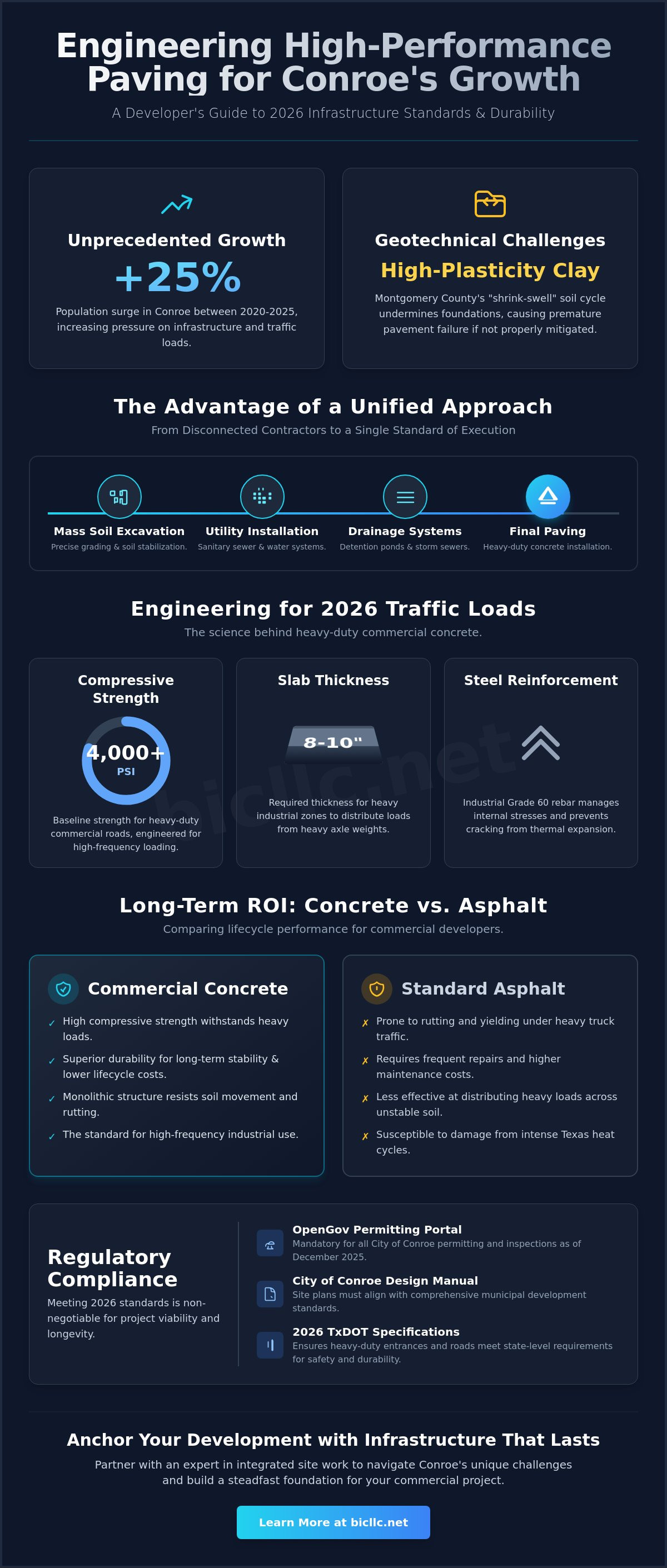
Conroe's 2026 landscape is defined by massive industrial hubs and distribution centers. With the city's population growing by 25% since 2020, the roads serving these facilities face unprecedented stress. Standard asphalt often yields to the weight of heavy-truck traffic, leading to rutting and frequent repairs. For developers, commercial concrete paving Conroe projects represent a commitment to long-term stability. The material properties of concrete make it the standard for high-frequency industrial use due to its high compressive strength and ability to distribute heavy loads across a wider surface area.
Montgomery County presents a specific set of geotechnical challenges that demand professional attention. The local soil is characterized by high-plasticity clay that reacts aggressively to moisture changes. In the intense Texas heat, these soils contract; during heavy seasonal rains, they expand. This "shrink-swell" cycle creates a shifting foundation that can undermine structural integrity. If the paving isn't engineered to account for this movement, even high-strength slabs will crack prematurely. Addressing these soil conditions at the outset is the only way to ensure a project's long-term viability.
Navigating Montgomery County Soil Conditions
Successful paving begins well below the surface. High-PI soils require careful management through mass soil excavation and specialized paving stabilization techniques. Moisture content must be strictly controlled during the site preparation phase to prevent future shifting. We believe that preliminary site testing is a non-negotiable step for every commercial developer. It provides the data necessary to determine whether chemical additives or mechanical stabilization are required to create a steadfast subgrade.
Adapting to Conroe’s Urban Development Standards
Regulatory compliance is a critical component of modern infrastructure. As of December 2025, the City of Conroe requires all permitting and inspections to be managed through the OpenGov online portal. Developers must ensure their site plans align with the City of Conroe Design Manual and 2026 TxDOT specifications for heavy-duty concrete entrances. This includes a comprehensive approach to integrated site work. Proper management of detention ponds and storm sewer systems is essential to protect the paving from water damage and meet local drainage requirements. Meeting these standards ensures that the infrastructure serves the community reliably for decades.
Engineering Standards for Heavy-Duty Commercial Concrete Roads
Building a road capable of withstanding the industrial demands of 2026 requires a rigorous adherence to established Engineering Standards for Heavy-Duty Commercial Concrete Roads. When executing commercial concrete paving Conroe developers must prioritize a structural system engineered specifically for high-frequency loading and heavy axle weights. This isn't a standard parking lot application; it's a critical infrastructure component. Utilizing Cast-in-Place (CIP) concrete is fundamental to achieving maximum structural integrity. CIP allows for a monolithic pour that adapts to the specific geometry of the site while maintaining a consistent density and professional finish across the entire expanse.
Reinforcement strategies are equally vital to the longevity of the pavement. Industrial-grade applications typically utilize Grade 60 rebar, with sizing and spacing determined by the expected shear and tensile stresses of heavy machinery. We calculate slab thickness by projecting traffic volumes through 2026 and beyond, often resulting in sections eight to ten inches thick for heavy industrial zones. Proper placement of reinforcement ensures the slab manages internal stresses caused by thermal expansion without compromising its load-bearing capacity. If you're planning a facility with high-volume logistics, it's wise to review your slab on grade requirements with a partner who understands these structural demands.
The Science of High-PSI Concrete Mixes
A 4,000 PSI compressive strength is the baseline for heavy-duty commercial roads, though many high-traffic zones require even higher specifications. In the Montgomery County climate, we utilize chemical admixtures to control set times, preventing the concrete from curing too quickly in the extreme Texas heat. This operational precision ensures the material reaches its full design strength. Additionally, air entrainment is incorporated into the mix to improve durability and resistance to surface scaling, creating a finish that withstands both environmental stress and high-frequency use.
Precision Jointing and Load Transfer
Cracking is often a result of poor joint design rather than material failure. We engineer expansion and contraction joints to guide the natural movement of the concrete, preventing random fractures that lead to maintenance issues. Smooth dowel bars are placed across these joints to facilitate effective load transfer between slabs, which prevents uneven settling. The timing of saw-cutting is also critical; it must be performed as soon as the concrete can support the equipment but before internal stresses cause uncontrolled cracking. This methodical approach to commercial concrete paving Conroe ensures a stable, long-lasting surface.
Concrete vs. Asphalt: The Long-Term ROI for Conroe Developers
Choosing a paving material is a fundamental financial decision that dictates the lifecycle costs of a commercial asset. In the 2026 Conroe market, developers often face a choice between lower upfront costs and long-term structural reliability. While asphalt may appear more accessible during the initial construction phase, commercial concrete paving Conroe projects offer a superior return on investment over a twenty-year horizon. Concrete's rigid structure provides a permanent solution that maintains its integrity under the high torque and heavy axle loads typical of modern distribution centers and industrial zones. This permanence is a key driver of property value, as prospective buyers prioritize infrastructure that doesn't require immediate capital reinvestment.
Beyond structural durability, concrete offers significant operational savings through its reflective properties. Known as the Albedo effect, the light color of concrete surfaces reflects more solar radiation than dark asphalt. This reduces the "Heat Island" effect on large-scale sites, which can lower ambient temperatures and decrease cooling costs for adjacent buildings. Additionally, the high reflectivity of concrete allows for better visibility at night, often reducing the number of lighting fixtures required for parking areas and access roads. These cumulative savings contribute to a more efficient operational budget and enhance the overall professionalism of the site.
Maintenance Cycles and Operational Downtime
Asphalt requires a rigorous maintenance schedule, including seal-coating and crack filling every three to five years. These recurring tasks don't just cost money; they cause business disruptions and restricted access to facilities. In contrast, concrete slab on grade applications provide a "set it and forget it" solution with minimal intervention required. By eliminating the need for frequent resurfacing, developers avoid the logistical headaches of closing down loading docks or redirecting tenant traffic. This reliability is a hallmark of professional-grade infrastructure that supports 24/7 operations without interruption.
Sustainability and LEED Credits
Modern Texas construction increasingly prioritizes environmental stewardship and sustainable practices. Concrete is a highly recyclable material, often incorporating locally sourced aggregates that reduce the total carbon footprint of the project. Developers seeking LEED certification can leverage concrete's high Albedo ratings to earn credits for heat island reduction. By utilizing paving stabilization and high-quality concrete mixes, you create a foundation that aligns with both ethical standards and fiscal responsibility. This steadfast approach to building ensures that Conroe's growth remains sustainable and resilient for future generations.
The Critical Role of Integrated Site Prep and Paving Stabilization
Excellence in commercial concrete paving Conroe developments isn't achieved at the surface level; it's established in the earth beneath the slab. We operate under the Born Integrated approach, which recognizes that the foundation is far more critical than the finish. A road is a structural system, and its longevity depends on how well the subgrade supports the concrete. When site preparation is treated as a separate, disconnected phase from paving, the risk of subgrade failure increases. By treating mass soil excavation, utility installation, and paving as a single, cohesive operation, we ensure that every layer of the project supports the next with precision.
The synergy between mass soil excavation and paving stabilization is the primary defense against Conroe's challenging clay. Excavation isn't merely about moving dirt; it's about reaching the correct elevations and preparing the soil for chemical or mechanical modification. In Montgomery County, where high-plasticity soils are common, stabilization is the only way to prevent the "shrink-swell" cycles mentioned earlier from destroying your investment. This process transforms unstable ground into a predictable, high-strength platform capable of carrying the heavy loads projected for 2026 industrial traffic.
Paving Stabilization Techniques
We utilize chemical stabilization, typically involving lime or cement, to modify the chemical structure of the soil and reduce its plasticity. This process binds the clay particles together, making the ground less susceptible to moisture-induced expansion. Mechanical stabilization complements this by achieving optimal compaction density through rigorous moisture control and heavy machinery. Stabilization creates a moisture-resistant bridge that uniformly distributes structural loads while shielding the subgrade from seasonal volume changes.
Managing Site Utilities and Drainage
Integrating underground utilities before the first concrete pour is a hallmark of a well-managed project. Domestic water, sanitary sewer, and storm sewer systems must be installed and tested with surgical accuracy to avoid future excavations that compromise the pavement. Strategic placement of storm sewers is particularly important for protecting the paving from water infiltration, which is a leading cause of base erosion. For large-scale parking sites, the integration of detention ponds is essential to manage runoff according to municipal standards. Coordinating these utility installations with the final commercial concrete paving Conroe schedule ensures a seamless transition from raw land to finished infrastructure. Secure your project's foundation by partnering with a team that provides integrated site work and paving services.
Born Integrated Construction: Leading Conroe’s Infrastructure Projects
Born Integrated Construction serves as a cornerstone for Montgomery County’s industrial and commercial sectors. With decades of experience in large-scale infrastructure developments, we provide a level of operational precision that complex projects demand. Our steadfast commitment to safety and integrity ensures that every project is executed with professional stability. Developers value our ability to manage the entire civil and structural scope, which creates a sense of security and confidence in the final result. By maintaining a single-source model, we eliminate the friction often found between separate site work and paving contractors. This ensures that the commercial concrete paving Conroe developers receive is built on a foundation we've personally verified through every phase of construction.
Our role as a dependable partner means we take full accountability for the project’s success. From the initial mass soil excavation to the final high-rise foundation, we maintain a disciplined focus on execution. We understand that Conroe’s rapid expansion requires infrastructure that isn't just functional but enduring. This is why we specialize in both CIP and precast projects, providing the technical proficiency needed for the most demanding structural requirements. Whether we are installing heavy-duty roads or complex CIP garages, our focus remains on building lasting foundations that support the community's long-term viability.
Our Methodical Approach to Project Management
We maintain a methodical approach to project management that prioritizes predictable scheduling and meticulous detail management. Our team understands that commercial timelines are rigid, and we strive to deliver consistent value through every stage of the build. We believe that lasting professional relationships are built on a foundation of reliability and quality. Every project phase, from the first site prep meeting to the final flatwork inspection, is defined by transparent communication. This unhurried, organized cadence allows our clients to absorb the breadth of our expertise while trusting in our proven results.
Comprehensive Concrete and Civil Services
Our technical capabilities extend across the full spectrum of commercial and civil construction. We utilize state-of-the-art equipment for paving stabilization and mass excavation to ensure the subgrade is perfectly prepared for structural loading. Our specialized expertise includes:
- CIP Garages and Precast Garage Foundations
- Slab on Grade and Podium Slabs
- CIP Midrise and Highrise structures
- Sidewalks, Flatwork, and Retaining Walls
- Integrated Site Utilities: Domestic Water, Storm Sewer, and Sanitary systems
- Detention Ponds and Paving Stabilization
This comprehensive service offering ensures that your commercial concrete paving Conroe project is executed with unwavering consistency. We act as a seasoned expert, managing the meticulous details of your site infrastructure so you can focus on the broader goals of your development. Contact Born Integrated Construction today for a steadfast partner in your next Conroe development.
Securing the Future of Conroe Infrastructure
Developing high-performance roads for 2026 requires a move beyond surface-level solutions toward integrated structural engineering. Successful projects in Montgomery County prioritize the synergy between paving stabilization and high-PSI concrete to withstand the region's shifting clay soils. By selecting a single-source partner for mass excavation, site utilities, and final slabs, you ensure every component of your infrastructure meets a unified standard of excellence. High-quality commercial concrete paving Conroe developments demand this level of operational precision to deliver long-term value and minimal maintenance.
Born Integrated Construction brings established reliability from major developments in Houston and the Woodlands to your site. We're specialized in complex CIP foundations and high-rise structures, offering the integrated civil and site utility expertise necessary for industrial success. Our methodical approach ensures your foundation is as steadfast as your professional goals. Request a Consultation for Your Conroe Commercial Paving Project to begin building a legacy of durability and strength.
Frequently Asked Questions
Why is concrete preferred over asphalt for commercial roads in Conroe?
Concrete is preferred because of its rigid structural properties and ability to distribute heavy loads across a broad surface area. Asphalt is a flexible pavement that often develops ruts or shoving under the intense heat and heavy torque of industrial vehicles. Choosing concrete for your infrastructure ensures a permanent surface that requires far less frequent intervention over its lifecycle.
What is paving stabilization and why is it necessary for Texas soil?
Paving stabilization is the process of modifying subgrade soil with chemical additives like lime or cement to improve its structural integrity. This is necessary in Conroe because the local clay soils possess a high plasticity index, meaning they expand and contract significantly with moisture changes. Stabilization creates a moisture-resistant bridge that prevents these soil movements from cracking the overlying concrete.
How long does a commercial concrete road typically last?
A professionally engineered commercial concrete road typically provides a service life of 25 to 30 years. This durability is achieved through precise slab thickness calculations and high-quality reinforcement strategies. While the initial investment is higher than asphalt, the extended lifecycle and reduced maintenance costs offer a much stronger return on investment for developers.
What is the difference between slab on grade and podium slabs for commercial buildings?
Slab on grade refers to concrete poured directly onto a prepared subgrade, whereas podium slabs are structural elements that support levels above a ground floor, such as in midrise or highrise developments. We execute both types of installations to meet the specific architectural demands of modern Conroe commercial projects. Each requires distinct engineering approaches to manage load-bearing stresses.
Does Born Integrated Construction handle underground utility installation?
Yes, we provide comprehensive civil services including the installation of domestic water, storm sewer, and sanitary systems. Managing these underground utilities in-house allows for better coordination with the mass soil excavation and paving phases. This integrated approach reduces the risk of utility conflicts and ensures the infrastructure is correctly protected beneath the commercial concrete paving Conroe project.
What PSI concrete is required for heavy-duty industrial paving?
Heavy-duty industrial paving typically requires a baseline of 4,000 PSI concrete to ensure structural durability. For facilities experiencing high-frequency loading from heavy delivery fleets, we often specify 5,000 PSI mixes or higher. The specific compressive strength is determined based on the projected 2026 traffic volumes and the specific needs of the industrial zone.
How does Conroe’s climate affect the concrete curing process?
High temperatures in the Conroe area can accelerate the hydration process, potentially leading to thermal cracking if not managed correctly. We utilize chemical admixtures to control set times and apply specialized curing compounds to retain moisture within the slab. This methodical approach ensures the concrete cures evenly and reaches its full structural potential despite environmental challenges.
Can you integrate detention pond construction with the paving project?
Detention ponds are an essential component of the site prep process and are frequently integrated into the broader paving contract. Managing detention pond construction alongside mass excavation ensures that the site's drainage system is functional before paving begins. This coordination is vital for protecting the new concrete from water infiltration and meeting local municipal drainage regulations.