Commercial Flatwork Contractor Texas: Precision Engineering for 2026 Developments
If your commercial flatwork isn't engineered to withstand the 95% standard Proctor density benchmark required for the expansive "gumbo" clays of Texas, you aren't just pouring concrete; you're scheduling a future failure. It's an expensive reality for developers that even high-quality slabs can succumb to the volatile soil movements common in the Austin and Houston metros. You likely recognize that the coordination gap between site preparation and concrete finishing is where most project delays and structural vulnerabilities take root. Selecting a steadfast commercial flatwork contractor Texas developers can rely on is about more than just aesthetics. It's about ensuring your 2026 developments remain stable under high-load conditions for decades.
This article demonstrates how integrated site preparation and expert concrete finishing ensure the longevity of your paving projects. We will examine the technical necessity of subgrade stabilization using lime or cement, the impact of 2026 regulatory updates such as Houston's Chapter 19 floodplain requirements, and the logistical advantages of a unified civil partner. By the end, you'll understand how a disciplined approach to earthwork and flatwork creates a foundation of professional stability for your next commercial venture.
Key Takeaways
- Understand the critical role of subgrade stabilization in mitigating the structural risks posed by Texas's expansive clay soils.
- Identify the logistical benefits of an integrated approach that bridges the coordination gap between mass soil excavation and final concrete finishing.
- Learn how a specialized commercial flatwork contractor Texas projects require can provide the precision engineering needed for high-load sidewalks and paving.
- Evaluate potential concrete partners based on their safety culture and operational capacity to handle the rigorous demands of 2026 developments.
- Distinguish between slab on grade and standard flatwork applications to ensure that reinforcement patterns meet specific load-bearing requirements.
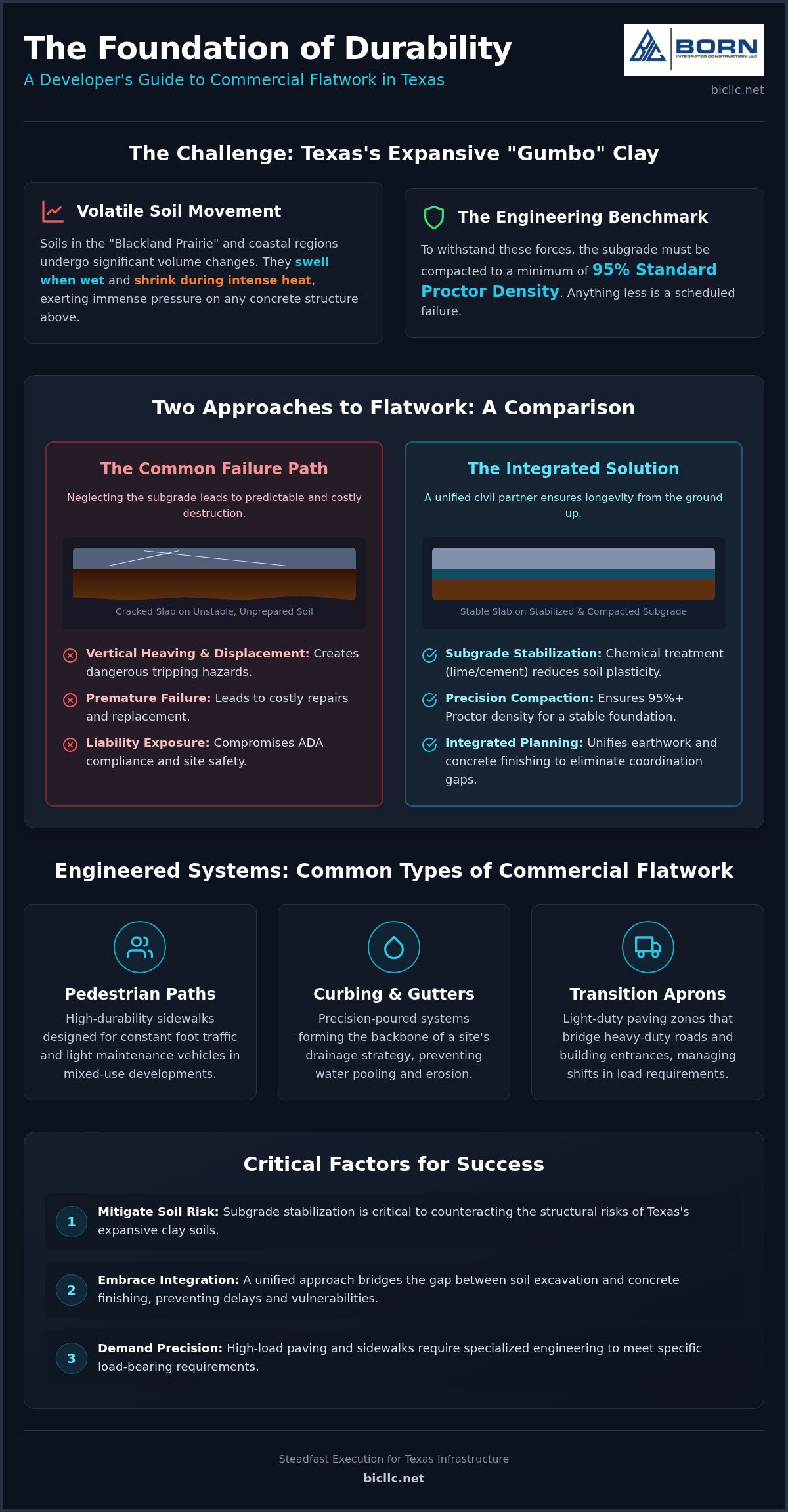
What is Commercial Flatwork and Why Does Texas Soil Demand More?
Commercial flatwork encompasses the horizontal concrete surfaces that define a property's functionality and accessibility. While a standard concrete slab often serves as the foundation for a building, flatwork refers to the exterior elements like sidewalks, curbs, gutters, and transition zones. These surfaces are not merely decorative. They are engineered systems designed to manage heavy pedestrian traffic and direct site drainage. In the demanding environment of the Lone Star State, hiring an experienced commercial flatwork contractor Texas developers trust is essential because the ground beneath the concrete is rarely stable.
The "Blackland Prairie" and coastal regions of Texas are notorious for expansive clay soils, often referred to as "Houston gumbo." These soils undergo significant volume changes, swelling when wet and shrinking during the intense summer heat. This constant movement exerts immense pressure on concrete surfaces. Residential-grade flatwork, which often lacks the reinforcement and subgrade preparation required for industrial use, quickly fails in these conditions. Without professional engineering, a simple sidewalk can become a series of displaced, hazardous slabs within a single season.
Common Types of Commercial Flatwork in Texas
- Pedestrian Paths: High-durability sidewalks designed for mixed-use developments that must withstand constant foot traffic and light maintenance vehicles.
- Curbing and Gutters: Precision-poured systems that serve as the backbone of a parking lot's drainage strategy, preventing water from pooling and eroding the pavement.
- Transition Aprons: Light-duty paving zones that bridge the gap between heavy-duty roads and building entrances, managing the shift in load requirements.
The Consequences of Subgrade Neglect
When a commercial flatwork contractor Texas relies on fails to prioritize subgrade stabilization, the results are predictably destructive. Poorly compacted soil or inadequate chemical treatment leads to horizontal displacement and vertical heaving. These shifts create tripping hazards that compromise ADA compliance and expose property owners to liability. Additionally, flatwork often fails prematurely when underground utility trenches aren't compacted to at least 95% standard Proctor density, leading to localized sinking. You can view examples of our disciplined approach to these challenges on our projects page.
Flatwork is a critical component of a project's long-term infrastructure, acting as the primary interface between the built environment and the end user.
The Integrated Approach: Why Subgrade Stabilization Matters
Subgrade stabilization is the silent partner of every successful concrete project. A professional commercial flatwork contractor Texas developers partner with understands that site readiness begins long before the first mixer truck arrives. If the mass soil excavation isn't executed with precision, the structural integrity of the flatwork is compromised from day one. Integrating civil site work with concrete finishing eliminates the typical friction between separate earthwork and paving teams. This unified approach ensures that the subgrade is prepared specifically for the loads and moisture conditions unique to the property, preventing the common "finger-pointing" that occurs when slabs fail.
Moisture management is particularly critical in regions where detention pond placement influences the local water table. If a pond is situated too close to a pedestrian path without proper drainage engineering, the resulting hydrostatic pressure can destabilize the slab. This is why Texas expansive soil research highlights the necessity of controlling soil moisture to prevent foundation movement. By managing the site as a single ecosystem, we ensure that every element supports the longevity of the infrastructure. You can learn more about our commitment to this philosophy on our company overview page.
Paving Stabilization Techniques for 2026
Current industry standards for 2026 emphasize chemical stabilization for high-plasticity clays found throughout North and Central Texas. Lime stabilization remains a primary method for reducing the plasticity index of heavy clays, while cement treatment is often preferred for more granular subgrades or when rapid strength gain is required. Mechanical stabilization, involving the blending of aggregate, is used when soil conditions allow for simpler structural improvements. Achieving the correct moisture-density relationship during compaction is vital. We target 95% standard Proctor density to ensure the ground provides a steadfast foundation. For insights into regional requirements, see our paving stabilization services in the Conroe area.
The Role of Underground Utilities
The integrity of commercial flatwork is often threatened by what lies beneath it. Coordinating storm sewer installation with the flatwork schedule is a logistical necessity that prevents settlement issues. Improperly backfilled domestic water lines or electrical conduits create "soft spots" that eventually lead to surface cracking. Our team focuses on the meticulous management of utility cut-outs and backfill compaction. This level of precision ensures that sidewalks and gutters don't sink or shift over utility crossings. A steadfast commercial flatwork contractor Texas relies on will always verify that the subgrade remains uniform across all underground infrastructure before the pour begins. This thoroughness protects the owner's investment from the hidden costs of utility-related failures.
Comparing Concrete Solutions: Slab on Grade vs. Flatwork
Understanding the distinction between structural slabs and standard flatwork is vital for maintaining project integrity. While both involve horizontal pours, their reinforcement patterns and engineering goals differ. Slab on grade typically serves as a primary building foundation, requiring heavy reinforcement to support structural loads. In contrast, flatwork focuses on exterior accessibility and drainage. A seasoned commercial flatwork contractor Texas firms trust will ensure that sidewalks and curbs are designed with the specific flexural strength needed to withstand environmental shifts without the massive thickness of a structural slab.
Load-bearing expectations dictate the mix design and reinforcement density. For 2026 commercial developments, high-PSI concrete mixes ranging from 4,000 to 5,000 PSI are becoming the standard for high-traffic paving. Proper jointing is equally essential. In the expansive Texas environment, saw-cut control joints must be placed at precise intervals to dictate where the concrete cracks as it shrinks. This methodical approach prevents random, spiderweb cracking that compromises both the appearance and the structural life of the pavement.
Slab on Grade for Commercial Facilities
Industrial facilities and warehouses require precision leveling to support heavy machinery and racking systems. Achieving high F-number ratings for floor flatness and levelness is a core competency. In the high-humidity regions of Texas, the installation of high-performance vapor barriers beneath the slab is mandatory. These barriers prevent moisture from migrating through the concrete, which protects sensitive flooring finishes and equipment. For a detailed look at how these structural principles scale, review our Houston podium slab projects for multi-story structural comparisons.
Finishing Standards for Safety and Aesthetics
The final texture of a concrete surface determines its safety profile. Medium-to-heavy broom finishes are standard for Texas sidewalks to provide necessary slip resistance during our frequent heavy rain events. For high-visibility retail zones, specialized textures may be employed, but they must never compromise the surface's durability. Curing compounds are applied immediately after finishing to regulate moisture loss. This step is critical in preventing surface scaling and ensuring the concrete reaches its full design strength. Maintaining consistent color and texture across large developments requires disciplined batching and finishing techniques, a hallmark of professional stability in our craft.
Vetting Your Commercial Concrete Partner in Texas
Choosing a commercial flatwork contractor Texas developers can trust requires a look beyond basic certifications. While an Experience Modification Rate (EMR) provides a snapshot of past safety performance, it doesn't reflect the daily on-site culture of a crew. You need a partner who views safety as a core organizational pillar rather than a box to check for 2026 compliance. This discipline extends to the bidding process. Integrity in bidding means conducting a thorough site analysis to account for Texas's specific soil challenges before submitting a proposal. This transparency helps you avoid the "change order trap" that often arises when a contractor fails to anticipate the necessity of subgrade stabilization or complex drainage requirements.
A steadfast partner must also possess the fleet and manpower to match the scale of modern industrial developments. In high-growth regions like the Dallas-Fort Worth metroplex or the Houston ship channel, logistical delays can derail aggressive 2026 schedules. Ensuring your contractor has dedicated equipment and a stable labor force is critical, especially as skilled trade wages in Texas are commanding 4-6% annual growth through 2026. This stability ensures that your project isn't left waiting for resources during peak construction windows.
Operational Precision and Scheduling
Turn-key civil capabilities are the most effective way to reduce overall project timelines. By managing both the earthwork and the concrete pour, an integrated commercial flatwork contractor Texas projects rely on can eliminate the coordination gaps that plague fragmented teams. This operational precision is vital for managing the concrete supply chain in busy corridors like I-35 and I-45. Proactive communication ensures that ready-mix deliveries are timed perfectly with site readiness, preventing idle crews or cold joints. This level of steadfast project management provides the professional stability needed to keep multi-million dollar developments on track. If you're looking for a partner focused on substance over style, contact our team today.
Documentation and Quality Control
Consistency in large-scale Texas developments depends on rigorous quality control protocols. For 2026, we utilize detailed pre-pour checklists and post-pour inspections to ensure every slab meets the required engineering specifications. This documentation provides essential transparency for both municipal inspectors and private developers. Transparent reporting isn't just about compliance; it's about building a foundation of trust through proven results. You can learn more about our steadfast commitment to quality and our focus on delivering enduring value across the state.
Born Integrated Construction: Steadfast Execution for Texas Infrastructure
Born Integrated Construction operates on the principle that professional stability is the foundation of every successful build. As a commercial flatwork contractor Texas developers rely on for high-stakes 2026 infrastructure, we prioritize substance over style in every phase of the project. Our vision for the coming years focuses on the increasing complexity of Texas developments, where vertical mixed-use and industrial expansions require more than just a standard pour. We provide a steadfast partnership that integrates mass soil excavation, underground utility coordination, and structural concrete to deliver results that endure the test of time and environmental stress.
The "Integrated" in our name represents a commitment to seamless project management. By serving as a single point of responsibility, we eliminate the operational friction that typically occurs when earthwork and concrete teams are disconnected. This unified approach is essential for maintaining the aggressive schedules required in high-growth corridors. Our teams possess the technical proficiency to manage mass soil excavation and complex earthwork concurrently with precision concrete paving, ensuring that every layer of the site meets our rigorous standards. This level of coordination is what distinguishes a seasoned expert from a standard vendor.
Turn-Key Civil and Concrete Solutions
Managing site preparation and flatwork concurrently allows for a more efficient use of resources and a significant reduction in overall project timelines. Our experience extends beyond simple paving to include complex CIP garages and midrise foundations in the Houston area. We understand the specific load-bearing requirements of podium decks and structured parking, applying the same level of operational precision to these structural elements as we do to our sidewalks and curbs. This versatility ensures that regardless of the project's vertical or horizontal scope, the civil foundations remain unyielding and compliant with 2026 engineering standards.
Partnering for Success in 2026
Success in the Texas construction market is built on integrity and long-term relationships with developers and vendors alike. We view ourselves as more than a service provider; we are a disciplined partner dedicated to the long-term viability of your infrastructure. Whether you're planning an industrial park in San Antonio or a commercial development in Fort Worth, our team provides the steadfast execution your project demands. We invite you to view our recent Texas concrete projects to see our commitment to quality and craftsmanship in action. Our focus remains on building lasting foundations through consistent performance, ethical conduct, and an unwavering focus on safety.
Securing the Future of Texas Infrastructure
The success of your 2026 development depends on a commitment to precision that begins long before the concrete pour. We've explored how integrated subgrade stabilization and meticulous site preparation mitigate the structural risks posed by expansive clay soils. By bridging the gap between mass excavation and final finishing, you ensure that your sidewalks, curbs, and paving remain structural assets rather than maintenance liabilities. Choosing a commercial flatwork contractor Texas developers can rely on is a strategic decision that directly impacts the long-term viability and safety of your property.
Born Integrated Construction provides the professional stability and technical expertise required for high-load commercial environments. Our approach combines integrated civil and concrete expertise with an unwavering focus on safety and integrity. Whether your project is located in Houston, Austin, Dallas, or San Antonio, we deliver enduring results through disciplined execution and operational precision. We invite you to Request a Steadfast Partnership Quote for Your Next Texas Project and experience the value of a partner focused on substance. We look forward to building a lasting foundation for your next commercial venture.
Frequently Asked Questions
What is the average lifespan of commercial flatwork in Texas soil?
Commercial flatwork typically has a design life of 20 to 30 years when supported by a stabilized subgrade. However, in the absence of proper engineering, the expansive nature of Texas clay can cause significant cracking and displacement within the first five years. A professional commercial flatwork contractor Texas developers trust will prioritize subgrade density to ensure the surface remains level and functional for its intended lifespan.
How much does soil stabilization add to the timeline of a concrete project?
Soil stabilization generally adds between two to five days to the initial phase of a project, depending on the chemical agent used and the total acreage. While this requires a modest upfront time investment, it prevents the months of delays associated with structural failure or remediation. Chemical treatments like lime or cement require specific curing windows before the concrete pour can commence to ensure maximum stability.
Can Born Integrated Construction handle both detention pond excavation and paving?
Yes, managing both mass soil excavation for detention ponds and final concrete paving is a core component of our integrated service model. This turn-key capability ensures that site drainage and horizontal concrete are engineered as a single, cohesive system. By handling the earthwork and the flatwork, we eliminate the logistical friction that often occurs when coordinating multiple civil subcontractors on a single site.
What safety certifications should a commercial concrete contractor in Texas hold in 2026?
In 2026, a reputable contractor should maintain a low Experience Modification Rate (EMR) and ensure all supervisors hold OSHA 30-hour certifications. Beyond these standard metrics, they must adhere to the latest Texas-specific safety updates for large-scale concrete sites. Our firm prioritizes a steadfast safety culture that focuses on proactive risk mitigation and the meticulous management of on-site details to protect all personnel and stakeholders.
How do you prevent concrete from cracking in the extreme Texas heat?
Preventing cracks during extreme Texas heat requires a disciplined approach to mix design and placement timing. We often utilize chemical retarders to control the set time and schedule pours during the cooler early morning hours. Additionally, the immediate application of high-quality curing compounds is essential to regulate moisture loss. These steps ensure the concrete reaches its full design strength without the surface scaling common in high-temperature environments.
What is the difference between flatwork and structural concrete for commercial buildings?
Flatwork refers to non-structural horizontal surfaces such as sidewalks, curbs, and gutters that primarily manage pedestrian traffic and drainage. Structural concrete, including slab on grade or podium decks, is engineered to carry the heavy loads of the building itself. While flatwork requires precision for aesthetics and drainage, structural concrete involves more complex reinforcement patterns and higher-PSI mixes to ensure the integrity of the entire facility.
Does Born Integrated Construction serve rural areas outside the major Texas metros?
Our operations are primarily focused on the high-growth corridors surrounding Houston, Austin, Dallas, and San Antonio. We serve both the central metro areas and the expanding industrial and commercial zones in the surrounding counties. This regional focus allows us to maintain the operational efficiency and equipment availability needed to support large-scale 2026 developments while ensuring consistent quality across all our project sites.
How do integrated civil services reduce overall project costs?
Integrated civil services reduce overall project costs by eliminating redundant mobilization fees and minimizing the risk of coordination errors. When a commercial flatwork contractor Texas firms partner with manages everything from mass soil excavation to paving stabilization, the project benefits from a streamlined schedule and improved resource allocation. This unified management approach prevents the expensive rework and change order traps that frequently arise when separate teams handle site prep and concrete.