Texas Infrastructure Concrete: 2026 Strategic Guide
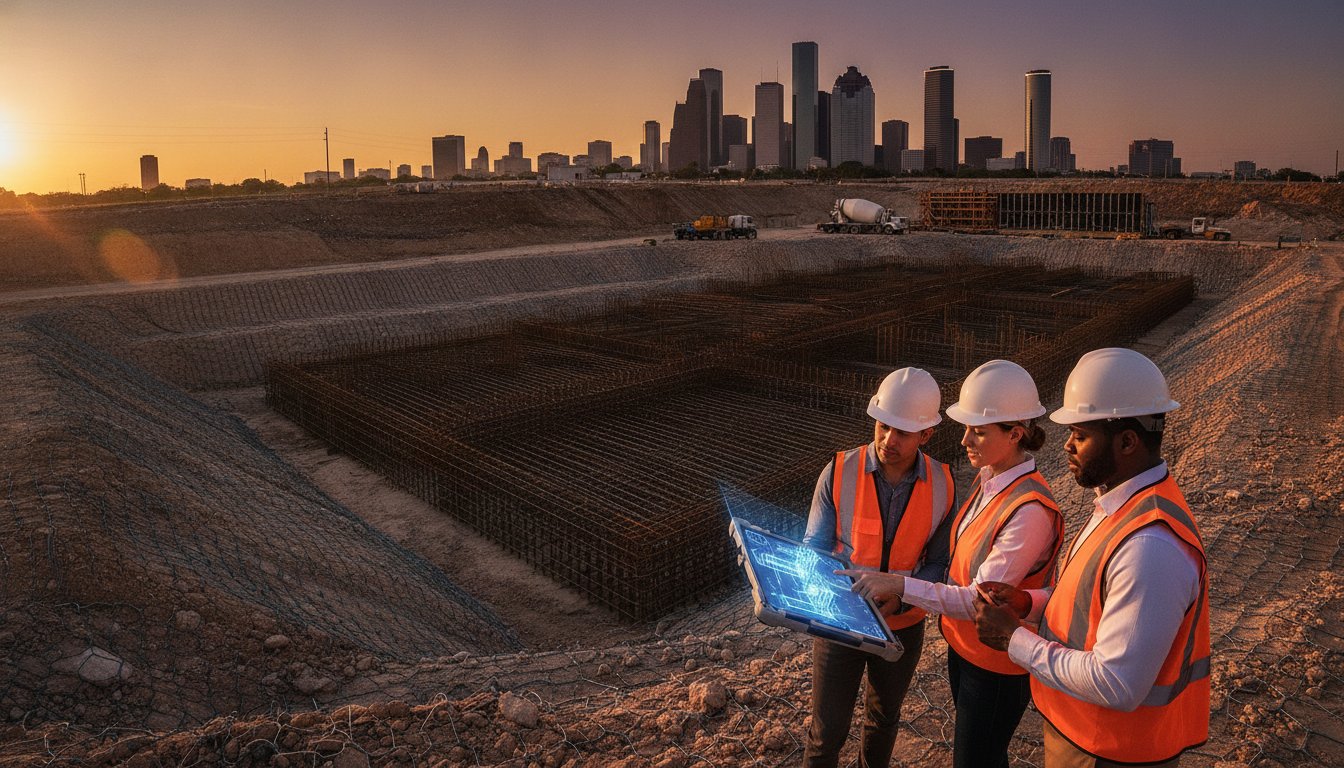
A single hairline fracture in a structural slab often isn't a concrete failure; it's a failure of the soil stabilization beneath it that was overlooked months before the first pour. Developers and municipal planners across the state recognize that the unforgiving nature of expansive Texas clay can dismantle even the most ambitious projects if the foundation isn't perfectly prepared. Managing the friction between separate excavation teams and concrete subcontractors often leads to communication gaps, resulting in subsurface failures and costly regulatory delays. You deserve a partner who views the site as a single, cohesive engineering challenge rather than a series of disconnected tasks.
This strategic guide explores how integrating mass soil excavation with advanced concrete construction for infrastructure projects Texas ensures your development meets strict municipal standards and withstands the test of time. We'll examine the critical role of turn-key civil site work, the precision required for structural engineering, and the rigorous safety protocols necessary to deliver high-traffic infrastructure with minimal long-term maintenance. By the end of this analysis, you'll understand how a steadfast commitment to craftsmanship and technical proficiency creates the enduring foundations our growing state requires.
Key Takeaways
- Learn how integrating earthwork and concrete services under a single partner eliminates coordination gaps and ensures structural consistency across large-scale developments.
- Understand the specific advantages of Cast-in-Place (CIP) systems for custom-designed midrise foundations, parking structures, and podium decks.
- Discover why precise mass soil excavation and stabilization are the most critical factors in preventing subsurface infrastructure failure in expansive Texas clays.
- Explore the 2026 strategic landscape for concrete construction for infrastructure projects Texas, focusing on meeting rigorous municipal standards and high-traffic demands.
- Identify the core management principles of reliability and safety that protect the long-term viability of the state's expanding urban corridors.
The State of Concrete Construction for Infrastructure in Texas (2026)
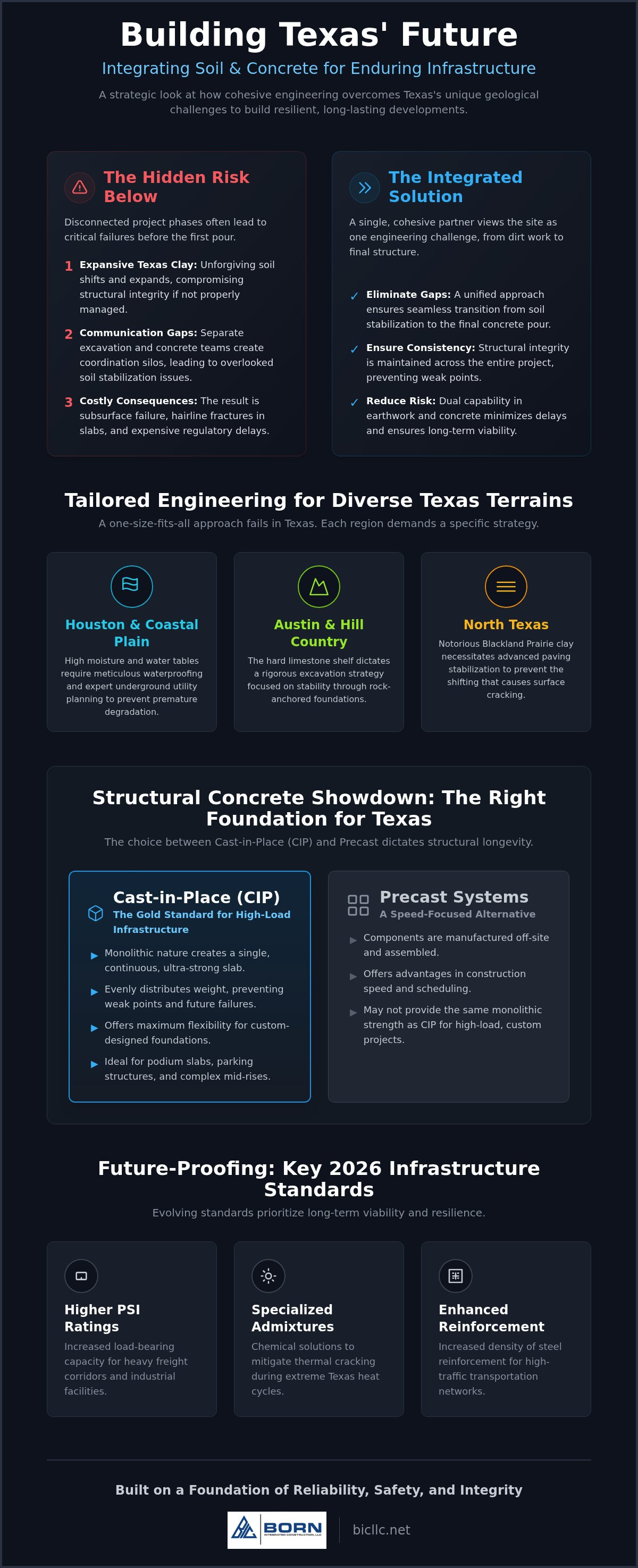
Infrastructure concrete serves as the silent, steadfast backbone of the expanding urban corridors in Houston, Austin, and Dallas. As the state's population grows, the demand for durable foundations and heavy-duty paving has reached a critical peak. Modern Concrete applications now move beyond simple slabs; they form the structural core of multi-modal developments that combine transportation hubs with commercial centers. In 2026, industry standards have evolved to prioritize long-term viability through several key requirements:
- Higher PSI ratings for increased load-bearing capacity in freight corridors.
- Specialized chemical admixtures to mitigate thermal cracking during extreme Texas heat.
- Enhanced reinforcement density for high-traffic transportation networks.
These technical advancements ensure that concrete construction for infrastructure projects Texas remains resilient against the heavy loads of freight transport and the expanding requirements of renewable energy facilities. Reliability in this sector is built on a foundation of precision and professional stability. The shift toward integrated projects means that contractors must now master both the earthwork required for massive detention ponds and the complex engineering of structural slabs. This dual capability reduces the risk of project delays and ensures that the transition from soil stabilization to the final pour is seamless. It's a matter-of-fact reality that the longevity of our state's transportation and energy networks depends entirely on the meticulous management of these early-stage details.
Regional Demands: From Houston’s Coastal Plain to Austin’s Hill Country
Geographic diversity across Texas dictates specific engineering responses that cannot be standardized. In Houston and Beaumont, the coastal moisture and high water tables require meticulous waterproofing and underground utility planning to prevent premature degradation. Conversely, the limestone shelf in Austin and San Antonio dictates a rigorous excavation strategy, focusing on stability through rock-anchored foundations. North Texas presents its own challenges with the notorious Blackland Prairie clay. This expansive soil necessitates advanced paving stabilization techniques to prevent the shifting that causes surface cracking. A seasoned partner understands that the dirt work is just as important as the concrete itself.
The Rise of Mixed-Use Infrastructure in 2026
Urban density is forcing a significant shift in how we design our primary infrastructure. We see a growing trend of integrating structured concrete parking garages directly into residential and commercial hubs to maximize land use. This concrete construction for mixed-use development requires a hybrid engineering approach. It must balance the heavy-duty requirements of vehicle traffic with the precise structural integrity needed for high-rise podium decks. In these high-density zones, the focus remains on Cast-in-Place (CIP) solutions that offer the flexibility and strength to support vertical growth while maintaining a compact and safe footprint for the public.
Structural Concrete Excellence: CIP vs. Precast Foundations
The selection between Cast-in-Place (CIP) and precast systems is a fundamental decision that dictates the structural longevity of Texas developments. While precast components offer speed, CIP remains the gold standard for high-load infrastructure due to its monolithic nature. In concrete construction for infrastructure projects Texas, the ability to distribute weight evenly across a single, continuous slab is often the difference between a century-old foundation and one that requires early remediation. Following TxDOT's 2024 Standard Specifications ensures these structural pours meet the highest benchmarks for durability and material quality. This steadfast approach to engineering prioritizes the enduring nature of the professional output over short-term scheduling gains.
Podium slabs have become a technical necessity in modern Texas midrise construction. These thick, reinforced concrete decks allow for a transition from heavy retail or parking levels below to lighter residential or hotel framing above. By utilizing CIP for these slabs, engineers gain the flexibility to handle complex load paths that precast systems often struggle to accommodate. This method creates a rigid diaphragm that enhances the overall stability of the building, providing a sense of security for both developers and future occupants.
CIP Midrise and High-Rise Structural Framing
Structural concrete framing provides essential wind-load resistance for Texas high-rises, particularly in coastal regions prone to severe weather. Thin-shell cast-in-place concrete techniques allow for sleek, modern residential and hotel structures without sacrificing the rigidity required for vertical expansion. These systems create a unified skeleton that absorbs lateral forces more effectively than segmented alternatives. When building on expansive soils, a CIP foundation provides the necessary stiffness to resist the upward pressure of shifting clays, maintaining the building's alignment over decades of service. It's a disciplined approach to vertical construction that values substance and proven results.
Parking Garage Foundations and Structured Parking
Modern urban planning relies heavily on efficient CIP garage construction to support high-density residential and commercial hubs. Unlike precast foundations, CIP garages offer superior customization for tight urban footprints and complex site elevations. Designing these foundations requires a focus on vehicle turnover and long-term load distribution. Retaining walls play a vital role here, managing the transition between various site elevations while protecting the integrity of the garage's lower levels. For developers seeking a dependable partner, understanding our steadfast approach to structural concrete helps ensure every podium slab and garage foundation is built to endure.
Integrating Civil Site Work: The Foundation of Paving Longevity
Failure in civil projects is rarely a visible surface phenomenon. It's almost always the result of subsurface instability that was ignored during the early stages of development. The 2025 Texas Infrastructure Report Card underscores the immense pressure on our state's networks, reinforcing why long-term viability must be the primary objective. Mass soil excavation acts as the essential first step in creating a reliable site. This process involves more than simply moving earth; it requires establishing a predictable, load-bearing platform that supports the heavy requirements of concrete construction for infrastructure projects Texas depends on for its economic growth.
Integrating underground utility installation, including storm, sanitary, and water systems, before the first pour prevents the structural compromises that occur when contractors must cut into finished concrete later. This methodical approach ensures that every pipe and conduit is protected by a stable subgrade. It also allows for the seamless construction of detention ponds, which are critical for managing the unique stormwater runoff challenges present in the Texas climate. A turn-key solution that handles both the dirt and the pour eliminates the coordination gaps that frequently lead to project delays and foundational failures.
Paving Stabilization and Soil Treatment
Chemical soil stabilization is a technical requirement for any heavy-duty commercial road. The choice between lime and cement treatment depends entirely on the chemical composition of the local soil and its plasticity index. A qualified paving stabilization contractor uses rigorous testing and verification to confirm that the subgrade meets specific load-bearing benchmarks. This phase is non-negotiable; it's the only way to ensure the finished paving doesn't buckle under the weight of heavy freight or high-volume traffic over time.
Underground Utilities and Stormwater Management
Proper stormwater management begins with the strategic coordination of storm sewer installation and mass excavation. This sequence prevents site flooding during construction and protects the surrounding environment from erosion. Detention and retention basins must be engineered to meet strict municipal codes while maximizing the usable area of the development. Protecting domestic water systems during heavy concrete construction for infrastructure projects Texas is equally vital. It requires a disciplined, organized workflow that prioritizes the integrity of the underground infrastructure just as much as the visible surface, ensuring a project that is as resilient as it is functional.
Managing Large-Scale Infrastructure: Safety, Efficiency, and Integrity
Managing concrete construction for infrastructure projects Texas requires a disciplined approach that prioritizes operational precision over marketing hype. Large-scale developments involve high stakes where a single management failure can lead to catastrophic delays or safety breaches. We focus on building lasting foundations through a steadfast commitment to high standards and technical proficiency. Consistent performance isn't just about the current project; it's about maintaining the professional stability that clients and vendors depend on for long-term partnerships. This steady rhythm of communication and execution allows stakeholders to absorb the technical scope of a project without unnecessary surprises. It's a matter-of-fact reality that the most successful infrastructure is born from meticulous management and a deep-rooted sense of duty.
Safety Protocols for Structural Concrete Projects
Establishing safety as an organizational pillar is essential because it dictates every movement on a job site. In CIP high-rise construction and deep mass soil excavation, the risks are inherent and significant, requiring a seasoned expert to navigate. Establishing a clear hierarchy of safety protocols ensures that every worker and structural component is protected from the first day of earthwork to the final topping-out ceremony. These rigorous standards are vital for legal compliance and the long-term viability of the project, instilling a sense of security in both the developer and the public. We prioritize the act of establishing safe environments through disciplined oversight and a focus on operational precision. Born Integrated Construction maintains an unwavering commitment to achieving zero-incident job sites through meticulous planning and constant oversight.
Efficiency through Integrated Civil Solutions
Project timelines are often compromised by the friction between different contractors. By combining mass soil excavation, underground utilities, and heavy-duty paving under a single turn-key contract, developers gain immediate efficiency and a more predictable project schedule. This integrated approach is the most effective way to manage concrete construction for infrastructure projects Texas requires for its continued urban expansion. The model streamlines communication between site preparation crews and structural concrete teams, ensuring that the subgrade is perfectly prepared for the specific requirements of the slab. We eliminate the coordination gaps that occur when multiple subcontractors fail to align their technical specifications. You can learn more about our approach on the Born Integrated Construction About page, where we detail our philosophy of professional stability and substance over style.
Reliability is earned through proven results and unwavering consistency. For your next major development, partner with a firm that values substance and execution above all else. Review our completed infrastructure projects to see how integrated civil and concrete solutions deliver superior value and long-term durability.
Born Integrated Construction: Your Steadfast Infrastructure Partner
Born Integrated Construction stands as a dependable partner for the state's most demanding developments. We don't just pour concrete; we manage the entire site lifecycle from the initial excavation to the final structural finish. This integrated approach is vital for the concrete construction for infrastructure projects Texas requires to support its rapid urban growth. By controlling both the earthwork and the structural execution, we eliminate the risks associated with subcontractor fragmentation. Our commitment to integrity ensures that every slab and foundation is built to endure the specific environmental stresses of the Texas landscape. From the coastal humidity of Houston to the rocky terrain of San Antonio, we deliver a level of professional stability that instills confidence in every stakeholder.
Reliability is the cornerstone of our operations. We prioritize substance over style, focusing on the act of delivering consistent value through meticulous management and a deep-rooted sense of duty. Our team operates as a quiet leader in the industry, leading through proven results rather than hyperbole. We understand that infrastructure is a long-term investment, and our work is designed to reflect that reality through durability and operational precision.
A Portfolio of Proven Results
Our history is defined by technical proficiency across a diverse range of project types. We've established a reputation for excellence in CIP garages, complex high-rise foundations, and large-scale mass excavation. Whether it's a multi-story residential building, a high-density hotel structure, or a heavy-duty industrial site, our team applies the same level of operational precision. We serve the residential, commercial, and infrastructure sectors with equal precision, ensuring that every project meets our rigorous internal standards. You can explore our past work on the BIC Projects page to see how our turn-key civil and concrete solutions translate into long-term viability for developers across the state.
The BIC Advantage for 2026 Projects
As we look toward 2026, the complexity of Texas municipal standards continues to increase. A local firm that understands these nuances is a strategic asset for any developer or municipal planner. Our grounded, professional tone isn't just a communication style; it's a direct reflection of our physical construction standards. We value discipline, safety, and the meticulous management of details. This approach provides a sense of security for our partners, knowing that their infrastructure is in the hands of seasoned experts who prioritize the following:
- Adherence to strict municipal and state engineering codes.
- Zero-incident safety cultures on every job site.
- Seamless coordination between civil site work and structural pours.
- Long-term durability that reduces future maintenance costs.
Choosing BIC means selecting a partner that views every project as a contribution to the state's enduring foundation. We invite you to partner with a firm that builds with integrity and values the legacy of its craftsmanship. Let's establish a foundation for your next project that is as steadfast as the Texas spirit itself.
Establishing Resilient Foundations for the Future of Texas
The success of large-scale developments depends on the seamless integration of site preparation and structural execution. We've explored how soil stabilization and mass excavation provide the necessary platform for high-precision concrete work. By prioritizing Cast-in-Place systems and rigorous safety protocols, developers ensure their projects meet the evolving standards of 2026. This strategy mitigates the risk of subsurface failure and avoids coordination gaps that lead to project delays.
Choosing a partner with a deep-rooted commitment to technical proficiency is the most effective way to manage concrete construction for infrastructure projects Texas needs for long-term viability. Integrity is non-negotiable. Our team brings expertise in complex CIP structural concrete and integrated turn-key civil and site work services to every job site. We maintain an unwavering commitment to safety and integrity, ensuring your professional output is enduring and reliable. Request a Consultation for Your Texas Infrastructure Project to begin establishing a foundation built on substance and proven results. We're ready to build the future of our state alongside you.
Frequently Asked Questions
What are the benefits of Cast-in-Place (CIP) concrete for Texas infrastructure?
Cast-in-Place (CIP) concrete provides superior structural integrity by creating a monolithic unit without the joints found in precast systems. This continuous structure is vital for distributing heavy loads across a building's footprint. Engineers prefer CIP for custom-designed parking garages and high-rise foundations because it adapts to unique site geometries. It provides the rigidity required to withstand lateral forces like wind loads, ensuring the long-term professional stability of major urban developments.
Why is soil stabilization necessary before commercial concrete paving in Texas?
Soil stabilization is essential in Texas to mitigate the risks posed by expansive clay soils that shift with moisture changes. By treating the subgrade with lime or cement, contractors create a rigid, predictable platform for heavy-duty paving. This process prevents the subsurface movement that leads to surface cracking and structural failure. It's a critical step in concrete construction for infrastructure projects Texas requires to ensure roads and parking areas remain functional under high-traffic demands.
How do detention ponds impact the overall concrete construction plan?
Detention ponds are integrated into the initial mass excavation phase to manage stormwater runoff and meet strict municipal drainage codes. These basins prevent site flooding during the construction process and protect the surrounding environment after completion. By planning detention ponds early, developers can optimize the site's footprint and ensure that drainage systems don't interfere with the structural foundations. This organized approach to water management is a hallmark of disciplined civil engineering and site planning.
Can Born Integrated Construction handle both excavation and structural concrete?
Born Integrated Construction provides turn-key civil and concrete solutions that encompass both mass soil excavation and complex structural pours. This integrated model eliminates the coordination gaps that often occur when developers hire separate subcontractors for dirt work and foundation work. By managing the entire site lifecycle, we ensure that the subgrade preparation perfectly aligns with the structural requirements of the slab. This steadfast approach improves project efficiency and reinforces the overall integrity of the development.
What is the difference between slab on grade and podium slab construction?
Slab on grade construction involves pouring concrete directly onto a prepared subgrade for ground-level surfaces like warehouses or parking lots. In contrast, a podium slab is a heavy-duty structural deck that supports several floors of lighter framing above, often transitioning from a concrete garage to residential levels. Podium slabs require complex reinforcement and structural engineering to handle vertical load paths. Both systems are essential components of modern concrete construction for infrastructure projects Texas developers utilize for high-density mixed-use sites.
How does BIC ensure safety on high-rise and mid-rise concrete projects?
Safety on high-rise projects is maintained through a disciplined hierarchy of protocols and constant on-site oversight. We prioritize risk mitigation during deep excavations and vertical structural pours to protect both the workforce and the project's long-term viability. Our organizational pillar of safety focuses on achieving zero-incident job sites through meticulous planning and the use of high-quality equipment. This serious approach to operational precision ensures that every structural component is installed without compromising the security of the site.
What areas of Texas does Born Integrated Construction serve?
Born Integrated Construction serves the major metropolitan corridors of Texas, including Houston, Dallas, Austin, and San Antonio. We understand the regional nuances of these markets, from the coastal plains' moisture challenges to the expansive clays of the Blackland Prairie. Our team is equipped to handle large-scale infrastructure and commercial developments across the state's vast landscape. This local expertise allows us to navigate municipal standards effectively while delivering the professional stability our clients expect from a seasoned partner.
Why is underground utility coordination critical for new infrastructure?
Coordinating underground utilities like storm, sanitary, and water systems before the first pour prevents the structural compromises that happen when finished concrete must be cut later. This methodical sequence ensures that utilities are properly bedded in a stable subgrade, protecting them from the weight of heavy paving operations. It also streamlines the transition from mass excavation to structural construction. Proper coordination is a matter-of-fact requirement for building resilient infrastructure that functions reliably for decades with minimal maintenance.