Paving Stabilization Contractor in Texas: The Essential Guide to Soil Durability
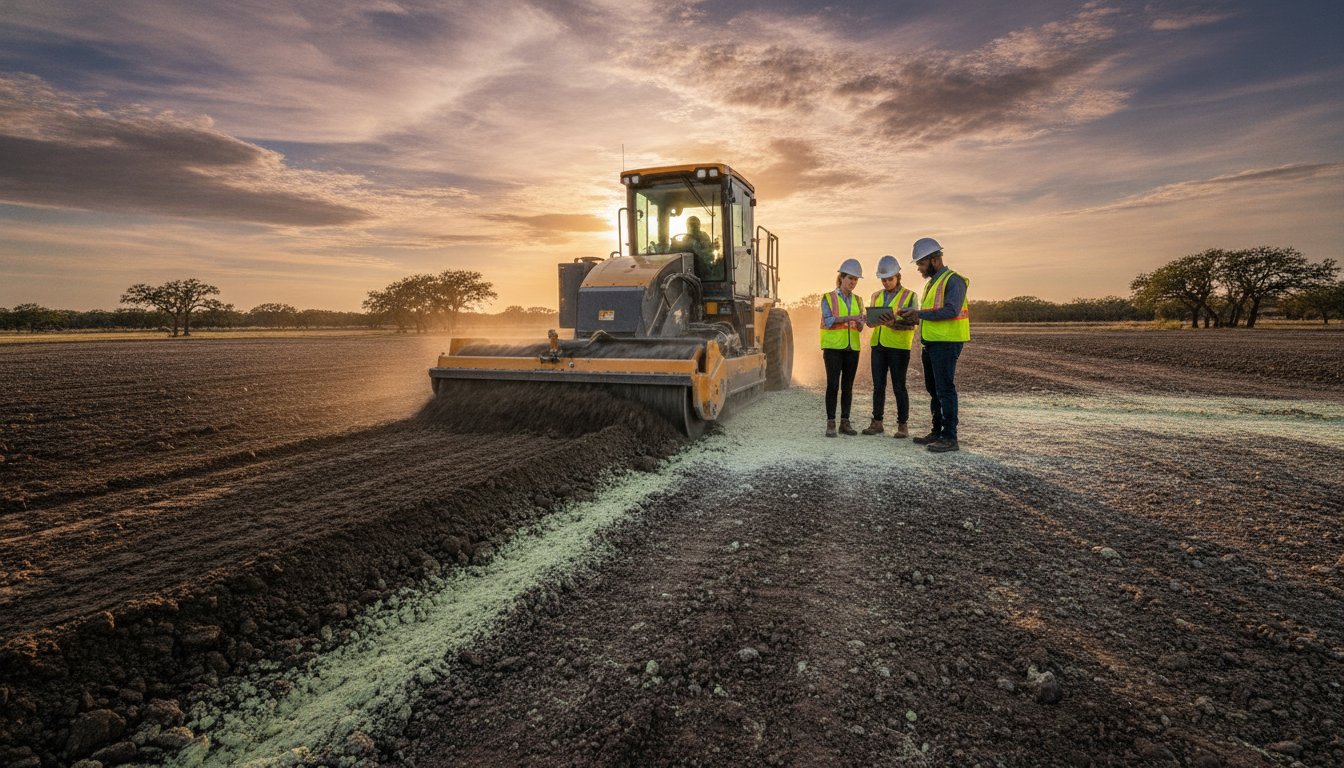
A 30-year pavement lifespan in Texas isn't a matter of luck; it's a matter of chemistry. Most commercial developers understand the frustration of watching a significant investment crack and shift within just a few seasons. The culprit is almost always the state's notorious expansive clay, which expands and contracts with enough force to destroy even the thickest concrete slabs. You've likely felt the pressure of project delays after a heavy rain or the budget strain of importing select fill to replace poor local soil.
Partnering with a professional paving stabilization contractor Texas relies on ensures your infrastructure is built on a foundation of stability rather than shifting earth. This guide explains how professional soil treatment protects your investment from structural failure while maintaining compliance with the latest TxDOT 2026 special provisions for lime and cement treatment. We'll examine the technical principles that allow construction to continue after a storm and the methodical processes required to deliver an enduring, high-quality result that meets municipal engineering standards.
Key Takeaways
- Learn the technical difference between temporary soil modification for moisture control and the permanent chemical stabilization required for structural durability.
- Understand why a specialized paving stabilization contractor Texas professionals rely on is necessary to transform volatile clay into a predictable, load-bearing foundation.
- Gain insight into the chemical processes of flocculation and agglomeration that effectively neutralize the destructive expansion of Texas Blackland Prairie soils.
- Discover how to ensure compliance with TxDOT 2026 special provisions to secure a 30-year lifespan for commercial and municipal paving projects.
- Recognize the operational efficiency gained through an integrated civil approach that manages everything from mass excavation to final concrete paving.
The Foundation of Texas Infrastructure: Understanding Paving Stabilization
Paving stabilization is the engineered modification of soil properties through the strategic introduction of chemical additives like lime, cement, or fly ash. This process isn't a mere suggestion for regional projects; it's a technical necessity for long-term viability. By Understanding Paving Stabilization, developers can transform volatile earth into a rigid, predictable foundation. This structural enhancement often allows engineers to reduce the required thickness of the final concrete paving because the stabilized base provides superior load-bearing support. As we move through 2026, the Texas construction industry is shifting toward more sustainable, precision-mixed additives that offer higher efficiency and reduced environmental impact in civil work.
Why Texas Soil Demands Specialized Stabilization
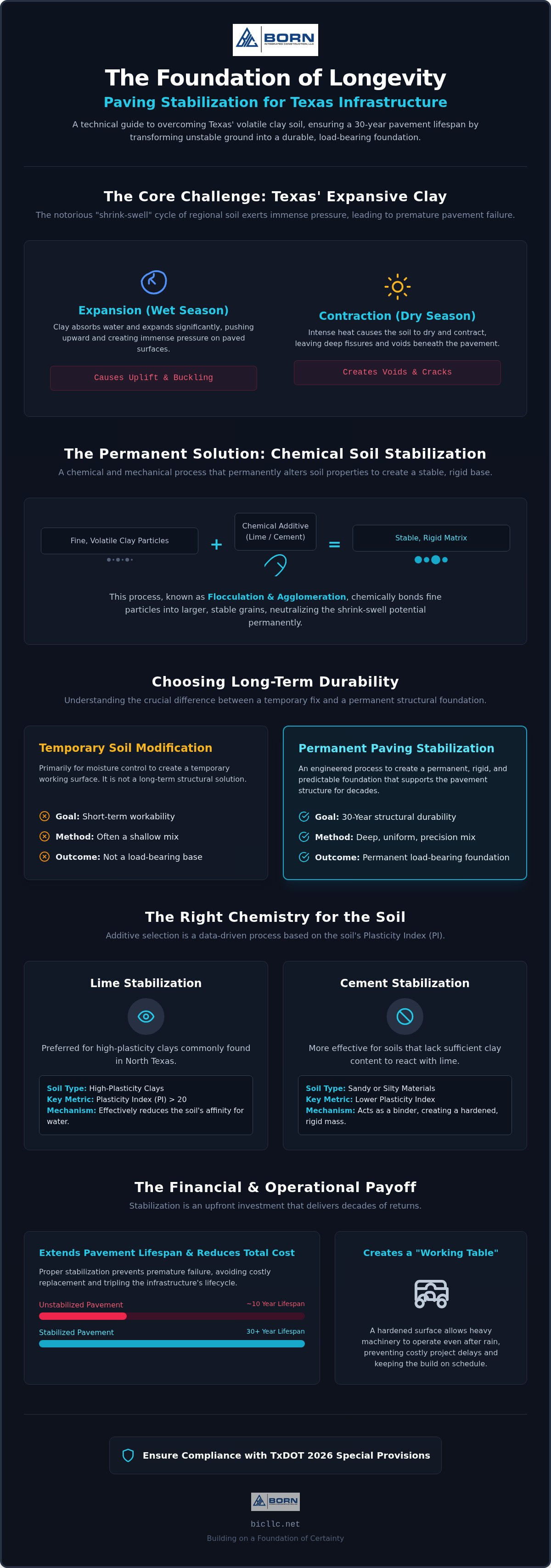
The Texas Blackland Prairie and the Gulf Coast regions are home to some of the most volatile clays in the country. These soils undergo a dramatic "shrink-swell" cycle. When it rains, the clay particles absorb water and expand significantly. During the intense heat of a Texas summer, the soil dries and contracts, leaving deep fissures in the earth. This constant movement creates massive internal pressure beneath any rigid surface. Without a specialized paving stabilization contractor Texas soils will eventually cause "pumping," a phenomenon where moisture and soil particles are forced upward through cracks under heavy traffic loads. This leads to rapid subgrade failure and surface buckling. Our regional weather patterns, characterized by sudden and heavy rainfall, can turn an un-stabilized job site into an impassable mud pit in hours, halting all construction progress and delaying schedules for weeks.
The Economic Impact of Proper Site Prep
Choosing to stabilize early is a financial decision that pays dividends over decades. While some stakeholders view it as an upfront cost, it's actually an insurance policy against total pavement replacement. If a surface fails in 10 years instead of the intended 30, the lifecycle cost of that infrastructure triples. Stabilization also creates what's known as a "working table." This hardened surface allows heavy machinery to operate and continue the build even immediately after rain events, keeping the entire project on its critical path. An engineered subgrade is the primary load-bearing element of any road. By investing in this foundational layer, you ensure the structural concrete above it isn't forced to compensate for a weak or shifting foundation. For those interested in the long-term performance of these systems, reviewing our past turn-key civil projects demonstrates the tangible difference a stable base makes for commercial infrastructure.
The Chemical and Mechanical Science of Soil Stabilization
Soil stabilization isn't just about mixing powder into dirt; it's a sophisticated cation exchange process. When additives like lime or cement are introduced, they swap ions with clay minerals. This triggers flocculation, where fine clay particles clump into larger, stable grains. Agglomeration then follows, turning the soil into a rigid matrix. This molecular shift is permanent. As a leading paving stabilization contractor Texas firms depend on, we prioritize these chemical bonds to prevent future shifting. In 2026, many projects are moving away from traditional fly ash in favor of eco-friendly binders that offer superior long-term strength and reduced environmental impact.
Lime vs. Cement: Selecting the Right Additive for Your Site
Choosing the correct additive is a data-driven process based on the soil's Plasticity Index (PI). North Texas projects often encounter high-plasticity clays with a PI greater than 20. In these cases, lime is the preferred chemical because it effectively reduces the soil's affinity for water. Sandy soils or silty materials found in coastal regions lack the clay content to react with lime, making cement the more effective choice. Modern fleets now utilize pelletized lime and precision spreaders to ensure uniform coverage without the dust associated with traditional methods.
The Precision Mixing Process
Mechanical execution is as vital as the chemistry. The distinction between Stabilized Base vs. Soil Modification lies in the depth and uniformity of the mix. High-horsepower reclaimers pulverize the soil to a specific depth, ensuring additives are distributed evenly throughout the subgrade. For lime applications, a 24-hour "mellowing" period allows the chemical reaction to break down heavy clay clods. Final compaction must reach 95% or higher density, verified through Proctor testing, to create a reliable working table. Understanding these technical nuances is part of why our team is regarded as a steadfast paving stabilization contractor Texas partners can rely on for professional execution.
Stabilized Base vs. Soil Modification: Choosing Long-Term Durability
Many site owners confuse soil modification with true stabilization. Modification is a reactive measure used primarily to dry out a rain-saturated job site so equipment can move. While it solves the immediate problem of mud, it offers zero structural credit in an engineering design. True stabilization is a proactive strategy. It acts as an engineered bridge that distributes heavy loads across the subgrade. A professional paving stabilization contractor Texas developers trust will emphasize that modification is often a temporary fix with a five-year performance window. In contrast, full stabilization is designed for a 30-year infrastructure lifecycle.
This distinction is critical for commercial concrete paving where heavy-duty traffic is expected. Without a stabilized base, the concrete slab must bear the entire structural load. Over time, this leads to fatigue and premature failure. By transforming the soil into a rigid platform, we ensure the surface layer remains intact under the most demanding conditions.
Engineering for a 30-Year Service Life
Stabilization significantly increases the soil's Resistance value (R-Value) and its Structural Layer Coefficient. These metrics represent the subgrade's ability to resist deformation under pressure. A stiffer subgrade provides a solid platform that enhances the fatigue resistance of the concrete above it. Engineers in industrial hubs like Conroe and Beaumont specify stabilization because it allows for a more efficient pavement design. By strengthening the foundation, you reduce the stress on the surface layer. This ensures the road can handle thousands of heavy vehicle repetitions without structural cracking.
Moisture Control and Expansive Clay Management
Chemical binders do more than just add strength; they lock the moisture content of the soil. This is vital in regions with "fat clays," such as Houston, where soil volume changes can be extreme. Stabilization prevents water from migrating under concrete slabs, which is a leading cause of subgrade softening and "pumping." By neutralizing the clay’s ability to absorb water, the soil stays at a consistent volume year-round. This stability protects the slab from the vertical movement that typically causes foundational cracking. We've seen projects in high-plasticity areas where this process was the only factor preventing immediate site failure after seasonal flooding.
Choosing a steadfast paving stabilization contractor Texas partners can rely on ensures these engineering principles are applied with precision. It's the difference between a site that is merely accessible and one that is built to last for decades.
Key Criteria for Selecting a Paving Stabilization Contractor in Texas
Choosing a paving stabilization contractor Texas developers can trust requires a thorough evaluation of their technical fleet and operational history. It's not enough to simply possess mixing equipment. A capable partner must demonstrate a deep understanding of mass soil excavation and the ability to interpret site-specific geotechnical reports with precision. The complexity of modern infrastructure also demands a contractor who can seamlessly manage the integration with underground utility installation. This level of coordination prevents the structural compromise of the stabilized base during subsequent construction phases.
Precision Equipment and Technology in 2026
In 2026, the standard for commercial civil work has shifted away from "old-school" disc-harrow methods. These outdated techniques often fail to achieve the uniform mixing depth required by updated TxDOT special provisions. Modern projects demand high-horsepower reclaimers equipped with automated additive spreading systems. These machines ensure an exact pound-per-square-yard application of lime or cement, eliminating the risks of human error. We utilize GPS-guided grading technology to achieve perfect subgrade elevations. This precision ensures that the final concrete layer maintains a consistent thickness, which is a primary factor in preventing premature structural failure.
Safety Standards and Environmental Compliance
Safety and integrity extend beyond the physical build. When working near residential areas like The Woodlands, dust mitigation becomes a critical operational requirement. Professional contractors employ specialized water-injection systems and pelletized additives to control chemical drift. This protects both the local environment and the health of the crew. We prioritize compliance with OSHA standards regarding silica and chemical exposure, ensuring a safe job site for all stakeholders. To maintain transparency, we advocate for third-party lab verification of soil-binder ratios. This objective testing confirms that the chemical reaction described in previous sections has achieved the intended design strength. For a partner that prioritizes these rigorous standards, explore our integrated civil project portfolio to see our commitment to quality in action.
Born Integrated Construction: Delivering Stabilized Paving Solutions
Born Integrated Construction (BIC) operates on the principle that a project's success is determined by the integrity of its earliest stages. As a dedicated paving stabilization contractor Texas developers depend on, we provide a "Turn-Key Civil" approach that eliminates the friction often found between separate earthwork and paving crews. Our methodology integrates mass soil excavation, detention pond construction, and precise soil stabilization into a single, cohesive workflow. This integration ensures that the technical specifications established during the subgrade preparation are perfectly maintained until the final concrete surface is poured. By managing the transition from raw earth to finished slab, we ensure that the "Integrated" in our name represents a seamless, high-standard execution for every client.
Our Integrated Civil Site Work and Concrete Approach
Managing a complex commercial site requires meticulous coordination between various civil disciplines. We oversee the entire site lifecycle, starting with mass excavation and continuing through the final stages of CIP concrete construction. By serving as a single point of contact, we prevent the communication gaps that often lead to project delays or structural inconsistencies. Our teams are experienced in balancing the technical requirements of detention pond construction with the immediate needs of paving stabilization, ensuring that site drainage and foundation stability work in tandem. This comprehensive oversight is a hallmark of our commitment to quality-driven execution for large-scale infrastructure developments. We don't just move dirt; we establish the structural insurance policy that protects your investment for 30 years or more.
Serving Texas Hubs from Houston to San Antonio
Our operational reach extends across the Texas Triangle, providing specialized civil services to the rapidly growing corridors of Houston, Dallas, Austin, and San Antonio. We possess a deep understanding of the unique soil profiles found in regional hubs such as San Marcos, Boerne, and New Braunfels. Each of these areas presents distinct geological challenges that require a tailored stabilization strategy, whether it's dealing with the high-plasticity clays of North Texas or the silty soils of the coast. Whether we're managing a high-density development in the Dallas-Fort Worth metroplex or a heavy-duty industrial site in Houston, we bring the same level of disciplined professionalism to every project. We invite you to view our recent projects to see how our integrated stabilization and paving solutions have established lasting foundations for Texas commercial infrastructure.
Securing the Future of Texas Infrastructure
The durability of Texas commercial infrastructure depends on the technical integrity of its foundation. We've explored how permanent chemical stabilization transforms volatile clay into a rigid, load-bearing platform, ensuring a 30-year service life for heavy-duty paving. Choosing a specialized paving stabilization contractor Texas professionals trust is the first step in mitigating the risks of expansive soil damage and structural failure. By prioritizing precision mixing and integrated civil site work, you protect your long-term investment from the inevitable shifts of the Blackland Prairie and Gulf Coast regions.
Born Integrated Construction provides the stability your project requires through a steadfast commitment to safety and integrity on every job site. Our team offers proven reliability in mass soil excavation and detention pond construction, combined with deep expertise in high-performance concrete paving for heavy-duty Texas infrastructure. We manage the entire site lifecycle to ensure your project remains on schedule and meets the highest engineering standards. Partner with Born Integrated Construction for your next stabilized paving project and build with the confidence that your foundation is as enduring as your professional goals. We look forward to establishing a lasting partnership on your next development.
Frequently Asked Questions
How much does soil stabilization cost per square yard in Texas?
Costs are determined by the soil's plasticity index, the required depth of treatment, and the specific chemical additive selected. While project totals vary based on scope, factors like the current price of Portland cement or lime significantly influence the final estimate. Engaging a paving stabilization contractor Texas developers trust ensures a precise assessment of these material requirements. We recommend a site-specific soil report to establish an accurate budgetary framework for your infrastructure project.
Can paving stabilization be performed during the rainy season?
Yes, stabilization is often the primary tool used to maintain construction schedules during wet weather. Chemical additives like lime react with water-saturated soil to reduce moisture content and create a "working table." This hardened surface allows heavy machinery to operate on-site even after significant rainfall events. Without this treatment, jobsites often become impassable, leading to extensive delays. Stabilization effectively transforms a muddy environment into a stable, load-bearing platform for continued civil work.
What is the difference between lime stabilization and cement stabilization?
The primary difference lies in the chemical reaction with the specific soil type. Lime is utilized for high-plasticity clays, common in North Texas, where it triggers a cation exchange to reduce soil swelling. Cement is preferred for sandy soils with lower clay content, as it creates a rigid matrix through hydration. Selecting the wrong additive can lead to subgrade failure. A qualified paving stabilization contractor Texas relies on will use geotechnical data to determine the most effective binder.
How long does it take for a stabilized base to cure before paving?
Curing times typically range from 48 to 72 hours, depending on the additive and local weather conditions. Lime-treated soils often require a 24-hour "mellowing" period to break down heavy clay clods before final compaction. Once the subgrade reaches its target density, it must remain undisturbed to allow the chemical bonds to strengthen. Rushing the final paving process before the base has cured can compromise the structural integrity of the entire infrastructure project.
Is soil stabilization required by Texas building codes?
Requirements vary by municipality and project type, but most commercial and TxDOT-regulated projects mandate stabilization for expansive clay areas. Local engineering standards often specify a minimum treatment depth and additive percentage to ensure the pavement meets its 30-year design life. Compliance with these codes is essential for passing inspections and securing long-term structural viability. It is best to consult local TxDOT 2026 special provisions for the most current regional mandates.
Does stabilization help with drainage on a commercial construction site?
Stabilization improves site management by creating a low-permeability surface that resists water infiltration. While it doesn't replace a primary drainage system like detention ponds, it prevents the subgrade from absorbing water and softening. This helps maintain the site's grade and prevents the formation of standing pools on the working surface. By "locking" the soil's moisture levels, stabilization ensures that the foundation remains predictable and firm during and after heavy Texas rainstorms.
What happens if a contractor skips the stabilization step in Texas clay?
Skipping this step usually leads to premature pavement failure within the first few seasons. Untreated expansive clay will shift, swell, and contract, causing the concrete above to crack and buckle. This movement often results in "pumping," where soil particles are forced through cracks, hollowing out the foundation. The cost of repairing these structural failures far exceeds the initial investment in a stabilized base. Long-term durability is impossible without addressing the underlying soil volatility.
How deep does the stabilization process usually go for commercial roads?
Commercial roads typically require stabilization to a depth of 6 to 12 inches, depending on the expected traffic loads and soil plasticity. Heavier industrial applications or areas with extremely volatile "fat clays" may require deeper treatment to provide sufficient structural support. Modern high-horsepower reclaimers allow for precise depth control, ensuring the chemical additives are mixed uniformly throughout the entire specified layer. This depth is calculated by engineers to create a robust, load-bearing bridge over the native soil.