Turnkey Civil Contractor in Texas: Integrating Site Prep and Structural Concrete
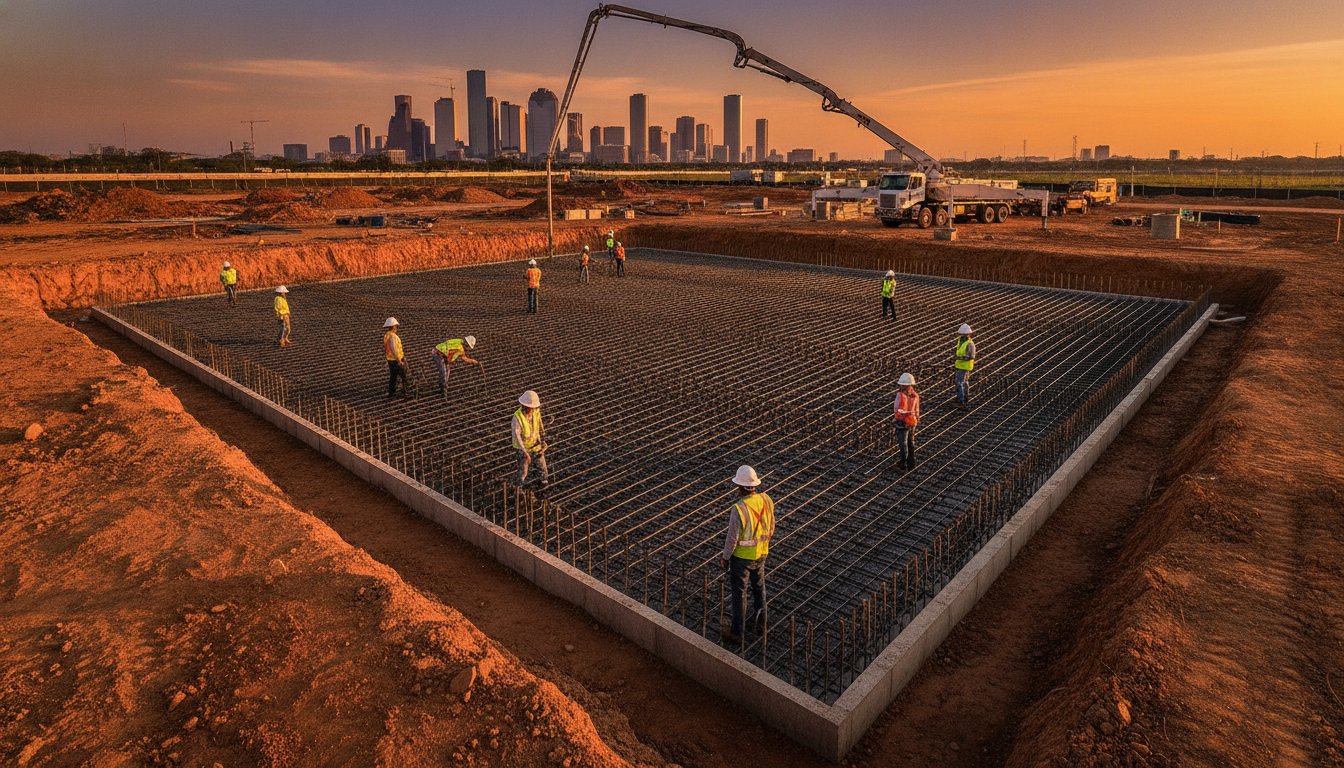
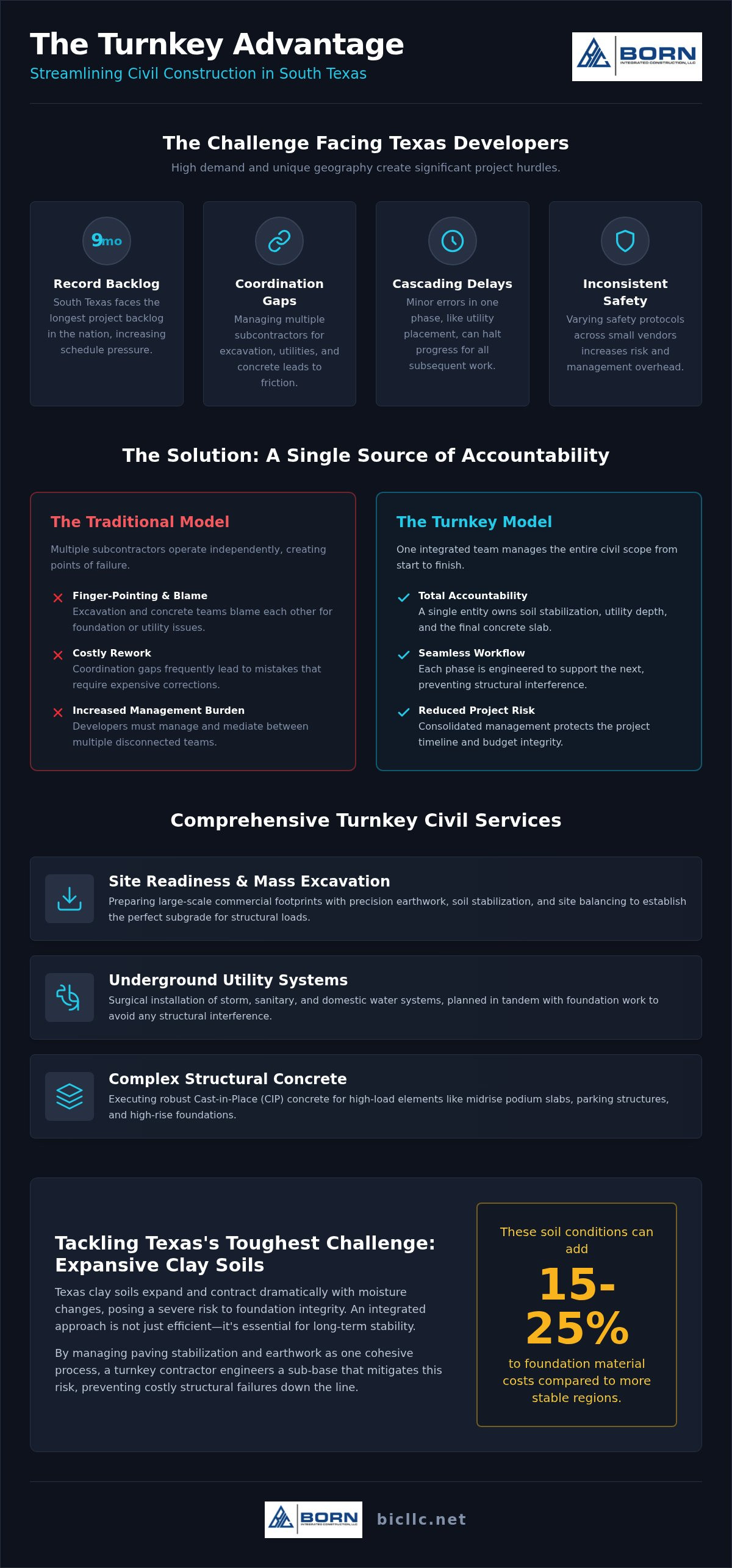
With the South Texas construction market currently managing a nine-month backlog, the longest in the nation, project efficiency has never been more critical. You likely understand that even a minor coordination gap between your excavation team and your concrete subcontractors can lead to cascading delays. It's a common frustration to see schedules slip due to utility installation errors or inconsistent safety protocols across various small vendors.
Partnering with a turn key civil contractor Texas developers can rely on provides the single-source accountability needed to protect your timeline. By integrating earthwork, underground utilities, and complex structural concrete into one cohesive workflow, you ensure that every phase of site preparation supports the next. This article examines how a unified approach to civil services reduces project durations and delivers high-quality foundations capable of withstanding the unique challenges of expansive Texas soils. We'll detail the technical advantages of combining mass excavation with precision structural work to create a more stable, predictable construction process.
Key Takeaways
- Understand how a turn key civil contractor Texas developers rely on mitigates project risk by consolidating mass excavation and structural concrete under a single-source contract.
- Learn the technical requirements for site readiness, including mass soil excavation and the precision needed for underground utility systems to avoid structural interference.
- Explore the advantages of integrated Cast-in-Place (CIP) concrete solutions for midrise developments, such as podium slabs and parking structures.
- Identify how single-source accountability reduces the management burden and ensures consistent safety standards across all early-phase project activities.
- Recognize the importance of robust foundation designs and paving stabilization in addressing the unique challenges posed by expansive Texas clay soils.
Defining the Turnkey Civil Contractor in the Texas Market
In the Texas construction sector, a turnkey project model represents a shift toward streamlined accountability. For civil works, this means one entity manages the entire lifecycle from raw earth to finished structural elements. A turn key civil contractor Texas developers trust doesn't just move dirt; they establish the precise conditions required for the building's structural health. Moving away from multi-subcontractor models reduces the risk of coordination gaps that often lead to costly rework. It's about establishing a single point of responsibility that spans from the initial site clearing to the final pour of the structural slab.
When excavation and concrete are split between different vendors, a friction point often emerges. If a foundation settles or a utility line is misplaced, the excavation sub and the concrete sub often blame each other. Integrated delivery eliminates this cycle of finger-pointing. One team owns the soil stabilization, the utility depth, and the final slab on grade. This ensures that the structural concrete rests on a base specifically engineered for its load requirements. This continuity is vital for maintaining the integrity of the project's early-phase schedule.
The Scope of Turnkey Civil Services
A comprehensive civil package covers the full spectrum of early-stage construction. This includes:
- Pre-construction evaluation: Assessing site conditions and performing mass soil excavation to reach subgrade.
- Underground utilities: Installing storm, sanitary, and domestic water systems with surgical precision.
- Structural concrete: Executing complex elements like CIP garages, podium slabs, and high-rise foundations.
Our approach at Born Integrated Construction focuses on the seamless transition between these phases. By managing mass excavation alongside detention pond construction, we ensure the site remains workable through various weather cycles. You can view our previous work on our projects page to see how these scopes merge in complex commercial environments.
Why Texas Geography Demands Integrated Expertise
Texas geography presents unique challenges, specifically the prevalence of expansive clay soils. These soils expand and contract with moisture changes, which can compromise foundations if not handled with technical precision. Industry data shows that these soil conditions can add 15% to 25% to foundation material costs compared to more stable regions. An integrated contractor manages paving stabilization and earthwork with this specific risk in mind. We also navigate complex Texas-specific drainage requirements, ensuring detention ponds are integrated into the initial site plan. This foresight prevents the structural interference that occurs when utilities and foundations aren't planned in tandem.
Site Readiness: Excavation, Utilities, and Stabilization
Achieving site readiness requires a disciplined approach to earthwork that prioritizes long-term stability. A turn key civil contractor Texas developers rely on understands that the success of a structural slab depends entirely on the quality of the subgrade. Mass soil excavation isn't merely about moving dirt; it's about site balancing and managing soil export to maintain project efficiency. We focus on preparing large-scale commercial footprints by ensuring the soil is compacted to the exact specifications required for heavy-duty structural loads. This phase establishes the physical boundaries and elevation levels that dictate the success of all subsequent construction.
Paving stabilization serves as a critical bridge between raw earthwork and finished concrete. By creating a reliable sub-base, we ensure that heavy-duty concrete roads and parking areas can withstand the rigors of industrial traffic. This often involves chemical treatments to modify the soil's properties, reducing the risk of shifting or buckling. Without this technical intervention, even the highest quality concrete will eventually succumb to the pressures of an unstable foundation.
Mass Excavation and Detention Pond Strategy
Efficient earthwork involves moving high volumes of soil while adhering to strict developer timelines. In Texas, managing stormwater is a primary regulatory concern. We construct detention ponds that comply with local municipal codes, providing the necessary volume to manage runoff during flash flooding events. By balancing the site internally, we minimize the costs associated with importing or exporting fill. This methodical management of site materials keeps the project budget on track while meeting all environmental requirements.
Underground Utility Infrastructure
The precision of underground utility systems is a critical factor in avoiding future structural interference. Installing storm sewers, sanitary lines, and domestic water systems requires meticulous planning to ensure they don't conflict with foundation piers or grade beams. Our team prioritizes the following standards:
- Trench Safety: Implementing rigorous shoring and safety protocols to protect workers and adjacent structures.
- Compaction Standards: Ensuring backfill under future paving areas is compacted to prevent settlement and surface cracking.
- System Integrity: Testing all lines for leaks and flow efficiency before the structural concrete phase begins.
When backfill isn't properly compacted, the resulting settlement can cause the concrete to fail prematurely. Our integrated team manages these transitions to ensure the infrastructure remains functional for the life of the building. If you're planning a complex development, you can learn more about our integrated approach to civil and concrete services.
Structural Mastery: Slabs, Garages, and Podium Decks
Transitioning from earthwork to vertical execution requires a seamless handoff that only an integrated team can provide. Once the subgrade is stabilized and utilities are verified, the focus shifts to the structural integrity of the build. The advantage of employing a turn key civil contractor Texas developers rely on is the elimination of the traditional gap between site preparation and the first structural pour. This continuity ensures that the foundational elements, whether they're slab on grade or complex post tension slabs, are placed on a base that's been prepared to exact engineering standards. It's about establishing a reliable foundation that accounts for the specific load requirements of the commercial structure.
Choosing the correct foundation type is a technical decision based on both the building's purpose and the soil's plasticity. While slab on grade is often sufficient for standard commercial footprints, post tension slabs offer enhanced durability and resistance to soil movement. For midrise and high-rise developments, Cast-in-Place (CIP) concrete provides the necessary strength to support multiple stories. This vertical growth requires a disciplined approach to forming and reinforcement to maintain the long-term viability of the asset.
Cast-in-Place (CIP) Parking Structures
Structured concrete parking garages are essential for maximizing land use in retail and commercial centers. These CIP garages offer superior durability compared to alternative materials, standing up to high-traffic volumes and environmental exposure. Integrating these structures requires precise coordination with existing site utilities to ensure drainage and electrical systems aren't compromised during the multi-level pour. Our team focuses on efficiency in forming and pouring to keep these complex structural elements on schedule. By managing the garage foundations alongside the broader civil scope, we ensure the entire footprint remains structurally sound.
Podium Slabs and Structural Framing
In high-density urban markets like Houston and Austin, podium slabs enable the density required for modern mixed-use projects. These slabs allow for the construction of wood-frame residential units atop a robust concrete base, which often houses retail or parking. The technical challenge lies in transferring the significant loads from the upper levels through the concrete base to the ground. A podium slab acts as the critical transfer level that distributes loads from upper wood-frame levels to the concrete base below. We address these framing challenges with meticulous attention to load-bearing points and structural reinforcement, ensuring the transition between different building materials is secure and stable.
The Value of Single-Source Accountability in Civil Projects
Managing a complex development often involves a heavy "management tax" when multiple subcontractors are involved in the early phases. Each additional interface between an excavation vendor and a concrete team introduces potential for miscommunication and scheduling friction. By utilizing a turn key civil contractor Texas firms can consolidate these responsibilities under one roof. This single-source model ensures that site readiness and structural progress are reported with complete integrity. There's no ambiguity about which party is responsible for the next milestone. One point of contact manages the entire civil scope, providing a clear hierarchy of accountability that simplifies the developer's oversight requirements.
Consolidating these services also reduces the administrative burden on your project management team. Instead of reviewing safety plans, insurance certificates, and bonding capacities for three or four different vendors, you deal with a single, established partner. This professional distance reinforces authority and ensures that the project's foundational goals remain the priority. When the team responsible for the mass excavation is also responsible for the structural slab, they have a vested interest in the accuracy of the subgrade. This alignment of interests is the most effective way to eliminate the "finger-pointing" that often plagues multi-vendor job sites.
Safety and Integrity on the Job Site
Safety isn't just a checkbox; it's a reflection of operational discipline and professional stability. Maintaining high EMR ratings requires a unified approach that spans the entire early-phase scope of work. When one safety director oversees both the heavy machinery used for mass excavation and the specialized crews handling structural concrete, standards remain unwavering. This consistency in safety protocols is a primary driver of project speed. It minimizes the risk of incidents that can halt production. Professional conduct and established vendor relationships further ensure that the work proceeds with a sense of duty and precision. This focused management style builds the long-term developer trust necessary for large-scale Texas infrastructure.
Efficiency through Integrated Scheduling
Efficiency is achieved when the transition from soil stabilization to structural execution is seamless. Integrated scheduling removes the typical downtime that occurs when waiting for "the other guy" to finish their portion of the work. With in-house mass excavation, the transition to concrete paving or the first structural pour is immediate. This foresight allows for early-phase planning that proactively avoids utility conflicts before they become expensive field changes. You can see the practical application of this model by viewing our integrated civil and concrete results. This methodical approach accelerates the timeline without sacrificing the quality or the enduring nature of the end result. If you're ready to simplify your project management, partner with Born Integrated Construction for your next development.
Partnering with Born Integrated Construction for Texas Infrastructure
Born Integrated Construction (BIC) provides a comprehensive civil and concrete package designed for the unique demands of the Texas landscape. We serve developers in Houston, Austin, San Antonio, Dallas, and the surrounding regions with a focus on professional stability and reliability. As a turn key civil contractor Texas projects require for technical precision, we ensure every phase of construction is handled with a deep-rooted commitment to high standards. Our "Integrated" name is more than a label; it's a core service philosophy that bridges the gap between raw earthwork and structural completion. This approach provides the logical conclusion for developers seeking to minimize risk and maximize efficiency in a volatile market.
The current Texas market, characterized by significant backlogs and complex soil conditions, demands a partner who understands the nuances of local geography. We bring a grounded perspective to every job site, prioritizing substance over style. By managing the transition from mass soil excavation to structural execution in-house, we eliminate the coordination gaps that often lead to project delays. This methodical approach ensures that your development stays on schedule while meeting the rigorous demands of Texas-specific engineering and municipal codes.
Expertise Across Diverse Project Scales
Our capabilities extend across a wide range of project scales and complexities. We manage everything from initial commercial pad sites to the execution of multi-story structural concrete frames. This includes specialized expertise in both CIP garages and precast garage foundations, ensuring that parking infrastructure is as durable as the buildings it serves. In growing Texas hubs, our focus on high-rise and midrise structural concrete allows us to support the density required for modern mixed-use developments. By managing the wet utilities and structural foundations in tandem, we maintain the operational precision necessary for large-scale commercial and infrastructure projects.
A Steadfast Partner for Texas Developers
The BIC philosophy is built on the pillars of safety, integrity, efficiency, and quality. We don't seek to disrupt for the sake of innovation; instead, we focus on being masters of execution and the meticulous management of details. This disciplined approach instills a sense of security in our partners, knowing that their project is in the hands of a seasoned expert. We cultivate strong relationships with our customers and vendors by delivering consistent value and maintaining a professional distance that reinforces authority. Our steadfast commitment to craftsmanship ensures that every foundation we build is meant to last. Contact BIC today to discuss your next turnkey civil project in Texas and discover the value of a truly integrated partner.
Building a Resilient Foundation for Texas Developments
Consolidating early-phase construction scopes under a single contract is the most effective way to protect your project schedule. By integrating mass excavation, underground utilities, and structural concrete, you eliminate the coordination gaps that frequently lead to budget overruns. This unified approach ensures that the technical precision of the subgrade directly supports the durability of the final structural pour. It's a deliberate choice that prioritizes substance over style for the long-term viability of the asset.
Choosing a turn key civil contractor Texas developers can depend on means prioritizing operational stability and professional integrity. We bring specialized expertise in CIP high-rise and podium slab construction to every job site, providing a grounded approach to large-scale infrastructure. This single-source management model offers the transparency and consistency required to navigate complex soil requirements successfully. Our commitment to craftsmanship ensures that your project is established with the highest standards of durability.
We invite you to partner with Texas's premier turnkey civil and concrete contractor to ensure your next development is built on a foundation of excellence. Our team is ready to deliver the reliability and craftsmanship your project deserves.
Frequently Asked Questions
What does a turnkey civil contractor actually do?
As a turn key civil contractor Texas firms trust, BIC manages the complete early-phase project scope. This includes mass soil excavation, the construction of detention ponds, and the installation of underground utility infrastructure. By handling everything up through the placement of structural concrete, we provide a single point of accountability. This integration ensures that the technical requirements of the site preparation are perfectly aligned with the structural needs of the building foundations.
Why is soil stabilization so important for Texas concrete paving?
Soil stabilization is critical because of the prevalence of expansive clay soils across Texas. These soils expand and contract significantly based on moisture levels, which can lead to foundation failure or buckling in concrete paving. By applying chemical treatments to the subgrade, we create a stable, non-reactive base. This process is essential for ensuring the long-term durability of roads, parking lots, and heavy-duty industrial surfaces that must withstand significant loads.
Can one contractor really handle both mass excavation and high-rise structural concrete?
It's entirely possible and highly efficient for one contractor to manage both scopes. BIC maintains specialized teams for both heavy civil work and high-rise structural concrete. This dual capability ensures that the transition from subgrade preparation to vertical construction is seamless. Developers benefit from having a single partner who understands how the mass excavation phase directly impacts the integrity of the CIP midrise or high-rise frame, resulting in a more stable build.
What is the difference between a podium slab and a slab on grade?
A slab on grade is a concrete foundation poured directly onto the prepared soil. In contrast, a podium slab is a structural concrete deck that acts as a transfer level for multi-story developments. It typically supports lighter wood-frame residential units above while housing retail or parking spaces below. While slab on grade is common for warehouses, podium slabs are the standard for high-density, mixed-use urban projects in major Texas cities.
How do turnkey civil services impact the overall project timeline?
Integrated services significantly reduce the project timeline by eliminating the communication gaps associated with multiple vendors. When you hire a turn key civil contractor Texas developers can rely on, you remove the downtime between excavation and concrete arrival. Scheduling becomes a unified process where site stabilization and structural pours are coordinated in-house. This streamlined approach prevents the delays often caused by coordination errors or conflicting safety standards between separate, unaligned subcontractors.
Does BIC provide underground utility installation for commercial developments?
Yes, we provide full underground utility installation for commercial and infrastructure developments. Our crews specialize in storm sewer systems, sanitary lines, and domestic water infrastructure. By managing these wet utilities alongside the structural foundations, we prevent conflicts between underground pipes and grade beams. This foresight is a core component of our integrated service philosophy, ensuring that the site's infrastructure is both functional and safe for the long term.
Which areas of Texas does Born Integrated Construction serve?
Born Integrated Construction serves the primary growth hubs of Texas, including Houston, Austin, San Antonio, and Dallas. We also provide services to the surrounding regions, focusing on commercial, industrial, and large-scale residential infrastructure. Our team is equipped to handle the unique geographical and regulatory challenges found across these diverse markets. This regional expertise ensures that each project complies with local municipal codes and specific soil conditions for lasting stability.
Why should I choose CIP (Cast-in-Place) for my parking garage project?
CIP (Cast-in-Place) concrete is chosen for its exceptional durability and structural flexibility. Unlike precast systems, a CIP garage is poured as a monolithic structure, which provides superior load distribution and resistance to environmental stressors. It's particularly effective for high-traffic commercial centers where long-term maintenance costs are a primary concern. This method also allows for tighter integration with complex site footprints and ensures the structure is built to the highest professional standards.