Commercial Retaining Wall Contractor Texas: Integrated Structural Solutions for 2026
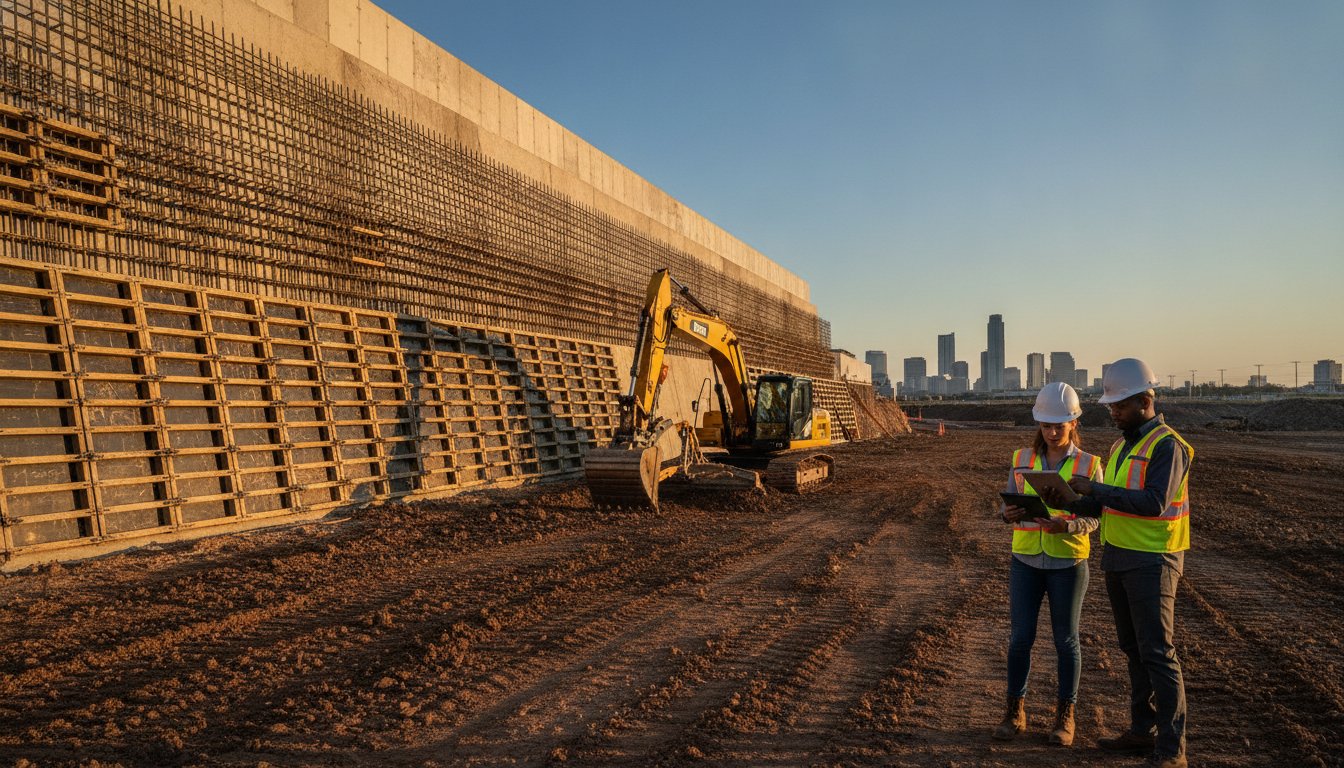
In the volatile landscape of Texas development, a retaining wall isn't a mere perimeter boundary; it's the primary structural anchor that dictates the viability of your entire site plan. You likely recognize that managing a commercial project in cities like Austin or Houston means contending with aggressive municipal codes and the relentless pressure of expansive clay soils. It's often frustrating when coordination gaps between grading crews and wall installers lead to delays or structural shifting that threatens your buildable square footage. Selecting an integrated commercial retaining wall contractor Texas developers rely on ensures that earthwork and structural engineering function as a single, cohesive unit to secure your investment.
We understand that long-term stability requires more than just stacking blocks. It demands meticulous management of soil pressure and drainage. This article provides a comprehensive overview of how integrated civil services and advanced structural concrete techniques meet the rigorous 2026 engineering standards. You'll discover how a unified approach to mass excavation and wall construction streamlines your schedule, maintains professional stability, and protects the enduring nature of your professional output.
Key Takeaways
- Understand how strategic grade separation allows developers to maximize buildable square footage on topographically challenging Texas sites.
- Evaluate the structural superiority of Cast-in-Place (CIP) concrete systems for managing the high lateral pressures of expansive clay soils.
- Learn why hiring an integrated commercial retaining wall contractor Texas relies on reduces project risk by unifying mass soil excavation with structural wall installation.
- Navigate the updated 2026 municipal engineering standards and permit thresholds required for high-load commercial infrastructure in Houston and Austin.
- Discover how a single-source civil partner streamlines construction schedules by eliminating the common communication failures between grading and structural subcontractors.
Optimizing Site Footprints with Commercial Retaining Walls in Texas
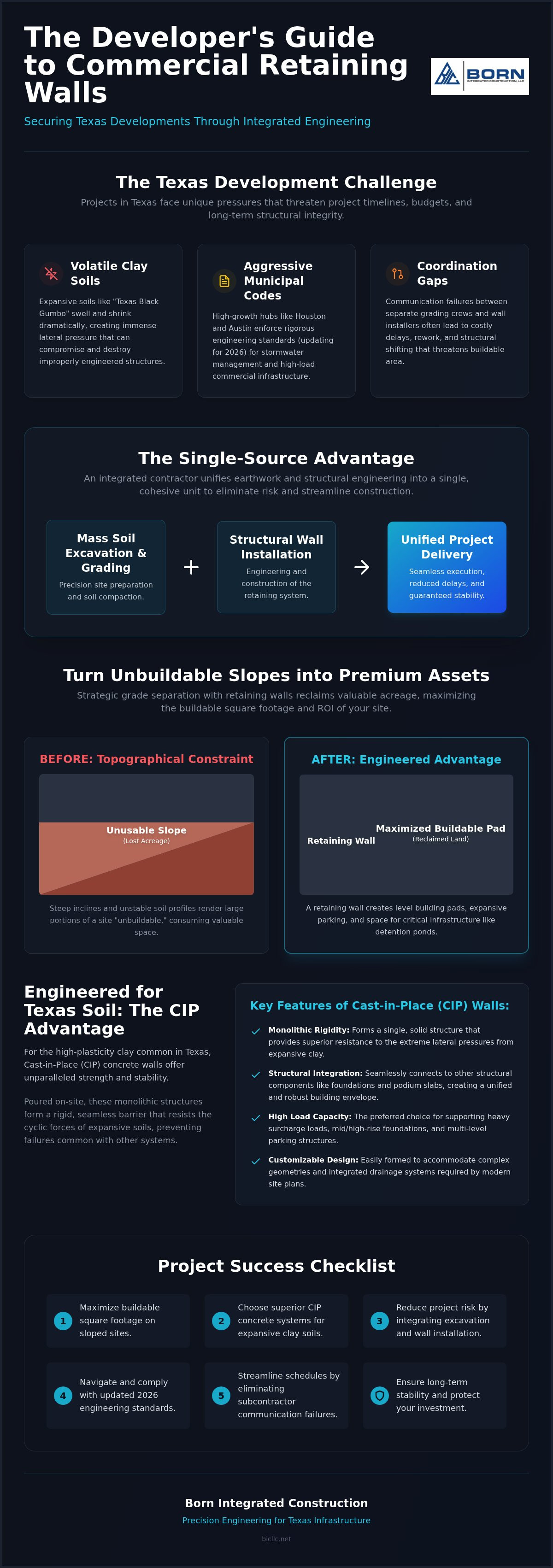
In commercial development, the efficiency of a site footprint directly dictates the project's ultimate return on investment. Texas terrain, particularly in regions with significant elevation changes or unstable soil profiles like "Texas Black Gumbo," often presents "unbuildable" slopes that consume valuable acreage. A professional retaining wall serves as a critical engineering tool to reclaim this land. By implementing aggressive grade separation, developers can transform steep inclines into level building pads or expansive parking areas. This process requires a commercial retaining wall contractor Texas firms trust to handle the complex interplay between lateral soil pressure and structural stability.
These structures don't exist in isolation. They must interface seamlessly with other civil elements, such as slab-on-grade foundations and heavy-duty paving. When a wall is engineered correctly, it provides the necessary containment to prevent soil migration under concrete slabs. This ensures the long-term integrity of the entire development, preventing the costly shifting often associated with volatile soil conditions.
Maximizing Real Estate Value in Urban Hubs
High-density markets like Houston and Austin leave little room for error. Every square foot of buildable land is a premium asset. Retaining walls are often the only viable solution for creating the vertical separation needed for multi-level sites or integrated detention ponds. These ponds are mandatory for managing stormwater runoff under 2026 municipal codes. Integrating these walls with commercial concrete paving in Conroe or other high-growth areas ensures that heavy-duty access roads remain stable even when situated on reclaimed slopes. It's about turning a topographical constraint into a functional advantage through precise grade management.
Structural Integrity for Texas Infrastructure
Beyond simple soil retention, these walls support the heavy surcharge loads of Texas infrastructure. A seasoned commercial retaining wall contractor Texas understands that the wall's foundation is just as vital as the visible face. Precision mass soil excavation and proper compaction are non-negotiable standards for preventing common failures seen in volatile clay environments. This discipline is essential for projects involving:
- Supporting multi-level developments and CIP parking structures
- Stabilizing transport hubs and industrial generator yards
- Ensuring safety for high-traffic commercial zones
A commitment to structural discipline ensures that the final output remains steadfast for decades. This approach provides the security and professional stability that commercial stakeholders demand when building lasting foundations.
Engineering for Texas Soil: CIP vs. MSE Retaining Wall Systems
Texas Black Gumbo is a high-plasticity clay that presents a unique set of challenges for civil construction. It expands significantly when wet and shrinks as it dries. This constant movement creates extreme lateral earth pressure that can compromise the stability of inferior structures. A seasoned commercial retaining wall contractor Texas must account for these cyclic forces during the initial design phase. Proper Engineering for Texas Soil requires a deep understanding of geotechnical reports to ensure the wall doesn't bow, rotate, or fail over time. Selecting the right system depends on the specific load requirements and site constraints of your development.
Cast-in-Place (CIP) Structural Walls
CIP concrete walls represent a monolithic approach to earth retention. These structures are formed and poured on-site, allowing for a rigid, seamless barrier that integrates directly with other structural components. This rigidity makes them the preferred choice for mid-rise and high-rise foundation support where tolerances are tight and loads are heavy. They are easily customized for complex geometries or integrated drainage systems. For developers focusing on vertical density, linking these walls to expert podium slab construction creates a unified structural envelope. This method ensures that the foundation and retention systems work in concert to maintain site stability regardless of soil volatility.
MSE and Segmental Modular Systems
Mechanically Stabilized Earth (MSE) systems offer a different mechanical advantage. These walls use layers of geogrid reinforcement to turn the soil itself into a stable, reinforced mass. They are highly cost-effective for large-scale grade changes, such as those found in industrial parks or expansive infrastructure projects. The modular nature of the blocks allows for a faster installation pace compared to traditional poured methods. Developers can choose from various aesthetic options, ranging from natural stone looks to clean industrial finishes, without compromising the wall's structural duty. The flexibility of MSE systems also allows them to tolerate minor soil settlements more gracefully than rigid structures.
Gravity walls rely solely on their own mass to resist soil pressure. While simpler in design, they require significant material volume and are often reserved for lower-height applications where geogrid reinforcement isn't feasible. Whether your project requires the monolithic strength of CIP or the efficiency of an MSE system, the priority remains long-term structural integrity. If you are planning a complex commercial development, you can learn more about our steadfast approach to structural concrete and how it secures volatile Texas sites.
The Single-Source Advantage: Integrating Earthwork and Wall Construction
A significant risk in commercial development is the coordination gap between mass earthwork teams and structural concrete crews. This division often results in costly delays and finger-pointing when subgrade compaction fails to meet the wall engineer's strict requirements. Selecting an integrated commercial retaining wall contractor Texas developers can trust ensures that these two critical phases function as a single, disciplined operation. When one partner manages both the excavation and the structural build, the transition between phases is seamless and the accountability is absolute.
The structural longevity of any wall depends entirely on the precision of the mass soil excavation performed at the outset. Inaccurate cuts or poorly stabilized subgrades predispose a wall to shifting or rotation, regardless of the quality of the concrete. By unifying these services, a single civil partner can coordinate backfill compaction with specific wall structural milestones. This methodical approach is essential for maintaining the compressed construction schedules required for 2026 projects, where site readiness often dictates the start of vertical construction.
From Mass Excavation to Finished Grade
Managing the transition from raw earth to a finished structural grade requires operational precision. We ensure that every square foot of subgrade is verified for stability and moisture content before the first pour or block placement occurs. This process is particularly vital when the site plan requires paving stabilization adjacent to the retaining structure. Proper stabilization of the surrounding soil ensures that the lateral loads from heavy-duty access roads or parking lots don't compromise the wall's long-term structural integrity. It's about establishing a foundation that lasts.
Managing Underground Utilities and Drainage
Hydrostatic pressure is the primary cause of retaining wall failure in Texas. If water isn't effectively diverted from behind the wall face, the resulting pressure can exceed the design limits of even the most robust CIP or MSE systems. Our approach to turnkey civil site work integrates storm sewer lines and domestic water systems directly into the wall's footing and drainage plan. This prevents utility lines from interfering with the wall's structural zone. By managing these complex underground components as part of a comprehensive package, we eliminate the conflicts that often arise when multiple subcontractors occupy the same narrow footprint. This level of organization provides the security and reliability that seasoned developers demand for high-stakes infrastructure.
Compliance and Planning: Texas Engineering Standards for 2026
Adhering to municipal codes and state regulations is a foundational requirement for any commercial development. In major hubs like Dallas, Fort Worth, and Austin, a building permit is mandatory for any retaining wall that reaches four feet in height, measured from the bottom of the footing to the top of the wall. Some jurisdictions maintain even stricter thresholds. For instance, the City of San Antonio requires permits for walls over two feet, while a 2026 update in Arlington mandates a permit for any wall within four feet of a public right-of-way, regardless of its height. Engaging a commercial retaining wall contractor Texas developers trust ensures these specific local amendments are addressed during the pre-construction phase.
The state requires a licensed Professional Engineer (PE) to provide sealed structural drawings for any wall exceeding the four-foot threshold. These designs must be based on a comprehensive geotechnical report that determines the specific lateral earth pressure coefficients for your site. Without this data, a wall cannot be properly engineered to withstand the unique soil stresses of its location. Professional oversight prevents the structural failures that occur when standard designs are applied to non-standard soil conditions.
Geotechnical and Structural Coordination
A "one-size-fits-all" engineering approach is insufficient for the diverse Texas landscape. Soil behavior in the limestone-heavy Hill Country differs fundamentally from the expansive clays found along the Gulf Coast. Engineering must also account for surcharge loads, which are critical in high-traffic commercial zones. A surcharge load represents any additional vertical weight placed on the soil surface behind a retaining wall, such as heavy machinery or parked commercial vehicles, which increases the lateral pressure exerted against the structure. Planning for these loads during the excavation phase ensures the wall maintains its integrity under maximum operational stress.
Stormwater and Environmental Compliance
Retaining walls often serve as the structural boundaries for detention ponds and basin designs. Under the Texas Commission on Environmental Quality (TCEQ) Construction General Permit TXR150000, any project disturbing one acre or more requires a Stormwater Pollution Prevention Plan (SWPPP). We implement rigorous erosion control measures during the mass excavation phase to prevent silt runoff and ensure compliance with these state-mandated environmental standards. This methodical approach to compliance protects the long-term viability of the development and prevents the legal complications of environmental oversight. To ensure your next project meets these rigorous standards, review our civil infrastructure portfolio for examples of compliant, high-load structural solutions.
Born Integrated Construction: Precision Engineering for Texas Infrastructure
Choosing a commercial retaining wall contractor Texas developers trust involves more than evaluating a bid; it's about selecting a partner capable of executing complex civil synergy. Born Integrated Construction (BIC) was established on the principle that civil and structural phases shouldn't exist in silos. Our "Integrated" designation reflects a deep-rooted commitment to managing the critical transition between mass soil excavation and structural concrete placement. This unified approach eliminates the common operational friction that often leads to structural instability or schedule delays in Texas high-density markets.
Our commitment to safety and integrity is evident in our meticulous management of details, from initial site stabilization to the final pour. We prioritize reliability, ensuring that every project meets the rigorous engineering standards required for 2026 developments. By maintaining a steadfast focus on craftsmanship, we deliver professional output that serves as a lasting foundation for commercial infrastructure. You can review our portfolio of Texas commercial projects to see how this integrated philosophy translates into successful, high-load structural solutions across the state.
The BIC Difference in Commercial Concrete
BIC specializes in high-stakes structural applications that require specialized technical proficiency and precise execution. Our expertise extends beyond standard retention systems to include CIP garages, podium slabs, and foundations for high-rise developments. We understand that the enduring nature of these structures depends on the quality of the initial engineering and the precision of the construction process. We don't seek to disrupt the industry through innovation alone; we lead through proven results and unwavering consistency. Learn more about our mission and values and how our professional stability reinforces our authority in the Texas construction market.
Contact Us for Your Next Texas Project
We provide turnkey civil solutions for general contractors and developers throughout Houston, Austin, Dallas, and San Antonio. Our team is prepared to partner with your organization to manage the complexities of volatile soil and aggressive municipal requirements. Whether your 2026 development requires specialized earthwork or the construction of a high-load structural wall, we offer the operational precision necessary to protect your investment. Request a comprehensive bid for your next project to experience the security of a partnership built on substance and professional stability.
Securing Your Texas Development with Integrated Structural Expertise
Successful commercial development in 2026 requires more than just meeting permit thresholds; it demands a unified approach to site stabilization and soil retention. By choosing a commercial retaining wall contractor Texas developers trust, you ensure that mass earthwork, underground utilities, and structural wall installation function as a single, disciplined operation. This level of integration is essential for eliminating the coordination gaps that often lead to structural shifting in expansive clay soils. It's the most reliable way to protect your investment from the ground up.
Our specialized expertise in both Cast-in-Place (CIP) and Mechanically Stabilized Earth (MSE) systems provides the flexibility needed to maximize buildable square footage across all major Texas metropolitan areas. We remain committed to delivering the reliability and professional stability your infrastructure requires for long-term viability. When you prioritize substance over style, you establish a foundation that withstands the unique environmental pressures of the Texas landscape. You'll find that meticulous management of every civil detail today prevents the costly structural failures of tomorrow.
Request a Turnkey Civil and Structural Concrete Bid today to begin establishing a steadfast foundation for your next commercial project. We look forward to partnering with you to deliver enduring results.
Frequently Asked Questions
When is a retaining wall required for a commercial site in Texas?
A retaining wall is necessary whenever grade changes exceed the soil's natural angle of repose or when site constraints require vertical separation to maximize buildable square footage. In most major Texas municipalities, a permit and sealed engineering are mandatory for walls four feet or taller. Some cities maintain stricter thresholds, such as College Station's two-foot requirement. Consulting a commercial retaining wall contractor Texas developers trust is the most reliable way to verify local 2026 amendments.
What is the difference between a CIP wall and an MSE wall?
Cast-in-Place (CIP) walls are monolithic structures formed and poured on-site, offering maximum rigidity for high-load applications like high-rise foundations. Mechanically Stabilized Earth (MSE) walls use geogrid reinforcement and modular blocks to turn the soil into a stable mass. While CIP is often considered the gold standard for structural longevity, MSE provides a cost-effective solution for large-scale grade changes. The choice depends on your site's specific load requirements and soil conditions.
How does Texas soil affect retaining wall design?
Expansive clay soils, commonly known as "Black Gumbo," exert extreme lateral pressure as they swell and shrink with moisture changes. Design must account for these cyclic forces to prevent the wall from bowing or rotating over time. Engineering for these conditions requires deep foundations and robust drainage systems. A professional approach ensures that the structure remains steadfast despite the volatile nature of the soil, maintaining long-term stability for the entire development.
Can Born Integrated Construction handle both the excavation and the wall building?
Yes, our team self-performs both mass soil excavation and structural wall installation as part of our turnkey civil services. This integrated approach removes the coordination gaps that often occur between separate earthwork and concrete subcontractors. By managing the full civil scope, we ensure that subgrade stability and backfill compaction meet the exact specifications required by the Engineer of Record. This synergy protects the schedule and the structural integrity of the project.
What are the common causes of retaining wall failure in Texas?
Inadequate drainage and hydrostatic pressure are the primary causes of wall failure across the state. When water is trapped behind the wall, the resulting pressure can exceed the structure's design limits. Other contributing factors include improper compaction of backfill and the failure to account for the lateral pressure of expansive clays. Professional oversight during the excavation and construction phases is essential to prevent these issues and ensure the enduring nature of the wall.
How much does a commercial retaining wall cost per square foot in 2026?
The investment for a commercial retaining wall is determined by specific engineering requirements, wall height, and the geotechnical profile of the site. Factors such as surcharge loads from parking lots or the necessity for deep foundations in volatile clay will influence the final cost. We recommend requesting a comprehensive bid to receive an accurate assessment based on your project's unique constraints. This methodical approach ensures that all structural and regulatory factors are accounted for upfront.
How long does it take to construct a large-scale commercial retaining wall?
The construction timeline depends on the wall's height, length, and the complexity of the site's topography. A standard commercial project may take several weeks to months from the start of mass excavation to final grade. Partnering with an integrated commercial retaining wall contractor Texas relies on often accelerates this schedule. By transitioning seamlessly between the earthwork and structural phases, we eliminate mobilization delays and keep the civil construction timeline on track.
Do I need a separate contractor for underground utilities near the wall?
You don't need a separate contractor when you utilize our turnkey civil site work services. We integrate storm sewer lines and domestic water systems directly into the wall's structural and drainage plan. This coordination prevents underground utility conflicts and ensures that drainage systems are properly placed to manage hydrostatic pressure. Managing these complex components as a single package provides the security and reliability that seasoned developers demand for high-stakes infrastructure.