Concrete Contractor for Distribution Centers in Fort Worth
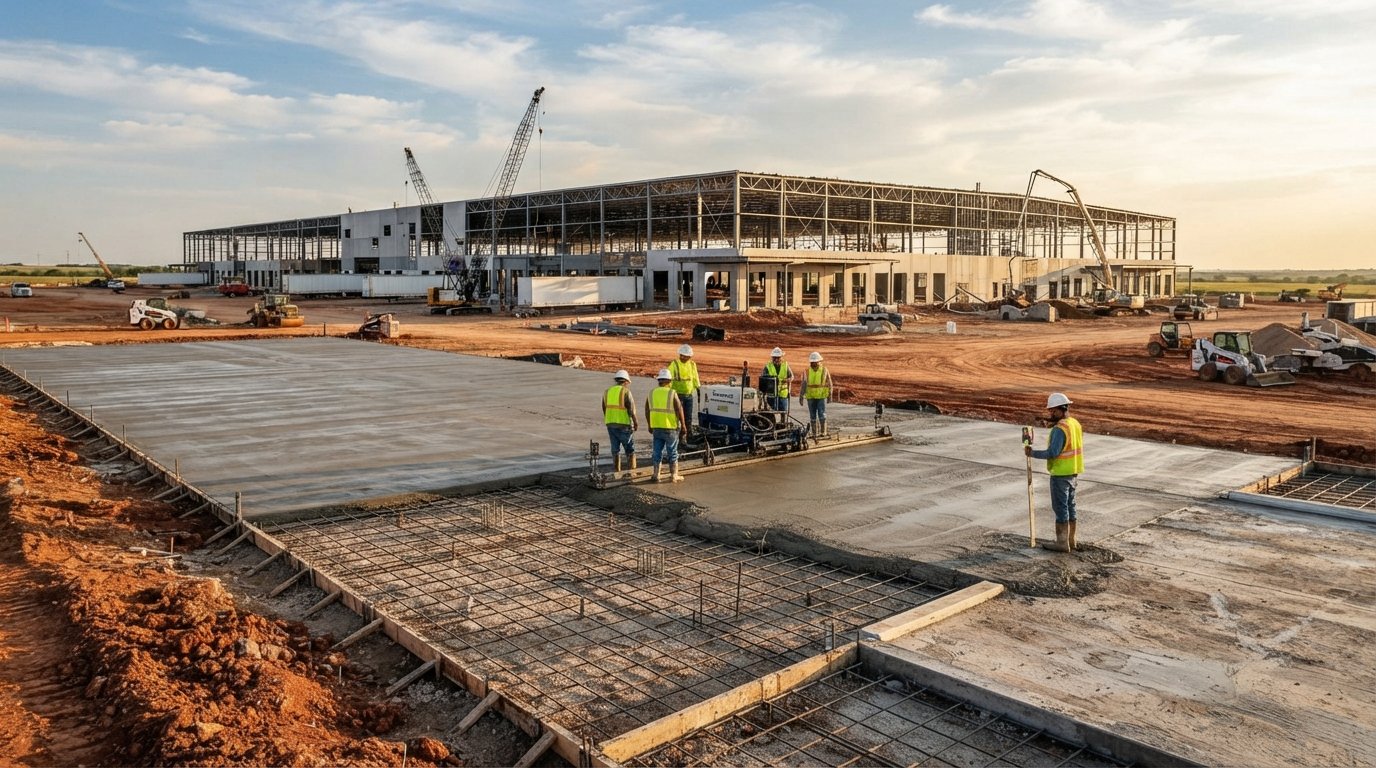
The structural integrity of a modern logistics facility is decided long before the first tractor-trailer backs up to a dock apron. Selecting an experienced concrete contractor for distribution centers Fort Worth developers can depend on means directly addressing the harsh reality of North Texas geology: expansive clay soils that shift with moisture changes, threatening premature slab cracking and differential settlement. When strict project timelines leave zero margin for error, coordination friction between separate excavation teams and structural paving crews only magnifies schedule and performance risks.
You already know that standard commercial paving practices cannot endure continuous 80,000-pound axle loads, severe landing gear point loads, or the strict Floor Flatness and Floor Levelness tolerances required by automated racking systems. Discover how specialized commercial concrete construction and integrated civil execution ensure structural longevity and heavy-load performance for North Texas logistics facilities. We examine the technical capabilities, from subgrade chemical stabilization to reinforced apron design, required to protect your capital investment from the ground up.
Key Takeaways
- Understand how rigorous Floor Flatness and Floor Levelness specifications protect automated storage systems and prevent edge spalling under relentless forklift traffic.
- Discover the soil stabilization and moisture management practices required to neutralize active North Texas clays and stop slab deflection before placement begins.
- Learn the pavement thickness and reinforcement standards necessary for exterior truck aprons and dolly pads to endure severe static landing gear point loads.
- Identify the core technical capabilities to verify when choosing a concrete contractor for distribution centers Fort Worth logistics developers depend on for heavy industrial performance.
- Explore how a single-source turnkey civil and structural concrete partner eliminates coordination gaps and safeguards critical project delivery schedules.
Demands on Concrete Infrastructure in Fort Worth Logistics Facilities
Industrial concrete specifications for modern logistics hubs define the precise structural thickness, compressive strength, subgrade stability, and joint design needed to withstand continuous heavy dynamic loads without structural failure. Major freight arteries like I-35W and the Alliance Texas logistics corridor support immense daily haul volumes. Slabs-on-grade in these regional facilities don't operate as passive platforms; they endure relentless cyclical stress from multi-ton lift trucks, tandem-axle transport, and dense vertical storage. Beneath this surface load, active expansive clay soils typical of North Texas introduce continuous uplift pressures that threaten structural equilibrium. Coordinating initial earthwork with structural concrete construction is the only reliable way to prevent early slab deflection, cracked seams, and expensive operational interruptions.
Engaging a specialized concrete contractor for distribution centers Fort Worth operators rely on ensures that high-volume transit areas remain stable under sustained industrial use.
Floor Flatness and Levelness Standards for Automated Warehousing
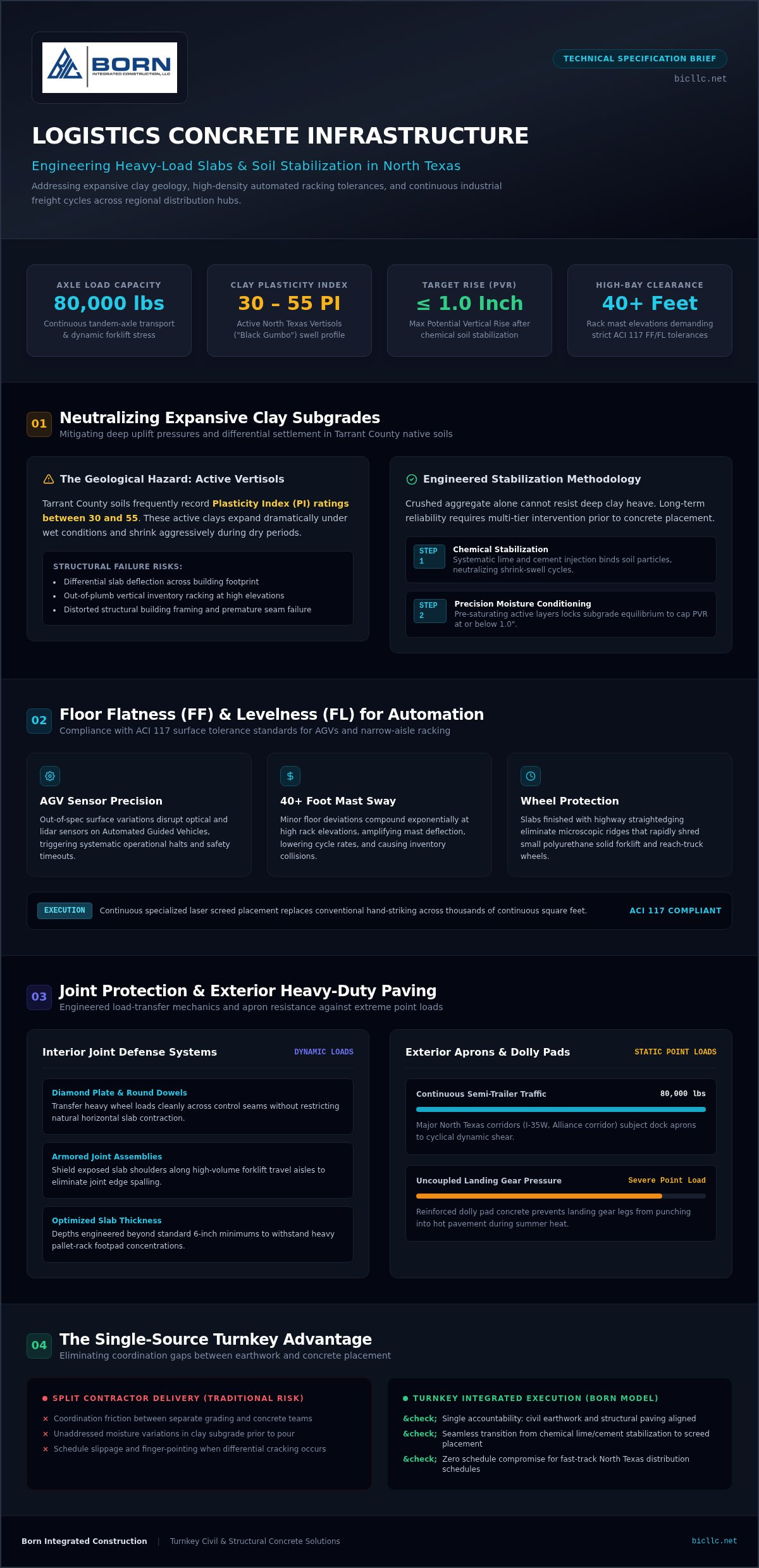
Automated guided vehicles (AGVs) and high-density narrow-aisle racking systems depend on stringent American Concrete Institute (ACI 117) surface tolerance classifications. Even slight floor variations compound as mast heights climb past forty feet. Out-of-spec slabs trigger sensor faults in automated machinery, accelerate mast sway, and shred small polyurethane forklift wheels over repeated trips. Meeting these elevated Floor Flatness (FF) and Floor Levelness (FL) numbers requires continuous, specialized laser screed placement techniques and meticulous highway straightedging rather than conventional hand striking, ensuring uniform flatness across thousands of continuous square feet.
Dynamic Axle Loading and Joint Durability Under Continuous Traffic
Control joints represent the most vulnerable component of an interior logistics floor. As heavy solid-tire forklifts traverse unreinforced joints, dynamic wheel loads shear the slab edges, causing severe joint spalling and long-term concrete failure. Preserving concrete integrity under this punishment requires engineered load-transfer dowels and armor-faced construction joints:
- Diamond Plate and Round Dowels: Transfer heavy axle wheel loads cleanly across joints without restricting horizontal slab contraction.
- Armored Joint Assemblies: Protect exposed slab shoulders along high-traffic travel aisles against hard-wheel impact.
- Optimized Slab Thickness: Slab-on-grade depths engineered beyond standard six-inch minimums directly counteract severe static foot-load pressures imposed by tall, fully loaded industrial pallet racks.
Choosing a dedicated concrete contractor for distribution centers Fort Worth developers trust establishes the heavy-duty foundation and precise joint mechanics needed to sustain continuous facility operations without unbudgeted downtime.
Subgrade Stabilization and Foundation Prep for North Texas Expansive Soils
Subgrade performance dictates slab longevity across Tarrant County. The native soils of North Texas consist predominantly of highly active Vertisols, often referred to as black gumbo. These soils exhibit Plasticity Index ratings that frequently sit between 30 and 55, meaning they expand aggressively during wet periods and shrink substantially during dry Texas summers. Unmitigated subgrade shifting produces differential settlement across the building envelope. This causes interior floor deflection, distorted structural framing, and serious out-of-plumb issues on high-bay inventory racks. Pouring heavy-duty concrete over simple crushed aggregate cannot stop deep clay heave. Long-term slab reliability demands systematic chemical stabilization and precise moisture conditioning that lowers the Potential Vertical Rise to an acceptable threshold of 1.0 inch or less.
Developers who hire a qualified concrete contractor for distribution centers Fort Worth projects rely on can bridge the risky technical gap between civil site grading and structural concrete construction.
Chemical Soil Stabilization Techniques Using Lime and Cement
Stabilizing native clay requires a disciplined, three-step chemical modification process:
- Geotechnical Core Analysis: Testing core samples determines natural moisture levels, sulfates, and clay plasticity across the entire building pad footprint.
- Chemical Reagent Blending: Crews apply calculated proportions of hydrated lime, quicklime, or Portland cement, tilling the reagent deeply into the subgrade to permanently alter clay mineralogy.
- Moisture Conditioning and Compaction: Operators introduce controlled water volumes to achieve optimal moisture content, compacting the treated earth in dense lifts to satisfy strict density requirements.
This process transforms reactive soil into an inert, load-bearing platform aligned with rigid FHWA concrete pavement standards for heavy industrial applications.
Integrating Mass Earthwork, Moisture Barriers, and Sub-Base Drainage
Subgrade stabilization succeeds only when tied directly into broad site civil design. Mass soil excavation and engineered structural fill placement establish true elevations while eliminating low-bearing pockets across multi-acre sites. Beneath interior floor slabs, contractors install continuous high-performance polyolefin vapor barriers to halt sub-slab moisture migration that could otherwise delaminate epoxy sealers or corrode embedded steel reinforcement.
Civil teams shape drainage swales, perimeter collector channels, and dedicated detention ponds to channel severe storm runoff away from structural edges. Water must never pond against dock walls or under trailer parking aprons. Contracting an experienced partner that self-performs earthwork, paving stabilization, and slab on grade work eliminates disputes between separate trade subcontractors. Reviewing recent regional industrial projects illustrates how unified earthwork and structural paving safeguard mission-critical logistics facilities from costly foundation failures.
Engineering Exterior Concrete Paving, Heavy-Duty Aprons, and Dolly Pads
Exterior pavement in an industrial freight terminal experiences intense tortional fatigue. When heavy multi-axle freight trucks turn at low speeds within tight truck courts, their tandem tires exert massive scrubbing forces that quickly rip apart weak surfaces. The situation intensifies along the loading dock face, where Class 8 tractor-trailers repeatedly back in and brake against dock levelers. While flexible pavements might seem appealing for initial site budgets, they routinely fail under this punishment. Heavy-duty concrete paving provides the rigid structural matrix required to distribute these rolling loads across the prepared subgrade without rutting, shoving, or surface shear.
Working with an established concrete contractor for distribution centers Fort Worth project leaders rely on ensures that exterior courts, trailer staging bays, and drive lanes match the structural rigor of the building slab itself.
Reinforced Concrete Dolly Pads Versus Flexible Pavements
Uncoupled trailers introduce an entirely different engineering challenge: concentrated static point loading. When a tractor disconnects, steel landing gear feet exert concentrated loads exceeding 25,000 to 50,000 pounds over small steel shoes. In the extreme heat of Texas summers, asphalt softens and gives way, allowing trailer landing gear to punch directly through the pavement surface. Constructing continuous reinforced concrete dolly pads eliminates this vulnerability:
- Engineered Depth and Reinforcement: Poured dolly ribbons feature 8-to-12-inch slab thicknesses tied with #4 or #6 rebar grids, distributing extreme static points across a broad footprint.
- High-Strength Mix Design: Compressive strengths reaching 4,000 to 5,000 PSI prevent punch-through shear and resist damage from dropped container corners.
- Long-Term Maintenance Elimination: Rigid concrete ribbons prevent the perpetual patching, depression filling, and rut repairs inherent to flexible staging yards.
Joint Detailing and Heavy Pavement Optimization for Truck Courts
Joint engineering dictates the lifespan of exterior paving. Rigid jointed pavements subject to continuous freight traffic require slip-dowels across transverse contraction joints to ensure clean vertical load transfer without locking the joint against horizontal thermal movement. Tied longitudinal joints prevent lane separation when heavy rigs execute tight turns. Contractors verify subgrade stability using regional data from the USDA Web Soil Survey before pouring to balance joint spacing against local soil expansion profiles.
Surface durability relies on applying high-solids curing compounds immediately after finishing. This seals internal moisture during curing and hardens the concrete surface against fuel spills and abrasive tire wear. Apron geometry must incorporate a consistent 1% to 2% drainage fall away from dock doors, directing storm runoff cleanly into perimeter collector gutters and concrete swales. A seasoned concrete contractor for distribution centers Fort Worth developers trust builds these exterior zones to withstand continuous freight cycles without costly operational interruptions.
Key Evaluation Criteria When Selecting a Commercial Concrete Contractor
Evaluating an industrial concrete partner requires scrutiny beyond standard insurance limits or general trade licenses. Logistics facilities operate under severe time constraints, where pour delays can trigger severe liquidated damages under tenant leases. A capable partner must demonstrate operational self-reliance, documented field safety protocols, and direct command over concrete placement rates. When vetting candidates, developers need to look past basic marketing claims and examine physical production capacity, fleet allocation, and past performance on massive tilt-wall and warehouse footprints.
Selecting the right concrete contractor for distribution centers Fort Worth logistics builders work with comes down to verified technical competence and proven execution models.
Evaluating Turnkey Civil and Structural Capabilities
Dividing civil grading, soil stabilization, and structural concrete across distinct subcontractors creates substantial project risk. When pad settlement or moisture discrepancies emerge later, separate contractors routinely trade blame, stalling critical project schedules. A turnkey civil delivery model eliminates these operational handoffs entirely:
- Single-Source Oversight: One team manages mass soil excavation, chemical subgrade stabilization, and final structural flatwork under a unified chain of custody.
- Aligned Execution: The earthwork crew compacts the sub-base with complete accountability to the structural crew placing dowel baskets and concrete hours later.
- Schedule Preservation: Seamless internal trade handoffs eliminate mobilization delays, keeping large-scale concrete pours firmly on track.
Technical Equipment Fleet and Quality Verification Metrics
Hitting high-tolerance floor specifications across hundreds of thousands of square feet cannot be achieved with manual screeds. Qualified industrial outfits deploy advanced laser screeds with integrated automated grading heads and 3D surface profilers. These systems allow continuous pours that maintain strict surface tolerances while pacing high-output ready-mix batch deliveries. Verification procedures must be systematic rather than occasional.
Field technicians must conduct continuous slump tests, check air entrainment, and cast compressive test cylinders in strict accordance with ASTM C39 standards to confirm that design strengths are met before traffic access. General contractors should audit concrete placement portfolios to verify sustained performance under comparable logistical scale. Examining the BIC projects page demonstrates the level of comprehensive structural civil delivery required on complex Texas warehouse developments. Before awarding your next freight terminal package, partner with a single-source team capable of managing your site from initial mass earthwork through heavy structural paving.
Partnering with Born Integrated Construction for Distribution Projects
Executing large-scale industrial concrete requires unwavering accountability across every phase of civil sitework and structural placement. Born Integrated Construction operates as an integrated commercial partner, self-performing mass soil excavation, paving stabilization, concrete paving, and structural slab on grade installations across Texas. Decades of combined leadership experience guide the firm's approach to the complex geotechnical conditions of the Dallas-Fort Worth metroplex. Rather than relying on layers of sub-tier trade contractors, the company deploys internal crews and dedicated heavy machinery to ensure structural performance, uncompromised job site safety, and strict schedule adherence. Reviewing the company background and operational pillars on the BIC about page highlights a continuous commitment to dependable commercial craftsmanship.
Selecting an accountable concrete contractor for distribution centers Fort Worth developers trust establishes a clear line of operational responsibility from initial earthmoving to the finished floor.
Single-Source Accountability from Raw Ground to Polished Slab
Managing the critical interface between civil earthwork and structural paving internally eliminates the friction common to split-scope projects:
- Coordinated Site Sequencing: Mass excavation teams, stabilization crews, and concrete placement squads operate under unified project leadership, preventing costly delays between site prep and pad construction.
- Direct Quality Control: Soil density, subgrade lime stabilization depths, and vapor barrier integrity are preserved directly by the team placing the concrete.
- Enduring Structural Results: Turnkey delivery produces industrial slabs, dolly pads, and heavy aprons engineered to withstand intense dynamic cycling and extreme static point loads over decades of operational service.
Initiating Pre-Construction Planning and Constructability Reviews
Early alignment during pre-construction uncovers critical site optimization opportunities before field mobilization begins. Born Integrated Construction conducts thorough constructability reviews of civil grading plans, geotechnical borings, and structural paving details. Geotechnical analyses across Tarrant County frequently reveal variable sulfate levels and high plasticity indexes that require customized stabilization formulas. Identifying these conditions during design planning prevents costly field change orders and unexpected delays.
Engaging directly with estimating and pre-construction teams allows developers to verify ready-mix batching logistics, joint layouts, and drainage profiles well ahead of schedule. As a seasoned concrete contractor for distribution centers Fort Worth project leaders depend on, Born Integrated Construction provides the technical depth, safety discipline, and self-performed control required to protect your logistics capital investments from groundbreaking through final inspection.
Secure Your Logistics Infrastructure with Integrated Concrete Execution
Long-term operational success for North Texas logistics facilities depends entirely on the resilience of their concrete foundations. Neutralizing active subgrade clays through engineered soil stabilization stops differential settlement before placement ever begins. Inside the facility, high-tolerance floor flatness protects automated material handling machinery, while doweled joint systems and reinforced dolly pads outside easily endure continuous dynamic wheel cycling and massive trailer landing gear point loads.
Managing these critical phases under a single point of accountability eliminates trade friction, protects tight tenant delivery schedules, and delivers enduring structural value. When you need an experienced concrete contractor for distribution centers Fort Worth developers rely on, single-source self-performance makes all the difference. Proven regional leadership, rigorous jobsite safety, and comprehensive civil-to-paving capabilities ensure your capital investment performs without compromise. Partner with Born Integrated Construction for dependable commercial concrete execution on your next industrial logistics development and build with lasting confidence.
Frequently Asked Questions
Why is soil stabilization critical for distribution centers in Fort Worth?
Native Tarrant County soils contain active clays that expand and shrink with moisture shifts. Chemical stabilization using lime or Portland cement creates a rigid, non-expansive subgrade platform. Without this treatment, differential movement causes slab deflection, cracks interior floors, and distorts tall automated racking systems. Stabilizing the subgrade before placement permanently binds the clay particles, reducing Potential Vertical Rise down to engineered limits and ensuring a reliable foundation.
What is the ideal floor flatness (FF) rating for a modern logistics warehouse?
Automated logistics facilities typically require overall Floor Flatness (FF) numbers ranging from 45 to over 65, depending on racking height and equipment types. Very Narrow Aisle (VNA) systems with automated wire guidance demand specialized Superflat profiles reaching FF 80 or higher in designated transit paths. Achieving these elevated numbers prevents vehicle mast sway, reduces sensor misreads, and protects polyurethane wheels from accelerated fatigue during continuous inventory operations.
How thick should concrete paving be for heavy truck courts and distribution docks?
Exterior heavy-duty logistics paving typically requires a thickness between 8 and 12 inches of reinforced concrete. Pavements positioned directly along the dock approach experience repetitive braking and turning from fully loaded tractor-trailers, demanding 10 to 12 inches of depth paired with 4,000 to 5,000 PSI compressive strength. Standard commercial designs of five or six inches quickly fail under daily Class 8 freight traffic.
Why are reinforced concrete dolly pads necessary instead of full asphalt paving?
Uncoupled semi-trailers exert massive concentrated point loads through their steel landing gear feet, often exceeding 25,000 to 50,000 pounds. In sustained North Texas summer heat, flexible surfaces soften, allowing these narrow landing legs to punch through the sub-base. Choosing a qualified concrete contractor for distribution centers Fort Worth facilities rely on ensures rigid, reinforced concrete dolly ribbons are installed to distribute these static forces evenly without punching or rutting.
What is the benefit of hiring a turnkey civil and concrete contractor?
A single-source turnkey contractor manages everything from mass excavation and soil chemical stabilization to structural slabs and exterior paving under one roof. This integrated delivery model eliminates scheduling disputes and finger-pointing between separate dirt and flatwork crews. Selecting an accountable concrete contractor for distribution centers Fort Worth developers trust ensures subgrade preparation directly satisfies structural design requirements, preventing unexpected delays and protecting your project timeline.
How do temperature extremes in North Texas affect industrial concrete placement?
High ambient temperatures, low humidity, and sustained summer winds accelerate moisture evaporation during placement. Rapid hydration increases the risk of plastic shrinkage cracks and makes finishing high-tolerance slabs difficult. Industrial contractors mitigate thermal extremes through specialized retarders, night pours, liquid evaporative reducers, and immediate application of membrane-forming curing compounds. In winter conditions, crews monitor ground temperatures closely and utilize insulated blankets to protect early compressive strength development.
What joint design best prevents spalling under heavy forklift operations?
Armored construction joints and engineered plate dowels offer the most reliable defense against edge spalling. Standard sawed joints often break down under continuous hard-wheel forklift travel. Installing steel-armored joint assemblies protects slab shoulders in high-traffic corridors, while diamond plate dowels transfer heavy dynamic wheel loads cleanly across panels. This mechanical transfer eliminates joint impact, allows free horizontal shrinkage, and prevents expensive wheel damage on material handling equipment.