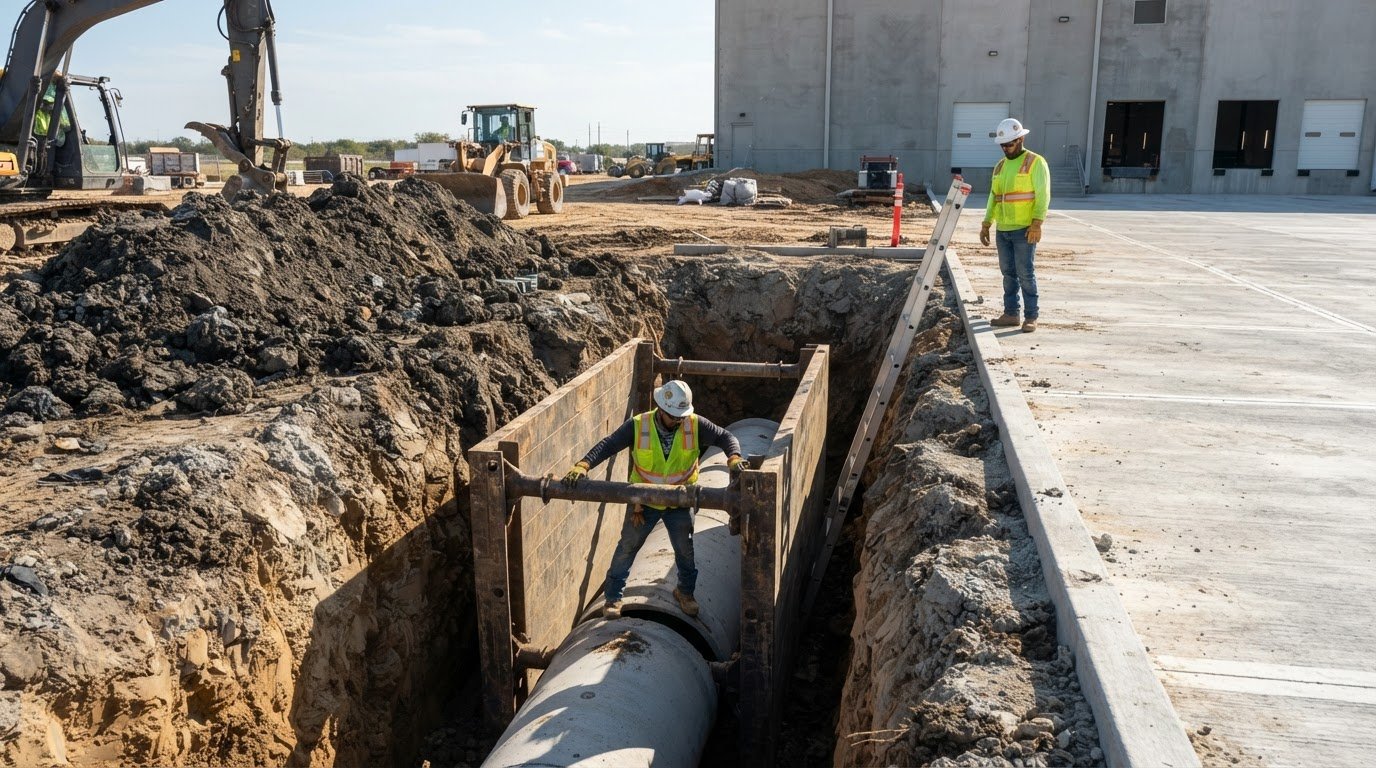
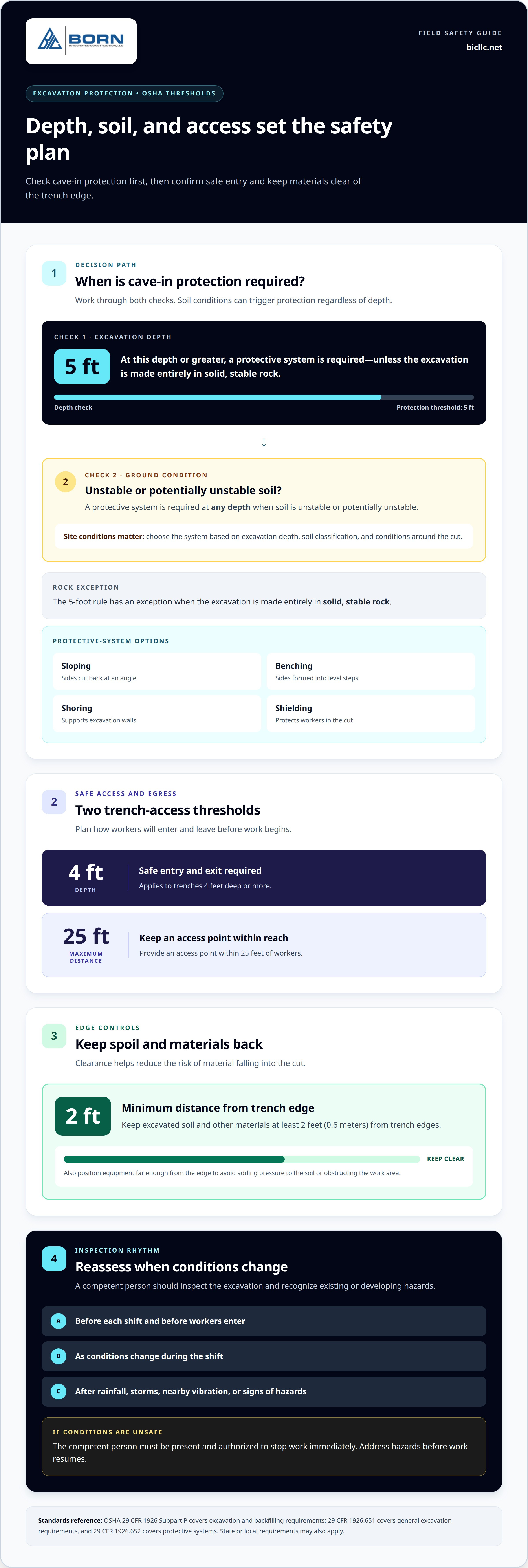
Most excavation hazards take shape before a worker enters the cut. Reliable deep excavation safety procedures start with applying the right protective system: according to the Occupational Safety and Health Administration (OSHA), excavations 5 feet or greater deep require protection from cave-ins unless made entirely in solid, stable rock.
That threshold is central, but it isn’t the only rule crews need to understand. OSHA also requires safe entry and exit for trenches 4 feet deep or more, with an access point within 25 feet of workers. These requirements help make excavation safety a planned part of the work, not a last-minute response to changing site conditions.
This guide explains the OSHA excavation standards that apply in the United States, when protective systems are required, and how to provide safe access and egress. It also covers common violations, including unsafe spoil placement, missed inspections, and inadequate cave-in protection. These controls help organize excavation work and protect workers.
Key Takeaways
- Make inspections part of the work plan: a competent person should assess the excavation, weather, and changing site conditions before workers enter.
- Account for cave-ins, falling materials, nearby traffic, and hazardous atmospheres; atmospheric testing helps identify risks before work begins.
- Select sloping, benching, shoring, or shielding according to soil classification and site conditions, rather than relying on a single approach for every excavation.
- Keep spoil piles and other materials at least 2 feet (0.6 meters) from trench edges, as required by the Occupational Safety and Health Administration.
- Plan excavation work alongside the construction that follows, so earthwork and concrete operations can proceed with safety controls established.
What is Excavation Safety?
Excavation safety means identifying and controlling hazards before employees enter or work near a cut. Effective deep excavation safety procedures combine inspections, weather checks, utility planning, and fall protection.
Daily Excavation Inspections
Before work begins, a competent person should inspect the trench, nearby ground, and work area. The inspection should be repeated when conditions change, such as after rain, storms, or nearby vibration. Water and disturbed soil can affect trench stability between shifts.
If water appears, reassess the excavation before entry. For example, after rainfall, check the trench walls and access route rather than relying on an earlier inspection. Record and address hazards before work resumes.
Competent-Person Inspections
A competent person conducts inspections, recognizes existing and developing hazards, and monitors excavation work. This person must be present and authorized to stop work immediately if unsafe conditions develop. Active oversight helps workers leave before a hazard causes an incident.
Inspect before each shift, as conditions change during the shift, and after rainfall, nearby vibration, or signs of hazards. Deep excavation safety procedures should reflect actual site conditions. A completed checklist alone does not prove that a trench remains safe.
Underground Utility Protection
Before digging, employers should use cable, pipe, and service plans to locate underground utilities. Mark identified services on the ground so equipment operators and employees can see where lines cross the work area. This planning helps crews avoid damage and adjust the excavation route before work reaches a buried service.
If the planned cut approaches a marked line, keep work clear of that area until it is safe to proceed. Update markings and work plans when excavation boundaries change, and keep utility locations visible to the crew as work progresses.
Fall protection helps protect people near open excavation edges. Guardrails, physical barriers, barricades, or load-rated covers can reduce fall risks for workers and passersby. Include these measures in inspections and check that they remain in place as equipment and work areas shift. Address a missing barrier near an active access route before employees continue.
What are OSHA Excavation Standards?
U.S. federal excavation and backfilling requirements are set out in OSHA’s 29 CFR 1926 Subpart P. OSHA’s 29 CFR 1926.651 covers general requirements for excavation work.
Cave-In and Falling-Material Hazards
Cave-ins and falling materials can trap, strike, or bury workers inside an excavation. OSHA defines a trench as an excavation deeper than it is wide, typically less than 15 feet wide at the bottom. Excavated soil and other materials must be kept at least 2 feet (0.6 meters) from trench edges, according to the Occupational Safety and Health Administration. This clearance reduces material falling back into the cut.
Keep equipment far enough from the edge to avoid adding pressure to the soil or obstructing the work area. The appropriate position depends on ground conditions, equipment, and excavation layout.
Atmospheric Hazards and Testing
Hazardous atmospheres, including toxic gases, may be present in or around an excavation. Test atmospheric conditions before employees work at the site. Testing can reveal hazards that visual checks of soil and trench walls cannot detect.
If conditions suggest a confined-space hazard, assess that risk separately and establish suitable entry and emergency procedures before work proceeds. An open trench is not proof that its atmosphere is safe.
Traffic and Falling Loads
Moving vehicles and equipment create hazards near excavation edges, while raised or suspended loads can strike workers below. OSHA requires warning signs or barricades when mobile equipment operators cannot easily see an excavation edge. These controls alert operators before they approach.
Workers should not work beneath raised loads. Plan equipment routes and material handling so workers stay clear of both excavation edges and suspended materials.
Training, Documentation, and Protective Equipment
OSHA’s 29 CFR 1926.651 establishes general requirements for excavation work; the controls needed depend on hazards and site conditions. Employers should communicate the work plan, inspection findings, and relevant hazards to employees. Select protective equipment for the exposures present, such as falling materials or nearby traffic, rather than relying on a single list for every site.
The federal standard discussed here is 29 CFR 1926 Subpart P. State or local requirements may also govern a project, so apply the rules for its jurisdiction. For a trench collapse, call emergency responders and keep untrained workers out of the unstable excavation; a second collapse can endanger would-be rescuers.
When Is a Protective System Required?
Choose a protective system based on excavation depth, soil classification, and conditions around the cut. Sloping, benching, shoring, and shielding address cave-in risk in different ways.
According to the Occupational Safety and Health Administration, protective systems are required for excavations 5 feet or greater in depth, unless they are made entirely in solid, stable rock. A protective system is also required at any depth when soil is unstable or potentially unstable. OSHA regulation 29 CFR 1926.652 covers protective systems for trenches.
Sloping cuts the sides back at an angle, while benching creates a series of level steps. Shoring supports excavation walls with a structure; shielding uses a trench box or similar system to protect workers if soil moves. These methods are not interchangeable in every condition. For example, benching cannot be used in Type C soil.
Soil and Site Conditions
Soil classification and surrounding site conditions determine which protective approach is suitable. For excavations less than 20 feet deep, the listed maximum slopes are ¾:1 for Type A soil, 1:1 for Type B, and 1 ½:1 for Type C. These ratios describe horizontal distance to vertical depth.
Nearby structures, vibration, water, and loads near the edge can affect soil stability. A protective plan must account for actual ground and work conditions, not just the excavation’s dimensions. A slope suitable for one soil type may not suit another.
Protective-System Depth Requirements
Depth helps determine when protection is required and how a system must be designed. For trenches 20 feet deep or greater, a protective system must be designed by a registered professional engineer or based on qualifying tabulated data. Sloping or benching for excavations greater than 20 feet deep must also be designed by a registered professional engineer.
For cuts below that depth, the listed slope limits depend on soil type and configuration. The competent person’s assessment of soil and site conditions remains essential when selecting protection. A trench box shields workers but does not prevent surrounding soil from moving.
Protective systems address cave-in hazards, but fall protection is a separate control. OSHA regulation 29 CFR 1926.501(b)(7) addresses fall protection for pits, shafts, and excavations. Fall protection is mandatory where workers face potential falls of 6 feet or more into excavations. Guardrails, barriers, or covers can address exposed edges, while the selected system must suit the specific opening and work activity.
Safe excavation access and egress
Safe access and egress give workers a controlled route into and out of an excavation. OSHA sets depth and distance requirements, while ground conditions, shielding, utilities, and equipment affect where access can be placed. Plan the route with the excavation layout so workers do not have to cross hazardous areas or unstable ground.
According to the Occupational Safety and Health Administration, trenches 4 feet deep or more require a safe means of entry and exit. This requirement applies to trench access, not simply to having a route nearby. A ladder, stairway, ramp, or other suitable means should be established so employees can leave without climbing trench walls or relying on equipment not designed for access.
Distance matters as well. According to the Occupational Safety and Health Administration, access points must be within 25 feet of workers in trenches requiring safe entry and exit. Position access before work begins, then reassess it as crews move along the trench. For example, extending excavation work beyond the original work area may leave employees too far from the planned exit.
Keep the access route usable throughout the shift. Spoil, tools, hoses, and materials can obstruct a ladder or ramp, while mud and water can make footing dangerous. A competent person should consider changing ground conditions and work activity when assessing access. If shielding or other protective equipment changes the trench layout, adjust the route to maintain clear entry and exit.
Structural ramps used by employees or equipment around excavations must follow a competent person’s design. Where the layout allows, separate employee access from equipment movement and make the intended route clear. A ramp carrying equipment has different demands from a pedestrian route, so its design should reflect its purpose and site conditions.
Utilities also affect access planning. Keep routes clear of marked underground services, and avoid placing an entry point where excavation work could expose or damage a utility. If a service location changes the planned trench alignment, revise the access arrangement with the work plan rather than leaving employees to find another way out.
Before employees enter, confirm that the route reaches stable ground and remains available during the task. Check access again as the excavation progresses, shielding moves, or site conditions change. These measures make required access points usable in practice, not just present on a plan.
Common excavation safety violations
Excavation violations often occur when site controls no longer match construction conditions. A spoil pile moved toward the edge, an unmarked underground service, or missing cave-in protection can expose workers to serious hazards. Review deep excavation safety procedures against the active work area to identify gaps before they lead to collapse, falling materials, or equipment damage.
Edge clearance is a basic control. According to the Occupational Safety and Health Administration, excavated soil and other materials should be kept at least 2 feet (0.6 meters) from trench edges. A pile too close can fall into the excavation and add pressure near its edge. Keep spoil, tools, and construction materials outside this separation zone, and preserve clear space around the trench.
Underground utility work can also go wrong when crews use mechanical excavation near known services. Use cable, pipe, and service plans to identify and mark buried lines before digging. Near underground services, workers should avoid mechanical excavation equipment and use spades or shovels instead. Picks and forks can pierce cables or pipes, causing damage and disrupting construction work.
Allowing workers into an excavation without required cave-in protection is another serious violation. OSHA requires protective systems at the applicable depth threshold, with solid, stable rock as the stated exception. Sloping and benching reshape excavation walls; shoring supports them, while shielding protects workers inside the trench. Because benching cannot be used in Type C soil, soil classification must inform the method.
Missed inspections can leave hazards undiscovered after conditions change. Inspect before each work shift, as conditions change during the shift, and after rainfall, nearby vibration, or signs of hazards. For example, new water or disturbed soil near a trench wall calls for reassessment before work continues. An earlier inspection does not establish that conditions remain safe.
Traffic and raised loads need attention too. Keep heavy equipment away from trench edges, and never allow workers beneath raised loads. Use warning signs or barricades to alert mobile equipment operators who cannot easily see an excavation edge. Treat deep excavation safety procedures as a site-wide discipline: verify that edge clearance, utility markings, protective systems, inspections, and traffic controls reflect current conditions.
Born Integrated Construction: Mass Soil Excavation
Born Integrated Construction provides Mass Soil Excavation for projects that require substantial earthwork before construction. This service fits site preparation that establishes the ground conditions and working area for later building phases. It connects excavation planning with a defined construction scope, while OSHA requirements continue to govern the excavation work itself.
Mass Soil Excavation may form part of a wider sequence that includes Concrete Paving, Slab on Grade, or Podium Slabs. Each scope serves a different stage: earthwork prepares the site, paving creates exterior paved surfaces, and slabs provide concrete building or deck elements. Discussing these needs together helps define how earthwork relates to the concrete work that follows.
For a project team, a useful first step is to describe the site and the work required. Identify the intended construction area, planned earthwork, and any transitions to paving or slabs. Project drawings and scope documents can clarify where excavation ends and the next phase begins. Clear boundaries support coordination among the trades responsible for each stage.
Excavation safety is a project-wide responsibility, not a substitute for selecting the right construction scope. The work plan should account for protective systems, access and egress, utility locations, spoil placement, and inspections required for the site. These controls address hazards; Mass Soil Excavation describes the earthwork service. Keeping the purposes distinct helps teams plan the work and its safety requirements.
When a project includes more than one of these offerings, define the relationship between earthwork and the concrete scope early. For example, a plan involving site excavation followed by Slab on Grade should define the work areas and sequence for each phase. Projects with Podium Slabs or Concrete Paving have different construction interfaces, so scope documents should make those boundaries clear.
Born Integrated Construction is a next step for project teams whose scope includes Mass Soil Excavation, Concrete Paving, Slab on Grade, or Podium Slabs. Contact Born Integrated Construction to discuss your project.
Frequently Asked Questions
What are the Hazards in Excavation?
Excavation hazards include cave-ins, falling soil or materials, falls at exposed edges, moving equipment, underground utilities, and hazardous atmospheres. Water can weaken trench walls, while nearby vibration or heavy equipment can affect ground stability. For example, a worker beside an open trench may face both fall and traffic hazards. The necessary controls depend on the excavation, surrounding work, and conditions employees encounter.
What OSHA standards apply to excavation and trenching safety in the United States?
OSHA’s 29 CFR 1926 Subpart P sets out federal excavation and backfilling requirements. General excavation requirements appear in 29 CFR 1926.651, while 29 CFR 1926.652 addresses protective systems. These standards apply to construction excavation work, including trenching. In Texas, Born Integrated Construction serves project areas including Houston, Austin, San Antonio, Dallas, Fort Worth, San Marcos, New Braunfels, Boerne, Beaumont, Conroe, The Woodlands, and Arlington.
When are protective systems required for excavations, and what are the exceptions?
According to the Occupational Safety and Health Administration, protective systems are required for excavations 5 feet or greater in depth unless made entirely in solid, stable rock. Soil that is unstable or potentially unstable also requires protection at any depth. For example, a shallower cut in disturbed ground still needs a protective approach. The system must suit the soil and site, rather than relying on depth alone.
How do sloping, benching, shoring, and trench shields compare for excavation protection?
Sloping cuts excavation walls back; benching creates stepped levels. Shoring supports the walls, while a trench shield protects workers inside the excavation if soil moves. Selection depends on soil type, depth, and site constraints. For instance, benching cannot be used in Type C soil. A shield does not stabilize surrounding ground, so crews must still address movement and other hazards outside it.
What must a competent person inspect before workers enter an excavation and during each shift?
A competent person should assess the excavation, adjacent ground, and conditions that could change during work. Look for cracking, sloughing soil, water, damaged supports, and changes caused by equipment or nearby vibration. OSHA inspection timing includes before each shift, as conditions change, and after rainfall or signs of hazards. If an inspection identifies danger, workers should remain out until the hazard is addressed.
What are the safe access and egress requirements for trenches?
According to the Occupational Safety and Health Administration, trenches 4 feet deep or more need a safe means of entry and exit. For trenches requiring safe entry and exit, access points must be within 25 feet of workers. Keep routes clear as excavation progresses. For example, if a crew moves farther along a trench, reposition access so workers remain within the required distance and can reach a stable exit.
What are the main excavation hazards, including cave-ins, water, hazardous atmospheres, and falling loads?
Cave-ins can bury workers; water can undermine trench walls, and hazardous atmospheres may expose workers to toxic gases. Falling materials and raised loads can strike people below, while mobile equipment creates hazards near excavation edges. Test atmospheric conditions before employees work at the site. Keep workers clear of raised loads, control equipment near edges, and reassess the excavation after water or other conditions change.
What emergency response and rescue procedures are required for a trench collapse?
Call emergency responders and keep untrained workers out of an unstable excavation, since a second collapse can endanger would-be rescuers. Emergency equipment such as stretchers and harnesses should be available at excavation sites.