
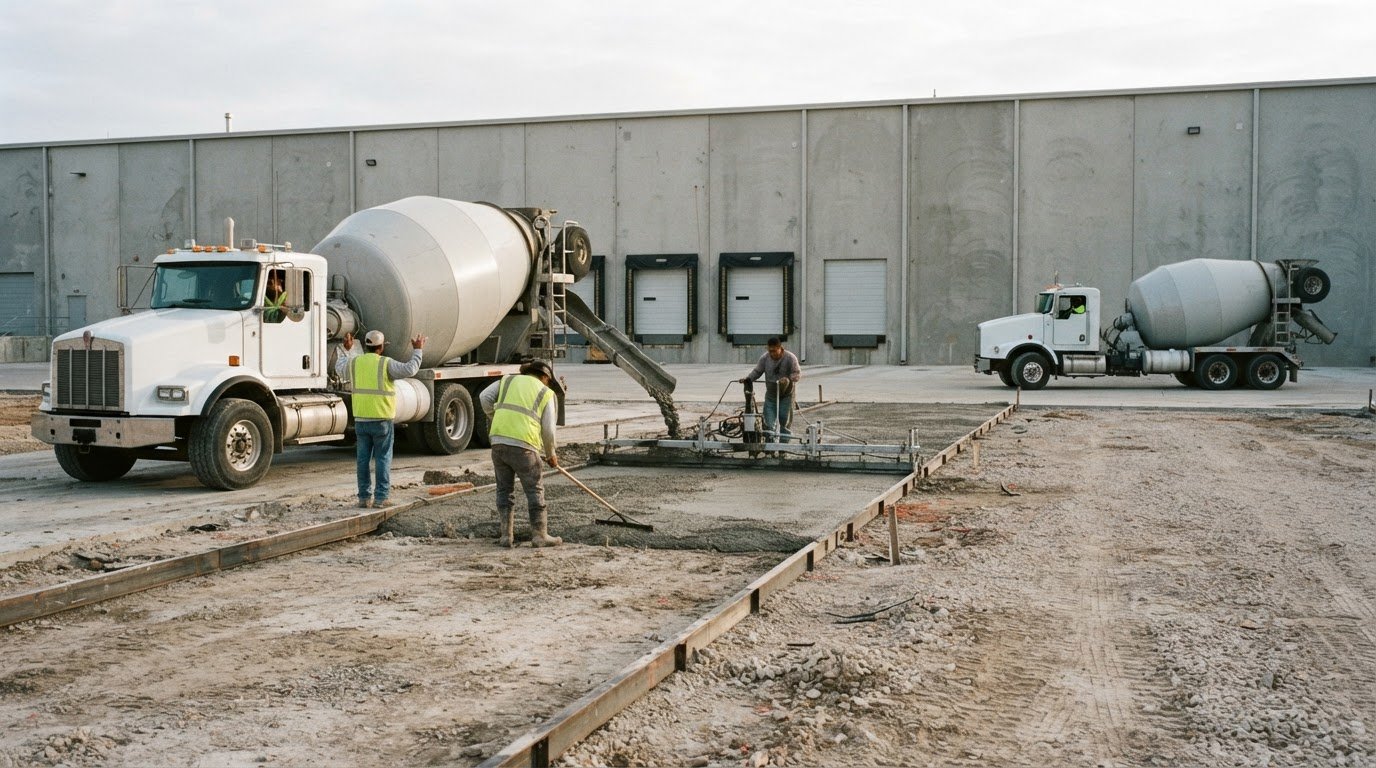
A concrete pour succeeds when delivery, placement, site access, and crew readiness work as one coordinated operation. Effective concrete pour logistics planning aligns truck arrival intervals with the placement method and crew capacity, while accounting for the route, staging area, pump setup, and finishing sequence. A workable schedule also includes a response plan for supply delays or equipment problems.
That level of coordination matters because a delay in one part of the operation can affect the rest of the pour. A professional plan establishes who is responsible for key tasks, what must be ready before delivery, and how the team will respond if conditions change. This article explains how delivery timing and placement speed fit together, what to account for when planning routes and site access, and how scheduling, inspections, and contingency measures support a controlled pour. It also clarifies how a concrete construction team can coordinate these details for a project with demanding placement requirements.
Key Takeaways
- Align delivery intervals with the crew’s placement capacity, pump output, and the full truck cycle.
- Coordinate placement, compaction, finishing, testing, and curing as one continuous sequence.
- Plan truck entry, staging, discharge, and exit around site conditions and access constraints.
- Build the pour schedule around readiness, inspections, weather decisions, and clearly assigned responsibilities.
- Set out responses to foreseeable disruptions, including pump failure, delivery delays, and pipeline blockage.
1. Coordinating delivery intervals with placement speed
Truck spacing should reflect the crew’s actual placement rate, not a fixed dispatch interval. Before dispatch, confirm the placement area, estimated quantity, method, and site readiness. The supplier contact and field lead should share dispatch updates so the crew can respond to traffic or access changes. For a large mat foundation, compare arrival intervals with pump output to support continuous placement. Effective concrete pour logistics planning matches supply to the work the crew can complete.
Load size and sequence depend on pour dimensions, placement method, and access constraints. Estimate quantity with thickness changes, footings, grade variations, and a reasonable waste allowance in mind. Sequence loads to match the placement area and the crew’s ability to receive, place, consolidate, and finish concrete. Dispatch planning should account for loading, travel, traffic, site entry, queuing, discharge, and the truck’s return cycle. Long waits at the gate can disrupt spacing even when trucks leave the plant on schedule.
Ready-mix prices and delivery fees vary across the United States. The cost depends on order quantity, engineered mix specifications, haul distance, delivery timing, and placement requirements. Project pricing is provided after a quote request.
Account for traffic restrictions before releasing trucks. The dispatcher and site team should consider route conditions, permitted access windows, congestion, and safe waiting locations. Confirm the jobsite address, approach route, discharge point, and pump requirements. If a restricted street or congested entrance could delay arrivals, adjust dispatch timing or plan a workable staging sequence. This links supplier timing to actual site access.
Delivery models can compare truck-cycle times with placement rates and highlight potential conflicts. AI-assisted modeling can test sequences using planned quantities, haul conditions, traffic assumptions, pump output, and crew capacity. For example, a model may show that arrivals exceed pump capacity and create a queue. The team can then revise intervals or phase the placement. Use model results alongside field conditions and the structural specification.
Coordination also supports the specified concrete strength and finish. The approved mix requirements, including strength, slump, aggregate, and admixtures, should suit the project specification and placement method. If delivery gaps interrupt continuous placement, fresh concrete may meet material that has begun to set, increasing the risk of an unintended construction joint. A practical schedule balances truck supply, pump capacity, crew readiness, and finishing speed, with room to adapt to access delays and changing field conditions.
2. Placement, compaction, finishing, testing and curing sequence
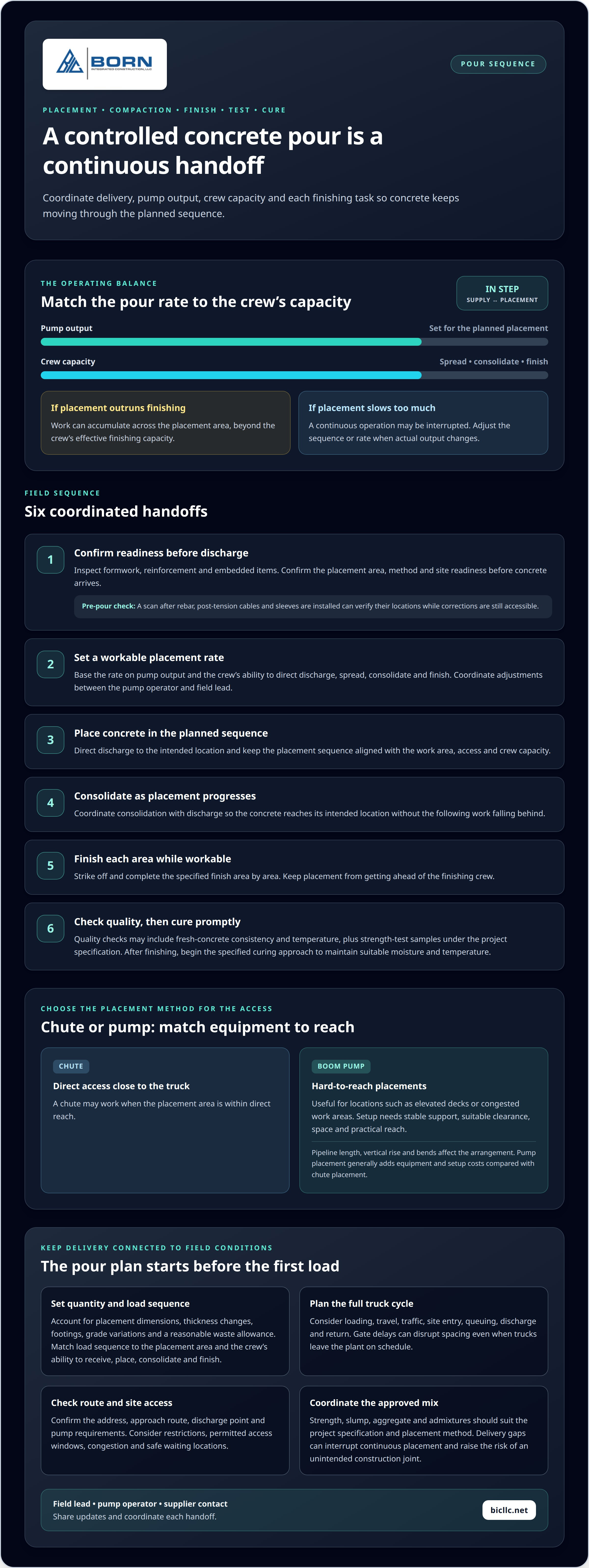
A controlled placement sequence moves concrete from discharge through consolidation, finishing, testing, and curing. The field lead coordinates each transition so concrete reaches its intended location without the finishing work falling behind. Set the expected placement rate according to pump output and the crew’s capacity to spread, consolidate, and finish the material. If the rate exceeds finishing capacity, work can accumulate across the placement area. If it is too slow, a continuous operation may be interrupted.
A boom pump suits placements that are difficult to reach by chute, such as an elevated deck or congested work area. Setup requires stable support, suitable clearance, enough space, and practical reach. Pipeline length, vertical rise, and bends also affect the arrangement. A chute may work for direct access close to the truck. Pump placement generally adds equipment and setup costs compared with chute placement, with the total depending on access, reach, pipeline configuration, and project requirements.
Assess crew capacity across the full sequence, not placement alone. Consider how quickly workers can direct discharge, consolidate concrete, strike off the surface, and complete the specified finish. The pump operator and field lead should coordinate adjustments when actual output changes. If delivery temporarily exceeds the crew’s capacity, revise the sequence or rate rather than letting concrete accumulate beyond effective finishing capacity.
Start volume planning with placement dimensions, then account for changes in slab thickness, footings, grade variations, and a reasonable waste allowance. Compare the total with the anticipated placement rate, pump arrangement, and available finishing crew. For example, a slab with stepped thickness needs a different quantity estimate from a uniform slab with the same footprint. The approved mix specification also matters: aggregate, workability, strength requirements, and admixtures must suit the placement method and project demands.
Before concrete placement, Juneau recommends laser scanning after rebar, post-tension cables, and sleeves are installed. The scan checks their locations while corrections remain accessible, rather than after concrete covers those components. Formwork, reinforcement, and embedded items also need inspection before discharge begins. This readiness sequence helps prevent a misplaced sleeve or incomplete inspection from disrupting the planned pour.
During discharge, place and consolidate concrete in the planned sequence, then finish each area while it remains workable. Quality checks may include fresh-concrete consistency and temperature, along with samples for strength testing under the project specification. Begin curing promptly after finishing, using the specified approach to maintain suitable moisture and temperature. Assign clear roles for each handoff, from placement and testing through surface protection, so completed concrete is not left exposed unnecessarily.
3. Planning truck routes, access, and staging
Route planning starts with the exact jobsite address, truck approach, discharge point, and pump requirements. Map where each vehicle enters, waits, discharges, and exits. This sequence helps keep arriving trucks from blocking active construction traffic or public roadways. Mark a staging area away from unstable ground, with enough space for safe truck movement.
Before dispatch, review the route for narrow entrances, tight turns, overhead restrictions, weak surfaces, and traffic constraints. A low overhead obstruction, for example, can rule out an approach even if the road is otherwise suitable. Consider whether a loaded truck can turn around or needs a separate exit. These details matter because a truck unable to reach the discharge point can delay pumping and interrupt placement.
Coordinate truck arrivals and pump logistics in one plan. The pump setup area needs stable support, adequate clearance, practical reach, and enough room for the boom or pipeline. Plan a route that brings each truck within the pump’s usable discharge area without crossing unsafe or congested zones. Pipeline length, vertical rise, and bends shape pump placement. Plan as well to support and protect the pipeline from movement or damage during the pour.
Arrival timing should reflect route conditions rather than dispatch time alone. Loading, travel, traffic, gate access, queuing, discharge, and the return cycle all affect truck availability. Extended hauls above 60-90 minutes can threaten initial slump, particularly in hot weather. A transportation post recommends monitoring drum revolution counters instead of relying only on dispatch-to-arrival time. The project team can use these details to identify delays and adjust the delivery sequence.
Truck mixing during transport helps maintain the uniformity and characteristics established during batching. The drum should continue mixing as intended for the concrete, while dispatch and field personnel communicate changes in travel time or site access. On arrival, direct each truck to its assigned waiting or discharge position and keep the route clear for the next vehicle. Controlled movement helps reduce avoidable congestion around the pump and placement area.
Safety planning covers vehicle movement, pump setup, overhead clearance, and worker access around the discharge point. Establish controlled truck paths, clear communication between drivers and spotters, and an exclusion area around equipment and active placement. Before discharge, confirm that the pump position, pipeline supports, access route, and nearby formwork are ready. These controls help manage struck-by, pinch-point, and equipment-movement risks without obstructing the pour.
For each delivery, connect the truck’s approach, staging position, pump access, discharge sequence, and exit in the route plan. If traffic restrictions narrow the arrival window, account for that constraint in dispatch timing and staging before the first truck arrives.
4. Concrete pour scheduling and site logistics
Build a dependable schedule by working backward from the planned pour date and assigning time for each prerequisite. Include forming, reinforcement, inspections, pump setup, placement, finishing, and curing. Complete required inspections before delivery day whenever possible. Confirm subgrade, reinforcement, and formwork readiness before dispatch to avoid trucks arriving while the placement area is incomplete.
Pull planning connects the pour date to procurement and field responsibilities. According to Juneau, concrete procurement scheduling works backward from the planned pour date, accounting for material transit, fabrication lead times, approvals, submittal preparation, and subcontractor award. Juneau also recommends three-week look-aheads as part of lean construction planning. These reviews help identify dependencies early, such as an approval that must precede a purchase or a pump setup that needs a cleared work area.
The order should state estimated yardage, engineered mix specifications, placement method, anticipated placement rate, and preferred pour date. Coordinate supply, pumping, placement, labor, access, testing, and finishing as one operational sequence. Assign people to delivery, mix verification, pumping, placement, testing, and washout. Clear responsibility prevents missed handoffs. For example, the person tracking mix verification can flag a discrepancy before unloading proceeds.
Protect the schedule with readiness checks at defined points. Before confirming delivery, verify subgrade, reinforcement, and formwork status, then align inspection completion with pump and crew availability. This sequence limits avoidable rework, such as moving reinforcement after inspection or resetting forms after concrete arrives. The pour plan should also identify joint locations according to structural specifications, so schedule changes do not lead to unreviewed shifts in placement.
Weather planning needs a decision-maker and a communication deadline. Decide in advance who makes the final weather call and when that decision must reach the supplier, pump crew, finishers, and testing personnel. Mix design, set time, and ambient conditions affect the plan. For a summer deck pour, an early start may be paired with coordinated mix adjustments and a curing plan to manage set time and moisture loss.
Plan finishing and curing around the expected placement sequence, not just truck arrival times. The finishing crew needs to be ready as each area reaches its finishing stage, while testing personnel coordinate checks and sampling under project specifications. Prepare curing materials and methods before placement so protection can begin promptly after finishing. If weather changes require a revised start, adjust labor, equipment, inspection timing, delivery, and curing arrangements together, rather than changing one calendar entry in isolation.
5. Contingency planning for equipment or supply problems
A pour contingency plan assigns responses before disruptions threaten placement. Identify likely problems, name the decision-makers, and establish how updates reach the crew and supplier. Consider pump failure, delivery delays, power loss, pipeline blockage, access problems, labor shortages, inspection delays, and unexpected changes in placement speed. Each scenario needs a clear response path, not an improvised decision during active placement.
For pump failure, establish who pauses or redirects delivery and who assesses the equipment. A pipeline blockage requires a controlled response from the pump operator and field lead, with personnel kept clear during troubleshooting. If power loss affects pumping or other equipment, communicate the interruption to dispatch and the placement crew. These steps help prevent more concrete arriving before the site is ready to receive it.
Supply delays call for direct communication with the supplier and a prompt review of the remaining pour sequence. Compare expected arrivals with placement progress, finishing capacity, and concrete already placed. If a gap threatens continuous placement, follow the project’s planned sequence and structural specifications. Construction joint locations should follow the structural design, not be chosen informally under schedule pressure.
Site contingencies include blocked truck access, unstable staging areas, and incomplete formwork or reinforcement. Identify who can pause arrivals, clear the route, or report a readiness issue. Assign a contact and decision point for inspection delays before delivery begins. If an inspection cannot be completed as scheduled, communicate revised timing to the supplier, pump crew, finishers, and testing personnel.
Weather planning requires a named decision-maker and a set time for communicating the final call. Consider forecast conditions alongside the mix design, concrete set time, placement method, and curing arrangements. A weather change may require revising the pour window, adjusting crew timing, or postponing delivery. Inform the supplier and site personnel promptly so trucks do not continue toward a site that cannot proceed.
A useful plan also states what information triggers escalation. For example, the field lead reports a pump stoppage, changed delivery estimate, or blocked access route to the designated coordinator. The coordinator records the issue, informs affected teams, and confirms the next operational decision. Clear roles reduce conflicting instructions during a time-sensitive pour and help preserve the intended placement sequence.
Reviewing concrete construction project examples can help frame the coordination required across complex site operations. A project-specific contingency plan should connect equipment, supplier communication, weather decisions, site access, and structural requirements before the pour window begins.
Born Integrated Construction
Born Integrated Construction provides concrete construction services including Slab on Grade, Podium Slabs, CIP Garages, and Concrete Paving. These projects often depend on coordinated sequencing, access, and site readiness. The company is a fit when a project needs concrete construction and placement coordinated as part of the work, rather than treating delivery logistics as a separate task. Project requirements, site conditions, and structural specifications inform how the work is organized. Contact Born Integrated Construction to discuss your concrete construction scope.
Put the Plan to Work on Your Project
A project-specific approach to concrete pour logistics planning gives the team a shared basis for decisions before field conditions demand quick responses. Connect the logistics plan to the broader construction sequence, including who communicates changes and who has authority to act. This makes coordination a working part of project delivery, not just a document used on pour day.
Bring the relevant project requirements, drawings, and anticipated site constraints into the planning conversation. With those details in view, the construction team can organize an approach suited to the work and its structural demands. Early coordination also clarifies how logistics decisions fit the project’s priorities.
Discuss your concrete project with Born Integrated Construction and take the next step toward a coordinated plan.
Frequently Asked Questions
How does a concrete contractor calculate the volume and order quantity for a pour?
Calculate the placement area and depth, then account for changes in thickness, footings, and grade. For an irregular pour, divide the layout into simpler shapes, estimate each separately, and combine the quantities. Include a reasonable waste allowance and check the estimate against project drawings. For example, a stepped slab needs separate depth calculations for each section, rather than one average depth across the full footprint.
How far in advance should a concrete contractor schedule ready-mix delivery?
No single lead time suits every pour. Scheduling depends on procurement requirements, approvals, supplier coordination, and site readiness. Work backward from the intended pour date, allowing time for mix submittals, material transit, inspections, and equipment arrangements. A project with outstanding approvals needs a different schedule from one with completed submittals and a ready site. Early coordination reveals dependencies before they affect the planned date.
What affects how many cubic yards per hour a concrete crew can place and finish?
The practical hourly rate depends on placement method, pump output, access, crew size and organization, and the area’s geometry. Finishing capacity matters as much as discharge speed: a crew unable to consolidate and finish concrete at the incoming rate may fall behind. Assess the full sequence and set the planned rate to suit actual conditions. Complex edges, changing slab depth, or restricted pump reach can also affect progress.
What site access, staging, and equipment should clients plan for concrete truck deliveries?
Plan a truck approach, assigned waiting area, discharge position, and clear exit route. The staging surface must support vehicles, and entrances and turns must accommodate truck movement. Pump placement also requires stable support, adequate clearance, and practical reach to the pour. On a constrained site, map vehicle movement and pump position together to reduce conflicts between deliveries, active construction, and workers moving through the area.
How do temperature, rain, wind, and hot or cold weather affect concrete pour logistics?
Weather can change concrete set behavior, placement timing, and curing needs, so coordinate the pour window with the mix design and site conditions. Heat may increase moisture loss and shorten workable time; cold conditions can affect setting and curing. Rain and wind can complicate placement and surface protection. Establish who makes the weather decision, how changes reach affected crews, and what curing approach will be ready before placement.
What permits, traffic controls, and local rules should a concrete contractor account for when planning truck access and street pours?
Identify the project jurisdiction and determine which approvals or traffic controls apply to the planned access and work area. Requirements may depend on whether trucks use public streets, occupy a right-of-way, or restrict traffic. For projects in Texas, including Houston, Austin, San Antonio, Dallas, Fort Worth, San Marcos, New Braunfels, Boerne, Beaumont, Conroe, Woodlands, and Arlington, incorporate jurisdiction-specific requirements into the schedule before finalizing delivery timing.
What backup plans can a concrete contractor use to reduce delays, cold joints, and concrete waste during a pour?
A useful contingency plan assigns responses to pump failure, blocked pipelines, delivery delays, power loss, and changing placement speed. Set communication responsibilities and determine when dispatch should pause or revise deliveries. For example, if pumping stops, the field lead can notify the supplier while the crew reviews the planned placement sequence. The plan should also establish how structural joint locations guide decisions if an interruption makes continuous placement impractical.