
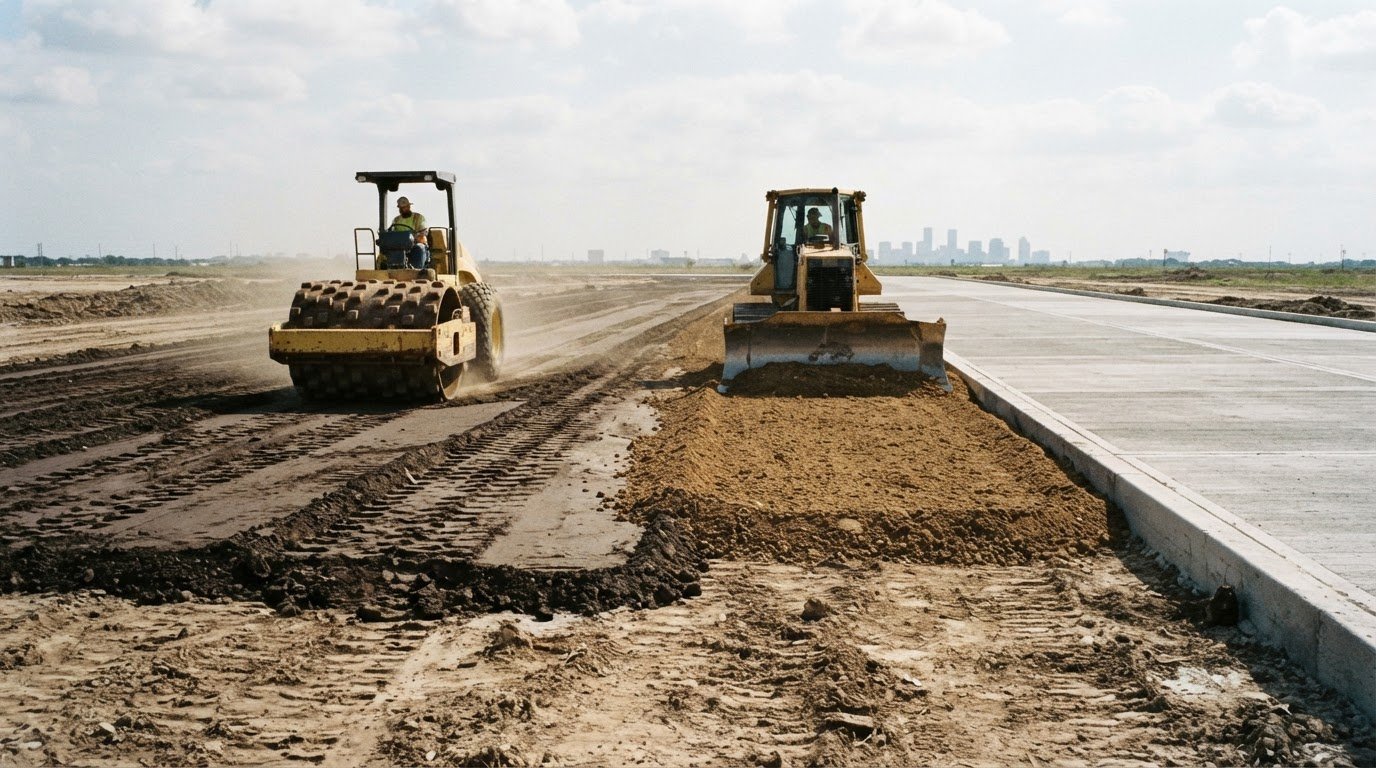
Earthwork project scheduling turns a site’s scope into an ordered plan for tasks, timing, crews, and equipment. A construction schedule shows what work must happen, in what sequence, how long activities are expected to take, and which resources each phase needs. It coordinates work from initial excavation through grading and the handoffs that follow.
That structure matters because earthwork activities depend on one another. Unclear quantities or poorly timed transitions can leave crews and equipment waiting or lead to rework. A useful schedule connects site-specific cut-and-fill quantities and production assumptions to a timeline the project team can track and adjust.
This guide explains how to define scope with a work breakdown structure, estimate task durations, sequence dependent work, and display the plan in a timeline or location-based chart. It also covers assigning crews and equipment, reviewing progress with look-ahead schedules, and updating the plan when actual production differs from expectations. Together, these steps provide a practical framework for coordinating earthwork and knowing what needs to happen next.
Key Takeaways
- Break the project into clearly defined work packages, ensuring their combined scope accounts for the full project.
- Use site-specific earthwork quantities and task dependencies to build a schedule grounded in the work that must be completed.
- Choose a timeline view that makes task order, duration, and location easier to understand and coordinate.
- Plan crews and equipment around task needs, then adjust assignments when activities compete for the same resources.
- Review upcoming work and compare planned progress with actual production so schedule conflicts can be addressed early.
Defining project scope and tasks with a work breakdown structure
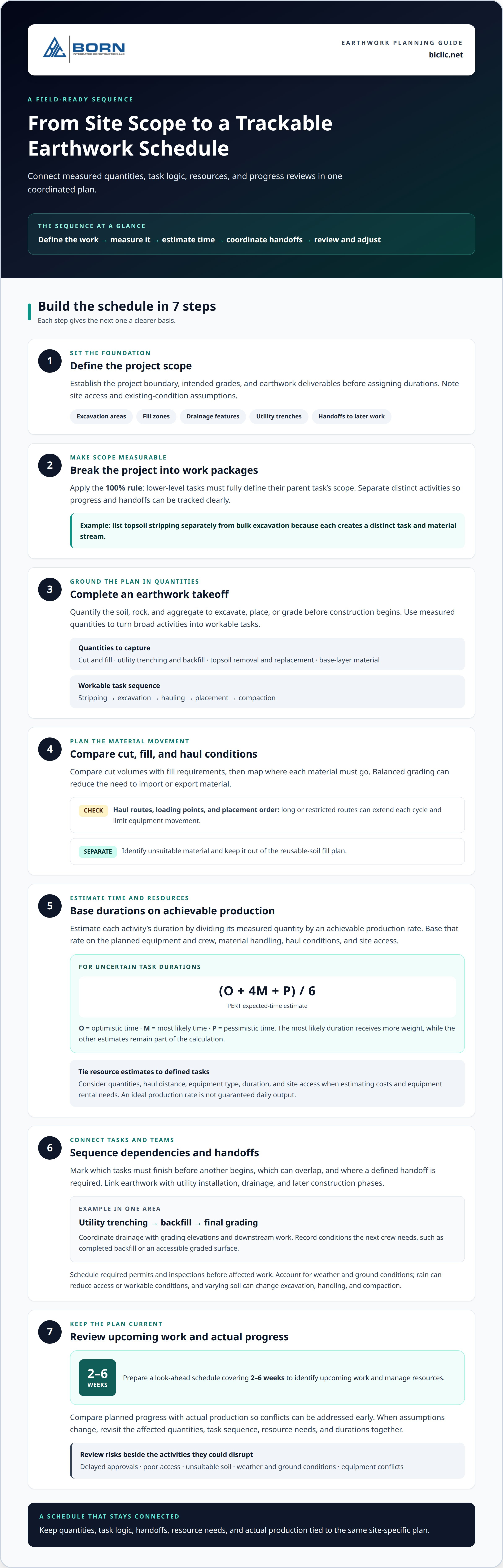
Start the work breakdown structure by dividing the construction project into measurable earthwork activities. Apply the 100% rule: lower-level tasks must fully define their parent task’s scope.
-
Define the Project Scope
Establish the project boundary, intended grades, and earthwork deliverables before assigning durations. Identify excavation areas, fill zones, drainage features, utility trenches, and handoffs to later construction. For example, list topsoil stripping separately from bulk excavation, since each creates a distinct task and material stream. Record assumptions about site access and existing conditions so the schedule reflects the defined work.
- Measure the site with an earthwork takeoff before setting task durations. A takeoff quantifies the soil, rock, and aggregate to excavate, place, or grade before construction begins. It can include cut-and-fill quantities, utility trenching and backfill, topsoil removal and replacement, and base-layer material. Use these quantities to break broad activities into workable tasks, such as stripping, excavation, hauling, placement, and compaction.
-
Evaluate Cut-and-Fill and Haul Distances
Compare cut volumes with fill requirements, then map where each material must go. Balanced grading can reduce the need to import or export material, but the schedule also depends on haul routes, loading points, and placement order. Long or restricted routes can extend each cycle and limit equipment movement. Identify unsuitable material and separate it from reusable soil so the fill plan does not rely on material that cannot serve that purpose.
- Build permitting and inspection milestones into the activity sequence. Applicable permits, regulations, and inspection requirements depend on the project’s location, scope, and site conditions, so schedule required reviews before the affected work. Account for weather and ground conditions in task logic: rain can reduce access or workable conditions, while varying soil can change excavation, handling, and compaction. Use site-specific assumptions rather than assigning the same duration to every area.
- Estimate costs and equipment rental needs using quantities, haul distance, equipment type, duration, and site access. Since costs and rental rates vary with project conditions, tie each resource estimate to defined tasks instead of relying on a generic allowance.
List risks beside the activities they could disrupt, such as delayed approvals, poor access, unsuitable soil, or equipment conflicts. Reduce their impact by clearly sequencing dependent tasks, identifying alternate work areas, and reviewing quantity assumptions before crews mobilize.
Earthwork takeoffs can provide cut-and-fill quantities for balanced grading. Use them to align excavation, hauling, and placement with the defined scope, and show how material movement connects each activity. List risks beside the tasks they may affect, including access limits, unsuitable material, weather, ground conditions, and required reviews. Define task boundaries so each handoff can be tracked without leaving part of the work unclear. When assumptions change, revisit the affected quantities, sequence, resource needs, and durations together. This keeps the schedule tied to the scope instead of treating each task as an isolated estimate.
Construction schedules and schedules of works
Turn measured earthwork quantities into a sequence of activities, durations, and handoffs. A construction schedule connects field production to the wider project, while a schedule of works sets out planned activities and timing. Effective earthwork project scheduling makes these connections visible to the teams carrying out and coordinating the work.
-
Estimate Production and Duration
Estimate each activity’s duration by dividing its measured quantity by an achievable production rate. Base the rate on planned equipment, crew, material handling, haul conditions, and site access. For example, estimate excavation separately from hauling and placement, since each involves different resources and operating conditions. Do not treat an ideal production rate as guaranteed daily output.
For uncertain task durations, PERT estimates expected time with the formula (O + 4M +P) / 6, where O, M, and P are the task’s three time estimates. This weighted estimate gives the most likely duration more influence while retaining optimistic and pessimistic possibilities. Apply it to activities with variable conditions, then use the resulting duration to build a realistic sequence.
- Set activity logic before assigning calendar dates. Mark which tasks must finish before another begins, which can overlap, and which require a defined handoff. For instance, sequence utility trenching and backfill before final grading in the same area. Coordinate drainage installation with grading elevations and downstream work so teams do not obstruct completed areas or repeat work.
-
Coordinate Construction Phases
Link earthwork tasks with utility installation, drainage, and later construction phases in one coordinated schedule. Identify the area each activity occupies, its access needs, and the condition required for the next crew to proceed. Avoid simultaneous work when crews, haul routes, or equipment would conflict. Record handoff requirements, such as completed backfill or an accessible graded surface.
- Prepare a look-ahead schedule covering 2-6 weeks to identify upcoming work and manage resources. Break the period into activities with clear locations, predecessor tasks, material needs, and assigned crews or equipment. Use it to identify constraints early, such as a pending handoff or a material delivery that affects placement. Update the look-ahead as completed work and current conditions change.
- For linear earthwork, use a location-based schedule to show where work occurs over time. A time-location chart places location on one axis and time on the other; the planned activity’s slope represents its production rate. Compare planned and actual slopes to identify possible overlaps or conflicts early. If progress diverges from the plan, revise the sequence, production assumptions, or resource assignments rather than keeping outdated dates.
- Review schedule adjustments with the people coordinating connected phases. Sound earthwork project scheduling links changes to excavation or grading with their effects on utility access, drainage installation, and follow-on work. Record affected tasks and handoffs together so updates stay consistent across the project, rather than resolving one activity while creating a conflict elsewhere.
Gantt charts, network diagrams, and 4D BIM
Choose a schedule view that makes task duration, dependencies, and work interfaces clear. Gantt charts, network diagrams, and 4D BIM each present a different part of construction coordination.
- Build a Gantt chart to display each earthwork activity as a bar across a timeline. Set each bar’s start and finish based on its planned duration, then show overlapping work where crews can proceed independently. For example, the chart can place site stripping before bulk excavation and show separate zones progressing at the same time. Include handoff milestones, such as an area becoming available for utility installation.
Use consistent task names in the chart and schedule of works. This lets the team trace each bar to a defined activity instead of interpreting vague labels. Keep the view focused on the decisions it supports: sequence, duration, overlap, and upcoming handoffs.
- Map task dependencies in a network diagram before finalizing dates. Connect each activity to its prerequisites so the sequence shows what can begin and what must wait. For example, a drainage connection may depend on excavation access, while final grading may depend on completing underground work. The diagram reveals chains of dependent tasks that may be less apparent in a calendar view.
Identify the critical path, the sequence of dependent activities that determines the earliest possible project completion. Review its tasks when considering adjustments. A delayed activity outside the path may have room to move, while a delay on the path can affect later milestones. Use the network as a logic check, not simply as another version of the Gantt chart.
- Connect the Gantt chart and network diagram using shared activity names and dates. A change to a predecessor should carry through to dependent tasks rather than leaving conflicting views. For example, if excavation in one area takes longer, revise the linked utility and grading activities. This alignment supports coordination between field teams and schedule reviewers.
- Use 4D BIM when the project has a relevant 3D digital building model. 4D BIM links a 3D digital model of a building with time or schedule-related information, representing construction over time. The sequence can help teams see how scheduled work relates spatially to the modeled structure, such as where earthwork enables a later building phase.
Keep the model sequence consistent with the schedule’s activities. A visual simulation is useful only when its task order and timing match the working plan. Review model views at key handoffs, including transitions from site preparation to building work, and correct mismatches before relying on them for coordination.
- Select the view based on the question the team needs to answer. Use a Gantt chart to review timing, a network diagram to inspect dependencies, and 4D BIM to understand the relationship between modeled construction and time. Together, these views make the schedule easier to interpret without replacing clear task definitions or regular progress updates.
Resource allocation and leveling
Assign each crew and machine to a defined activity, work area, and time period. Resource leveling resolves conflicts when the schedule assigns the same equipment or personnel to multiple places at once.
- List the resources each activity needs before assigning them. An excavation task may require an excavator, haul trucks, operators, and workers directing placement. A separate grading task may need a dozer, grader, and compaction equipment. Match resources to the task’s location and production method rather than treating all earthwork crews as interchangeable.
- Identify equipment and crew requirements that affect the schedule. Production depends on the machines selected, operator availability, crew composition, haul conditions, and work sequence. For example, excavation may slow if trucks cannot reach the loading area or the placement crew cannot accept material. Record these dependencies with the activity instead of assuming equipment operates in isolation.
- Check scheduled activities for resource conflicts. If one excavator is assigned to two work areas at once, sequence the tasks or assign another suitable machine. Make the same check for shared haul trucks, operators, and compaction equipment. A resource-loaded schedule makes competing assignments visible before they cause idle time or disrupt a handoff.
- Level the schedule by moving flexible tasks while preserving required dependencies. For example, shift grading in an available zone if the same crew must first complete a constrained excavation area. Confirm that the change does not block utility access, drainage work, or a planned construction handoff. Document the revised dates and affected assignments together.
- Coordinate equipment capacity with material flow for each task. Excavation, hauling, placement, and compaction must work as a connected operation. If trucks deliver material faster than the placement crew can handle it, congestion can build. If hauling falls behind, downstream crews may wait. Adjust resources or the activity sequence to keep each stage aligned.
- Review assignments against actual progress when updating the schedule. Compare completed quantities with planned production, then identify whether a delay stems from equipment, crew availability, access, or task coordination. For example, if grading falls behind because the dozer is shared with another area, revise the assignment and update dependent activities. Keep the resource plan aligned with the current schedule.
Use earthwork takeoffs to check whether planned crews and equipment can support the sequence. Takeoffs can inform realistic project timelines and resource planning. Connect quantities to the activities that produce, move, place, and compact material, then compare the workload with the assignments in the schedule. This grounds the plan in project scope rather than broad assumptions about crew capacity.
When quantities or work areas change, revisit the resource plan alongside affected activities. Confirm that the revised workload fits available equipment, personnel, access, and handoffs, then adjust the sequence as needed. Record the reasoning with the schedule update so the team can see which assignment changed and what downstream work may be affected. Apply the same review when actual production differs from the plan, distinguishing a quantity change from a resource conflict before shifting crews or equipment.
What are the steps to create an earthwork project schedule?
Earthwork project scheduling starts by defining the work, then connecting activities, durations, resources, and updates. Build the plan in sequence so field decisions follow a coordinated schedule rather than disconnected assumptions.
- Gather the drawings, site information, quantity takeoffs, and project milestones. Confirm work limits, planned grades, access points, and required handoffs. Keep assumptions visible, especially where field conditions may affect quantities or access. These inputs define the schedule’s boundaries and help keep unrelated tasks out of the earthwork plan.
- Divide the defined scope into activities that can be assigned and tracked. Separate stripping, excavation, hauling, placement, compaction, and finish grading when each involves a distinct operation. Divide large areas into practical work zones. Name activities consistently so the schedule, field updates, and coordination records refer to the same work.
- Estimate durations using task quantities and achievable production rates. Consider equipment, crew composition, haul conditions, and working space for each activity. Keep excavation, hauling, and placement estimates distinct when their production differs. Record the assumptions behind each duration so the team can identify which condition needs adjustment if progress changes.
- Connect activities through clear dependencies and handoffs. Mark which tasks must finish before others begin and which can proceed concurrently. For example, schedule utility installation before final grading in the same zone. Include drainage interfaces and access needs so one crew’s sequence does not prevent another from reaching its work area.
- Assign equipment and crews to each activity, then resolve overlapping demands. Check whether shared machines, operators, or haul routes appear in simultaneous assignments. Move flexible work when needed while preserving the required task order. A schedule is workable only when its durations and sequence match the resources available for each operation.
- Display the plan in a format that supports field coordination. Use a Gantt chart to show timing and a network diagram to review dependencies. For linear work, a location-based view can show how production moves across the site. Keep task names and dates aligned across schedule views to avoid conflicting versions.
- Set the approved sequence and durations as the working baseline. During updates, compare completed quantities and locations with planned progress. Record delays, changed conditions, and affected handoffs, then revise dependent activities and resource assignments together. This keeps earthwork project scheduling useful for current decisions instead of merely preserving the original dates.
For help coordinating earthwork scope and project sequencing, discuss your project plan.
Born Integrated Construction: Earthwork
Born Integrated Construction provides earthwork for projects that need site preparation coordinated with construction work that follows. Turn to the team when project scope includes excavation, grading, or the transition from prepared ground to concrete work. Its offerings include Earthwork, Concrete Paving, Slab on Grade, and Podium Slabs.
Clear sequencing aligns earthwork activities with the next phase, including access and handoffs between site work and concrete construction. Discussing the planned scope and project sequence helps establish how these activities fit together.
Contact Born Integrated Construction to discuss your earthwork project.
Put the Schedule to Work
A schedule delivers value when it guides decisions throughout the work, not just during initial planning. Establish who records field progress, who reviews changes, and how revised dates reach affected teams. Clear ownership helps keep the working plan aligned with site conditions and project priorities.
Use earthwork project scheduling as an ongoing coordination practice. When scope, access, or production conditions change, assess which decisions and handoffs are affected before changing dates. This keeps updates connected to upcoming work and gives the team a consistent basis for planning its next actions.
As the project moves toward execution, a conversation about the planned work can clarify where earthwork fits within the broader construction sequence. Contact Born Integrated Construction to discuss your project. With a defined plan and clear coordination, your team can move forward with greater purpose.
Frequently Asked Questions
Which software and methods are best for scheduling earthwork projects?
Texas projects need scheduling software that links activities, dependencies, crew assignments, and field progress in one plan. Choose capabilities before a brand: a straightforward site may need editable task dates and crew loading, while phased work across Houston, Austin, San Antonio, Dallas, Fort Worth, San Marcos, New Braunfels, Boerne, Beaumont, Conroe, The Woodlands, or Arlington may benefit from location tracking and model coordination. Assign one person to maintain updates and define how field changes enter the schedule.
What permits, regulations, and inspection requirements can affect earthwork timelines in the United States?
Required permits, regulations, and inspections depend on the project’s location, scope, and site conditions. Schedule the required reviews before affected work begins.