Houston Underground Utility Guide for Developers

The success of a Houston development often rests on what remains invisible once the project is complete. While the skyline captures the attention, the integrity of the storm, sanitary, and water systems determines whether a site remains operational or becomes a liability. Most developers recognize that Houston's expansive clay soils and rigorous municipal drainage standards create a high stakes environment where a minor oversight in trenching leads to failed pressure tests and significant delays. It's a reality that demands precision and a deep understanding of local ground conditions.
Securing a reliable underground utility installation contractor Houston ensures your infrastructure is built to withstand local geological pressures while meeting all regulatory requirements. This guide offers a comprehensive technical roadmap for mastering these complexities, from navigating the latest Infrastructure Design Manual updates to integrating utility work with mass excavation and paving stabilization. You'll gain the essential insights needed to deliver a turn-key civil solution that prioritizes reliability, safety, and long term structural stability. We examine the standards for technical execution that ensure your project passes every municipal inspection and stands the test of time.
Key Takeaways
- Understand why Houston’s flat topography and expansive clay soils demand specialized engineering to prevent system failures and drainage issues.
- Identify the specific material requirements and trench bedding techniques necessary to maintain the integrity of storm, sanitary, and water systems.
- Navigate the complex regulatory landscape of the City of Houston and Harris County to ensure all infrastructure passes mandatory pressure and vacuum tests.
- Learn the benefits of engaging a turn-key underground utility installation contractor Houston who can seamlessly coordinate mass excavation with utility placement.
- Gain insights into capacity planning for high-density developments to ensure long-term reliability and minimize future maintenance costs.
The Critical Role of Underground Utility Installation in Houston Site Development
Underground utility installation serves as the functional backbone of any commercial or residential development. In Houston, where the topography is notoriously flat, precision is a requirement rather than a preference. Even a slight deviation in pipe grading can compromise gravity-fed systems, leading to drainage failure and regulatory rejection. Every developer understands that Subsurface Utilities must be established correctly the first time to avoid the compounding costs of rework. Selecting a qualified underground utility installation contractor Houston is the first step in ensuring a project remains on schedule and within budget.
Utility delays often trigger a cascade of financial setbacks. When underground systems fail inspection, it halts mass excavation, delays concrete paving, and pushes back the delivery of the final structure. These disruptions lead to increased carrying costs and potential liquidated damages. Transitioning to a "Turn-Key Civil" model has become the modern standard for project efficiency. This approach integrates earthwork and utility placement into a single, cohesive workflow, ensuring that every phase of the site development supports the next without the friction of multi-vendor coordination.
Why Site Preparation and Utility Integration Matter
Effective utility installation begins long before the first pipe is laid. Mass soil excavation sets the foundational grade for the entire site. If this stage is handled by a separate contractor from the utility team, communication gaps often lead to grading errors that aren't discovered until it's too late. Using an integrated approach is a method to eliminate site coordination errors by ensuring that earthwork and utility teams work from the same logistical plan. This synergy ensures that detention ponds and trench depths align perfectly with the overall site plan, reducing the risk of costly field adjustments during the critical path of construction.
Navigating Houston’s Unique Geological and Drainage Challenges
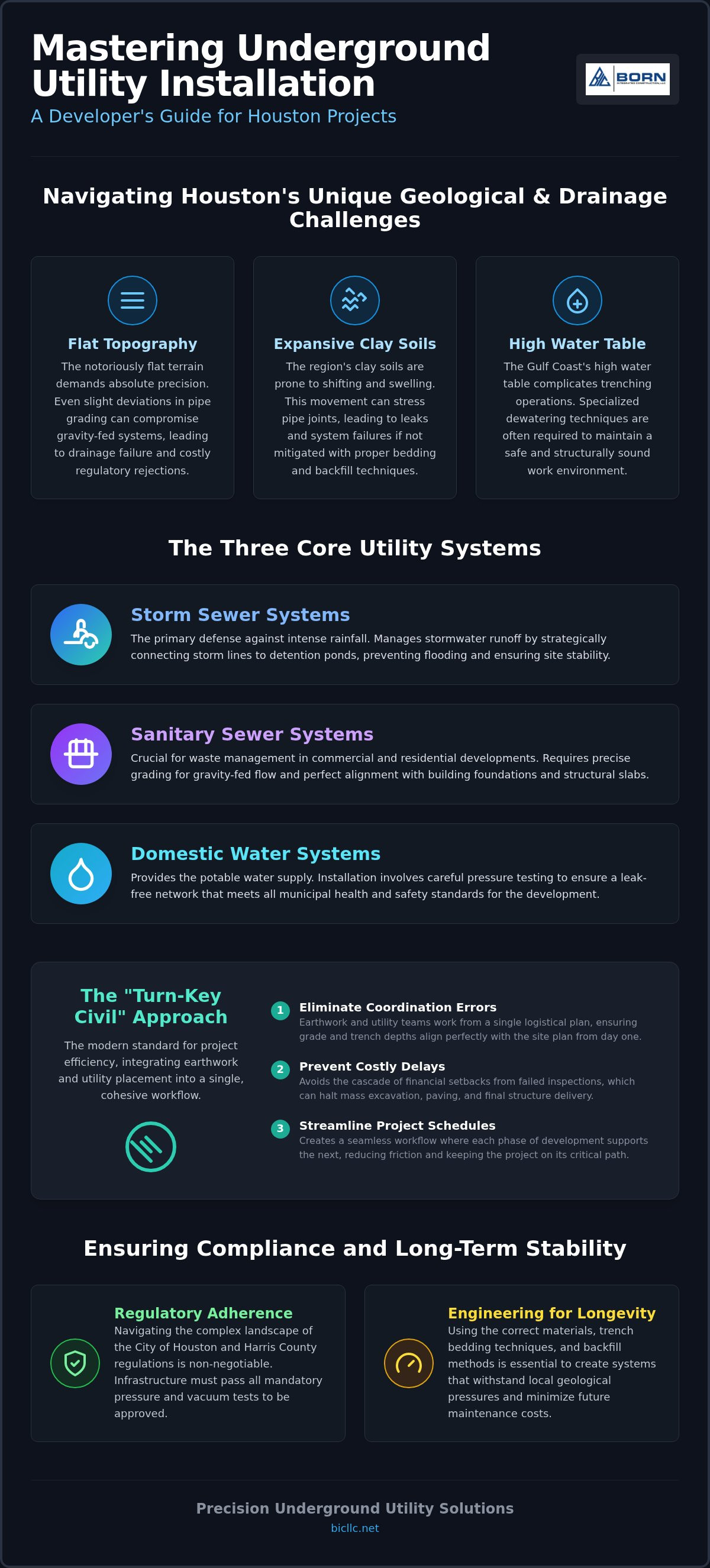
Houston's environment presents specific technical hurdles that require a disciplined hand. The region's expansive clay soils are prone to shifting, which can stress pipe joints and lead to system leaks if not properly mitigated through correct bedding and backfill. Additionally, the high water table in the Gulf Coast region complicates trenching operations, often requiring specialized dewatering techniques to maintain safety and structural integrity. A seasoned underground utility installation contractor Houston understands these variables and employs rigorous standards to ensure long-term stability. Our team has deep roots in the local market; you can learn more about our commitment to these standards on our about page. We prioritize reliability in every trench we dig, building infrastructure that stands the test of time.
Essential Underground Utility Systems for Commercial Developments
Commercial site success depends on the meticulous coordination of three primary systems: storm, sanitary, and domestic water. For high-density multi-use developments, capacity planning becomes a critical exercise in engineering foresight. These systems don't just provide services; they must integrate physically with the structural concrete foundations and podium slabs that form the building's skeleton. An experienced underground utility installation contractor Houston ensures that stub-outs and main lines align perfectly with cast-in-place garages and structural footings. This level of precision prevents costly structural modifications after the concrete has set. During the deep trenching required for these systems, adherence to federal excavation safety requirements is non-negotiable to protect personnel and project timelines.
Storm Sewer Systems and Stormwater Management
Storm sewer systems are the primary defense against the intense rainfall common in the Gulf Coast. Proper installation involves more than just burying pipe; it requires a strategic connection between storm lines and detention pond construction to manage runoff effectively. High-capacity concrete pipes and custom cast-in-place structures are often required to meet municipal drainage volumes. The grading must be exact to ensure water moves efficiently toward outfalls, preventing localized ponding that can compromise paving stabilization or structural integrity. For developers seeking a turn-key partner, exploring integrated civil solutions is the best way to ensure these systems work in harmony from day one.
Sanitary Sewer and Domestic Water Line Installation
Sanitary sewer installation relies on unwavering standards for line grading to maintain reliable gravity flow. In areas where the local topography lacks the necessary slope, the role of lift stations becomes vital to move effluent to municipal mains. Simultaneously, domestic water systems must be engineered for both daily consumption and fire line demands. Fire line installation requires specific pressure ratings and backflow prevention to meet safety codes. Coordinating these various lines within the tight footprints of modern developments is a task for a partner who understands the full civil scope. You can view examples of these integrated systems in our completed projects. We focus on establishing infrastructure that supports the long-term viability of the development through operational precision and technical proficiency.
Engineering for Longevity: Materials and Installation Techniques
Long-term infrastructure reliability begins with a precise understanding of the chemical and physical properties of the project site. In the Gulf Coast region, an underground utility installation contractor Houston must account for high sulfate levels and acidity in the soil that can accelerate the degradation of certain materials. Selecting the correct pipe is a matter of matching the material’s structural capacity with the site’s specific load requirements and soil chemistry. Every choice made during the design phase impacts the enduring nature of the development's foundation.
Comparing Pipe Materials: RCP, PVC, and Ductile Iron
Reinforced Concrete Pipe (RCP) remains the standard for large-scale storm sewer systems due to its immense load-bearing capacity. It's particularly effective under heavy commercial paving where traffic loads are significant. Conversely, PVC is often preferred for sanitary sewer lines because it resists the corrosive gases found in effluent and provides a smoother interior for consistent flow. For high-pressure domestic water and fire lines, Ductile Iron offers the necessary tensile strength, though it requires specific coatings or polyethylene encasement to survive Houston’s corrosive clay. Adhering to ASCE's utility engineering standards ensures that these material choices align with national best practices for durability and safety.
Excavation and Bedding: Preventing System Failure
The method of installation is just as critical as the material itself. Proper trench bedding acts as a structural cradle that prevents pipe deflection, which is a leading cause of joint failure in expansive soils. We utilize select fill and aggregate bedding to provide a stable foundation that distributes loads evenly across the pipe’s surface. Compaction standards must be strictly enforced during the backfill process. Poorly compacted trenches lead to future settling, which eventually manifests as unsightly cracks in the final concrete paving. Precision in the trench is the only way to guarantee the system passes municipal pressure and gravity tests.
Before any final paving occurs, soil stabilization is necessary to create a rigid platform over the utility corridors. This process often involves the use of lime or cement to neutralize the reactive properties of the clay. Additionally, we employ specialized structural concrete for the construction of utility manholes and vaults. These structures must be cast with precision to ensure they integrate seamlessly with the broader site design. This level of technical execution is similar to the requirements found in expert podium slab construction, where structural integrity and underground coordination are paramount. By managing the transition from deep utilities to surface structures, we deliver a cohesive and enduring result.
Navigating the Regulatory Landscape and Safety Standards
Adhering to City of Houston and Harris County drainage regulations is more than a legal obligation; it's a fundamental aspect of site stability. A seasoned underground utility installation contractor Houston manages the rigorous inspection and testing phase, including the pressure and vacuum tests required for municipal acceptance. These tests confirm that the sanitary and water systems are hermetically sealed and correctly graded. Regulatory compliance should be viewed as a byproduct of operational integrity. When a project is executed with technical proficiency, it naturally meets the stringent requirements set by local authorities. This disciplined approach ensures that the infrastructure remains a long term asset rather than a liability.
Permitting and Compliance for Houston Utility Projects
The timeline for utility permitting in the Houston area varies based on project complexity, but early engagement with municipal departments is essential to prevent bottlenecks. Detention ponds play a vital role in this process, serving as the primary mechanism for meeting stormwater detention requirements. These ponds must be engineered to specific volume standards to mitigate downstream flooding. Providing accurate "As-Built" drawings is another critical step. These documents serve as the permanent record of the subsurface infrastructure, facilitating future site maintenance and ensuring the project meets the latest environmental and drainage codes. Maintaining a clear hierarchy of documentation is essential for the long term viability of any large scale infrastructure project.
Safety Protocols in Deep Trenching and Excavation
Deep trenching presents significant risks that require disciplined mitigation. We utilize trench boxes and shoring systems to provide reliable worker protection in unstable soils. Adhering to OSHA standards for excavation is a core pillar of our operational framework. This includes the presence of a "Competent Person" on site who is trained to identify hazards and has the authority to take corrective action. Born Integrated Construction maintains a steadfast commitment to a zero-accident safety culture. We believe that no project is successful unless every team member returns home safely. If you are planning a complex development, partner with a turn-key civil expert who prioritizes safety and regulatory precision.
Selecting the Right Underground Utility Installation Contractor in Houston
Selecting an underground utility installation contractor Houston requires a thorough evaluation of operational capacity and local reputation. Large-scale infrastructure projects are complex, demanding a partner with the financial stability to manage material procurement and the vendor relationships needed to secure resources during market shifts. A contractor's history of safety and quality performance serves as the most reliable indicator of future success. In the Houston market, local expertise is non-negotiable. A firm must understand Harris County drainage requirements and regional soil behaviors to deliver infrastructure that passes municipal tests without costly rework. This professional stability is what separates a vendor from a strategic partner. It’s about finding a disciplined professional who values substance over style and focuses on building lasting foundations. Safety and integrity aren't just buzzwords; they're the pillars of a successful civil project. Reliable infrastructure is the result of a deep-rooted commitment to high standards and long-term viability. Choosing a partner who understands the act of establishing and maintaining consistent value is essential for avoiding the delays and failures that plague less organized operations.
The Advantage of Integrated Civil Site Work
The modern standard for project efficiency is the turn-key civil model. By integrating utilities with mass soil excavation, developers can significantly reduce the total project duration. Cost savings are realized through optimized equipment mobilization and streamlined site management. Most importantly, integrated services provide a single point of accountability. When one firm manages the entire civil scope, the risk of communication gaps between separate teams is eliminated, ensuring a steady and predictable construction experience that prioritizes the enduring nature of the final output.
Born Integrated Construction: Reliability from the Ground Up
Born Integrated Construction (BIC) is built on safety, integrity, efficiency, and quality. We offer a comprehensive breadth of services from detention ponds to specialized structural concrete for garages. We invite you to view our completed infrastructure projects to see our results. As an underground utility installation contractor Houston, we lead through unwavering consistency and meticulous management. We don't just lay pipe; we establish the infrastructure that supports long-term commercial success and operational precision. Our team projects the image of a seasoned expert who acts as a dependable partner for every developer.
Building a Foundation for Long-Term Development Success
Mastering the complexities of Houston's subsurface environment requires a synthesis of technical precision and local regulatory knowledge. Success isn't merely about laying pipe; it's about ensuring every storm, sanitary, and water system integrates seamlessly with the broader site preparation and structural concrete requirements. By prioritizing proper material selection and rigorous testing protocols, developers protect their projects from the risks of soil shifting and drainage failure. This disciplined approach ensures that the invisible infrastructure remains a durable asset for the life of the development.
Securing a partner who offers turn-key civil solutions from mass excavation to final paving stabilization provides a single point of accountability that streamlines the entire construction process. Finding a seasoned underground utility installation contractor Houston is the most effective way to manage these variables while maintaining a steadfast commitment to safety and integrity. Our deeply established expertise in the Texas infrastructure market ensures your project is built with operational precision. We invite you to Partner with Born Integrated Construction for Your Next Infrastructure Project. Let's work together to build a legacy of reliable and enduring infrastructure.
Frequently Asked Questions
What are the main types of underground utilities installed for commercial sites?
The primary types of underground utilities include storm sewers, sanitary sewer lines, and domestic water systems. Storm systems are designed to manage large volumes of runoff, while sanitary lines transport effluent to municipal mains. Domestic water lines provide essential potable water and fire protection services. Each system requires specific materials and grading to ensure operational precision. These components must be integrated with the overall site plan to support long-term structural viability.
How does Houston’s soil impact the cost of utility installation?
Houston's expansive clay soils and high water table necessitate specialized installation techniques that influence project complexity. The reactive nature of the clay often requires the use of select fill and aggregate bedding to prevent pipe deflection or joint failure. Additionally, deep trenching in the Gulf Coast region frequently requires dewatering systems to maintain a safe and dry working environment. These technical requirements ensure the infrastructure remains stable despite the challenging regional geological conditions.
Why is a detention pond necessary for my underground storm sewer system?
Detention ponds are essential for managing the rate of stormwater runoff from a developed site into the municipal system. Houston and Harris County regulations require these structures to prevent downstream flooding during heavy rainfall events. The underground storm sewer collects water and directs it to the pond, which holds the volume and releases it at a controlled rate. This integrated approach is a requirement for meeting local drainage codes and ensuring environmental responsibility.
What is the difference between a private utility and a public utility connection?
A private utility refers to the infrastructure located within the property lines of a development, which the owner is responsible for maintaining. In contrast, a public utility connection is the point where the private system ties into the municipal main. An underground utility installation contractor Houston must ensure that the private system meets specific public standards to gain approval for the connection. This transition point is critical for ensuring reliable service and regulatory compliance.
How long does the typical underground utility installation take for a commercial project?
The duration of utility installation depends on the project's scope, site size, and weather conditions. It's common for a typical commercial installation to span several weeks to months. Factors such as the depth of the trenches, the complexity of the utility network, and the integration with mass soil excavation affect the timeline. Efficient coordination between the earthwork and utility teams can reduce total project duration by optimizing equipment mobilization and minimizing site coordination errors.
What safety measures are required for deep utility trenching in Texas?
Deep utility trenching in Texas requires strict adherence to OSHA safety standards, including the use of trench boxes, shoring, or sloping to prevent cave-ins. Any trench deeper than five feet must have a protective system in place. A designated "Competent Person" must be on-site to inspect the excavation daily and identify potential hazards. These measures are foundational to a zero-accident safety culture and ensure the protection of all personnel during construction.
Can one contractor handle both mass excavation and utility installation?
A turn-key civil provider can manage both mass soil excavation and underground utility installation. This integrated approach offers significant benefits, including a single point of accountability and improved site coordination. When a qualified underground utility installation contractor Houston handles the earthwork and utilities, it's certain that the site grading and pipe depths align perfectly from the start. This synergy reduces the risk of field errors and streamlines the transition to structural concrete work.
What testing is required before an underground utility system can be approved?
Before a system is approved, it must pass rigorous municipal testing to confirm its integrity. Sanitary sewer lines typically undergo vacuum or low-pressure air testing to check for leaks in the joints. Domestic water lines require hydrostatic pressure tests to ensure they can handle fire and consumption demands. Gravity-fed storm systems are often inspected for proper grading and alignment. These tests are mandatory for achieving final acceptance from the City of Houston or Harris County.