A retaining wall on a Texas commercial site is never just a landscape feature; it's a high-stakes structural anchor that determines the long-term viability of your entire development. You likely understand that managing expansive clay and meeting the rigorous engineering standards in cities like Houston or Austin requires more than just stacking blocks. The coordination gaps between separate grading and wall subcontractors often lead to costly delays and structural shifting that can jeopardize your buildable square footage. When these critical phases are fragmented, the risk of structural failure increases. By partnering with an integrated commercial retaining wall contractor Texas, you can bridge these gaps through unified earthwork and structural concrete services. This article explores how a single-source approach to mass excavation, soil stabilization, and reinforced wall engineering ensures your site remains stable and compliant while maximizing your usable land. We'll examine the technical requirements for permanent structures and the importance of professional oversight in managing the volatile soil conditions inherent to the region. This methodical approach provides the professional stability and reliability needed to secure your investment against shifting earth and strict municipal mandates.
Key Takeaways
- Learn how strategic grade separation and aggressive soil retention maximize buildable square footage on constrained commercial sites.
- Understand the technical differences between CIP and MSE systems to ensure long-term structural integrity in expansive Texas clay.
- Discover how partnering with an integrated commercial retaining wall contractor Texas eliminates coordination gaps by unifying mass excavation and structural concrete services.
- Streamline your civil construction schedule by aligning site grading with wall foundations to prevent structural shifting and project delays.
- Identify the critical engineering standards and permitting requirements in major Texas markets to ensure full site compliance and long-term viability.
Optimizing Site Footprints with Commercial Retaining Walls in Texas
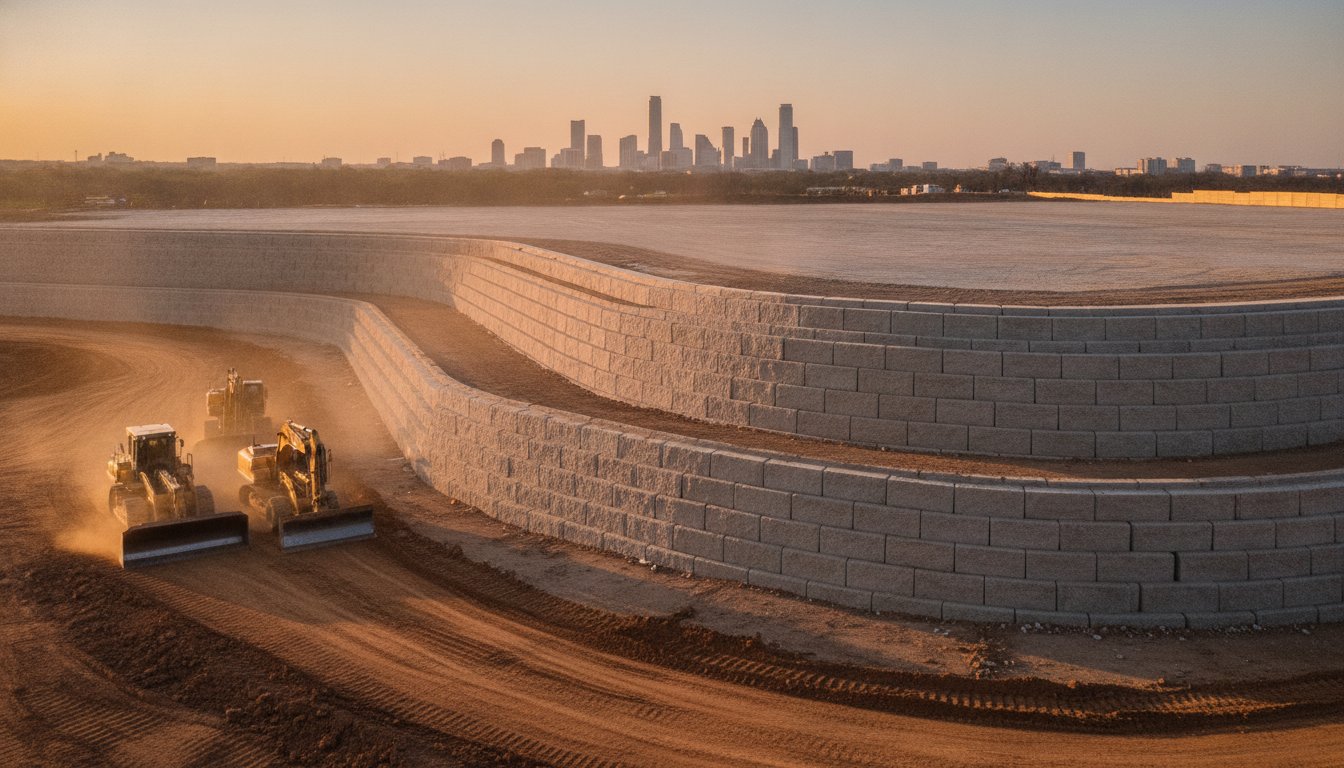
In the competitive Texas real estate market, land is a finite resource. Every square foot of a commercial site must justify its development cost. A seasoned commercial retaining wall contractor Texas understands that grade separation is not merely a civil requirement; it's a strategic tool for maximizing buildable area. By implementing aggressive soil retention strategies, developers can reclaim land previously deemed unbuildable due to steep topography. These structures allow for the creation of level building pads and expansive parking areas on sites that would otherwise be lost to natural slopes. It's about turning a liability into an asset.
Texas topography, from the rolling hills of Central Texas to the shifting basins of the Gulf Coast, requires aggressive soil retention. It isn't enough to simply hold back dirt. You must manage the hydrostatic pressure and soil expansion that are native to these regions. When a project interfaces with commercial paving and slab-on-grade foundations, the precision of the retaining wall becomes the literal foundation of site stability. Proper execution ensures that the transition between different elevations remains secure for the life of the structure.
Maximizing Real Estate Value in Urban Hubs
High-density urban centers like Houston and Austin leave little room for wasted space. Vertical grade changes are essential for accommodating the density required for profitable multi-family or mixed-use projects. Retaining walls play a critical role in managing stormwater by supporting the perimeter of detention ponds. This integration is vital. It ensures the site remains compliant with municipal drainage requirements while preserving the integrity of adjacent structures. Without these vertical barriers, detention ponds would require vast, sloping footprints that eat into valuable parking or retail space.
On projects requiring heavy-duty access, these walls must interface naturally with commercial concrete paving in Conroe and similar high-growth markets. This ensures that the transition from a reinforced grade to a traffic-bearing surface remains stable under the weight of logistics and emergency vehicles. Meticulous planning at this stage prevents the joint separation and cracking that often occurs when paving and walls are treated as isolated systems.
Structural Integrity for Texas Infrastructure
Beyond simple grade retention, these walls provide the necessary support for complex infrastructure. For multi-level developments, including CIP parking structures, the wall serves as a primary structural component. In industrial generator yards or transport hubs, the lateral pressure from heavy equipment requires robust engineering. Many modern projects utilize Mechanically Stabilized Earth (MSE) systems to achieve the necessary height and load-bearing capacity. These systems offer the flexibility and strength needed to handle the dynamic loads of a busy commercial environment.
As a reliable commercial retaining wall contractor Texas, we prioritize the meticulous interface between the wall and structural concrete components. This focus prevents the settling and shifting that often plagues sites with inferior earthwork. Safety and stability in high-traffic commercial zones depend on this level of operational precision. We believe in building foundations that endure, ensuring that every project meets the highest standards of professional stability.
Engineering for Texas Soil: CIP vs. MSE Retaining Wall Systems
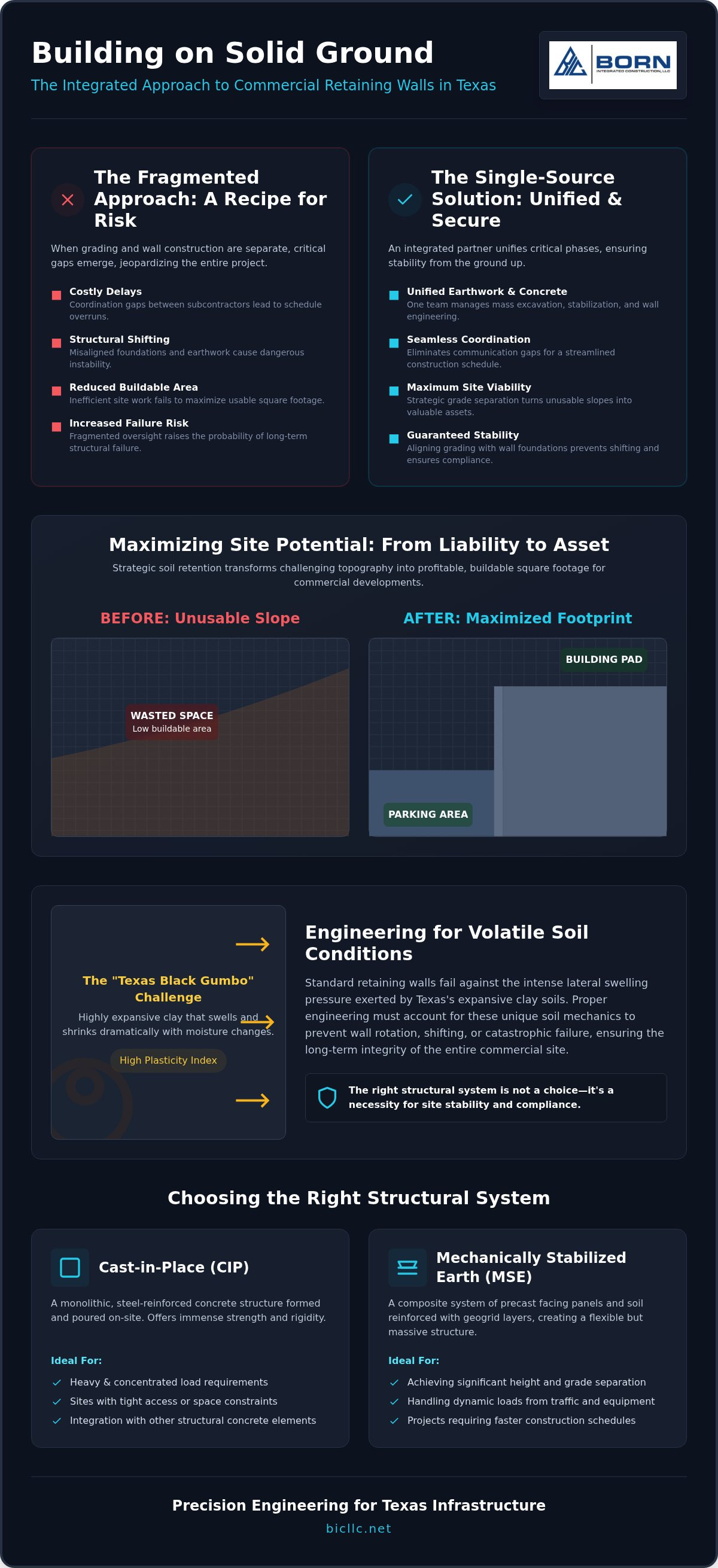
Texas soil presents a unique set of engineering hurdles that require more than standard solutions. The highly expansive clay, commonly referred to as "Texas Black Gumbo," possesses a high plasticity index. This means the soil undergoes significant volume changes based on moisture content. When these clays hydrate, they exert intense lateral swelling pressure against subterranean structures. A qualified commercial retaining wall contractor Texas must account for these specific soil mechanics to prevent wall rotation or catastrophic sliding. Choosing between Cast-in-Place (CIP) and Mechanically Stabilized Earth (MSE) depends entirely on the site's load requirements and soil profile.
Cast-in-Place (CIP) Structural Walls
Cast-in-Place (CIP) concrete remains the premier choice for projects requiring maximum structural longevity and heavy load support. These walls are formed and poured on-site. This allows for seamless integration with other structural elements like piers or foundations. This method is particularly effective for mid-rise and high-rise developments where the retaining structure must interface with expert podium slab construction. CIP walls offer the rigidity needed to resist the volatile movement of expansive clay. They also allow for complex, custom geometries and integrated drainage systems that are often required in tight urban sites.
MSE and Segmental Modular Systems
Mechanically Stabilized Earth (MSE) systems provide a cost-effective alternative for large-scale grade changes. These systems rely on layers of geogrid reinforcement to stabilize the backfill. This creates a composite mass that can withstand significant heights. While MSE walls offer excellent speed of installation, their success in Texas depends heavily on the quality of the select fill used behind the wall. When working with a commercial retaining wall contractor Texas, it's vital to ensure the select fill meets municipal specifications to prevent internal erosion. Developers often choose modular blocks for their aesthetic versatility. Options range from natural stone textures to clean, industrial finishes. For broader infrastructure projects, MSE offers the flexibility to accommodate minor soil settlements without the cracking often seen in rigid systems.
Gravity walls rely on their sheer mass to resist the pressure of the earth behind them. These are typically used for shorter heights. In these cases, the simplicity of the design outweighs the need for complex reinforcement. However, in regions with deep deposits of black gumbo, the weight of a gravity wall must be carefully balanced against the bearing capacity of the underlying soil. Excessive weight on unstable clay can lead to sinking or uneven settlement. Selecting the right system is a matter of long-term viability. You can review our recent structural implementations by exploring our civil and concrete project history.
The Single-Source Advantage: Integrating Earthwork and Wall Construction
Managing a commercial site development involves balancing multiple specialized trades. One of the most significant risks to a project's timeline is the coordination gap between the earthwork subcontractor and the wall builder. When these responsibilities are split, "finger-pointing" often occurs if the subgrade isn't prepared correctly or if the backfill doesn't meet structural specifications. Choosing a single-source commercial retaining wall contractor Texas eliminates these friction points. By integrating mass soil excavation with wall construction, we ensure that the foundation of the wall is built on a precisely compacted subgrade from day one.
This integrated approach allows for seamless scheduling. Backfill compaction must happen in tandem with wall structural milestones. If these phases aren't synchronized, the wall's integrity is compromised. A unified team manages the civil construction schedule with precision. This ensures that every layer of soil is tested and approved before the next phase of the wall begins. It's about maintaining a steady, predictable workflow that protects the long-term viability of the site.
From Mass Excavation to Finished Grade
The transition from initial site clearing to the finished grade requires a deep understanding of soil mechanics. We manage this process by self-performing the mass excavation. This ensures that the subgrade is stable before the first pour of a Cast-in-Place (CIP) footing or the placement of the first MSE block. Stability doesn't end at the wall face. We also emphasize the importance of paving stabilization in the areas adjacent to the structure. This creates a cohesive site where the wall and the heavy-duty paving work together to support traffic loads and prevent shifting. It's a methodical way to build a lasting foundation.
Managing Underground Utilities and Drainage
Retaining walls often share space with critical infrastructure. Integrating storm sewer lines and domestic water systems with wall footings requires technical proficiency. If a utility line is placed too close to a wall's reinforcement zone without proper planning, it can weaken the entire system. We coordinate these installations as part of our turnkey civil site work to avoid conflicts. It's a disciplined approach to a complex problem.
Hydrostatic pressure remains the primary cause of retaining wall failure. Water trapped behind a wall increases the lateral load beyond what the structure was designed to hold. Our approach prioritizes complex drainage systems, including perforated pipes and drainage aggregate, to divert water away from the structure. By managing the site's utilities and drainage simultaneously with the wall, we provide a sense of security for the entire development. You can learn more about our commitment to these high standards on our about page.
Compliance and Planning: Texas Engineering Standards
Navigating the regulatory environment in Texas requires a disciplined approach to planning. Most jurisdictions, including major hubs like Houston and Austin, require a building permit for any wall exceeding 4 feet in height. If a wall supports a surcharge, such as a parking lot or a structural slab, a permit is often required regardless of the height. Engaging a commercial retaining wall contractor Texas early in the pre-construction phase ensures that you meet the specific requirements for an Engineer of Record (EOR). This professional oversight is essential for validating lateral earth pressure coefficients and ensuring the structure complies with the International Building Code (IBC) and local municipal amendments. It isn't just a suggestion; it's a mandate for long-term safety.
Geotechnical and Structural Coordination
Engineering solutions must be site-specific. A strategy that succeeds in the rocky slopes of the Texas Hill Country will likely fail in the expansive clays of the Gulf Coast. Geotechnical reports provide the data necessary to calculate the precise lateral earth pressure your wall will face. We use this data to plan for surcharge loads, which are critical in high-density developments. A surcharge load refers to any additional weight applied to the soil surface behind a retaining wall, such as the pressure from commercial concrete paving, parked vehicles, or heavy machinery, that increases the lateral force against the structure. Failing to account for these loads leads to wall leaning or foundational shifting that can't be easily ignored.
Stormwater and Environmental Compliance
Compliance also extends to environmental stewardship. Retaining walls are frequently integrated with detention pond excavation and basin design to manage stormwater runoff. These structures must meet Texas Commission on Environmental Quality (TCEQ) standards to prevent erosion and protect local water quality. During the mass excavation phase, we implement strict erosion control measures to maintain site integrity. This thoroughness ensures that your development remains compliant throughout its lifecycle. You'll find that meticulous planning at this stage prevents costly remediation later. You can ensure your project meets these rigorous standards by partnering with our experienced civil team.
Born Integrated Construction: Precision Engineering for Texas Infrastructure
Born Integrated Construction (BIC) was established to resolve the inherent conflicts between earthwork and concrete trades. As a steadfast commercial retaining wall contractor Texas, we prioritize reliability through a unified delivery model. Our name isn't just a label; it's a reflection of our approach to civil and concrete synergy. By self-performing mass soil excavation and earthwork, we maintain total control over the site's structural integrity from the outset. This methodical process removes the risk of trade interference and provides a clear hierarchy of accountability on the job site. We believe that a disciplined professional is a dependable partner.
Our commitment to safety, integrity, and efficiency is evident in every structural project we undertake. We don't seek to disrupt the industry with style over substance; we lead through proven results and unwavering consistency. You can gain a deeper understanding of our technical scope and operational precision by reviewing our portfolio of Texas commercial projects. These case studies showcase our ability to deliver enduring results in the face of complex site constraints and volatile soil conditions.
The BIC Difference in Commercial Concrete
The technical proficiency we bring to each site extends to specialized structural concrete applications. Our expertise includes the construction of CIP garages, podium slabs, and high-rise foundations that require meticulous management of details. We focus on the long-term structural viability of every build, ensuring that the foundations we establish today remain secure for decades. This sense of duty is a core organizational pillar. You can learn more about our mission and values to see how our ethical framework guides our physical operations. We pride ourselves on craftsmanship that stands the test of time.
Contact Us for Your Next Texas Project
We provide turnkey civil solutions across all major Texas markets, including Houston, Austin, Dallas, and San Antonio. Our team partners with general contractors and developers to streamline the construction schedule through integrated services. By managing both the earthwork and the retaining wall construction, we eliminate the coordination gaps that often lead to project delays. You can initiate a consultation for your next development by contacting our office. Request a comprehensive bid that includes mass soil excavation and reinforced wall engineering to ensure your site is built on a stable, professional foundation. We look forward to delivering the consistent value and technical excellence your project deserves.
Securing the Future of Your Texas Development
Securing your commercial development requires more than just a physical barrier; it demands a structural anchor built on precision and integrated expertise. We've explored how strategic grade separation maximizes buildable land and why specialized engineering for expansive Texas clay is vital for structural longevity. By partnering with an integrated commercial retaining wall contractor Texas, you eliminate the risk of subcontractor coordination gaps. This approach ensures that mass excavation, utility installation, and wall construction occur in a methodical, predictable sequence. Born Integrated Construction remains dedicated to providing this level of professional stability across Houston, Austin, Dallas, and San Antonio. Our specialization in both CIP and MSE structural systems allows us to tailor solutions to your site's specific load requirements and topography. We invite you to Request a Turnkey Civil and Structural Concrete Bid to see how our commitment to reliability can streamline your next project. Building on a stable foundation is the definitive first step toward a successful and enduring commercial legacy.
Frequently Asked Questions
When is a retaining wall required for a commercial site in Texas?
A permit is typically required for any retaining wall over 4 feet in height or any wall supporting a surcharge load like a parking lot or building pad. In Travis County, structural designs must be sealed by a licensed engineer for walls exceeding 5 feet. Local municipal codes in cities like Houston or Austin often have specific amendments. It's best to consult with a commercial retaining wall contractor Texas during the site planning phase to ensure compliance with all local ordinances.
What is the difference between a CIP wall and an MSE wall?
Cast-in-Place (CIP) walls are rigid structures formed and poured on-site using structural concrete and rebar. They're preferred for heavy-duty applications like high-rise foundations or tight urban sites. Mechanically Stabilized Earth (MSE) walls use modular blocks and geogrid reinforcement to create a stable composite mass. MSE systems offer more flexibility for soil settlement and are often more cost-effective for large-scale grade changes. Both systems require precise engineering to manage the lateral pressure of Texas soil.
How does Texas soil (expansive clay) affect retaining wall design?
Expansive clay, often called "Black Gumbo," swells when wet and shrinks when dry, creating intense lateral pressure. Designers must account for this movement by using select backfill and robust drainage systems. Poorly designed walls often fail because they don't have the mass or reinforcement to resist these seasonal volume changes. Engineers typically specify a higher safety factor and specific embedment depths to ensure the structure remains stable despite the volatile nature of local soil profiles.
Can Born Integrated Construction handle both the excavation and the wall building?
Yes, Born Integrated Construction self-performs mass soil excavation, earthwork, and structural concrete services. This integrated approach allows us to manage the transition from subgrade preparation to wall construction without the coordination gaps common among separate subcontractors. By handling the entire civil scope, we ensure the foundation of the wall is built on a precisely compacted site. This synergy improves the construction schedule and provides a single point of accountability for the developer.
What are the common causes of retaining wall failure in Texas?
Hydrostatic pressure caused by poor drainage is the primary cause of wall failure in the region. When water becomes trapped behind the structure, it increases the load beyond the original engineering specifications. Other factors include the use of improper backfill material and the failure to account for expansive clay movement. Meticulous compaction and the installation of perforated drainage pipes are essential steps to prevent rotation, sliding, or catastrophic collapse of the commercial retaining wall contractor Texas installation.
How much does a commercial retaining wall cost per square foot?
Costs for commercial retaining walls vary significantly based on the height, soil conditions, and the chosen structural system. While industry data suggests wide ranges depending on whether the project is in Houston or Dallas, your specific site constraints will dictate the final investment. Factors like excavation depth, geogrid requirements, and drainage aggregate impact the total. We recommend requesting a comprehensive bid from a professional team to get an accurate assessment based on your project's unique engineering requirements.
How long does it take to construct a large-scale commercial retaining wall?
The timeline depends on the wall type and the complexity of the site's topography. A standard MSE wall can often be installed faster than a CIP wall because it doesn't require the same curing time for concrete forms. However, the mass excavation and soil stabilization phases must be completed before the wall assembly begins. Large-scale projects typically follow a methodical schedule that aligns with the broader civil construction milestones to ensure the site remains organized and safe.
Do I need a separate contractor for underground utilities near the wall?
No, we manage the installation of storm sewers, sanitary lines, and domestic water systems as part of our turnkey civil services. Coordinating utilities with the retaining wall's footing is critical to avoid structural conflicts. By integrating these services, we ensure that underground lines don't interfere with geogrid zones or structural piers. This unified approach reduces the risk of utility damage and ensures that the site's drainage systems are perfectly aligned with the wall's structural engineering.