Industrial Concrete Slab Contractor in Dallas: Engineering Heavy-Duty Foundations
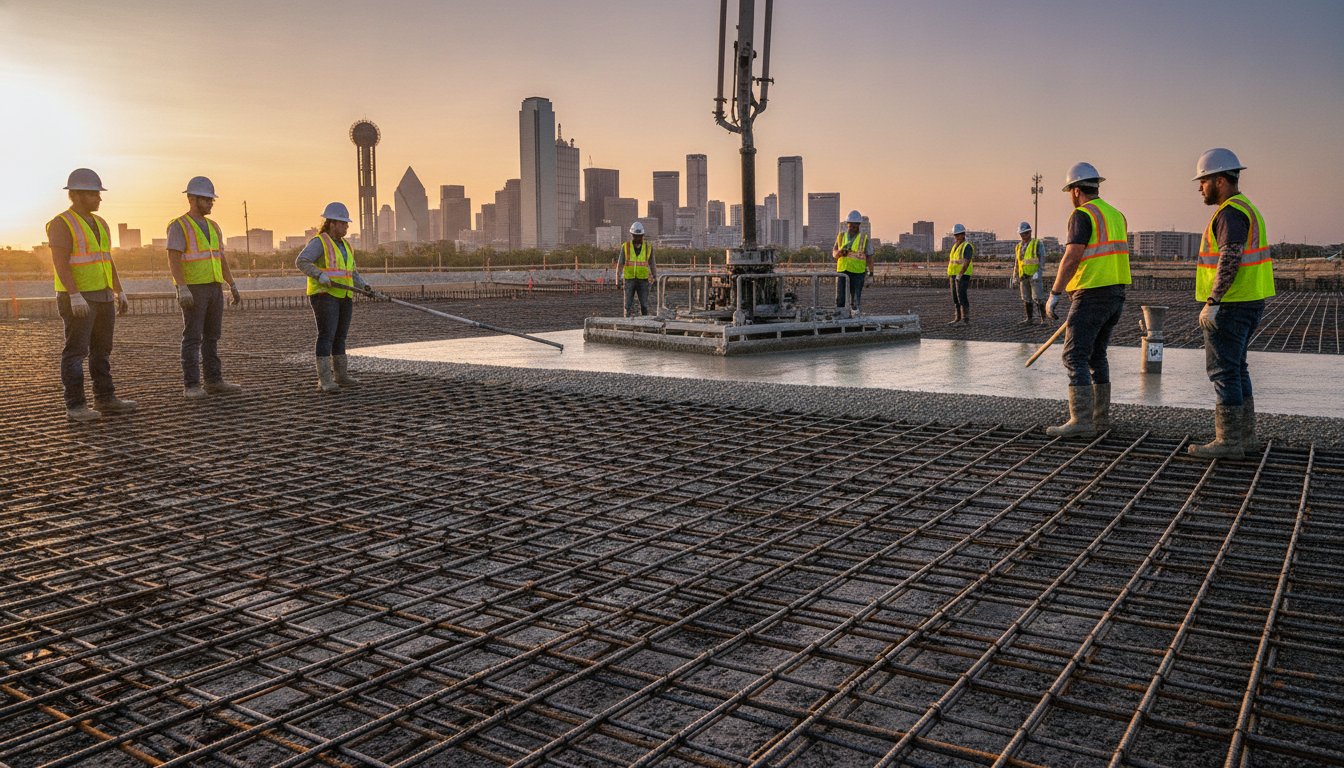
In North Texas, the ground beneath your feet is often the greatest threat to your facility's long-term stability. You likely recognize that the region's notorious "black gumbo" expansive clay can compromise even the most robust structural designs if the foundation isn't engineered for significant soil movement. Relying on a standard paving crew often leads to surface cracking and sub-standard load-bearing capacity for heavy machinery. Securing a reliable industrial concrete slab contractor Dallas businesses can depend on requires a partner who understands that the slab and the subgrade are a single, integrated engineering system.
This article outlines how to achieve a high-performance industrial floor through a combination of meticulous civil site preparation and precision structural engineering. We will discuss the critical role of mass soil excavation in stabilizing the building pad and how single-source accountability reduces the risk of costly delays between site prep and the final pour. By adhering to strict ACI standards and leveraging proven earthwork techniques, you can ensure your facility maintains its structural integrity under the most demanding operational loads.
Key Takeaways
- Understand why selecting a qualified industrial concrete slab contractor Dallas trusts is essential for managing the high-performance engineering demands of modern logistics and manufacturing facilities.
- Learn the technical distinctions between point loads and uniform loads to ensure your structural reinforcement and vapor barriers meet the specific requirements of heavy machinery.
- Identify the appropriate applications for Slab on Grade and Podium Slabs to determine the most effective foundation for your ground-level or multi-level industrial development.
- Discover why mass soil excavation and stabilizing the expansive clay of North Texas are non-negotiable steps for preventing long-term slab failure and cracking.
- Explore the operational advantages of an integrated construction model that consolidates earthwork and structural concrete under a single, accountable partner to ensure project efficiency.
Industrial Concrete Slabs in Dallas: Engineering for Heavy-Duty Performance
An industrial concrete slab isn't merely a floor; it's a precision-engineered system designed to withstand the constant stress of heavy machinery, dynamic loads, and repetitive forklift traffic. In the Dallas-Fort Worth metroplex, where logistics hubs and advanced manufacturing facilities drive the local economy, these slabs must meet rigorous performance specifications. As an established industrial concrete slab contractor Dallas trusts, we view every project through the lens of long-term stability. This requires a shift in perspective where the slab is treated as the final layer of a complex assembly that begins with the raw earth. High-performance slabs are the result of a disciplined approach that balances material science with operational demands.
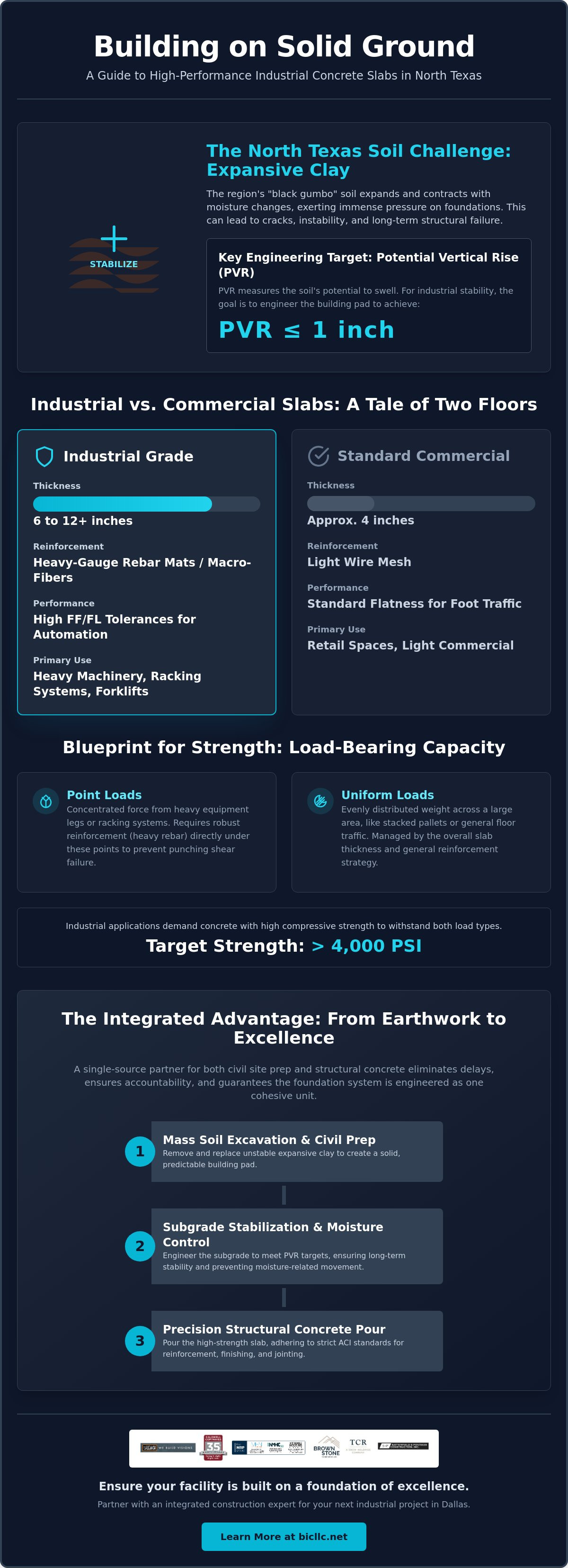
Industrial applications demand concrete mixes with higher compressive strength, often exceeding 4,000 PSI, to prevent surface abrasion and structural failure under load. The process integrates everything from initial mass soil excavation to the final power-troweled finish. By managing the entire lifecycle of the build, we ensure that the structural concrete aligns perfectly with the underlying civil preparation. This integrated construction model eliminates the gaps in accountability that often lead to project delays or premature foundation failure.
The Dallas Soil Challenge: Expansive Clay and Slab Stability
The geology of North Texas presents a unique set of obstacles, primarily the presence of "black gumbo" or expansive clay. This soil type undergoes significant volume changes based on moisture content, which can exert immense upward pressure on a foundation. Proper foundation engineering principles dictate that moisture control is paramount during subgrade preparation to prevent future shifting. In Dallas engineering, Potential Vertical Rise (PVR) is defined as the latent ability of a soil mass to swell based on its existing moisture and density conditions. A PVR of one inch or less is frequently the target for industrial pads to ensure the slab remains stable and level over decades of use.
Industrial vs. Commercial Slabs: Key Differences
While commercial retail spaces might perform adequately with a four-inch slab, industrial environments typically require thicknesses ranging from six to twelve inches or more. The reinforcement strategy also shifts significantly. Where commercial projects might use light wire mesh, industrial slabs rely on heavy-gauge rebar mats or specialized macro-synthetic fibers to manage shrinkage and load distribution. Working with a specialized industrial concrete slab contractor Dallas relies on ensures that these technical nuances are addressed during the pre-construction phase.
- Floor Flatness (FF) and Floor Levelness (FL): High-reach forklifts and automated racking systems require extremely tight tolerances, often necessitating FF/FL numbers significantly higher than standard commercial work.
- Joint Spacing: Strategic saw-cut placement is vital to control cracking while maintaining a smooth surface for wheeled traffic.
- Reinforcement: Heavy rebar cages are standard for point loads under racking systems or heavy manufacturing equipment.
By focusing on these specific engineering requirements, we deliver a product that supports the operational efficiency of the facility. A well-executed industrial slab reduces maintenance costs for both the floor and the equipment that traverses it, providing a reliable foundation for business growth.
The Technical Blueprint: Load-Bearing Capacity and Reinforcement Standards
Engineering a high-performance floor requires a blueprint that transcends basic paving. Every industrial facility operates under a specific set of stresses, making it necessary to adhere strictly to ACI 302.1R guidelines for floor and slab construction. As an experienced industrial concrete slab contractor Dallas firms rely on, we begin by analyzing the specific operational requirements of the space. This involves a detailed assessment of how the slab will interact with heavy equipment, high-density racking, and constant traffic. A failure to account for these variables during the design phase often leads to structural compromises that are difficult and expensive to rectify once operations begin.
Designing for industrial environments requires a precise calculation of load-bearing capacity and reinforcement standards. We distinguish between uniform loads, such as bulk storage on the floor, and point loads, which are the concentrated pressures exerted by rack uprights or heavy machinery legs. While uniform loads distribute weight across a larger area, point loads can exceed several tons on a single square inch. To mitigate these forces, the concrete mix design must strike a disciplined balance between high compressive strength and workability. We also integrate high-performance vapor barriers beneath the slab to protect sensitive industrial electronics and inventory from moisture migration, which is a common issue in the humid Texas climate.
Structural Reinforcement Options
The choice of reinforcement dictates the slab's ability to manage tension and prevent cracking. Traditional rebar mats remain the standard for heavy-duty load distribution where maximum rigidity is required. For large-span warehouse floors, post-tensioned slabs offer a superior, crack-resistant alternative by keeping the concrete in a permanent state of compression. Steel fibers are another viable option for industrial concrete paving, as they provide three-dimensional reinforcement and enhanced impact resistance, though they require careful finishing to ensure a smooth surface profile. Selecting the right method depends on your specific facility layout and the intended use of the floor.
Finishing for Longevity and Safety
The final surface of an industrial slab must be as durable as its core. We apply hardened finishes to the surface to resist the abrasive forces of steel-wheeled traffic and heavy pallets. Worker safety is equally prioritized through slip-resistance standards that don't compromise the ease of cleaning. Proper curing is the final, non-negotiable step in the process; it ensures the concrete reaches its full design strength and minimizes the risk of surface dusting. If you are planning a new facility, engaging early with a partner for structural concrete ensures these technical details are integrated into the initial project scope.
Slab on Grade vs. Podium Slabs: Selecting the Right Industrial Foundation
Selecting the appropriate foundation system is a critical decision that dictates both the initial capital expenditure and the long-term operational capacity of an industrial facility. In the Dallas market, the choice typically involves a trade-off between the straightforward utility of Slab on Grade and the complex engineering of Podium Slabs. Each system serves a distinct purpose within the industrial landscape. A seasoned industrial concrete slab contractor Dallas developers trust will evaluate the facility's intended use, soil conditions, and vertical requirements to recommend the most stable and cost-effective path forward. This decision impacts everything from machine vibration dampening to the eventual resale value of the property.
The cost-to-performance ratio in North Texas favors Slab on Grade for expansive, single-story footprints where ground-level access is the priority. However, as land prices rise and urban density increases, multi-story industrial developments are becoming more prevalent. These projects require the specialized structural integrity of podium systems. Our experience as a podium slab contractor Houston developers rely on provides the technical framework needed for these high-rise industrial applications, ensuring that the transition between different structural levels remains seamless and secure.
When to Choose Slab on Grade
Slab on Grade is the standard for heavy manufacturing, regional distribution centers, and cold storage facilities. It is particularly effective for managing the massive uniform loads of palletized inventory and the dynamic stresses of heavy-duty forklift traffic. To prevent edge failure, these slabs often utilize thick-edge designs where the concrete depth increases at the perimeter and at expansion joints. Maintenance for these floors is generally straightforward, provided the initial subgrade was properly stabilized. Ground-level slabs are the most economical way to achieve high floor flatness (FF) and floor levelness (FL) numbers required for automated racking systems.
The Rise of Podium and Elevated Slabs
Podium slabs support multi-story industrial structures by acting as a heavy-duty platform for additional levels or specialized mixed-use spaces. These systems present unique weight distribution challenges, as the slab must support not only the operational loads of the floor but also the weight of the building's own structural framing. Integration with Cast-in-Place (CIP) structural framing is essential for creating a rigid, durable skeleton. These elevated slabs require meticulous engineering to manage deflection and vibration, especially when heavy machinery is located on upper floors. While more complex than ground-level paving, podium slabs allow developers to maximize the utility of smaller urban lots without sacrificing industrial performance.
Beyond the Pour: Why Civil Site Prep and Soil Stabilization Dictate Slab Longevity
A high-performance slab is only as durable as the ground supporting it. An industrial concrete slab contractor Dallas projects rely on must prioritize the subgrade as much as the concrete itself. The longevity of a massive distribution center or manufacturing plant depends on creating a predictable, non-reactive base. If the soil shifts, even the most heavily reinforced slab will eventually fail. This is why civil site preparation is the most critical phase of the build. It requires a disciplined approach to moisture control and density to ensure the foundation remains stable under decades of heavy operational use.
Mass Excavation and Detention Pond Integration
Preparing large-scale industrial foundations requires extensive mass soil excavation. This process involves stripping unsuitable materials and re-engineering the topography to support the building pad and surrounding infrastructure. We integrate detention pond construction into this phase to manage stormwater runoff, protecting the site from erosion and saturation. This coordination is vital; water pooling near the foundation is the fastest way to compromise a slab. By managing both earthwork and concrete, we ensure that underground utilities are installed with precision before the slab is poured. This integrated method reduces the risk of utility damage and ensures that every pipe and conduit is perfectly aligned with the structural design.
Paving Stabilization Techniques
Chemical stabilization is the primary defense against the expansive "black gumbo" clay found throughout the Dallas area. We use lime or cement stabilization to alter the soil’s chemistry, significantly reducing its potential to swell or shrink with moisture changes. This chemical treatment is followed by mechanical stabilization, where we use heavy equipment to meet specific compaction standards and density requirements. You can discover why paving stabilization is critical for Texas soil and how it serves as a safeguard for your facility's infrastructure. Stabilization is the process that effectively prevents slab heaving, ensuring that the floor remains level despite the volatile nature of the local environment.
Choosing a partner who understands the relationship between soil and concrete is essential for project success. Our approach focuses on establishing a firm foundation from day one, minimizing future maintenance costs and operational disruptions. For developers seeking a reliable industrial concrete slab contractor Dallas offers, we provide the technical proficiency needed for complex sites. If you're planning an upcoming development, reach out to discuss our turn key civil and structural concrete capabilities.
Born Integrated Construction: Your Partner for Industrial Slab Excellence in Dallas
Successful industrial development in the Dallas-Fort Worth metroplex requires more than just a vendor; it demands a partner who understands the high stakes of heavy-duty infrastructure. Born Integrated Construction was established on the principle that civil site work and structural concrete are inseparable components of a single engineering system. As an industrial concrete slab contractor Dallas developers depend on, we eliminate the friction that typically occurs when transitioning from earthwork to paving. This integrated model allows us to maintain absolute control over the quality and schedule of the build, ensuring that the foundation is as stable as the business it supports.
Our organizational pillars of safety, integrity, and operational precision guide every project we undertake. We don't view a slab as an isolated pour but as the culmination of a rigorous technical process. This commitment to high standards has allowed us to build long-term relationships with the region's leading developers and project managers. By prioritizing substance over style, we deliver consistent value that stands up to the most demanding industrial environments. Our focus remains on the enduring nature of our work, providing a sense of security for clients who value professional stability and technical proficiency.
A Steadfast Approach to Industrial Projects
In the current 2026 market, characterized by rising labor costs and intense demand for logistics facilities, reliability is a critical asset. Our team brings extensive experience to complex structural challenges, including CIP midrise and highrise foundations and structured parking garages. We cultivate relationships based on transparency and proven results, ensuring that our clients have a dependable partner for even the most ambitious developments. This steadfast approach allows us to manage the nuances of Dallas soil and ACI compliance with unwavering consistency, regardless of project scale.
Get Started on Your Dallas Industrial Project
The most successful builds begin long before the first yard of concrete is delivered. Early-stage involvement in civil planning allows us to identify potential subgrade issues and optimize the site for long-term slab performance. We invite developers and project managers to engage with our team for a comprehensive analysis of their specific project needs. By integrating mass soil excavation with turnkey civil and structural concrete solutions, we provide a streamlined path to facility readiness. Let's establish a foundation that meets the highest standards of durability and engineering precision.
Partner with Born Integrated Construction for your next industrial build and secure a foundation engineered for excellence.
Establishing a Permanent Foundation for Your Industrial Assets
Securing the long-term viability of your facility doesn't just happen by chance; it's the result of disciplined engineering and a steadfast commitment to quality. As we've explored, a high-performance floor relies on the seamless integration of civil site preparation and structural concrete. By addressing the challenges of Dallas expansive clay soil through proven stabilization techniques and adhering to strict ACI engineering standards, you protect your investment from premature failure. This methodical approach ensures your slab remains level and durable under the most demanding operational loads.
Choosing a partner with comprehensive civil and structural integration capabilities ensures that your project moves forward with efficiency and precision. This integrated model provides the single-source accountability needed to manage complex point loads and high-traffic demands without the risk of communication gaps. As a dedicated industrial concrete slab contractor Dallas developers rely on, we focus on establishing foundations that remain stable for decades. We invite you to experience the confidence that comes from working with a professional team focused on substance and proven results.
Request a Consultation for Your Industrial Concrete Project to learn how our steadfast approach can bring professional stability to your next build. We look forward to helping you establish a foundation that supports your operational goals.
Frequently Asked Questions
What is the standard thickness for an industrial concrete slab in Dallas?
Industrial concrete slabs in the Dallas area typically range in thickness from 6 to 12 inches depending on the intended operational load. While a standard commercial floor might suffice with 4 inches, heavy manufacturing and distribution centers require the additional depth to manage point loads from high-density racking. We engineer each slab thickness based on specific load-bearing requirements and the frequency of heavy machinery traffic to prevent structural failure.
How does expansive clay soil in Dallas affect industrial foundations?
Expansive clay soil, commonly known as "black gumbo," undergoes significant volume changes when moisture levels fluctuate. In North Texas, this soil can exert immense upward pressure on a foundation, leading to uneven heaving and structural cracking. As a professional industrial concrete slab contractor Dallas trusts, we address this by implementing strict moisture control and subgrade stabilization measures to ensure the foundation remains stable regardless of the season.
Why is soil stabilization necessary before pouring a commercial slab?
Soil stabilization is necessary to create a predictable and non-reactive base that supports the weight of the structural concrete. By using chemical treatments like lime or cement, we alter the soil’s properties to reduce its potential for swelling and shrinking. This process ensures that the building pad remains level and prevents the slab from shifting over time, which is essential for protecting the integrity of the entire industrial facility.
What is the difference between a slab on grade and a podium slab?
A slab on grade is a foundation poured directly onto the prepared earth, making it the standard for single-story warehouses and distribution centers. In contrast, a podium slab is an elevated structural platform designed to support additional levels or multi-story industrial buildings. Podium slabs require more complex engineering to manage weight distribution and vibration, often integrating with cast-in-place structural framing to maintain the building's overall rigidity.
How long does an industrial concrete slab take to cure for heavy traffic?
Most industrial concrete slabs require approximately seven days of curing before they can support light foot traffic or small equipment. However, it's best to wait 28 days for the concrete to reach its full design strength before subjecting the floor to heavy machinery or high-density forklift traffic. Proper curing during this initial period is vital for ensuring the surface remains durable and resistant to abrasion over the long term.
Can Born Integrated Construction handle both excavation and concrete work?
Yes, our "Born Integrated" approach means we manage both mass soil excavation and structural concrete construction under a single point of accountability. By handling the earthwork, detention pond construction, and final paving, we eliminate the common delays that occur between different trade phases. This integration ensures that the civil site preparation perfectly aligns with the structural requirements of the slab, providing a more efficient and reliable project delivery.
What ACI standards should a Dallas industrial concrete contractor follow?
A qualified contractor should strictly adhere to ACI 302.1R guidelines for floor and slab construction and ACI 360R for the design of slabs on ground. These standards provide the technical framework for managing joint spacing, reinforcement placement, and floor flatness (FF) and levelness (FL) tolerances. Following these industry benchmarks ensures that the industrial concrete slab contractor Dallas developers hire delivers a product that meets rigorous safety and performance specifications.
What are the benefits of post-tensioned slabs in warehouse construction?
Post-tensioned slabs offer superior crack resistance and the ability to support large spans with fewer expansion joints. By keeping the concrete in a permanent state of compression, this method minimizes the risk of shrinkage cracks and provides a smoother surface for high-speed forklift traffic. These slabs are particularly beneficial in large warehouse environments where floor durability and minimal maintenance are primary concerns for the facility's long-term operational efficiency.