
Concrete Retaining Wall Cost Houston: 2026 Developer’s Guide
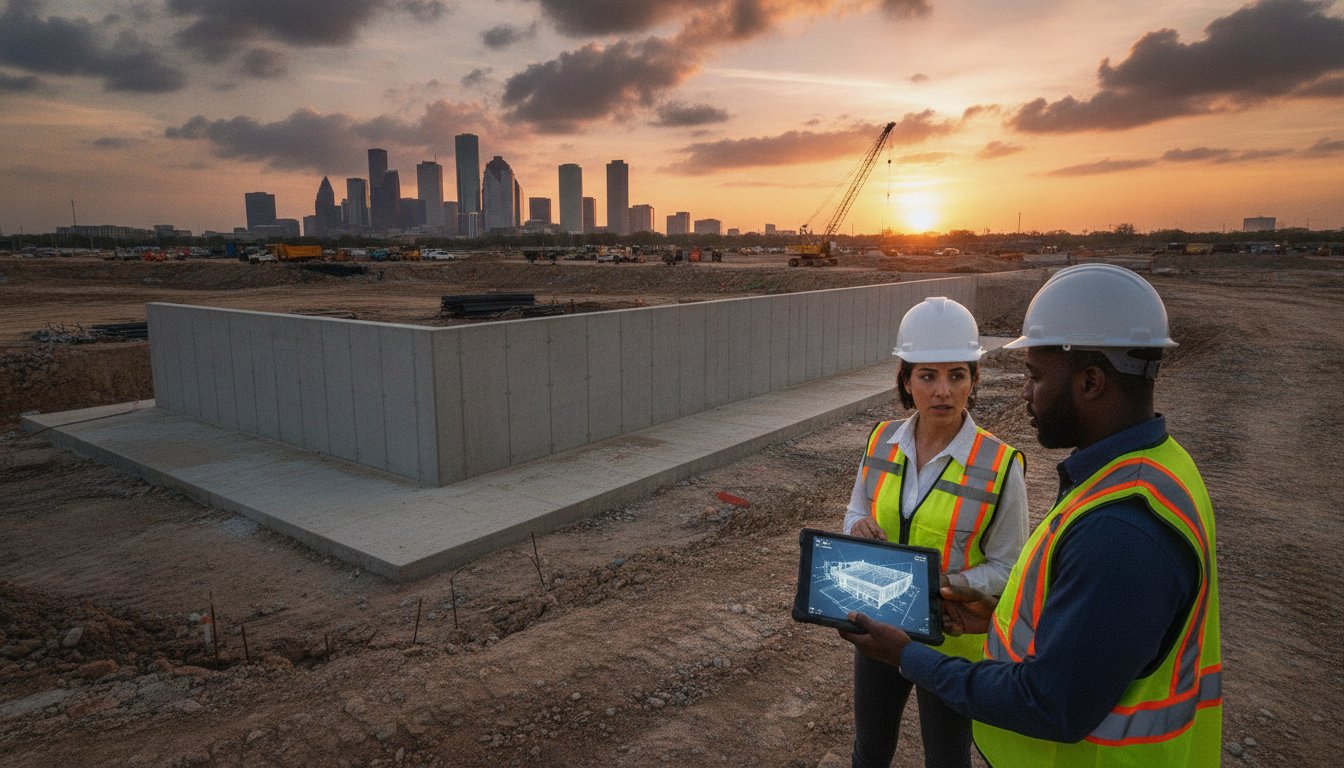
In the Houston development landscape, the true concrete retaining wall cost Houston isn't found in the price of the cement itself; it's found in the engineering required to combat the region's notorious gumbo clay. You likely recognize that a wall is only as stable as the soil it holds. In our coastal environment, the risks of structural failure or non-compliance are serious concerns that can derail a project's long-term viability. It's a reality where professional stability and technical precision are not just goals, but necessities for any enduring structure.
This guide provides a disciplined analysis of 2026 cost drivers, from the latest municipal permit fees under the 2021 International Building Code to the structural trade-offs between cast-in-place and precast systems. You'll gain a clear understanding of how to forecast budgets accurately while meeting the city's stringent floodplain regulations. We will examine the specific factors that influence ROI for structural concrete, ensuring your next project is built with the meticulous management of details required for Houston's unique regulatory and geological environment.
Key Takeaways
- Identify why Houston's expansive clay soils require specialized engineering and deeper foundations to ensure long-term structural viability.
- Analyze how verticality and surcharge loads from adjacent structures significantly influence the concrete retaining wall cost Houston for 2026 projects.
- Compare the structural advantages of cast-in-place concrete against the efficiency of precast solutions for large-scale developments.
- Review the necessary steps for municipal compliance, including the impact of the 2021 International Building Code on your permitting timeline.
- Determine the long-term ROI of choosing durable structural concrete to protect high-value assets like parking garages and midrise buildings.
Understanding Concrete Retaining Wall Costs in Houston’s Environment
Structural concrete retaining walls are fundamental components of civil site work across Southeast Texas. These installations aren't merely for aesthetics; they function as critical load-bearing structures that maintain site elevation and protect infrastructure. For developers, the concrete retaining wall cost Houston is dictated by the necessity of building for long-term viability. While temporary solutions might offer lower initial outlays, structural concrete provides a permanent foundation that resists the environmental stressors unique to the Gulf Coast. Understanding the engineering behind various Retaining wall types is essential for accurate budget forecasting.
The local environment presents two primary challenges: soil composition and climate. Houston's high humidity and intense rainfall cycles demand a higher standard of material selection. A wall that's built without considering these factors won't just require maintenance; it'll likely fail prematurely. This is why professional stability in design and execution is non-negotiable for 2026 projects. The concrete retaining wall cost Houston reflects the thoroughness required to establish a structure that meets both municipal codes and the physical demands of the region.
The Role of Expansive Clay in Foundation Design
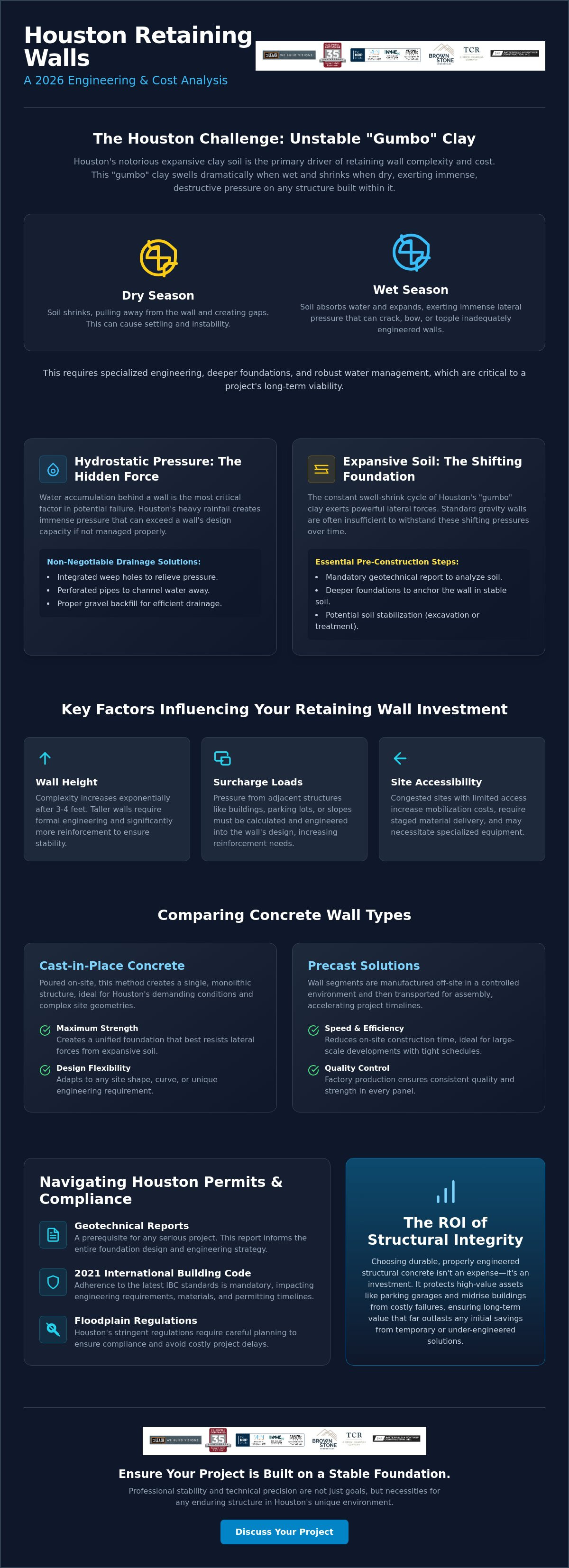
The "gumbo" clay prevalent in the Houston-The Woodlands corridor is notoriously unstable. This soil is highly expansive, meaning it swells significantly when wet and shrinks when dry. These volumetric changes exert immense lateral pressure on any vertical structure. Standard gravity walls often fail in this environment because they lack the deep foundation support needed to counter these shifting forces. To ensure durability, a geotechnical report is typically required to inform the foundation design. Developers should expect that soil stabilization, such as chemical treatment or mass soil excavation, will be a prerequisite before construction begins to ensure a stable base for the wall.
Hydrostatic Pressure: The Hidden Cost Driver
Water management is the most critical factor in retaining wall longevity. Hydrostatic pressure occurs when water accumulates in the backfill behind a wall, significantly increasing the load the concrete must support. In Houston, where heavy rain events are frequent, this pressure can quickly exceed the wall's design capacity if drainage is inadequate. Integrated drainage systems, including weep holes, perforated pipes, and specific gravel backfill, are non-negotiable components of the total project scope. Neglecting these details leads to structural cracking, bowing, or complete collapse. A disciplined approach to water management protects high-value assets and ensures the wall delivers consistent value over its entire lifespan.
Key Factors Influencing Your Retaining Wall Investment
Calculating the concrete retaining wall cost Houston requires a technical assessment of the site's intended use and physical constraints. For commercial developers, the investment is rarely limited to the visible concrete. It encompasses the logistical demands of mass soil excavation and the specialized equipment needed to manage heavy-duty structural pours. When a site is congested or has limited accessibility, mobilization costs and staged material delivery can influence the final budget significantly. Accuracy in these early estimates is vital for long-term project viability.
The choice between cast-in-place concrete, precast sections, or reinforced masonry blocks depends on the required load-bearing capacity and project timeline. While reinforced blocks might suffice for minor grade changes, large-scale civil projects often demand the monolithic strength of poured-in-place structural concrete. This approach ensures a unified foundation that resists the lateral forces inherent in Houston's shifting terrain. 2026 projects also require advanced formwork and high-capacity pumping equipment to maintain the pace of modern construction schedules.
Height and Structural Reinforcement
The complexity of a retaining wall increases exponentially as it gains height. Most standard designs reach a transition point at approximately three to four feet. Beyond this height, a simple gravity wall is no longer sufficient; the structure requires formal engineering to ensure stability. According to the structural integrity engineering manual, these taller walls must incorporate higher rebar density and specialized footing designs to prevent overturning. Wall thickness must increase proportionally to the height to maintain structural equilibrium against intensifying lateral loads. This structural necessity is a primary driver of the concrete retaining wall cost Houston for upcoming developments.
Surcharge Loads and Site Usage
A wall's design must account for surcharge loads, which are additional weights placed on the soil behind the wall. These loads typically come from parking lots, heavy-duty access roads, or adjacent buildings. If your project involves commercial concrete paving in Conroe or similar industrial applications, the wall foundation must be significantly deeper and wider to distribute the weight of heavy vehicles. Proximity to existing structures also complicates the excavation process, often requiring shoring to protect nearby foundations during construction. If you're planning a complex site layout, engaging a partner for turn key civil services ensures that surcharge calculations and foundation depths are managed with professional precision.
Comparing Concrete Wall Types: Cast-in-Place vs. Precast
Selecting the appropriate construction method is a pivotal decision that impacts both the immediate concrete retaining wall cost Houston and the long-term viability of the site. Developers must choose between the monolithic strength of cast-in-place systems and the modular efficiency of precast or segmental alternatives. Each approach carries specific technical requirements for foundation preparation and structural reinforcement. A disciplined evaluation of these options ensures that the final structure aligns with the project's load requirements and environmental demands. This decision shouldn't be based on initial price alone, but rather on the engineering standards required for the intended site usage.
The Case for Cast-in-Place (CIP) Concrete
Cast-in-place (CIP) concrete is the industry standard for high-stakes structural applications. This method involves forming and pouring the wall on-site, which allows for a seamless, monolithic structure that is exceptionally resistant to lateral pressure. In high-moisture environments like Houston and Beaumont, CIP's lack of joints minimizes the risk of water infiltration and subsequent rebar corrosion. This method is particularly advantageous for complex site geometries where standard modular units cannot provide the necessary coverage. For developers utilizing podium slab construction, CIP walls offer a unified structural solution that integrates perfectly with the building's primary foundation and vertical supports.
Precast and Segmental Alternatives
Precast garage foundations and wall panels are often selected for their ability to accelerate project timelines. Because these components are manufactured in a controlled facility, they can be delivered to the site ready for immediate installation. This speed, however, requires exceptionally precise site preparation. Any minor discrepancy in the base elevation can lead to significant alignment errors during assembly. Reinforced Segmental Retaining Walls (SRW) utilize interlocking dry-stack blocks and are common in lower-height applications. While they offer flexibility, they often lack the structural density required for heavy-duty commercial surcharge loads. When considering the concrete retaining wall cost Houston, developers must account for the specialized crane equipment and site access required to place large precast modules safely.
The life-cycle cost of these materials varies based on maintenance needs and structural durability. CIP walls typically offer the lowest maintenance requirements over a fifty-year span due to their monolithic nature. Precast systems may require periodic inspection of joint sealants to ensure the internal steel remains protected from the elements. Segmental walls are more susceptible to shifting or settlement in Houston's expansive clay, which can lead to aesthetic and structural issues if the original engineering was insufficient. A steadfast commitment to high-quality material selection at the outset protects the developer's investment and ensures the enduring nature of the professional output.
Navigating Houston Permits, Engineering, and Compliance
Compliance in Southeast Texas requires a disciplined approach to municipal standards. The 2026 concrete retaining wall cost Houston encompasses more than labor and materials; it includes the essential fees for professional engineering and rigorous site inspections. Navigating the Houston Permitting Center isn't just an administrative hurdle. It's a safety-critical process that ensures structural integrity in our challenging geological environment. Harris and Montgomery Counties have maintained strict drainage ordinances to address post-storm resiliency, making compliance a primary focus for any established developer.
The City of Houston has adopted the 2021 International Building Code (IBC) and the 2021 International Residential Code (IRC) with local amendments. These codes dictate the minimum requirements for wall stability and safety. For 2026 projects, developers must account for an administrative permit fee of $33.56 and a plan review fee typically set at 65% of the building permit fee. Performing work without these approvals results in a penalty of double the original fee, a risk that undermines professional stability and project budgets alike.
Engineering and Design Fees
Engaging a licensed Texas Professional Engineer (PE) is a non-negotiable requirement for any wall exceeding four feet or supporting a surcharge. The design phase must include site-specific soil borings to assess the shear strength of the clay. A global stability analysis determines if the entire slope, not just the wall, is secure. Meticulous engineering prevents catastrophic failure and protects the developer from long-term legal liability. These professional services are organizational pillars that establish a clear hierarchy of safety before the first yard of concrete is poured.
Local Codes and Drainage Regulations
The City of Houston Infrastructure Design Manual sets the baseline for all civil site work. Current standards place a heavy emphasis on stormwater management and "No Net Fill" policies, which require compensatory storage for any fill used in construction. Retaining walls often work in tandem with detention pond construction to manage runoff without impacting neighboring properties. Failure to meet these specific standards can result in significant penalties or the requirement to reconstruct non-compliant sections. For developers seeking a dependable partner to manage these complexities, our team provides turn key civil solutions that prioritize operational precision and regulatory alignment.
Quality control during the construction phase is just as vital as the initial design. On-site inspections verify rebar placement, formwork stability, and concrete slump before the pour begins. These checks ensure the final structure matches the engineered drawings exactly. Maintaining this level of oversight is part of our deep-rooted commitment to high standards and long-term viability.
Long-Term Value: Why Structural Integrity Outlasts Initial Savings
Investing in structural concrete is a calculated decision centered on the long-term viability of a development. While timber or thin-shell alternatives might offer a lower initial concrete retaining wall cost Houston, they lack the density and reinforcement required to withstand the region's lateral soil loads over time. A wall built with high-register structural concrete is a permanent asset that maintains its alignment and integrity for decades. In contrast, inferior materials often succumb to rot or structural fatigue, leading to repair costs that can easily double the original investment within ten to fifteen years. Choosing durability at the outset is a hallmark of disciplined project management.
High-value assets such as parking garages, podium decks, and midrise buildings depend on the stability of the surrounding grade. If a retaining wall fails to hold the line, the resulting soil movement can compromise the primary building's foundation or underground utilities. This risk makes the pursuit of "cheap" alternatives a dangerous trade-off that compromises safety and long-term asset value. A seasoned professional understands that a wall is not just a boundary; it's a protective barrier for the project's most critical infrastructure. Meticulous management of these details ensures that the site remains secure against the environmental pressures of Southeast Texas.
Protecting the Foundation of Your Investment
There is a direct relationship between the stability of a retaining wall and the overall safety of the site's primary structures. Structural failure or even minor shifting can lead to significant increases in property insurance premiums and negatively impact the asset's resale value. Institutional lenders and future buyers prioritize developments with documented engineering excellence and proven durability over those with temporary fixes. Born Integrated Construction ensures quality through consistent performance and a meticulous focus on the enduring nature of our structural output. By establishing a robust perimeter, you secure the long-term financial health and professional stability of the entire development.
Choosing a Partner for Texas Infrastructure
In the 2026 construction landscape, the strength of vendor relationships and the quality of raw materials are essential for maintaining project schedules. Utilizing turnkey civil services reduces operational friction by consolidating earthwork, mass soil excavation, and concrete construction under a single point of accountability. This methodical approach ensures that the principles guiding the site work are applied consistently from the first scoop of dirt to the final pour. It eliminates the communication gaps that often lead to project delays or non-compliance issues. For developers who prioritize reliability and technical proficiency, we invite you to consult with Born Integrated Construction for your structural concrete needs to ensure your next project is built with unwavering consistency.
Securing Your 2026 Development Infrastructure
Building for the future requires a disciplined understanding of both the geological and regulatory landscapes. The true concrete retaining wall cost Houston is an investment in site stability that must account for expansive clay and rigorous municipal codes. Prioritizing structural integrity over initial savings ensures that your infrastructure remains a permanent asset rather than a recurring liability. This methodical approach protects high-value assets and maintains the long-term viability of your commercial site through meticulous management of technical details.
Born Integrated Construction brings specialized expertise in structural CIP and precast foundations to every project. Our team is established in the nuances of Texas-specific soil stabilization, providing the professional stability required for complex high-rise and commercial developments. We maintain a deep-rooted commitment to high standards and operational precision, ensuring that every detail of your civil site work is managed with unwavering consistency. To establish a lasting foundation for your next project, Contact Born Integrated Construction for a Professional Site Evaluation. We look forward to serving as your dependable partner in building a resilient and successful future.
Frequently Asked Questions
How much does a concrete retaining wall cost per square foot in Houston?
The investment for a structural wall is determined by the specific engineering requirements of the site rather than a fixed rate. Factors such as wall height, the density of steel reinforcement, and the complexity of the foundation design are the primary drivers of the concrete retaining wall cost Houston. Developers should expect that commercial-grade structural concrete involves specialized labor and equipment that reflects the high standards of a permanent installation.
Do I need a permit for a retaining wall in Houston?
Yes, the City of Houston requires a permit for all retaining wall construction. The permitting process ensures compliance with the 2021 International Building Code and local floodplain regulations. Applications are typically submitted through the Houston Permitting Center. You must account for administrative fees, such as the $33.56 fee effective in 2026, and a plan review fee as part of your project's regulatory costs.
How long does a poured concrete retaining wall last in Texas?
A structural concrete wall built to high standards can last 50 years or more in the Texas environment. Poured concrete is specifically chosen for its ability to withstand Gulf Coast humidity and intense rain cycles without rotting or losing structural density. This durability makes it a superior investment compared to temporary materials that require frequent replacement or extensive maintenance to remain functional over the long term.
Is a cast-in-place wall better than a precast wall for commercial sites?
Cast-in-place walls provide a monolithic structure that is ideal for high-load commercial applications and complex site layouts. They offer a level of structural stability that is difficult to match with modular systems. While precast walls can accelerate the construction timeline, they demand meticulous site preparation and precise alignment. The choice depends on your project's specific need for customization versus the speed of installation.
What is the most expensive part of building a retaining wall?
The most significant cost drivers are often the engineering and the sub-grade preparation. Managing Houston's expansive clay through mass soil excavation or chemical stabilization is a significant undertaking. Additionally, the installation of comprehensive drainage systems is a non-negotiable expense. These components are vital for mitigating hydrostatic pressure and ensuring the long-term viability of the wall under various environmental stressors.
Can a retaining wall help with my property’s drainage issues?
Retaining walls are essential for correcting grade issues and managing site runoff effectively. When integrated with drainage pipes and detention ponds, they prevent erosion and help developers comply with local stormwater ordinances. A strategically placed wall can protect low-lying areas of a property from flooding. This functional role is a key factor in the overall concrete retaining wall cost Houston for new developments.
How does Houston’s clay soil affect the depth of the wall foundation?
Houston's gumbo clay is highly expansive, necessitating deeper footings to anchor the wall in stable soil. The foundation must be designed to resist the intense lateral pressure exerted when the clay swells with moisture. Without a deep, reinforced foundation, the wall is susceptible to leaning or sliding as the soil shifts over time. A geotechnical analysis is the standard method for determining the necessary foundation depth.
What happens if a retaining wall is built without proper engineering?
Building without proper engineering risks catastrophic structural failure and significant legal liability. In Houston, performing work without a permit results in a penalty of double the original fee. More importantly, an unengineered wall can collapse, causing damage to high-value assets like parking garages or sidewalks. This often leads to repair costs that far exceed the initial investment required for a professionally engineered structure.