Mass Excavation Cost Estimates in Dallas: A Developer’s Guide
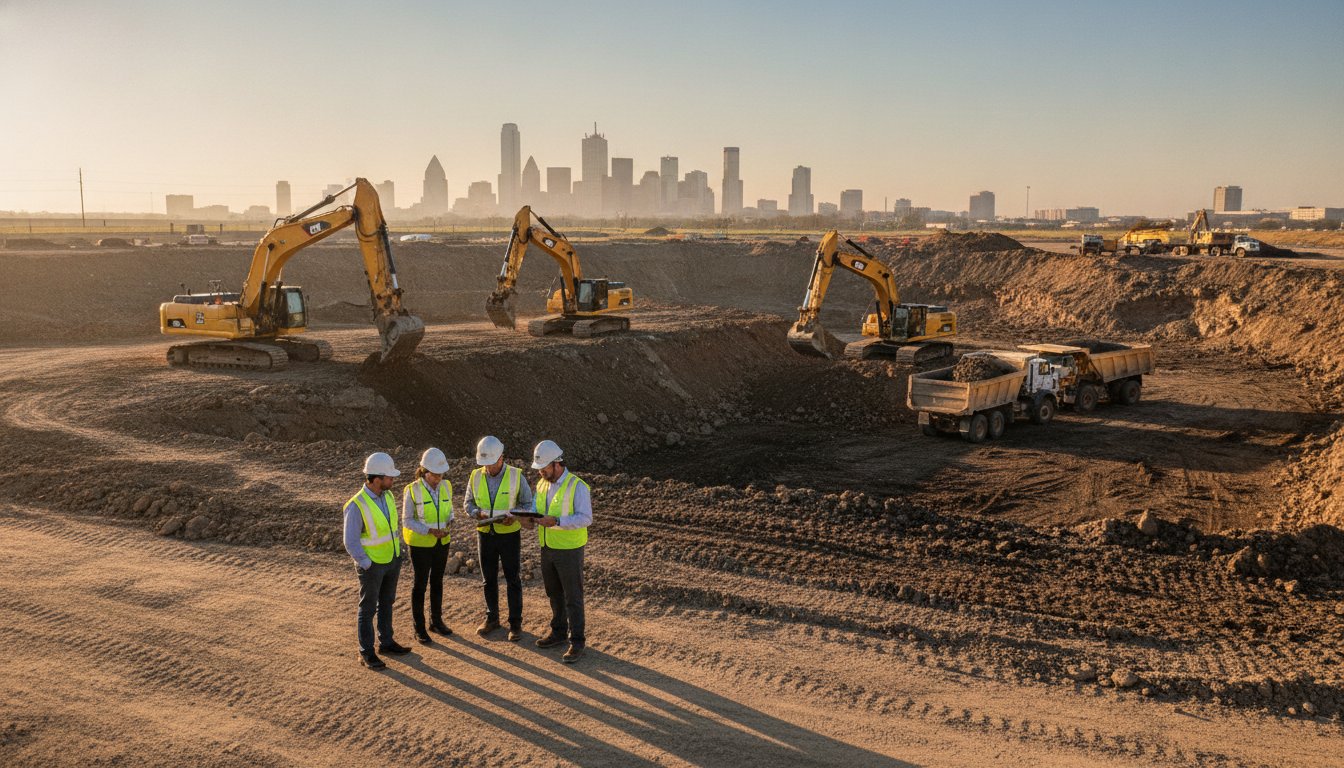
What if the most significant risk to your project’s timeline isn’t the structure itself, but the earth beneath it? In the Dallas-Fort Worth metroplex, the ground is rarely a neutral participant in construction. Developers often face the harsh reality of the Blackland Prairie, where expansive clay and unpredictable soil conditions can quickly invalidate a preliminary budget. Securing an accurate mass excavation cost estimate Dallas requires more than just calculating cubic yardage; it demands a deep understanding of local geology and logistical precision.
You’ve likely experienced the frustration of unforeseen soil issues or the friction that arises when excavation and concrete contractors aren't in sync. It's a common challenge that leads to budget overruns and haul-off delays. This guide promises to help you master these complexities by providing professional insights into soil stabilization, site preparation, and efficient logistics. We will outline a reliable framework for earthwork budgeting and demonstrate why a partner who handles both civil site work and structural concrete is essential for long-term project viability.
Key Takeaways
- Learn how to differentiate between standard site grading and complex mass excavation to ensure your project begins with a technically sound foundation.
- Understand the unique challenges posed by Dallas "Blackland Prairie" expansive clay and how moisture levels dictate the efficiency of heavy machinery.
- Developing a precise mass excavation cost estimate Dallas requires accounting for mobilization, fuel, and the logistical complexities of large-scale material haul-off.
- Identify hidden risks such as high water tables and unidentified underground utilities that can lead to significant budget volatility if not managed early.
- Discover the operational advantages of partnering with a single entity for both civil site work and structural concrete to eliminate coordination friction.
Understanding Mass Excavation Requirements for Dallas Commercial Sites
Mass excavation involves the large-scale movement and removal of earth to prepare a site for heavy infrastructure, deep foundations, or subterranean levels. Unlike light site grading, which focuses on surface leveling, or utility trenching for pipe installation, mass excavation requires heavy machinery to displace vast volumes of soil. For developers in the North Texas market, securing a reliable mass excavation cost estimate Dallas is a fundamental step in project feasibility. This data informs the entire financial structure of a development, from securing capital to establishing the critical path for the construction schedule.
In the urban core of Dallas, these projects often involve deep excavations for high-rise foundations or multi-level parking structures. Conversely, the surrounding suburbs frequently see massive industrial pads that require extensive soil stabilization and specific compaction standards to support large-scale logistics centers. Accurate early planning ensures that the site is ready for the technical demands of these structures without leading to costly mid-project corrections.
The Scope of Commercial Earthwork
The classification of a project as mass excavation typically depends on the total volume of material moved. While smaller pads might only require surface adjustments, commercial developments often cross thresholds where specialized scrapers and dozers become necessary. This process begins with clearing and grubbing, which involves the removal of vegetation and debris to ensure the underlying soil is ready for displacement. Properly executed Earthworks (engineering) principles ensure that the site is prepared for subsequent phases, such as slab on grade or the construction of CIP garages. This integration is vital; if the initial dig is inaccurate, the structural concrete phases will suffer from delays and increased material costs.
Why Estimates Vary Across North Texas
Topography in the Dallas-Fort Worth Metroplex is deceptively complex. The shift from the flat plains of North Dallas to the rolling hills in the west influences how much earth must be relocated to achieve a level building pad. Project depth and the footprint size are the primary drivers for equipment selection. A deep, narrow excavation for a midrise foundation requires different machinery than a broad, shallow cut for a retail center. The logistical challenge of hauling away thousands of cubic yards of soil also fluctuates based on the site’s proximity to disposal facilities. Understanding these regional nuances is why many developers seek a partner with deep-rooted local expertise. You can learn more About Born Integrated Construction and our history of managing these technical demands across North Texas. Providing a mass excavation cost estimate Dallas that remains stable through the life of a project requires a disciplined approach to site analysis and equipment management.
Key Geographic Factors Affecting Excavation Costs in North Texas
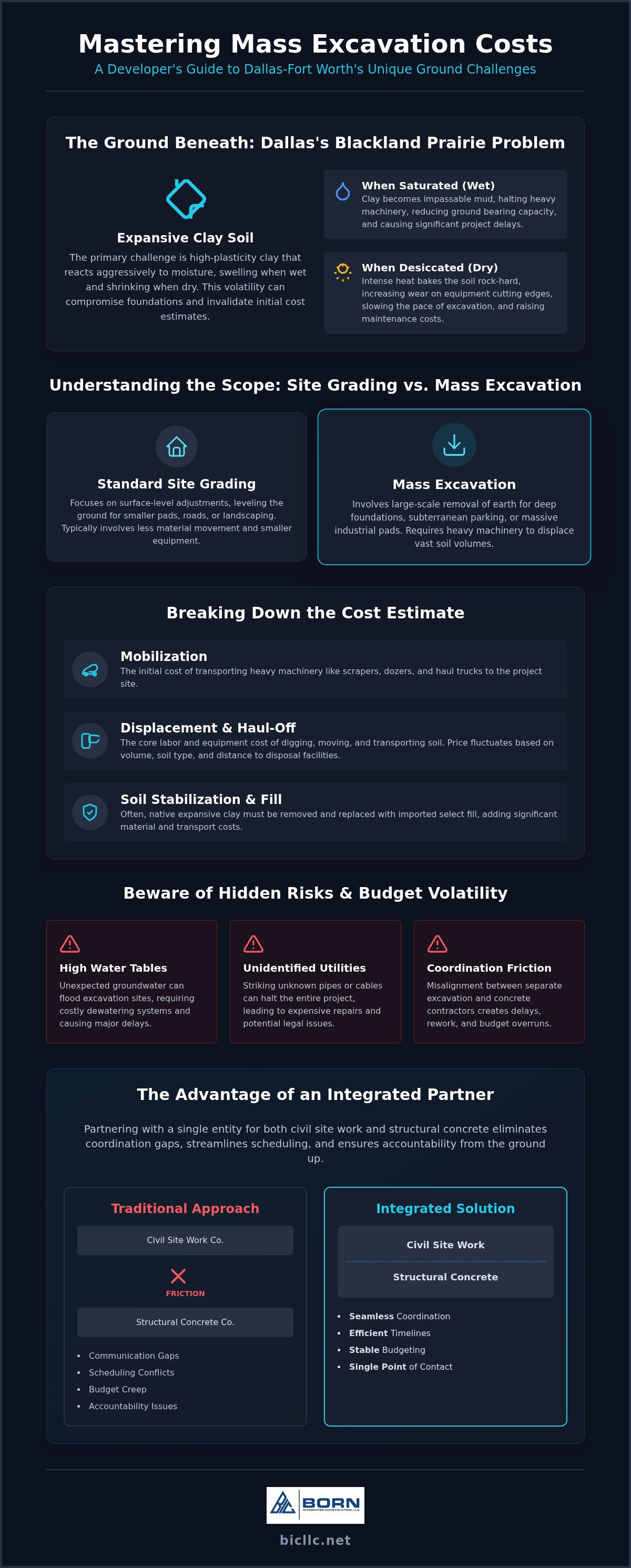
The geography of North Texas presents a unique set of challenges that can significantly alter a project's financial outlook. Unlike other regions where soil is relatively stable, the Dallas area is defined by the Blackland Prairie. This region is home to high-plasticity, expansive clay that reacts aggressively to moisture changes. When a contractor develops a mass excavation cost estimate Dallas, they aren't just measuring dirt; they're calculating the behavior of a material that can expand or contract by significant margins. This soil characteristic often requires developers to remove large quantities of native earth and replace it with select fill to ensure the structural integrity of future foundations.
Soil moisture content is another critical variable in the Dallas-Fort Worth market. High-plasticity clay becomes nearly impassable for heavy machinery when saturated. Saturated soil reduces the bearing capacity of the ground, leading to equipment downtime and decreased cycle times for scrapers and haul trucks. Conversely, during the intense heat of a Texas summer, the soil can become so hard that it increases wear on cutting edges and teeth, necessitating more frequent maintenance and slowing the pace of the dig. These environmental factors make it essential to work with a partner who understands the local terrain. You can review our past work and site preparation standards at our projects page to see how we manage these regional complexities.
Managing Expansive Clay and Soil Stability
Expansive clay requires a disciplined approach to stabilization. Because this soil "heaves" when wet and shrinks when dry, it can destroy commercial paving and foundations over time. To mitigate this, we often employ soil stabilization techniques such as lime or cement injection. These chemical treatments alter the soil's molecular structure, reducing its plasticity and creating a firm, reliable base. The cost of these treatments, along with the potential need for importing non-expansive select fill, must be factored into any serious mass excavation cost estimate Dallas to avoid structural failure in later phases.
Environmental and Regulatory Considerations
Navigating the regulatory landscape in North Texas is as important as the physical dig. Developers must account for Stormwater Pollution Prevention Plan (SWPPP) compliance, which involves installing silt fences, rock filters, and stabilized construction exits to prevent sediment runoff. Additionally, local noise ordinances and restricted work hours in dense urban areas like Uptown or the Dallas Design District can limit daily productivity. If your project includes a detention pond, you must also secure specific permits to manage drainage and runoff, adding both time and administrative costs to the initial site work phase. For those seeking long-term stability in their site prep, consulting with an expert at bicllc.net can help clarify these logistical requirements before the first shovel hits the ground.
Breaking Down the Cost Components: From Mobilization to Haul-Off
Developing a comprehensive mass excavation cost estimate Dallas requires a granular look at the operational lifecycle of a project. The process begins with mobilization, which involves the strategic deployment of a specialized fleet, including heavy excavators, scrapers, and dozers, to the job site. This isn't merely a delivery fee; it's a complex logistical phase that accounts for transport permits, pilot cars for oversized loads, and the assembly of machinery upon arrival. In dense urban environments like the Dallas Design District or Uptown, these initial movements require meticulous planning to avoid traffic disruptions and ensure safety before the first bucket of earth is moved.
Once equipment is on-site, the focus shifts to the actual movement of earth, where labor and fuel become the primary drivers of daily expenses. Excavation and stockpiling involve digging to the engineered depths and either placing material in designated areas for later use or preparing it for immediate removal. The efficiency of this phase depends on the cycle times of the machinery and the skill of the operators. Maintaining a steady rhythm is essential for keeping the project on schedule, as any interruption in the digging phase creates a ripple effect through the subsequent structural concrete and paving stages.
Calculating Cubic Yardage and Swell
Precision in volume calculation is where many preliminary budgets fail. It's vital to distinguish between "bank" cubic yards, which refers to soil in its natural, compacted state, and "loose" cubic yards, which is the volume the soil occupies once it's been excavated. Swell factor is the percentage increase in volume after excavation. In the Dallas area, the high-plasticity clay often features a swell factor of 20% to 30%. This means 1,000 yards of earth in the ground can become 1,300 yards once it's in the back of a truck. Failing to account for this expansion leads to inaccurate trucking counts and significant budget overruns during the haul-off phase.
Logistics and Transportation Management
Logistics represent the final, and often most volatile, component of a mass excavation cost estimate Dallas. The decision between on-site balancing, known as cut-and-fill, and total haul-off depends on the site’s final elevation requirements and soil quality. If the native soil is unsuitable for structural fill, it must be transported to a disposal site or landfill. This process is heavily influenced by fluctuating fuel prices and the availability of CDL drivers. Furthermore, site accessibility in congested areas can limit the size of trucks used, increasing the total number of trips required. Our team manages these variables by coordinating closely with our structural concrete divisions to ensure the site remains organized and accessible. You can see the results of this integrated approach on our projects page, where logistical precision is a hallmark of our civil site work.
Mitigating Risks and Hidden Costs in Large-Scale Earthwork
Hidden variables often dictate the finality of a project's budget. While volume and soil type are predictable, the subsurface environment rarely is. A comprehensive mass excavation cost estimate Dallas must account for the high probability of encountering unidentified underground utilities. These legacy lines, often omitted from old site maps, require immediate remediation and rerouting to maintain safety and compliance. Encountering these obstacles without a plan leads to work stoppages that jeopardize the entire development timeline.
Site moisture also extends beyond the soil's surface. High water tables or poor drainage patterns necessitate dewatering strategies. This involves the use of pumps and specialized basins to keep the excavation site dry enough for heavy equipment to operate. Without these measures, the site becomes a liability, risking both the safety of the crew and the stability of the surrounding structures. Addressing these unknowns with a healthy contingency budget in every estimate is not just a precaution; it's a requirement for operational stability.
Underground Utility and Infrastructure Coordination
Success in large-scale earthwork depends on meticulous preparation. Detailed site surveys and potholing, which involves the precision digging of small test holes to locate existing lines, are essential before mass excavation begins. Coordinating the installation of storm, sanitary, and water utilities concurrently with the primary dig can generate significant cost efficiencies. This integrated approach reduces the need for multiple mobilizations and ensures that the infrastructure is set correctly the first time. We leverage our deep experience in civil site work and infrastructure to manage these overlapping phases, ensuring that utility placement never compromises the structural integrity of the foundation.
Detention Ponds and Site Drainage
Detention ponds are a standard requirement for commercial developments across North Texas to manage stormwater runoff. Excavating these basins is a technical challenge that must meet strict municipal standards for volume and flow rate. Improperly managed drainage during the excavation phase can lead to severe erosion, resulting in environmental fines and project delays. By integrating detention pond construction into the broader earthwork strategy, we ensure that the site remains compliant and stable throughout the construction lifecycle. This proactive management of site drainage protects your investment and prevents the budget creep associated with reactive repairs. To ensure your site is prepared with this level of technical precision, contact our team at bicllc.net to discuss your project requirements.
Born Integrated Construction: Precision Civil Site Work and Integrated Solutions
Born Integrated Construction operates on the principle that the strength of a structure is defined by its foundation. For developers, the transition from moving earth to pouring concrete is often the most volatile phase of a project. By hiring a single partner to manage both mass excavation and structural concrete, you eliminate the coordination friction that typically leads to delays and budget creep. Our integrated project management ensures that the site is prepared precisely for the structural requirements of the building, providing a seamless hand-off between civil site work and vertical construction. This unified approach allows us to deliver a more accurate mass excavation cost estimate Dallas, as we account for the technical needs of the concrete phase during the initial dig.
Safety and integrity are not merely procedural goals; they are the core of our operational philosophy. On every North Texas job site, we prioritize disciplined execution and meticulous attention to detail. This steadfast commitment to high standards is a reflection of our focus on long-term project viability and the enduring nature of our work. By managing the site work and the structural components together, we maintain a consistent standard of quality that protects the developer’s investment from the ground up, ensuring the site remains organized and safe for all subsequent trades.
Our Turn-Key Civil and Concrete Approach
We specialize in the complex earthwork required for modern Dallas infrastructure. Our technical capabilities include mass soil excavation, the construction of detention ponds, and paving stabilization. These services are the essential precursors to our structural offerings, such as podium slabs or CIP garages. When we manage a project involving a podium deck, our civil team prepares the site with the specific load-bearing requirements of that structural concrete in mind. This foresight prevents the rework and structural compromises that often occur when disparate contractors fail to communicate effectively across trade lines, ensuring a more durable and reliable end result.
Partnering for Success in Dallas Infrastructure
We believe that professional stability is built on transparent communication and proven results. Our role is that of a seasoned and authoritative expert who acts as a dependable partner to developers across the Dallas-Fort Worth Metroplex. Understanding the local landscape, from the regulatory environment to the physical soil challenges, allows us to provide a mass excavation cost estimate Dallas that is both realistic and reliable. We prioritize substance over style, ensuring that every foundation we build is a testament to operational precision and craftsmanship. We invite you to view our completed projects to see our mass excavation and concrete work in action.
Securing the Future of Your North Texas Development
Successful commercial development in North Texas depends on a disciplined approach to site preparation. We've explored how the unique behavior of Blackland Prairie soil and the logistical realities of haul-off can impact your project's critical path. By identifying hidden risks like underground utilities and the necessity of dewatering early, you protect your investment from the volatility of the subsurface environment.
Securing a precise mass excavation cost estimate Dallas requires a partner who understands the technical intersection of civil site work and structural concrete. Born Integrated Construction brings decades of experience navigating the local regulatory landscape and North Texas soil conditions. Our unwavering commitment to safety and operational efficiency ensures that your project moves seamlessly from mass excavation to structural completion. We invite you to Request a Professional Mass Excavation Estimate from Born Integrated Construction to ensure your site is managed with precision. We look forward to helping you establish a lasting foundation for your next commercial project.
Frequently Asked Questions
What is the average duration of mass excavation for a commercial site in Dallas?
The duration of mass excavation for a Dallas commercial site varies significantly based on the total cubic yardage and local weather conditions. A typical industrial pad might take several weeks; however, deep excavations for high-rise foundations in urban centers often require months of methodical work. Factors such as site accessibility and the presence of underground utilities also influence the timeline. Selecting a partner who manages both earthwork and structural concrete helps streamline these transitions and maintains project momentum.
How does Dallas clay soil affect the total cost of excavation?
Dallas clay soil, specifically the Blackland Prairie expansive clay, increases excavation costs due to its high plasticity and technical handling requirements. This soil type requires heavy machinery with significant breakout force and often necessitates stabilization or replacement with select fill to ensure structural integrity. When developing a mass excavation cost estimate Dallas, contractors must account for the additional labor and materials needed to manage these aggressive soil characteristics to prevent future foundation shifting or paving failure.
What is a swell factor and why does it matter for my budget?
The swell factor is the percentage increase in soil volume once it's removed from its compacted, natural state. In the Dallas-Fort Worth area, the local clay often exhibits a swell factor between 20% and 30%, meaning the loose volume in a truck is much larger than the bank volume in the ground. This matters for your budget because it directly determines the number of truckloads required for haul-off and the associated disposal fees at regional landfills.
Do I need a separate contractor for excavation and concrete paving?
You don't need separate contractors for these phases if you partner with an integrated firm. Born Integrated Construction provides a turn-key civil and structural approach, handling mass soil excavation, detention ponds, and structural concrete like podium slabs or CIP garages. This integration reduces coordination friction and eliminates the common delays that occur when one trade waits for another to finish site preparation, ultimately delivering a more consistent standard of quality across the job site.
What are the main causes of budget overruns in Texas earthwork projects?
Budget overruns in Texas earthwork projects typically stem from unidentified underground utilities and inaccurate soil volume calculations. Unforeseen weather patterns also lead to costly downtime, as Dallas clay becomes difficult to manage when saturated. Additionally, failing to account for proper soil stabilization or the technical requirements of municipal drainage standards often results in reactive spending. A detailed mass excavation cost estimate Dallas that includes a healthy contingency budget is the best defense against these hidden variables.
How is the cost of haul-off and disposal calculated for excess soil?
Haul-off and disposal costs are calculated based on the total loose cubic yards of material, current fuel prices, and the distance to a certified disposal site. Logistics also depend on driver availability and the specific tipping fees charged by North Texas landfills. In dense urban environments, site accessibility limits the size of haul trucks, which can increase the total number of trips required. Efficient logistics management is essential to keep these transportation costs from eroding the project budget.
What permits are required for mass excavation in the Dallas-Fort Worth area?
Mass excavation in the Dallas-Fort Worth area requires several key permits to ensure environmental and municipal compliance. Developers must typically secure a Stormwater Pollution Prevention Plan (SWPPP) to manage runoff and erosion. Additionally, specific permits are required for detention pond construction and utility connections. Depending on the project's location, you may also need to navigate local noise ordinances or work-hour restrictions that dictate when heavy machinery can be operated on the site.
Can soil stabilization reduce the overall cost of my foundation work?
Soil stabilization can reduce the overall cost of foundation work by providing a firm, non-expansive base that protects the structure from shifting. Techniques like lime or cement injection alter the clay's molecular structure, which often allows for more efficient paving and concrete slab installation. While stabilization requires an initial investment, it prevents the long-term expenses associated with foundation repairs and structural failure, making it a critical component of a sustainable and cost-effective construction strategy.