How Long Does a Concrete Parking Lot Last in Texas?
A concrete parking lot is only as durable as the stabilized soil beneath it. For property owners and developers, the question of how long does a concrete parking lot last in Texas is often a matter of protecting a significant capital asset from the state's volatile environment. You likely understand that the combination of expansive clay soils and relentless thermal cycles creates a hostile setting for any rigid pavement. It's common to worry that poor initial execution or environmental stress will lead to premature failure and escalating repair costs.
This article provides a realistic assessment of concrete longevity and the technical factors that prevent structural degradation. You'll discover the specific construction standards, such as proper subgrade stabilization and thickness requirements, that allow a lot to remain functional for 25 to 40 years. We'll also outline a framework for evaluating construction quality and the actionable maintenance steps required to ensure your pavement remains a steadfast foundation for your operations. By prioritizing technical proficiency and operational precision during the planning phase, you can secure a result that stands the test of time and climate.
Key Takeaways
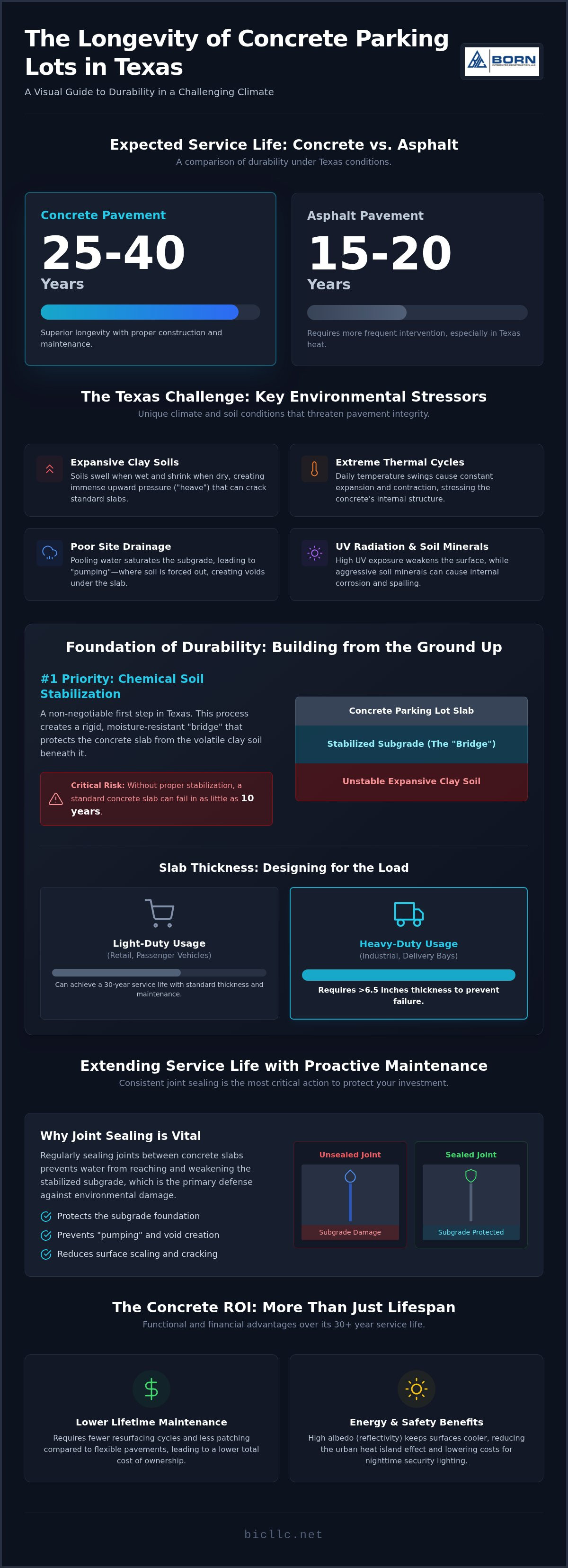
- Concrete parking lots in the Texas climate typically provide a service life of 25 to 40 years, which significantly exceeds the durability of asphalt alternatives.
- Determining how long does a concrete parking lot last in Texas depends heavily on how the design addresses extreme thermal cycles and expansive clay soils.
- Chemical soil stabilization is a non-negotiable first step to create a moisture-resistant bridge for the slab and prevent premature structural failure.
- Proactive maintenance strategies, particularly consistent joint sealing, are vital to protect the stabilized subgrade from water infiltration and surface scaling.
- Utilizing an integrated construction partner ensures that every phase of the project, from mass soil excavation to the final pour, adheres to rigorous quality standards.
The Expected Lifespan of Concrete Parking Lots in the Texas Climate
A professionally installed concrete parking lot in Texas typically provides a service life of 20 to 30 years. This longevity is notably superior to asphalt paving, which often requires significant intervention or replacement within 15 to 20 years. In the extreme heat of regions like Houston or Dallas, asphalt tends to soften and rut; however, concrete maintains its rigid structural integrity. When property owners ask how long does a concrete parking lot last in Texas, the answer depends on the distinction between service life and structural life. Service life refers to the period the pavement remains aesthetically pleasing and smooth for users. Structural life is the duration before the slab itself fails to support intended loads.
The total number of load cycles a lot can withstand is dictated by initial design thickness. Every vehicle that crosses the slab consumes a fraction of its fatigue life. If the slab is too thin for the volume of traffic, micro-cracks develop early, shortening the timeline for major repairs. Proper engineering ensures the road surface is thick enough to distribute these stresses across the stabilized subgrade without fracturing the concrete. Understanding how long does a concrete parking lot last in Texas allows for better capital planning and long-term asset management.
Standard Commercial Usage vs. Heavy-Duty Loading
Lifespan expectations vary based on the specific application of the facility. A light-duty retail lot primarily hosting passenger vehicles can reach the 30-year mark with minimal maintenance. Industrial distribution centers face a different reality. Heavy-duty loading from delivery bays and garbage truck routes subjects the concrete to intense point loading. These areas require specialized thickness, often exceeding 6.5 inches, to prevent the "punch-through" effect that leads to premature failure. You can view examples of these high-capacity designs in our completed industrial projects.
The ROI of Concrete Over the Decades
Analyzing the total cost of ownership reveals that concrete is a more stable long-term investment despite its higher initial price. It requires fewer resurfacing cycles and less frequent patching than flexible pavements. Concrete’s high albedo, or reflective property, also provides a functional advantage in Texas cities by reducing the heat island effect and lowering nighttime lighting costs. The light color reflects more sunlight, keeping the surface cooler and improving visibility for security purposes. Concrete ROI is the balance of higher initial cost against lower 30-year maintenance.
Primary Environmental Stressors Affecting Texas Concrete
Texas weather presents a unique set of challenges for rigid pavement. Extreme thermal cycles in Houston and North Texas cause concrete to expand and contract daily. This constant movement stresses the internal structure of the slab. UV radiation also plays a role. Without proper curing, high UV exposure leads to surface "chalking," where the top layer of cement paste weakens and powders. This degradation directly impacts how long does a concrete parking lot last in Texas by compromising the surface's resistance to traffic wear.
Poor site drainage is another silent killer of pavement. When water pools near the edges or seeps through cracks, it saturates the subgrade. Under heavy vehicle loads, this water is forced back up through the joints, carrying soil particles with it. This process, known as "pumping," creates voids under the slab that lead to sudden cracking. Additionally, local soil minerals can be chemically aggressive. Certain sulfates and chlorides found in Texas earth accelerate rebar corrosion, causing internal expansion that spalls the concrete from the inside out.
The Challenge of Expansive Clay Soils
Texas is known for its highly plastic clay soils. These soils act like a sponge, expanding when wet and shrinking during droughts. This movement creates "heave," which exerts massive upward pressure on the concrete. Standard slabs often fail within 10 years if the soil isn't stabilized. Effective mass soil excavation and stabilization are required to replace or treat these reactive layers before the first yard of concrete is poured. Addressing these "ground up" issues is essential for any long-term paving strategy.
Thermal Stress and Joint Integrity
Understanding how long does a concrete parking lot last in Texas requires a deep look at how 100-degree summers cause significant slab movement. Concrete expands as it heats, and without a professional jointing pattern, the slab will create its own "random cracks" to relieve the pressure. Expansion joints must be meticulously maintained. If these joints become clogged with incompressible debris, the slabs have nowhere to go, leading to "buckling" or crushed edges. Reliable civil site work ensures these systems are designed to handle the state's specific environmental volatility.
Why Soil Stabilization is the Foundation of Longevity
The integrity of a concrete surface depends entirely on the stability of the earth beneath it. In the context of commercial concrete paving, soil stabilization is the critical first step that defines the project's success. This process typically involves chemical stabilization using lime or cement to transform raw, reactive soil into a moisture-resistant bridge. By chemically altering the soil's composition, we increase its R-value, or support value. This allows for a more efficient slab design that doesn't have to compensate for a weak foundation. Skipping this phase in regions like San Antonio or Austin, where soil profiles are notoriously volatile, often leads to premature failure. The answer to how long does a concrete parking lot last in Texas is frequently determined before the first truck of concrete arrives on site.
The Mechanics of Paving Stabilization
Lime stabilization specifically targets the plastic index of Texas clay. It reduces the soil's tendency to swell when wet and shrink when dry. While mechanical compaction is necessary, it cannot provide the long-term structural change that chemical stabilization offers for commercial loads. Stabilization is not an option but a requirement for any lot intended to last its full intended lifespan. This technical proficiency ensures the ground remains a steadfast partner to the concrete slab. Stabilization directly influences how long does a concrete parking lot last in Texas by creating a predictable environment for the rigid pavement.
Integrating Civil Site Work with Paving
A lot's longevity is also tied to the precision of the underlying infrastructure. Detention pond construction and underground utility installation must be executed with meticulous management to avoid subgrade settling. We advocate for a turnkey civil approach where earthwork and paving are seamlessly coordinated. This integration prevents the subgrade from being compromised during the transition between phases. At BIC, we prioritize the protection of the stabilized base, ensuring it remains undisturbed until the final pour. You can see the results of this disciplined approach in our civil and concrete projects. Proper coordination between excavation and paving teams eliminates the gaps where moisture typically enters the system.
Maintenance Strategies to Extend Your Lot’s Service Life
Maintenance is a commitment to the enduring nature of your professional output. While initial construction sets the foundation, proactive care determines exactly how long does a concrete parking lot last in Texas. Joint sealing is the most critical defense. It prevents water from infiltrating the slab and reaching the stabilized subgrade. If moisture reaches the treated soil, it can cause the very heave that stabilization was meant to prevent. This simple act of sealing protects the investment from the ground up.
Regular inspections should also focus on "spalling" or surface scaling. These issues often stem from improper initial finishing or extreme weather during the pour. Managing heavy vehicle traffic is equally important. Overloaded slabs can develop structural cracks that compromise the entire system. Finally, property managers must ensure site drainage systems, like storm sewers, remain clear. Blocked drains allow water to pool and undermine the lot's edges. Operational precision in drainage management prevents the subgrade from becoming saturated and soft.
The 5-Year Inspection Framework
A methodical inspection every five years ensures technical proficiency in asset management. This cadence allows for the meticulous management of details before they become costly failures. A disciplined approach to inspections includes:
- Step 1: Conduct a visual assessment of all expansion and control joints for seal failure or debris accumulation.
- Step 2: Check for signs of "settlement" or voids near catch basins and storm sewer inlets.
- Step 3: Perform immediate crack injection for any structural fissures to prevent deep moisture ingress.
Professional Cleaning and Surface Protection
Removing oil and chemical spills is essential for maintaining the integrity of the concrete surface. These substances can degrade the binder over time. In the Texas climate, the use of concrete sealers is a point of professional debate. While not always necessary for structural life, they can provide an extra layer of protection against UV-driven surface degradation. Clear markings and striping also play a role in longevity. By directing traffic away from vulnerable edges, you reduce edge-load stress and prevent corner breaks.
The question of how long does a concrete parking lot last in Texas is ultimately answered by the quality of its upkeep. Ensuring your pavement remains a reliable asset requires a partner who values substance over style. To learn more about our commitment to high standards, explore our approach to professional stability.
Designing for Durability: The Born Integrated Construction Standard
Our commitment to integrity ensures that every project we undertake is built to exceed the standard service life of 20 to 30 years. We view each lot as a critical component of a property's capital value. When clients ask how long does a concrete parking lot last in Texas, they're looking for the assurance that their investment won't degrade prematurely. We provide this security by applying the same rigorous structural concrete standards to our paving projects that we use for high-rise foundations and complex parking structures. This disciplined approach focuses on execution, safety, and the meticulous management of every technical detail.
The Integrated Civil and Concrete Advantage
Property owners face significant risks when coordination fails between different trades. By utilizing a single firm for site work, utilities, and paving, you reduce the potential for subgrade contamination or settling. Our expertise in mass soil excavation allows us to control the project's foundation from day one. We don't rely on third-party assumptions; we verify the stabilization ourselves. Our About page reflects this steadfast commitment to long-term viability and professional stability. This engineering mindset, derived from our work on Cast-in-Place (CIP) structures, ensures that every slab is poured onto a base that's as reliable as the concrete itself.
Securing Your Investment with Reliable Paving
In the Texas market, the term "cost-effective" is often misunderstood. Real value isn't found in the lowest bid, but in avoiding the catastrophic failures that occur within 10 years due to poor initial installation. We maintain strong vendor relationships to ensure the delivery of high-quality materials that meet our exact specifications. This consistency allows us to provide a finished product that stands as a testament to our craftsmanship. We prioritize operational efficiency on every active job site, ensuring that your project remains on schedule without compromising safety. For developers and property owners seeking a steadfast partner for infrastructure and developments, we offer a foundation of proven results and unwavering consistency. Identifying how long does a concrete parking lot last in Texas is ultimately a question of who you trust to build it.
Building a Steadfast Foundation for the Future
The longevity of a commercial pavement is determined by the discipline applied during its initial construction. Determining how long does a concrete parking lot last in Texas requires looking beneath the surface at the quality of soil stabilization and the precision of the civil site work. A lot built on a moisture-resistant chemical bridge and designed with proper thermal jointing can reliably serve your operations for up to 40 years. This enduring nature is only possible when you prioritize technical proficiency over short-term savings.
At Born Integrated Construction, we're specialized in paving stabilization and full-service turnkey civil solutions. Our focus on integrity and quality results ensures that your infrastructure remains a stable asset. By managing every detail from mass excavation to the final slab pour, we eliminate the risks associated with fragmented trade coordination. If you're ready to secure your property with a partner who values professional stability and meticulous craftsmanship, we invite you to Request a Consultation for Your Commercial Paving Project. We look forward to establishing a lasting foundation for your next development.
Frequently Asked Questions
Is concrete better than asphalt for the Texas heat?
Concrete is the superior choice for the Texas climate because it doesn't soften under extreme thermal stress. Asphalt is a flexible pavement that ruts and deforms when surface temperatures exceed 100 degrees. Concrete's reflective properties also keep the surface cooler, which prevents the binder degradation common in asphalt. This thermal stability is a primary factor in how long does a concrete parking lot last in Texas compared to other paving materials.
How often should expansion joints be resealed in a concrete lot?
Expansion joints should generally be inspected annually and resealed every 3 to 5 years to maintain a moisture-resistant barrier. In the volatile Texas environment, joint sealant can pull away from the concrete due to extreme expansion and contraction. Keeping these seals intact is vital because it prevents water from reaching the stabilized subgrade. Once water bypasses the seal, it can lead to soil erosion and slab instability, which shortens the pavement's service life.
What is the #1 cause of concrete parking lot failure in Texas?
The primary cause of premature failure for Texas pavements is unaddressed soil movement within expansive clay layers. When the ground beneath a slab shifts due to moisture changes, it creates uneven pressure that the rigid concrete cannot accommodate. Without proper mass soil excavation and chemical stabilization, even the highest quality concrete will eventually crack and settle. Most 10-year failures are the result of poor foundation preparation rather than issues with the concrete mix itself.
Does a concrete parking lot require a specialized subgrade?
Yes, a specialized subgrade is a technical requirement for any lot intended to survive the Texas climate. Standard earthwork is rarely enough to support commercial loads over several decades. We utilize specialized paving stabilization techniques, such as lime or cement treatment, to create a consistent and non-reactive platform. This foundation ensures the slab remains level and supported, which is essential for determining how long does a concrete parking lot last in Texas for high-traffic facilities.
Can heavy trucks shorten the lifespan of my concrete paving?
Heavy trucks significantly accelerate the consumption of a slab's fatigue life if the design thickness is insufficient. Each pass of a loaded delivery vehicle or garbage truck exerts massive point loading on the concrete. If the lot was only designed for passenger vehicles, these heavy loads will cause micro-fractures that eventually lead to structural failure. Engineering for heavy-duty loading in Texas requires a minimum thickness of 6.5 inches to maintain long-term structural integrity and prevent premature cracking.
What is soil stabilization and is it necessary for every project?
Soil stabilization is a process where chemical additives like lime or cement are mixed into the raw earth to reduce its plasticity and increase its load-bearing capacity. It is a mandatory requirement for commercial projects in cities like Houston, Dallas, and San Antonio. This process creates a moisture-resistant bridge that protects the slab from the heave and shrink cycles typical of Texas clay. It is the most critical step in ensuring professional stability.
How long does it take for a new concrete lot to be ready for traffic?
A new concrete lot typically requires 7 to 14 days of curing before it can support standard commercial traffic. While concrete begins to harden within hours, it takes time to reach the compressive strength needed to handle heavy vehicle loads without cracking. Opening a lot too early can cause permanent structural damage that isn't immediately visible. We monitor the curing process closely to ensure the slab has achieved the necessary durability before allowing full operational use.
What happens if we don’t maintain the storm sewer system near the parking lot?
Neglecting the storm sewer system on a Texas property allows water to pool and eventually undermine the pavement's edge. When drainage is blocked, water seeps into the subgrade and softens the stabilized base. This leads to a process called pumping, where vehicle loads force water and soil particles out through the joints. Over time, this creates large underground voids that cause the concrete to collapse. Maintaining detention ponds and storm lines is essential for protecting the pavement's structural life.