Post Tension Slab Inspection Guide for Developers

A single miscalculation in tendon elongation isn't just a technical error; it's a fundamental threat to the multi-decade viability of a high-rise or podium structure. As a developer, you understand that the margin for error in structural concrete is virtually non-existent, especially when managing the volatile nature of expansive Texas soils. Meeting the mandatory post tension slab inspection requirements is often the difference between a project that stands as a testament to quality and one plagued by long-term structural instability. It's a complex process that demands unwavering attention to detail and a commitment to established PTI standards.
We recognize that the pressure to deliver zero-defect tensioning reports while maintaining a strict construction schedule is immense. This guide provides a clear roadmap to master the critical inspection phases of post-tensioned slabs, ensuring your next project achieves both structural integrity and full regulatory compliance. You'll gain a comprehensive overview of the essential protocols, including pre-pour anchor placement, pour monitoring, and the verification of jacking forces. By prioritizing these meticulous management steps, you establish a foundation of safety and durability that protects your investment for the long term.
Key Takeaways
- Identify how the Post-Tensioning Institute (PTI) benchmarks ensure structural safety through active reinforcement systems.
- Master the essential post tension slab inspection requirements for verifying tendon quantity, spacing, and vertical drape profiles before the pour.
- Learn to monitor hydraulic pressure and tendon elongation to confirm the slab meets the engineer's specified compressive strength.
- Ensure long-term durability by implementing proper corrosion protection protocols, including precise tail trimming and anchorage capping.
- Recognize the value of integrating soil stabilization with structural concrete to manage expansive soils and maintain slab integrity.
Understanding Post-Tensioned Slab Systems and Regulatory Standards
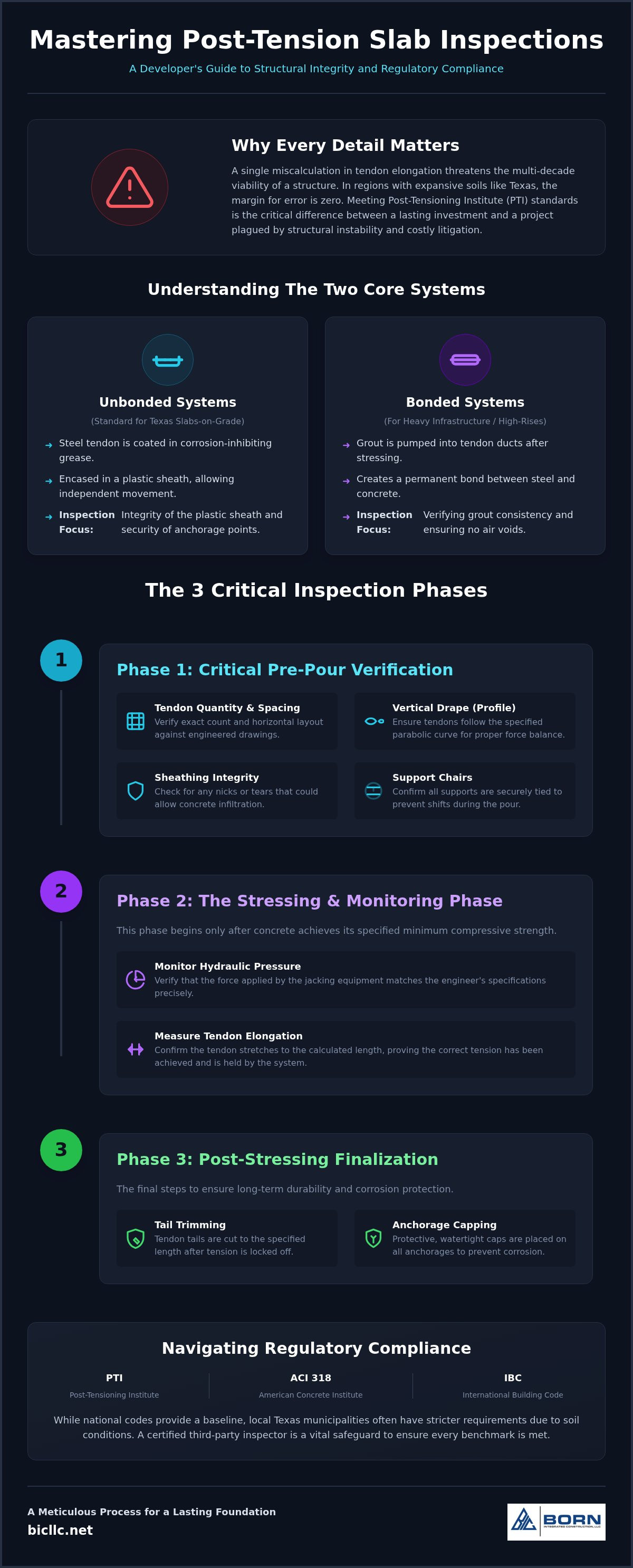
Post-tensioning represents a sophisticated engineering technique within the broader category of Prestressed concrete. It's defined as an active reinforcement system. High-strength steel tendons are placed in the formwork before the pour and tensioned after the concrete reaches a specific strength. This process compresses the concrete, significantly increasing its tensile capacity and resistance to cracking. The Post-Tensioning Institute (PTI) serves as the primary authority, setting the industry benchmarks that ensure these systems perform as designed. For developers across Texas, PT slabs are the preferred solution for managing expansive clay soils. These soils expand and contract with moisture changes, which can easily crack standard reinforced slabs. A post-tensioned system provides the structural rigidity necessary to float atop these shifting soils. Neglecting post tension slab inspection requirements carries severe consequences. Structural failure, tendon blowouts, and long-term litigation are real risks for projects that bypass these mandatory safety checks.
The Difference Between Bonded and Unbonded Systems
In most Texas developments, unbonded tendons are the standard for slabs on grade, including podium slabs and midrise foundations. In this system, the steel tendon is coated in a corrosion-inhibiting grease and encased in a plastic sheath. This allows the tendon to move independently of the concrete during the stressing phase. Inspection requirements for unbonded systems focus heavily on the integrity of the plastic coating and the security of the anchorage points. Bonded systems are different. They involve pumping grout into the tendon ducts after stressing. This creates a permanent bond between the steel and the concrete. Bonded systems are usually reserved for heavy infrastructure projects or specific high-rise foundation designs. Because the grout provides both structural bonding and corrosion protection, the inspection process is more rigorous. It requires verifying grout consistency and ensuring no air pockets remain in the ducts.
National vs. Local Texas Building Codes
Compliance begins with the American Concrete Institute’s ACI 318 and the International Building Code (IBC). These documents outline the minimum standards for structural concrete. However, regional soil conditions in Texas mean that local municipalities often have stricter interpretations. Cities like Houston, Austin, and Dallas have specific requirements for residential versus commercial post-tensioning. Developers must navigate these nuances to ensure their post tension slab inspection requirements are met at every stage. We integrate site preparation and soil stabilization with our concrete services to provide a more stable foundation for these systems. Utilizing a certified third-party inspector is not just a recommendation; it's a vital safeguard. These inspectors provide the documented proof that your project meets every regulatory benchmark. You can review how we maintain these high standards in our recent projects across the state.
Critical Pre-Pour Inspection: Verifying Tendon Placement and Profile
The period before concrete is poured represents the most critical window for quality control. Every tendon must be accounted for according to the structural engineered drawings. Verifying the exact quantity and horizontal spacing ensures the load is distributed precisely as the engineer intended. Meeting these post tension slab inspection requirements demands a methodical eye for detail. Beyond horizontal placement, the "profile" or vertical drape of the tendons determines the system's effectiveness. Tendons must follow a specific parabolic curve. If they're too high or too low in the slab, the balancing force is compromised, which can lead to deflection or cracking once the building is loaded.
Inspectors also focus on the integrity of the tendon sheathing. Any nicks or tears allow concrete slurry to infiltrate. This infiltration can lock the tendon and prevent proper stressing later. All chairs and supports must be tied securely to the subgrade or rebar. If a support shifts during the pour, the tendon profile changes. This creates structural deficiencies that are impossible to detect once the concrete hardens. The Post-Tensioning Institute provides detailed field guides that our teams utilize to maintain these rigorous standards throughout the installation process.
Anchorage and Pocket Former Setup
Anchorage points are the high-stress zones of the entire system. We verify that live-end and dead-end anchorages are seated correctly against the formwork. Pocket formers must remain perpendicular to the edge form. If they're angled, the hydraulic jack cannot seat properly during the stressing phase. We also confirm the presence of backup bars and burst reinforcement. These specialized rebar pieces absorb the massive concentrated forces at the anchor points. This prevents the concrete from splitting when the tendons are pulled to their full design force.
Reinforcement and Clearance Checks
While the tendons provide the primary strength, supplemental rebar remains essential in high-stress areas like slab corners and around plumbing penetrations. We check for minimum concrete cover to protect the steel from environmental corrosion. In the Texas market, subgrade stabilization is equally important. The ground must be level and free of debris to prevent the slab from varying in thickness. Our team manages the transition from site preparation to structural concrete to ensure the foundation remains stable across its entire footprint.
The Stressing Phase: Monitoring Elongation and Hydraulic Pressure
Tensioning transforms a passive concrete mass into an active structural element. Before this process begins, we must confirm the concrete has reached the required compressive strength, which is typically 3,000 PSI. This is verified through field-cured cylinder tests. Once strength is confirmed, the field crew follows the engineer’s specific stressing sequence. Skipping or reordering this sequence can introduce unbalanced stresses into the slab. Safety remains the highest priority during this phase. We establish strict "no-go" zones directly behind the hydraulic jacks. A tendon failure under high tension can lead to a dangerous blowout, so keeping personnel clear is essential. Every single tendon in the system must be measured and recorded to satisfy post tension slab inspection requirements.
Recording precise data provides the only empirical proof that the slab is performing as designed. We record the initial pull, the final gauge pressure, and the resulting elongation for every tendon. This documentation is vital for long-term liability and structural certification. Our commitment to operational precision ensures that these critical moments on the job site are managed with the discipline they deserve.
Hydraulic Jack Calibration and Gauge Pressure
Equipment reliability is non-negotiable. Every hydraulic jack and gauge must have a current calibration certificate. We match the gauge pressure to the specific force requirements provided by the structural engineer. If the gauge shows the correct pressure but the tendon doesn't move, it suggests an obstruction or equipment failure. Identifying these issues early prevents structural deficiencies. We maintain a steady focus on equipment maintenance to ensure that every pull is accurate and safe.
Calculating and Verifying Elongation
The +/- 7% rule is the industry standard for acceptable variance in tendon stretch. We compare the measured stretch of the tendon against the calculated elongation provided in the plans. If a measurement falls outside this 7% window, it triggers an immediate investigation. Common causes include excessive friction or an improper tendon profile. When a tendon fails to meet post tension slab inspection requirements, the engineer of record must be notified to determine if a supplemental fix is needed. The final stressing report serves as the permanent record of the building's structural integrity, providing a zero-defect roadmap for the project's completion.
Post-Stressing Verification: Grouting, Capping, and Final Certification
The final phase of post tension slab inspection requirements ensures that the structural gains achieved during stressing are preserved for the life of the building. Once the engineer of record approves the elongation report, the field crew moves to secure the tendons against corrosion and environmental wear. This isn't a mere finishing step; it's a critical durability measure. Cutting the tendon tails requires precision to ensure the correct length remains for anchorage. We then apply a specialized corrosion-inhibiting grease and install plastic caps in unbonded systems. The final act involves patching the anchorage pockets with high-quality, non-shrink grout. This creates a seamless, protected surface that prevents moisture from reaching the high-strength steel. A final walkthrough confirms that every pocket is sealed before the inspection package is submitted for certification.
Tendon Tail Management and Safety
Properly managing tendon tails is vital for both safety and structural longevity. We avoid using heat-based cutting methods that could damage the heat-treated anchor or wedges. Instead, abrasive saws or plasma cutters are used to trim the steel. Before the pocket is sealed, we perform a visual inspection of the wedge seating. If the wedges aren't seated uniformly after the jack is removed, it could indicate a potential slip. We ensure the pocket is clean and free of debris, which allows the non-shrink grout to bond effectively to the concrete slab.
Grouting Procedures for Bonded Systems
In bonded post-tensioning, the grouting process is the primary defense against corrosion. We verify the grout mix proportions and flowability using an efflux test to ensure the mixture can travel the entire length of the duct. Monitoring injection pressure is essential to confirm full tendon encapsulation without creating voids. We also cast grout cubes for compressive strength verification. This data proves that the grout provides the necessary bond between the tendon and the surrounding concrete structure.
The completion of these steps leads to the submittal of the final inspection package. This document serves as the permanent record of the project's structural integrity and compliance with all local codes. Ensure your project meets every regulatory standard by partnering with a team that values operational precision in our structural concrete projects.
Ensuring Structural Integrity with Professional Concrete Services
Selecting a contractor with integrated civil and structural expertise provides a significant advantage for complex developments. When a single partner manages both the initial earthwork and the final concrete construction, the risk of critical miscommunication between phases is greatly reduced. We understand that the stability of a post-tensioned system begins long before the first tendon is laid in the formwork. Our process prioritizes the seamless transition from mass soil excavation and paving stabilization to the final pour of podium or high-rise slabs. This continuity ensures that all post tension slab inspection requirements are not just met, but exceeded through proactive management and technical oversight.
In high-stakes structural concrete, safety and integrity aren't optional features. They're the foundation of professional stability. Developers face immense pressure to deliver durable structures while navigating the specific demands of volatile Texas soils. Improperly handled tensioning or neglected stabilization can lead to structural failures that are both dangerous and costly. By maintaining a disciplined focus on operational precision, we provide the security our partners need to move forward with confidence. Our commitment to high standards suggests a deep-rooted belief in the enduring nature of our professional output.
The BIC Approach to Structural Reliability
Our commitment to meticulous detail is evident in every CIP midrise and highrise project we undertake. We leverage our deep roots in the Texas construction market to anticipate and solve local site challenges, such as the expansive clays found in Houston and Dallas. This specialized knowledge allows us to maintain the highest standards of quality throughout the construction lifecycle. Our teams focus on the execution of details that ensure long-term viability for every podium deck and parking structure. You can view our extensive portfolio of structural concrete projects to see how we apply these principles in the field.
Partnering for Long-Term Success
Building lasting foundations requires more than just technical skill; it requires a relationship built on transparency and consistent performance. We act as a dependable partner for developers, providing the thoroughness needed to navigate complex post tension slab inspection requirements without compromising on the project schedule. We don't just seek to finish a job; we aim to establish a legacy of reliability. You can learn more about our values and our unwavering commitment to safety standards. The next step in ensuring the success of your structure is a pre-construction coordination meeting to align our technical scope with your project goals. Contact Born Integrated Construction for your structural slab needs to begin this process.
Securing Structural Longevity through Precise Inspection
Successful development relies on the meticulous management of every phase, from initial site preparation to the final sealing of anchorage pockets. Meeting the post tension slab inspection requirements isn't merely a regulatory hurdle. It's a fundamental commitment to the safety and long-term viability of your structure. By prioritizing accurate tendon profiles and recording precise elongation measurements, you eliminate the risks associated with structural instability and expansive soil movement.
We provide a steadfast approach to structural concrete, offering specialized mastery of CIP midrise and highrise foundations. Our team integrates expertise in Texas soil stabilization and paving to ensure your foundation remains resilient against regional environmental challenges. This attentive service for commercial and infrastructure developments allows you to focus on the broader vision of your project with absolute confidence in its structural integrity. Partner with BIC for your next structural concrete project to ensure your foundation is built on a legacy of craftsmanship and operational precision. We're ready to deliver the results your project demands.
Frequently Asked Questions
What is the most common reason for a PT slab to fail inspection?
Improper tendon profile or "drape" is the most frequent cause for a failed inspection. If tendons aren't placed at the exact vertical heights specified in the engineering drawings, the slab won't exert the necessary balancing force. Other common issues include damaged sheathing that allows concrete slurry to enter the duct or missing burst reinforcement at the anchorages. These errors compromise structural integrity and prevent the project from meeting mandatory post tension slab inspection requirements.
How long do you have to wait after pouring concrete before stressing the tendons?
You must typically wait until the concrete reaches a compressive strength of at least 3,000 PSI, which often takes three to seven days. This timing depends on the specific concrete mix design and ambient weather conditions in Texas metros like Houston or Dallas. Field-cured cylinders are tested in a lab to verify that the slab can withstand the massive compression forces applied during the tensioning process without crushing the concrete at the anchor points.
What is the +/- 7% elongation rule in post-tensioning?
The +/- 7% rule is the industry standard for comparing the actual physical stretch of a tendon against the engineer's calculated values. If a tendon's elongation falls outside this range, it indicates a problem such as excessive friction, a blockage in the sheath, or an incorrect profile. Every discrepancy must be documented and reviewed by the structural engineer of record to determine if the tendon provides sufficient force to meet the project's safety standards.
Are third-party inspections mandatory for all commercial PT slabs in Texas?
Yes, the International Building Code (IBC), which is adopted by most Texas municipalities, requires special inspections for post-tensioned concrete. Cities like Austin and San Antonio enforce these rules strictly for commercial and high-rise developments. A certified third-party inspector must verify tendon placement, monitor the stressing phase, and sign off on the final elongation reports. This process ensures that the developer receives a zero-defect structure that complies with all local building codes.
What happens if a tendon breaks during the stressing process?
If a tendon breaks, the area must be secured immediately to ensure worker safety before the engineer of record is notified. The engineer will evaluate the structural impact and typically require a replacement tendon or a supplemental reinforcement plan. Breaks are rare when using quality materials and calibrated equipment, but they can occur due to "hot spots" in the steel. We prioritize safety by establishing strict no-go zones behind the jacks during every pull.
How is corrosion prevented in post-tensioned tendons over time?
Corrosion prevention relies on a multi-layered system involving grease, plastic sheathing, and non-shrink grout. In unbonded systems, the steel is coated in a corrosion-inhibiting grease and encased in a durable plastic sheath. After stressing, the anchorage tails are trimmed and sealed with plastic caps filled with grease. Finally, the anchorage pocket is patched with non-shrink grout to prevent moisture and oxygen from reaching the high-strength steel components within the slab.
Do PT slabs require special maintenance after construction is complete?
Post-tensioned slabs are generally low-maintenance, but developers should avoid drilling or coring into the concrete without professional scanning. Severing a live tendon can cause explosive structural failure and expensive repairs. For podium slabs or parking garages, regular inspections of the grout pockets are recommended to ensure they remain sealed against water infiltration. This proactive approach ensures the foundation continues to meet post tension slab inspection requirements throughout its entire service life.
What documentation is required for the final structural certificate of occupancy?
The final documentation package must include the certified stressing logs, elongation reports, and the inspector's daily field observations. You also need the concrete strength test results and the equipment calibration certificates for the hydraulic jacks used on-site. These records prove that the slab was built and tensioned according to the structural engineered drawings. Submitting a complete, verified package to the local building department is essential for obtaining a final certificate of occupancy.