Sanitary Sewer Line Installation in Texas: A Guide to Commercial Infrastructure
A commercial development's success is often decided several feet underground before the first slab is even poured. You understand that a single municipal inspection failure or a shifting soil pocket can stall a multi-million dollar project for weeks. Proper sanitary sewer line installation Texas requires more than just digging a trench; it demands a precise alignment of engineering standards and local regulatory compliance. This guide provides the technical clarity you need to master material requirements, navigate utility conflicts in dense urban corridors, and ensure your infrastructure stands the test of time.
We'll examine the critical standards set by the TCEQ and local municipalities, the structural impact of Texas soil on pipe integrity, and the strategic coordination required to bridge the gap between underground utilities and finished paving. By establishing a durable, code-compliant system from the outset, you create a clear path to municipal acceptance and long-term operational stability. Our focus remains on the meticulous management of details that prevent future failures and maintain the integrity of your site's foundation.
Key Takeaways
- Understand the material selection process, comparing Polyvinyl Chloride (PVC) and Ductile Iron Pipe (DIP) to ensure long-term durability in high-capacity commercial environments.
- Learn how mass soil excavation and laser-guided precision maintain the specific gravity-flow gradients essential for a functional waste management network.
- Navigate the complex regulatory landscape of Texas Municipal Utility Districts (MUDs) and city-specific codes to avoid inspection failures and project delays.
- Master the technical standards required for sanitary sewer line installation Texas, ensuring your infrastructure meets the rigorous demands of mid-rise and high-rise developments.
- Discover the advantage of coordinating civil site work with concrete paving to eliminate subcontractor friction and streamline the path to municipal acceptance.
The Role of Sanitary Sewer Systems in Texas Commercial Development
The rapid expansion of the Texas commercial sector has placed unprecedented demand on underground infrastructure. High-capacity sanitary sewer line installation Texas is now a prerequisite for the high-rise and mid-rise developments reshaping cities like Austin and San Antonio. A commercial sanitary sewer is a dedicated waste management network designed to transport wastewater from a building to a treatment facility. These systems are typically gravity-fed, relying on meticulous grading, though some complex terrains require pressure-driven lift stations to move waste effectively. Unlike residential setups, commercial sanitary sewer systems must handle significantly higher volumes and varied flow rates while maintaining structural integrity over decades of use.
Failing to prioritize quality during sanitary sewer line installation Texas can lead to environmental hazards and structural instability. System failure isn't just a maintenance issue; it's a liability. Untreated waste leaks can lead to heavy fines from the Texas Commission on Environmental Quality (TCEQ). More importantly, the constant presence of moisture from a leaking pipe can saturate the subgrade, undermining a building's foundation. This often results in slab-on-grade cracking or structural shifts that require deep-level remediation and costly site repairs. Contractors must view the sewer network as part of the building's structural support system, not just a utility.
Sanitary vs. Storm Sewer: Key Differences for Developers
Developers must distinguish between waste transport and stormwater runoff management to ensure regulatory compliance. In major Texas metros like Houston or Dallas, these systems must remain entirely separate to prevent municipal treatment plants from becoming overwhelmed during heavy rain. Proper utility coordination ensures that sanitary lines don't cross-contaminate storm drains, which would lead to ecological damage and severe legal penalties. This separation requires precise planning during the early phases of site work to ensure every utility has its designated corridor without conflicting with other underground lines.
Texas Soil Challenges: Managing Expansive Clay
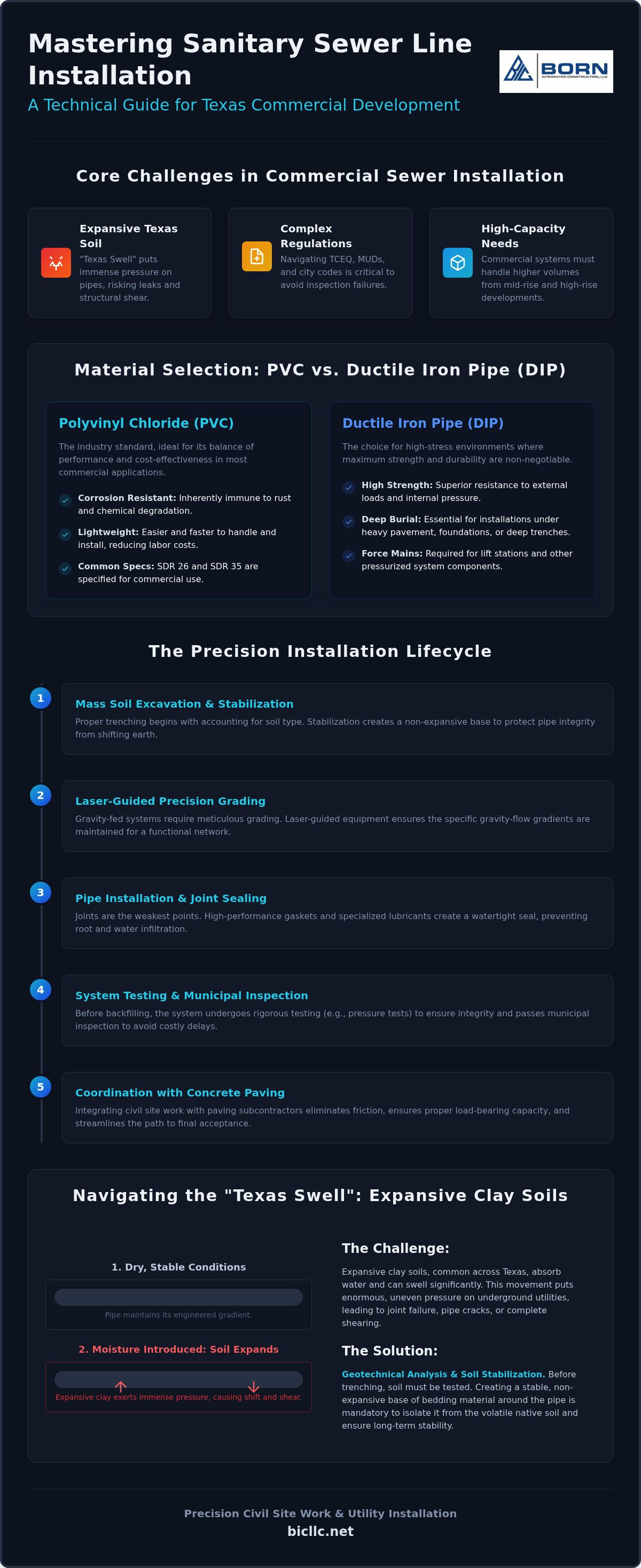
The 'Texas swell' is a significant factor in utility design, referring to the way expansive clay soils react to moisture changes. These soils put immense pressure on pipe joints and can cause shifting that leads to catastrophic leaks or pipe shear. Geotechnical coordination is mandatory before any trenching begins to account for these specific soil characteristics and to determine the necessary bedding requirements. Soil stabilization is the first step in protecting underground utilities because it creates a consistent, non-expansive base that prevents the shifting of heavy pipe segments. Using stabilized soil ensures that the designed flow line elevations remain accurate despite the volatile nature of the Texas earth.
Materials and Design Standards for Texas Utility Lines
Selecting materials for sanitary sewer line installation Texas requires a balance between initial capital expenditure and long-term operational durability. The expansive clay soils characteristic of the region make material choice a structural decision as much as a utility one. Engineers typically specify Polyvinyl Chloride (PVC) or Ductile Iron Pipe (DIP) based on burial depth, local soil chemistry, and the weight of surface structures. These decisions impact the system's ability to withstand the external pressures of the Texas landscape without compromising the flow of waste.
Precast concrete manholes and junction boxes serve as the primary access points for system maintenance and inspection. These structures must be engineered to resist hydrostatic pressure and the lateral forces of shifting soil. When a site's topography prevents a standard gravity-fed design, we implement lift stations and force mains. These mechanical systems are vital for moving waste from low-lying areas to municipal tie-ins at higher elevations. The reliability of these systems often rests on their weakest points: the joints. High-performance gaskets and specialized lubricants are essential to create a watertight seal that resists root penetration and groundwater infiltration.
PVC SDR 26 and SDR 35: The Industry Standards
PVC is the industry standard for commercial infrastructure due to its inherent resistance to the corrosive gases found in sanitary waste. SDR 26 is preferred for deep burials or installations beneath heavy-duty paving because it offers greater pipe stiffness than thinner alternatives. Adhering to specific standards for sanitary sewer line installation Texas during the design phase ensures these PVC systems meet TCEQ Chapter 217 requirements. These regulations mandate a velocity of at least 2.0 feet per second to prevent solids from settling and creating blockages.
Ductile Iron Pipe (DIP) for Heavy-Duty Applications
Ductile Iron Pipe provides the structural rigidity needed in high-stress environments where PVC might fail. We utilize DIP in areas with minimal cover or where lines must pass directly beneath heavy structural concrete elements like podium slabs or parking structures. In many Texas regions, DIP requires polyethylene encasement to protect against the corrosive nature of aggressive soils. Selecting the right material is a core part of the integrated expertise required for complex commercial developments. While the upfront cost of DIP is higher, its longevity in high-load areas provides significant value over the lifecycle of the infrastructure.
The Installation Lifecycle: Precision Engineering from Trench to Test
The execution of sanitary sewer line installation Texas is a sequence of high-stakes engineering phases. It starts with mass soil excavation, where we remove vast quantities of earth to reach the precise design flow line elevations required by civil plans. This stage isn't merely about depth; it's about creating a stable environment where heavy-duty utilities can function without interruption. Integrating these utility runs with commercial concrete paving is a critical step in ensuring the surface remains stable under heavy traffic loads and extreme weather conditions.
Trenching and Bedding Best Practices
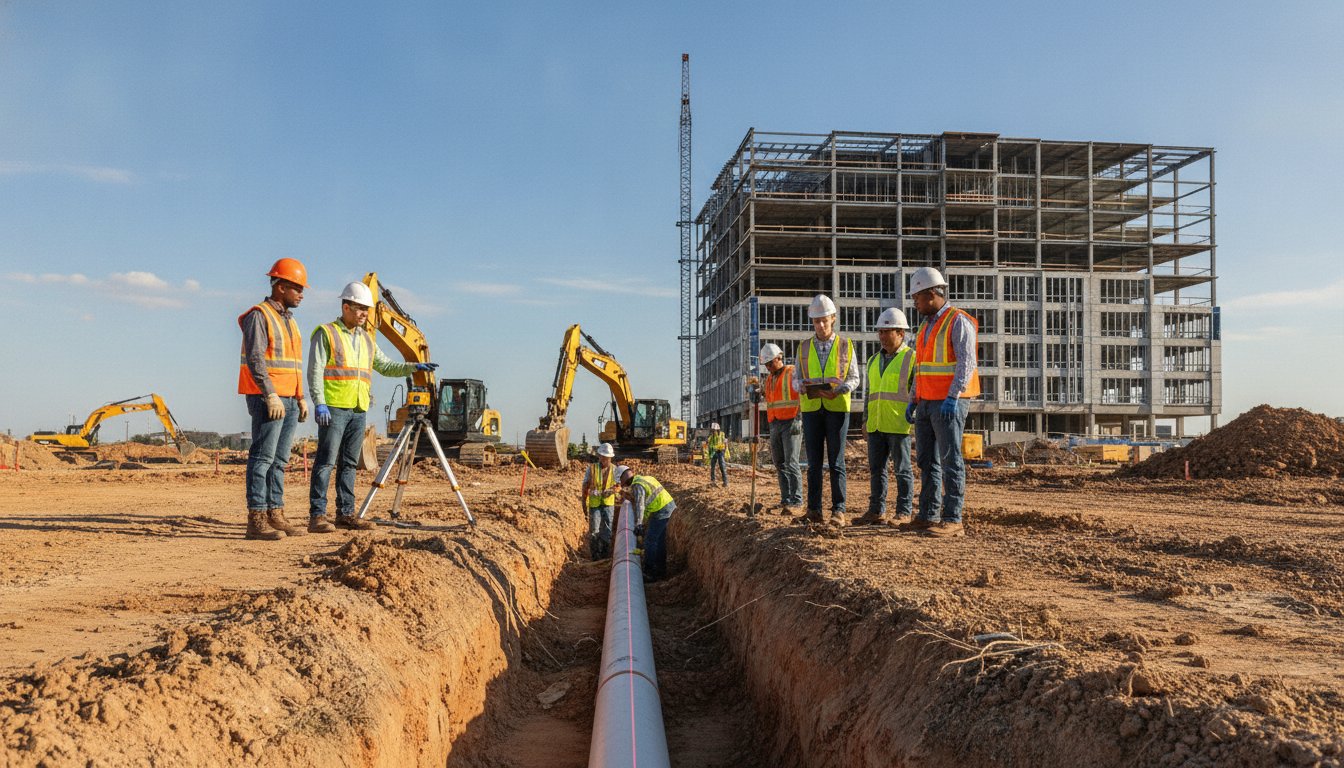
Establishing a safe and stable trench is the foundation of the entire installation. We utilize OSHA-compliant shoring and sloping techniques to protect the workforce and prevent trench wall collapse. Once the trench is secure, selecting the correct aggregate bedding is essential to support the pipe's alignment and prevent sagging over time. In coastal regions like Houston or Beaumont, managing high groundwater levels is a constant challenge. We employ specialized dewatering techniques to maintain a dry, workable environment, ensuring the pipe is laid on a firm, undisturbed base that won't shift as the soil settles.
Flow Line Accuracy and Grade Control
Gravity-fed sanitary systems depend entirely on consistent gradients to move waste. Most commercial designs require a 1% or 2% grade, leaving no room for error. During sanitary sewer line installation Texas, we utilize advanced pipe lasers to maintain millimeter-perfect elevations throughout the run. Achieving this level of precision is the only way to guarantee the system operates as intended without the need for future mechanical intervention. Millimeter-perfect flow line accuracy ensures that wastewater maintains the velocity required to prevent the accumulation of solids and chronic system blockages.
Backfilling and Soil Stabilization
The lifecycle concludes with backfilling, a phase that dictates the longevity of the surface structures above. We implement lift-by-lift compaction, where soil is added in small increments and compressed to meet rigorous engineering density specifications. This meticulous approach to utility trench compaction provides the necessary support for structural concrete slabs and prevents future pavement heaving. By managing backfill with this level of discipline, we eliminate the risk of 'bridging' or settlement that often plagues less organized civil projects. Our integrated approach ensures that the underground work and the concrete above function as a single, cohesive unit.
Regulatory Compliance: Navigating Texas MUDs and Municipal Codes
Successful sanitary sewer line installation Texas requires a disciplined approach to a dual-layered regulatory environment. Every project must satisfy the broad standards established by the Texas Commission on Environmental Quality (TCEQ) while simultaneously meeting the granular requirements of local municipalities. Major entities such as Dallas Water Utilities, the City of Houston, and the San Antonio Water System (SAWS) maintain distinct Standard Products Lists and design manuals. These local codes dictate everything from specific manhole coating requirements to precise burial depths. Reconciling these variations during the planning phase is essential to avoid inspection failures that can derail a project's timeline.
The transition from construction to public maintenance is a formal process known as utility acceptance. This milestone is only reached once the system proves its structural and operational integrity through a series of mandatory tests. Contractors must act as a bridge between the developer's goals and the municipality's long-term maintenance standards. This requires not only technical proficiency but also a commitment to transparent documentation and ethical conduct throughout the installation lifecycle.
Working with Municipal Utility Districts (MUDs)
Municipal Utility Districts play a pivotal role in Texas land development by financing the infrastructure necessary for new commercial hubs. In rapidly growing areas like the Woodlands and Conroe, coordinating with a MUD is a core component of the project's administrative framework. These districts often have technical specifications that are more stringent than general city codes to protect their long-term investment. Adhering to MUD-funded infrastructure requirements is vital for developers to secure necessary reimbursements and ensure the system is integrated into the district's broader waste management network.
Quality Assurance and Final Inspections
Verifying the integrity of sanitary sewer line installation Texas involves three primary testing protocols. Each test serves as a safeguard against future system failure and environmental contamination.
- Low-Pressure Air Testing: This protocol verifies the airtightness of the pipe and joints, ensuring the system is completely sealed against leaks.
- Mandrel Testing: We perform deflection testing on flexible pipe systems, such as PVC, to ensure the pipe has maintained its structural shape and hasn't deformed under the weight of the backfill.
- CCTV Inspections: A camera is deployed through the entire run to provide a visual record of the pipe's interior, confirming the absence of debris, cracks, or joint offsets.
Our team manages every phase of this regulatory path to ensure your project moves seamlessly toward final acceptance. We apply the same level of precision to our compliance documentation as we do to our commercial civil site work, providing developers with the security of a fully vetted infrastructure system.
Born Integrated Construction: Grounded Expertise in Civil Site Work
Born Integrated Construction operates on a philosophy of total site accountability. Our approach to sanitary sewer line installation Texas is defined by a commitment to operational precision and professional stability. We don't just act as a subcontractor; we function as a seasoned partner focused on the meticulous management of every detail from mass soil excavation to the final utility tie-in. This disciplined execution ensures that every project we touch is built on a foundation of safety and enduring value. Our team prioritizes results over rhetoric, providing the technical proficiency required for the most demanding commercial developments.
A Steadfast Approach to Commercial Utilities
Our grounded tone reflects a serious commitment to field execution and the long-term viability of the systems we install. We prioritize substance over style, focusing on the craftsmanship required for high-capacity underground networks. By building long-term relationships with Texas developers and municipal vendors, we create a predictable and transparent environment for project delivery. Our professional standards are designed to deliver consistent value, ensuring that the infrastructure we establish remains functional for decades. We take pride in the enduring nature of our professional output, acting as a quiet leader in the civil construction industry.
Comprehensive Civil and Concrete Solutions
The primary advantage of the 'Born Integrated' model is the seamless coordination between civil site work and concrete construction. We eliminate the friction often found between separate utility and paving crews by managing the entire site readiness phase in-house. This allows for a smooth transition from sanitary sewer line installation Texas to the placement of heavy-duty paving or structural slabs. Our expertise in managing complex infrastructure projects means we anticipate utility conflicts before they impact the schedule. We don't just lay pipe; we prepare the entire site for its final structural purpose.
We specialize in large-scale developments where utility work must be perfectly synchronized with podium slabs and CIP structures. By self-performing underground utility installation and soil stabilization, we maintain absolute control over the project's quality and timeline. This integrated approach isn't about innovation for its own sake; it's about the steadfast execution of a proven process that leads to municipal acceptance and operational excellence. Every project is handled with the same level of discipline, ensuring that your development's foundation is both stable and code-compliant.
Establishing a Reliable Foundation for Texas Infrastructure
The integrity of a commercial development is determined by the quality of its underground utilities long before the first tenant arrives. Mastering sanitary sewer line installation Texas requires a disciplined focus on laser-guided precision, material durability, and a deep understanding of municipal standards. Proper grading and the selection of high-performance materials like SDR 26 PVC or Ductile Iron Pipe provide the structural stability necessary to withstand expansive clay soils. Successfully navigating the regulatory requirements of MUDs and city water departments ensures your project moves from trenching to final acceptance without costly delays.
Born Integrated Construction brings a steadfast commitment to safety, integrity, and operational efficiency to every site. Our integrated approach to civil and concrete solutions eliminates subcontractor friction; this allows for a seamless transition from utility work to finished paving. We maintain a serious focus on field execution to ensure your infrastructure stands as a permanent asset for your development. Contact Born Integrated Construction for a professional civil site work consultation to discuss your next development. We look forward to building a lasting foundation for your commercial success.
Frequently Asked Questions
What is the typical lifespan of a commercial sanitary sewer system in Texas?
A properly engineered commercial sanitary sewer system typically has a lifespan of 50 to 100 years. This longevity depends heavily on the initial material selection and the quality of the installation. Polyvinyl Chloride (PVC) is resistant to the corrosive hydrogen sulfide gases common in waste streams, while Ductile Iron Pipe (DIP) provides structural strength in high-load areas. Regular maintenance and adherence to municipal standards ensure the system remains functional for several generations of development.
How does expansive clay soil affect sanitary sewer line installation?
Expansive clay soils, often called the "Texas swell," put immense physical stress on underground utilities through seasonal volume changes. These soil movements can lead to pipe shearing or joint separation if not addressed during construction. We mitigate these risks by performing mass soil excavation and implementing soil stabilization techniques. Providing a non-expansive aggregate bedding ensures the pipe maintains its structural integrity and alignment despite the volatile nature of the surrounding earth.
What is the difference between PVC SDR 26 and SDR 35 for commercial projects?
The primary difference lies in the pipe's wall thickness and stiffness. SDR 26 has a thicker wall than SDR 35, making it the preferred choice for sanitary sewer line installation Texas in areas with deep burials or heavy surface loads. While SDR 35 is common for standard gravity lines, SDR 26 provides the extra structural capacity needed beneath heavy-duty concrete paving or structural slabs to prevent pipe deflection. It's the standard for high-load commercial environments.
Why is a Municipal Utility District (MUD) involved in my sewer project?
Municipal Utility Districts (MUDs) are special-purpose districts that finance and manage the infrastructure for developments outside city limits. If your project's in a MUD, they act as the regulatory authority ensuring the system meets their specific technical requirements. This involvement is critical because the MUD will eventually own and maintain the lines. Coordination with MUD engineers ensures that your development's infrastructure is integrated correctly into the regional waste management network, maintaining long-term operational viability.
What kind of testing is required for a city to accept a new sanitary line?
Municipalities require a rigorous testing sequence before granting utility acceptance. This typically includes low-pressure air testing to verify a watertight seal and mandrel testing to check for pipe deflection. Most Texas cities also mandate a CCTV inspection to visually confirm that the line is clear of debris or structural defects. These protocols protect the public's investment by ensuring every segment of the new system meets the established engineering and safety standards before public maintenance begins.
Can sanitary sewer and storm sewer lines be installed in the same trench?
Sanitary and storm sewer lines are generally not installed in the same trench to prevent cross-contamination and ensure maintenance access. Texas regulations, specifically those from the TCEQ, mandate minimum horizontal and vertical separation distances between different utility types. Keeping these systems in separate corridors prevents a failure in one from compromising the other; it's a matter of safety. Proper site planning during the civil phase ensures each utility has the space required for long-term operational integrity.
How do you ensure the correct slope for a gravity-fed sanitary system?
Maintaining the correct slope is vital for sanitary sewer line installation Texas to prevent solids from settling. We achieve this through the use of high-precision pipe lasers that provide a constant, millimeter-perfect grade throughout the installation. This technology allows our crews to monitor the gradient in real-time as the pipe is laid. Combining these tools with precise mass soil excavation ensures the system achieves the velocity required for efficient, gravity-fed waste transport without chronic blockages.
What are the benefits of hiring a turn-key civil and concrete contractor?
Hiring a turn-key partner like Born Integrated Construction eliminates the friction between utility installation and surface-level concrete work. We manage the entire lifecycle from earthwork to structural paving, ensuring that underground trenching doesn't compromise the stability of the slabs above. This integrated approach leads to better communication, tighter schedules, and higher quality control. You benefit from a single point of accountability and a project built on a foundation of operational excellence and professional stability.