Soil Stabilization for Commercial Foundations in Houston: Building on Solid Ground
The success of a multi-million dollar commercial structure in Houston is decided long before the first yard of concrete is poured; it's determined by the chemical composition of the earth beneath it. You likely recognize that Houston’s expansive clay soils are notoriously volatile, frequently swelling and shrinking in response to the region's intense moisture cycles. This constant movement is a primary cause of foundation cracking and expensive structural repairs that can derail a project's timeline and budget. Implementing professional soil stabilization for commercial foundations Houston isn't just a preliminary site step; it's a critical structural prerequisite for high-performance concrete.
Discover how precise chemical treatments and mechanical stabilization mitigate the risks of shifting soil to ensure the long-term structural integrity of your commercial assets. This article explains the methods used to meet strict engineering PVR requirements and provide a stable, build-ready site. We'll provide a methodical overview of how disciplined site preparation and paving stabilization lead to enduring results. By prioritizing technical proficiency during the earthwork phase, you ensure your project stands on a reliable and steadfast foundation.
Key Takeaways
- Understand how Houston’s expansive clay creates a "swell-shrink" cycle that threatens the long-term structural integrity of commercial concrete foundations.
- Evaluate the technical benefits of chemical injection and mechanical mass excavation when performing soil stabilization for commercial foundations Houston.
- Learn why an integrated approach to earthwork and structural concrete minimizes project friction and protects the integrity of the stabilized subgrade.
- Identify the essential geotechnical testing and PVR requirements needed to ensure a build-ready site that meets rigorous engineering standards.
- Discover best practices for maintaining subgrade uniformity to prevent localized soft spots and ensure the long-term performance of commercial paving.
Understanding Houston’s Expansive Clay and Foundation Risks
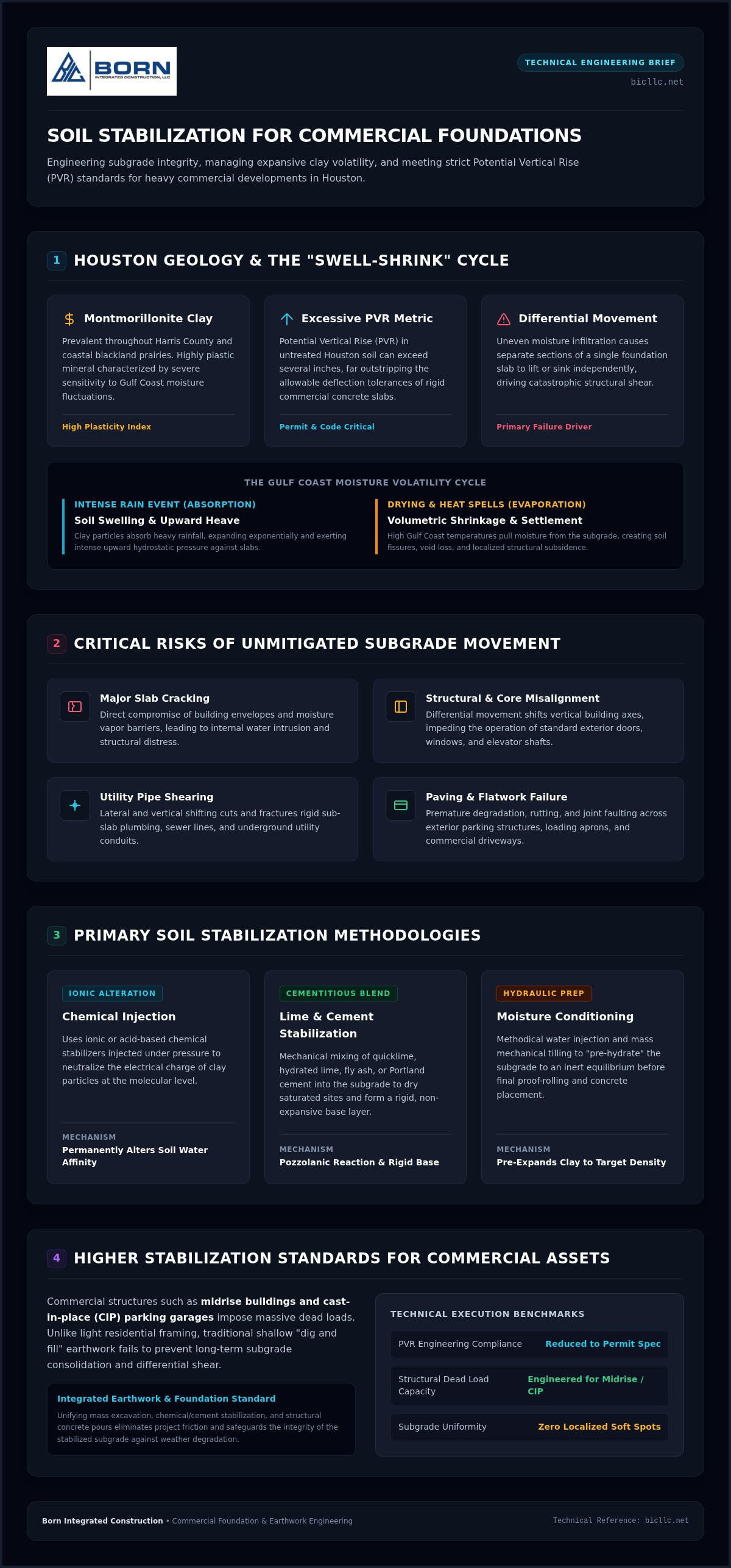
Houston’s geological profile presents a unique challenge for civil engineering, primarily due to the prevalence of montmorillonite clay. This mineral, common throughout Harris County, is characterized by its high plasticity and extreme sensitivity to moisture. When it rains, the clay particles absorb water and expand significantly; during dry spells, the water evaporates, causing the soil to contract and crack. This relentless "swell-shrink" cycle exerts immense pressure on any structure above it, often leading to differential settlement where one part of a foundation moves independently of another.
Geotechnical engineers quantify this risk through a metric known as Potential Vertical Rise (PVR). In many parts of the Houston region, untreated soil can have a PVR exceeding several inches, which far exceeds the tolerance of a rigid commercial concrete slab. Engineering specifications for modern permits typically mandate a significant reduction in PVR to ensure structural safety. Without professional soil stabilization for commercial foundations Houston, these movements lead to severe structural consequences that compromise the long-term viability of the asset.
The risks associated with unmitigated soil movement include:
- Major slab cracking that compromises the building envelope and moisture barriers.
- Structural misalignment affecting the operation of doors, windows, and elevator shafts.
- Shearing of underground utility pipes caused by lateral and vertical soil shifting.
- Premature failure of exterior paving and parking structures.
The Impact of Houston Geology on Commercial Development
The Gulf Coast climate accelerates soil volatility through frequent heavy rain events followed by periods of intense heat. While traditional "dig and fill" methods might suffice for minor projects, they often fail to address the deep-seated instability of Houston’s blackland prairies. Effective site preparation requires a deeper understanding of soil stabilization techniques to ensure the subgrade remains inert regardless of weather patterns. This is particularly vital when moving from the red clays of East Texas into the heavy, dark clays found closer to the coast.
Why Commercial Foundations Require Higher Stabilization Standards
Commercial projects, such as midrise buildings and CIP garages, demand higher stabilization standards than light residential work due to the massive dead loads they impose. The underlying earth must support these weights without shifting or compressing over time. Soil stabilization is the process of altering soil properties to improve load-bearing capacity. By investing in precise soil stabilization for commercial foundations Houston, developers create a financial safeguard against the catastrophic costs of future foundation failure. You can review our past projects to see how these rigorous standards are applied to complex commercial sites.
Primary Methods of Soil Stabilization for Commercial Sites
Selecting the right method for soil stabilization for commercial foundations Houston depends on the specific geotechnical report and the structural load of the planned facility. Because Houston’s clay varies from the heavy blackland prairies to more silty deposits, a single approach rarely suffices for complex commercial developments. Engineers typically specify a combination of chemical, mechanical, and cementitious treatments to ensure the subgrade remains inert and capable of supporting massive dead loads.
Chemical injection uses ionic or acid-based stabilizers to neutralize the electrical charge of clay particles at the molecular level. This process permanently alters the soil’s affinity for water, preventing the expansion that leads to slab upheaval. For sites with lower clay content, cementitious stabilization is a reliable alternative. This involves mixing fly ash, lime, or Portland cement into the subgrade to create a rigid, non-expansive base. Moisture conditioning follows these treatments, requiring precise water application to achieve the density specified by the project engineer. It's a methodical process that "pre-hydrates" the soil to a stable state before the final proof-roll.
Chemical Injection vs. Lime Stabilization
Lime stabilization is a traditional standard for drying out saturated sites and establishing a firm "working table" for heavy equipment. It’s highly effective for surface-level stability during the initial stages of earthwork. Chemical injection is a preferred choice when working near existing structures or when deep clay layers require treatment without massive earth movement. While lime provides immediate strength for construction traffic, chemical injection offers a deep-seated solution that targets the root cause of soil volatility. Both methods provide long-term durability when executed with professional precision.
The Role of Mass Excavation in Site Readiness
Mechanical stabilization often involves the physical removal of the "active zone," which is the top layer of soil most susceptible to moisture changes. By utilizing professional mass soil excavation services, contractors replace unstable clay with select fill or crushed stone. This creates a predictable, inert environment for the foundation to rest upon. This phase frequently integrates with the construction of detention ponds to manage site runoff effectively. A disciplined approach to these methods ensures the foundation performs as designed for decades. If you're planning a complex build, it's wise to consult with an integrated partner who understands both civil site work and structural concrete.
The Advantage of Integrated Site Prep and Foundation Construction
Fragmented contracting creates a high-risk environment for commercial developments. When site preparation and structural concrete are handled by separate vendors, the critical transition between a stabilized subgrade and the final slab often suffers from a lack of oversight. Choosing a single-source partner for soil stabilization for commercial foundations Houston ensures that the technical requirements established during the earthwork phase are maintained until the concrete is cured. This continuity is essential for complex structures like CIP garages and midrise buildings where load-bearing precision is non-negotiable.
A unified approach allows for the seamless coordination of mass excavation with CIP foundation schedules. It's not enough to stabilize the soil; the subgrade must be protected from environmental exposure and construction traffic until the slab-on-grade is poured. When one firm manages the process from dirt work to the final finish, the project benefits from a consistent standard of performance. This professional stability instills confidence in stakeholders and ensures the site remains build-ready throughout the duration of the civil phase.
Eliminating Accountability Gaps in Commercial Projects
Separate vendors for dirt and concrete work frequently lead to accountability gaps. If a slab exhibits differential settlement or cracking, the concrete contractor may blame the subgrade, while the earthwork team claims the stabilization was compromised after they left the site. An integrated team eliminates this friction by monitoring soil density and moisture levels up to the moment of the pour. You can see our integrated projects to understand how this unified approach preserves structural integrity and reduces long-term liability for developers.
Streamlining Underground Utility and Foundation Work
Stabilized soil is vulnerable during the installation of storm sewers and domestic water lines. If a utility contractor trenches through a treated area and backfills with unconditioned soil, they create a "soft spot" that undermines the entire foundation. Integrated management ensures that every phase of civil work, including detention pond excavation, supports the foundation pad's requirements. Often, the material removed for water management provides the necessary fill for the building pad, creating a closed-loop efficiency that streamlines the construction timeline. This level of coordination prevents project delays and ensures that soil stabilization for commercial foundations Houston remains effective across the entire footprint of the site.
Best Practices for Stabilizing Foundations and Paving
High-stakes commercial construction requires more than just a chemical application; it demands a disciplined adherence to engineering best practices. The process begins with comprehensive geotechnical worksite testing and soil borings. These tests provide the data necessary to determine the exact dosage of stabilizers required to reach the target PVR. Without this empirical foundation, any attempt at soil stabilization for commercial foundations Houston is merely guesswork. We rely on these reports to establish a baseline for all subsequent earthwork and structural decisions.
Consistency across the entire site footprint is equally vital. Ensuring subgrade uniformity prevents the formation of localized "soft spots" that can lead to differential settlement under the slab. Once the soil is stabilized, a critical window opens. You must pave or pour the concrete shortly after the treatment is completed. Leaving a stabilized subgrade exposed to the elements for too long allows moisture to re-enter the clay layers or causes the surface to desiccate, both of which compromise the engineering properties of the base. It's a matter of operational precision to time the concrete delivery with the completion of the stabilization phase.
Effective runoff management is the final piece of the puzzle. During the construction phase, temporary grading must direct water away from the building pad. If water is allowed to pond on a treated surface, it can penetrate the stabilized zone and re-activate the expansive properties of the underlying clay. This attention to detail protects the investment made during the mass excavation and stabilization stages.
Stabilization Requirements for CIP and Precast Garages
Multi-level parking structures impose massive point loads that require a non-shifting subbase to maintain structural alignment. For these projects, the precision of the stabilization determines the longevity of the entire facility. Precast garage foundations are particularly sensitive to movement, as even minor shifts can lead to joint separation or structural distress. Engaging an Expert Podium Slab Contractor in Houston ensures that the structural CIP solutions are built on a base that has been rigorously tested and verified.
Paving Stabilization for Heavy-Duty Commercial Roads
Commercial paving must withstand the constant stress of heavy-duty logistics traffic. Proper stabilization prevents common failures like "rutting" and "shoving," where the pavement deforms under weight. By integrating subbase stabilization with high-performance concrete paving, developers create roads that require significantly less maintenance over their lifecycle. This is especially critical for Commercial Concrete Paving in Conroe, where heavy traffic and local soil conditions demand a robust engineering approach.
If you are ready to ensure your project begins on a verified, stable subgrade, contact Born Integrated Construction to discuss our turn-key civil and concrete solutions.
Partnering with Born Integrated Construction for Stable Foundations
Born Integrated Construction (BIC) approaches every project with a deep-rooted commitment to high standards and professional stability. We don't view ourselves as a mere vendor; we act as a disciplined partner focused on the long-term viability of your development. Our team provides comprehensive soil stabilization for commercial foundations Houston, ensuring that the initial earthwork phase sets the stage for flawless structural execution. With extensive experience across Houston, The Woodlands, and Montgomery County, we understand the nuances of local soil conditions and the engineering precision required to mitigate them.
By providing turn-key civil site work and structural concrete, we eliminate the traditional friction between trades. This integrated model ensures that the integrity of the stabilized subgrade is preserved from the first day of mass soil excavation until the final structural pour. We build long-term relationships through transparent performance and a steadfast focus on safety and integrity. Our reputation is built on the enduring nature of our professional output and a quiet leadership that leads through proven results.
Our Approach to Houston’s Civil Infrastructure
We utilize advanced earthwork techniques to meet the most stringent engineering specifications. At BIC, we treat the soil as the most important part of the building because we know that even the most advanced concrete structures cannot overcome a failing subgrade. Our expertise spans complex projects including CIP garages, podium decks, and multi-story structural concrete. This technical proficiency allows us to manage the meticulous details of site preparation while keeping the broader structural goals in clear focus. We prioritize substance over style, ensuring every slab-on-grade and structured parking facility stands on a steadfast base.
Get Started on Your Next Commercial Development
Early consultation is the key to infrastructure longevity. By involving BIC during the pre-construction phase, you gain access to seasoned experts who can evaluate site-specific challenges before they become costly delays. Professional site preparation is a fundamental investment in the durability of your asset and the safety of its future occupants. We invite you to Contact Born Integrated Construction for a consultation to learn how our integrated approach provides the reliability and technical proficiency your next project deserves.
Securing the Future of Your Commercial Infrastructure
Ensuring the long-term viability of a commercial asset in Harris County requires a proactive stance against geological volatility. We've explored how Houston’s expansive clay demands more than just standard site prep; it requires precise chemical or mechanical intervention to meet rigorous engineering standards. By prioritizing subgrade uniformity and managing moisture levels, you establish a foundation that supports high-performance structural concrete for decades.
Professional soil stabilization for commercial foundations Houston provides the technical certainty needed for complex structures like CIP garages and midrise buildings. As turn-key civil and earthwork experts, BIC delivers operational precision from the initial mass excavation to the final structural pour. Our dedication to safety and integrity ensures that your project remains on schedule and within engineering tolerances.
Building on stable ground is the most important decision you'll make for your development's lifecycle. We invite you to Partner with Born Integrated Construction for Reliable Site Preparation. Our specialists in CIP garages and structural concrete are ready to provide the steadfast support your next project requires.
Frequently Asked Questions
How long does soil stabilization take for a commercial site in Houston?
Soil stabilization for a commercial site typically takes between three to seven working days depending on the acreage and the depth of treatment required. Chemical injection is often faster than mechanical methods because it requires less heavy hauling. Large-scale projects involving mass excavation and replacement with select fill may take longer. Our team coordinates these timelines closely with the structural concrete schedule to ensure the subgrade remains protected and build-ready.
What is the most common method of soil stabilization in Harris County?
Chemical injection and lime stabilization are the most frequent methods used across Harris County due to the heavy montmorillonite clay. Lime is excellent for drying wet sites and creating a working table during the earthwork phase. Chemical injection is often preferred for deep-seated stabilization because it alters the clay at a molecular level. These methods provide the reliable base necessary for soil stabilization for commercial foundations Houston and long-term structural performance.
Can you stabilize soil after a commercial foundation has already been poured?
It's possible to stabilize soil after a foundation is poured using remedial chemical injection, but it's far more complex and costly. This process involves drilling through the existing slab to reach the underlying clay. While it can mitigate further movement, it can't easily fix structural damage that has already occurred. Professional stabilization during the pre-construction phase is always the most reliable and cost-effective approach for ensuring foundation integrity.
Does soil stabilization eliminate the need for deep piers or pilings?
Soil stabilization doesn't always eliminate the need for deep piers or pilings, especially for multi-story CIP structures or high-rise foundations. Instead, it works in conjunction with deep foundations by managing the "active zone" near the surface. While piers support the building's primary weight, stabilization prevents the surface slab from heaving or cracking. Your geotechnical engineer will determine if the soil profile requires both stabilization and deep foundation elements.
Is chemical soil stabilization environmentally safe for Houston projects?
Modern chemical stabilizers used in Houston are designed to be environmentally responsible and inert once the reaction with clay minerals is complete. These ionic and acid-based solutions bind with the soil particles, meaning they don't leach into the groundwater or surrounding ecosystem. Our team prioritizes safety and professional standards, ensuring that all stabilization products meet the technical and safety requirements established for commercial and infrastructure developments in Texas.
What is PVR, and why does my engineer require a specific threshold?
Potential Vertical Rise (PVR) is a measure of how much the soil is expected to swell when it becomes saturated. Engineers require a specific PVR threshold, often one inch or less, to protect the structural integrity of the concrete slab. If the PVR is too high, the resulting soil movement will exceed the slab’s tolerance, leading to cracks and misalignment. Stabilization is the primary method used to bring a site into compliance with these engineering requirements.
How does soil stabilization affect the cost of commercial concrete paving?
While soil stabilization for commercial foundations Houston adds an initial line item to the budget, it often reduces the total lifecycle cost of the paving. A stabilized subbase prevents the "rutting" and "shoving" that lead to premature asphalt or concrete failure. In some engineering designs, a stronger subgrade allows for a more efficient pavement thickness. This investment ensures that high-traffic areas maintain their performance without the need for frequent, costly repairs.
Can mass excavation be used instead of chemical injection for stabilization?
Mass excavation is a highly effective mechanical alternative to chemical injection. This process involves removing the expansive clay to a specific depth and replacing it with non-expansive select fill or crushed stone. It's often the preferred method for sites where the soil is extremely volatile or where grading requirements already necessitate significant earthwork. We specialize in both mass excavation and paving stabilization, allowing us to implement the most efficient solution for your site.