
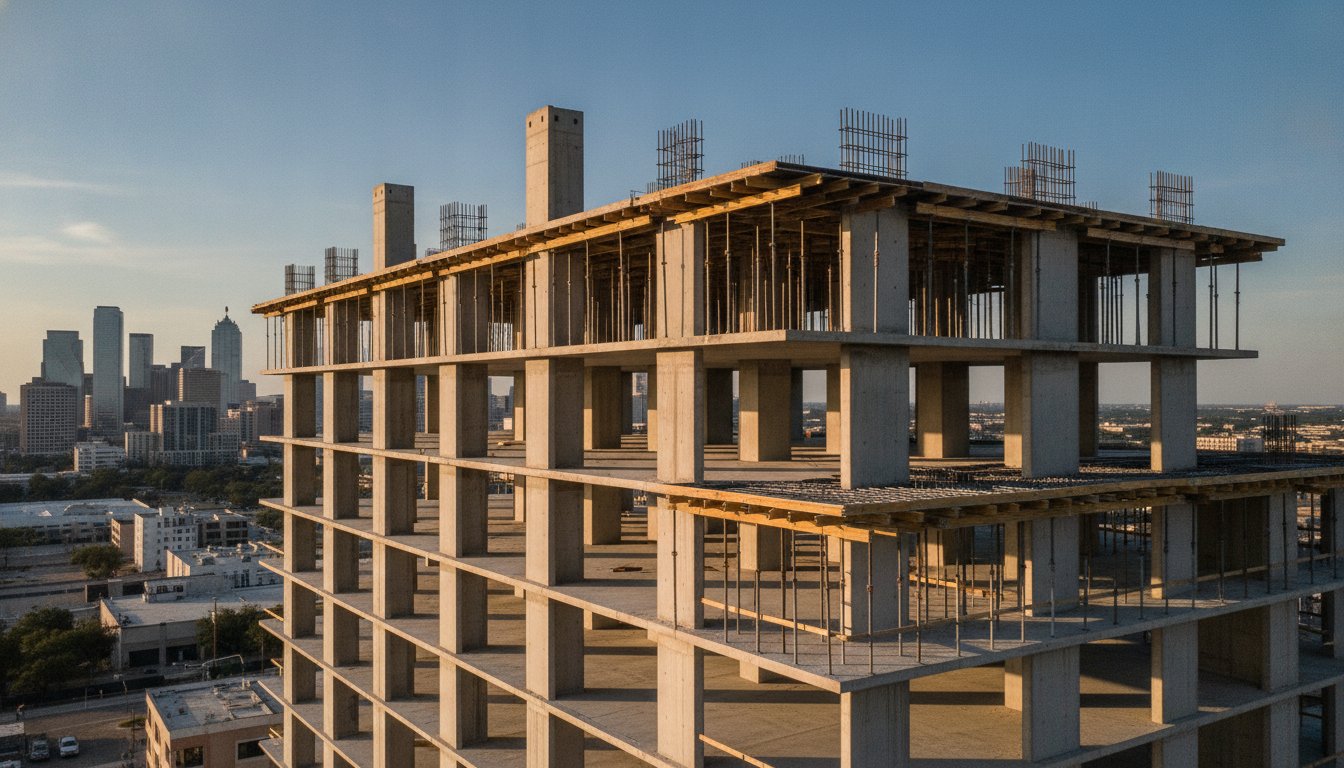
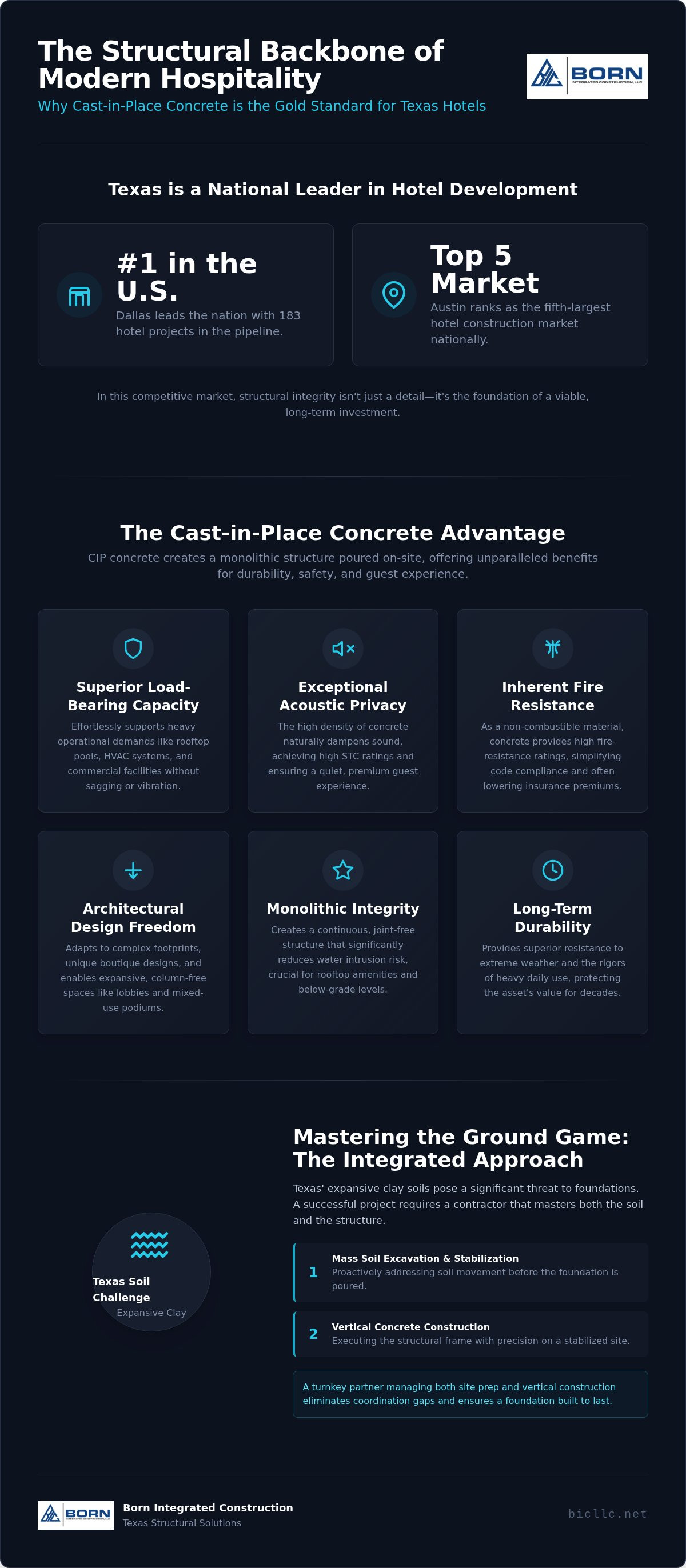
Dallas leads the United States in hotel construction with 183 projects currently in the pipeline, while Austin ranks as the fifth-largest market nationally. This high level of activity means developers must prioritize structural integrity to ensure their investments remain viable. You're likely aware that a hotel's reputation is often built on things guests never see, such as the acoustic privacy between rooms and a foundation that doesn't shift when the Texas clay expands. These technical details are the difference between a successful asset and a liability.
Partnering with a cast in place concrete hotel contractor Texas professionals trust is essential for achieving the gold standard in fire safety and soundproofing. This article explains why cast-in-place concrete is the superior choice for modern hospitality structures and how to select a contractor that masters both the soil and the structure. We'll preview how an integrated approach, combining mass soil excavation with vertical concrete construction, eliminates coordination gaps and ensures a foundation that withstands the most challenging soil movements.
Key Takeaways
- Understand why cast-in-place concrete serves as the structural backbone for Texas hotels by providing superior load-bearing capacity and acoustic isolation between guest rooms.
- Discover the essential safety and technical criteria for evaluating a cast in place concrete hotel contractor Texas developers trust for mid-rise and high-rise framing.
- Learn how integrated mass soil excavation and stabilization techniques address the challenges of expansive clay soils found across major Texas metropolitan areas.
- Explore how modern formwork systems and the inherent design flexibility of CIP concrete allow for unique architectural footprints and accelerated project timelines.
- Identify the benefits of a turnkey civil and structural partner that reduces coordination friction by managing both site preparation and vertical concrete execution.
Structural Requirements for Modern Texas Hotel Construction
Texas developers recognize that the structural integrity of a hospitality project dictates its long-term financial performance. At the center of this stability is cast-in-place concrete, a method where the material is poured into forms directly at the project site. This technique creates a monolithic structure that functions as a single, continuous unit. Unlike modular or prefabricated systems, monolithic construction eliminates weak points at joints; it provides the durability needed for the heavy operational demands of a hotel. It's a method that prioritizes permanence over temporary convenience.
Hotels require significantly higher load-bearing capacities than standard residential builds. While a residential floor supports basic furniture and foot traffic, a hotel must accommodate heavy HVAC systems, commercial laundry facilities, and often rooftop amenities like pools or gyms. Choosing an experienced cast in place concrete hotel contractor Texas trusts ensures that the structural framing is engineered to handle these concentrated loads. This expertise prevents the structural sagging or vibration issues that often plague lighter construction methods.
Acoustic Performance and STC Scores in Hospitality
Guest satisfaction depends heavily on the "quiet" factor. Sound Transmission Class (STC) ratings measure how well a building partition attenuates airborne sound. High-density concrete naturally provides a superior barrier compared to wood-frame or light-gauge steel construction. Because concrete is mass-heavy, it dampens vibrations and floor-to-floor noise transfer effectively. This inherent acoustic performance often allows developers to reach target STC scores without the expensive addition of multiple layers of resilient channels or specialized insulation. It's an efficient way to build silence into the guest experience from day one.
Fire Safety and Insurance Advantages
Safety is a non-negotiable pillar of hotel development. Structural concrete is inherently non-combustible, offering high fire-resistance ratings that protect occupants and the asset itself. Meeting strict Texas municipal fire codes is more straightforward with a concrete frame, as the material doesn't contribute fuel to a fire. This inherent safety often leads to lower builder's risk and property insurance premiums. By working with a professional cast in place concrete hotel contractor Texas firms can demonstrate a commitment to risk mitigation that appeals to both lenders and insurers. It's a disciplined approach to protecting the project's long-term viability.
Benefits of Cast-in-Place Concrete for Hotel Developers
Hotel developers face the challenge of balancing architectural ambition with structural stability. Cast-in-place concrete offers a versatile solution that adapts to complex footprints while maintaining high standards of reliability. By engaging a specialized cast in place concrete hotel contractor Texas professionals rely on, developers can execute designs that would be difficult or impossible with precast or steel alternatives. This method allows for the seamless integration of structural elements, ensuring the building's aesthetic and functional goals are met with operational precision.
Design Flexibility for Mixed-Use and Boutique Hotels
The hospitality market increasingly demands mixed-use spaces that blend retail, dining, and guest rooms. Modern hotel designs often require expansive, column-free lobbies to create a sense of luxury. CIP concrete provides the strength necessary for these long spans. This flexibility is particularly evident in the use of podium slabs, which allow for a transition between commercial retail and guest rooms above. Because the concrete is formed on-site, it easily accommodates irregular architectural features or unique boutique footprints.
Monolithic Integrity and Waterproofing
A primary concern for hotel operators is the prevention of water intrusion. Monolithic pours create a continuous structure that significantly reduces the risk of leaks at joints. This is a critical advantage for rooftop installations such as pools, bars, and garden terraces. Precision in these areas is paramount; a seasoned structural concrete partner ensures that the mix and pour sequence maintain the integrity required for wet environments. These structures also offer superior resistance to extreme Texas weather events, including high-wind scenarios and heavy storm surges.
Modern formwork systems have transformed the speed of CIP construction. Choosing a cast in place concrete hotel contractor Texas developers trust means gaining access to an integrated approach that handles both the site preparation and the vertical build. These systems allow for a rapid cycle of pouring and curing, which keeps projects on tight schedules. Additionally, the thermal mass of concrete provides significant energy efficiency benefits. It absorbs heat during the intense Texas afternoon and releases it slowly, reducing the load on HVAC systems. Over the building's lifecycle, the durability of concrete translates to lower maintenance costs. It doesn't rot, rust, or degrade under typical environmental stressors. Developers looking to secure their investment for the long term should explore our approach to structural stability to understand how these benefits manifest in real-world applications.
Overcoming Texas Soil Challenges: Stabilization and Site Prep
Texas soil conditions present a unique challenge for hospitality developers. The expansive clay soils found across Houston, Dallas, and San Antonio are notorious for their high plasticity, meaning they swell significantly when wet and shrink when dry. This constant movement can exert immense pressure on a building's foundation. To ensure a hotel remains structurally sound, a developer must prioritize precise earthwork before the first yard of concrete is poured. Choosing a cast in place concrete hotel contractor Texas firms trust often means selecting a partner that understands the critical link between soil stabilization and structural longevity.
The success of a structural slab depends entirely on the quality of the earthwork beneath it. If the subgrade isn't properly prepared, even the most robust cast-in-place structure will eventually face issues with cracking or settlement. Integrating civil site work with vertical construction reduces project risk by eliminating the coordination gaps that often occur between separate excavation and concrete teams. This unified approach ensures that the foundation is built on a steadfast and predictable base.
Mass Excavation and Paving Stabilization
The stabilization process begins with mass soil excavation to remove unstable organic matter and highly expansive topsoil. Once the site is cleared, engineers often require chemical stabilization to alter the soil's properties. In Texas, this typically involves mixing lime or cement into the clay to reduce its plasticity and create a more rigid platform. Achieving a compaction density of 95% or higher is a standard requirement for supporting the multi-story loads of a modern hotel. This level of precision ensures that the subgrade can support the weight of the building without shifting over time.
Stormwater Management for Foundation Protection
Water management is the second pillar of foundation protection. Since clay soil movement is triggered by moisture changes, keeping the area around the building footprint dry is essential. Professional detention pond construction plays a vital role here; it captures runoff and prevents the soil near the foundation from becoming saturated. A seasoned cast in place concrete hotel contractor Texas developers hire will ensure that storm sewers and site grading are perfectly integrated with the building's structural piers. Proper grading directs water away from the structure, maintaining the equilibrium of the soil and protecting the integrity of the concrete for decades. It's a methodical process that prioritizes long-term stability over short-term speed.
Selection Criteria for a Structural Concrete Partner
Selecting a structural partner is a decision that defines the long-term risk profile of a hospitality project. Developers must look beyond the initial bid to evaluate a firm's operational stability and technical depth. Identifying a cast in place concrete hotel contractor Texas professionals rely on requires a methodical review of safety metrics, such as the Experience Modification Rate (EMR), and the capacity for substantial insurance bonding. These indicators reflect a disciplined approach to risk management that protects the developer's investment from unforeseen liabilities.
Technical proficiency is equally critical. A contractor must demonstrate a proven history with mid-rise and high-rise structural framing, specifically in the execution of post-tensioning and complex slab-on-grade foundations. This specialized knowledge ensures the building can withstand the distinct structural demands of a hotel environment while maintaining tight tolerances. Accuracy during the structural phase prevents costly adjustments during the finishing stages of construction.
The Value of Integrated Civil and Concrete Services
Friction often occurs at the transition point between site preparation and vertical construction. When different firms handle these scopes, coordination gaps can lead to schedule delays or disputes over subgrade readiness. Utilizing a single-source contractor for integrated civil site work eliminates these bottlenecks. A unified project management team oversees everything from groundbreaking to topping out, which streamlines communication and results in significant cost savings. This integrated model ensures that the team responsible for the vertical structure is the same one that stabilized the soil beneath it, creating a seamless path to project completion.
Integrity and Professional Stability
A dependable cast in place concrete hotel contractor Texas firms choose must also demonstrate professional stability. Integrity plays a vital role in the quality of the end result. A steadfast partner prioritizes material integrity, ensuring that mix designs and reinforcement placement strictly adhere to engineering specifications. In the world of hotel franchising, schedule adherence is non-negotiable; a delay in the structure translates directly to lost room revenue. This requires a commitment to what we define as attentive service within the Born Integrated Construction philosophy. It's a focus on substance, safety, and the meticulous management of details that ensures a project remains on track.
If you are planning a hospitality development, contact us to discuss your structural requirements and see how our integrated approach provides a lasting foundation for your project.
Born Integrated Construction: Texas Structural Solutions
Born Integrated Construction (BIC) provides a comprehensive suite of structural concrete and civil site work services specifically tailored to the hospitality sector. Our organization prioritizes reliability and professional stability, acting as a steadfast partner for developers throughout the state's major metropolitan areas. Whether the project is located in the dense urban centers of Houston and Dallas or the rapidly expanding markets of Austin and San Antonio, BIC delivers the technical proficiency required for complex hotel structures. As a leading cast in place concrete hotel contractor Texas professionals rely on, we focus on building lasting foundations that ensure the long-term viability of every asset. This commitment to craftsmanship is reflected in our disciplined management of every project detail, ensuring that our professional output stands the test of time.
From Site Prep to High-Rise Topping Out
The transition from initial earthwork to the final topping out of a high-rise structure is a critical phase where coordination between separate trades often fails. BIC eliminates this risk by managing the entire lifecycle of the structural build through our turnkey civil and concrete offerings. Our expertise begins at the ground level with mass soil excavation, paving stabilization, and the construction of detention ponds. This integrated start ensures the ground is prepared to support significant vertical loads before we transition into the execution of complex foundations and post-tensioned slabs. In urban environments where site access is limited, our team excels at managing the logistical challenges of concrete delivery and formwork placement. Our specialized experience in CIP midrise and highrise construction allows us to maintain momentum on even the most demanding hospitality schedules.
Partnering for Texas Hospitality Growth
Delivering a successful hotel project requires more than technical skill; it demands a collaborative spirit and a focus on project safety. BIC works closely with developers and general contractors to provide cost-effective structural solutions that don't sacrifice durability or guest comfort. We maintain high standards in execution, ensuring every pour meets the rigorous acoustic and fire-safety demands of the hospitality industry. By choosing a cast in place concrete hotel contractor Texas developers can depend on, you secure a streamlined process that reduces coordination friction and prioritizes structural integrity. Our focus remains on delivering consistent value through unwavering consistency and proven results. We invite you to view our past projects to see the quality of our work in action.
To discuss the requirements for your next project, learn more about our approach or contact us directly to begin a partnership built on substance and reliability.
Building a Steadfast Foundation for Texas Hospitality
Success in the Texas hotel market requires a structure that can withstand both heavy operational demands and the environmental pressures of expansive clay soils. It's essential to prioritize cast-in-place concrete to secure a monolithic frame that offers superior fire safety and acoustic privacy for guests. This structural choice is only as effective as the ground beneath it. An integrated approach that combines mass soil excavation with vertical framing ensures that every pier and slab is anchored in stable, properly compacted earth.
Selecting a cast in place concrete hotel contractor Texas developers can trust involves finding a partner that masters both civil site work and high-rise structural execution. Born Integrated Construction provides this turnkey expertise across Houston, Austin, San Antonio, and Dallas. Our commitment to operational precision ensures your project transitions seamlessly from groundbreaking to topping out. We focus on substance and safety so your team doesn't have to manage coordination gaps between separate trades.
Contact Born Integrated Construction for a Structural Consultation to discuss your project's specific requirements. We look forward to establishing a reliable foundation for your next development.
Frequently Asked Questions
Why is cast-in-place concrete better than precast for hotels?
Cast-in-place concrete provides monolithic integrity and superior design flexibility compared to precast alternatives. Since the material is poured as a single continuous unit on-site, it eliminates the joints and weak points inherent in pre-fabricated panels. This is particularly beneficial for hotels with irregular footprints or expansive lobby spans. Developers prefer this method for mid-rise and high-rise structures because it adapts to complex architectural requirements without the logistical constraints of transporting massive pre-manufactured components.
How does concrete construction improve hotel STC (sound) ratings?
Concrete's high density naturally blocks airborne sound and dampens vibrations between guest floors. This mass-heavy material achieves superior Sound Transmission Class (STC) ratings compared to wood or light-gauge steel construction. In a hospitality environment, this ensures guests don't hear footsteps or conversations from adjacent rooms. By utilizing a specialized cast in place concrete hotel contractor Texas professionals ensure that the structural frame provides built-in acoustic privacy, which is a primary driver of guest satisfaction.
What is the average timeline for a CIP hotel foundation in Texas?
The timeline for a foundation depends on the project's scale and site complexity. Generally, the process involves mass soil excavation, stabilization, and the pouring of the slab or piers. For a typical mid-rise hotel, this phase can span several weeks. Factors like the depth of required detention ponds and the curing time for post-tensioned slabs influence the schedule. A steadfast contractor prioritizes operational precision to keep these early phases on a predictable and organized track.
Do I need soil stabilization for a hotel project in Houston or Dallas?
Soil stabilization is almost always necessary in Houston and Dallas due to expansive clay. These soils swell and shrink with moisture changes, which can cause foundation cracking if not addressed early. Chemical stabilization using lime or cement creates a rigid, predictable base for the structure. This process is a prerequisite for a stable hotel foundation. It ensures the subgrade reaches the high compaction density required to support multi-story structural loads without shifting over time.
Can a single contractor handle both site excavation and structural concrete?
Yes, an integrated firm like Born Integrated Construction manages both turnkey civil services and structural concrete. This single-source approach reduces coordination friction between the "dirt work" and the "vertical work." By handling mass excavation, detention ponds, and the structural frame under one contract, the contractor ensures the foundation is perfectly aligned with the site preparation. This integrated model streamlines communication and helps developers maintain tighter control over the project's long-term stability and reliability.
How does cast-in-place concrete affect hotel insurance premiums?
Cast-in-place concrete is inherently non-combustible, which often leads to lower insurance premiums for developers. Because the structure doesn't contribute fuel to a fire, it meets strict municipal fire codes more easily than combustible alternatives. Insurers view concrete as a lower-risk material for high-occupancy environments like hotels. This long-term cost saving, combined with the material's durability against extreme Texas weather events, makes it a financially sound choice for protecting hospitality assets and ensuring long-term viability.
What are the benefits of an integrated civil and concrete approach?
The primary benefit is the elimination of coordination gaps between separate trades. When one team manages soil stabilization and the vertical build, they take full responsibility for the structure's integrity from the ground up. This reduces the risk of schedule delays caused by trade disputes or subgrade readiness issues. Developers gain a more transparent project management experience, as a single point of contact oversees everything from initial earthwork to the final topping out of the structure.
How does Texas weather affect the concrete pouring schedule?
High temperatures and unpredictable rainfall require a disciplined approach to pouring. Intense heat can cause concrete to cure too quickly, while heavy rain can compromise the mix integrity. A professional cast in place concrete hotel contractor Texas firms hire will monitor weather windows closely to ensure optimal conditions. They use specialized mix designs and curing techniques to maintain quality during extreme summer months, ensuring the structural output remains durable for the building's entire lifecycle.