Most commercial concrete failures in Southeast Texas aren't the result of a poor pour, but a failure to respect the volatile nature of the Beaumont Clay beneath the surface. You've likely seen the consequences of inadequate site prep: spiderweb cracks in new lots and slabs that shift as soon as the moisture levels change. Selecting a qualified commercial concrete flatwork contractor Houston is the only way to avoid project delays caused by poor subcontractor coordination or a lack of transparency regarding quality standards. You need a foundation that holds its integrity under heavy loads and unpredictable weather without constant maintenance.
Reliability and technical proficiency are the pillars of high-performance infrastructure. This guide explores how an integrated approach to earthwork and concrete delivery creates surfaces that meet strict load-bearing requirements and current municipal codes. We'll outline the critical role of soil stabilization, the precision required for slab on grade projects, and how a turnkey partner simplifies the transition from mass excavation to the final pour. You'll gain a clear understanding of the standards necessary to deliver lasting value and professional stability for your next development. Discover how to secure concrete that withstands our unique environmental demands through precision engineering and integrated site preparation.
Key Takeaways
- Distinguish between residential standards and high-performance flatwork engineered for significant load-bearing demands.
- Identify why paving stabilization is a non-negotiable step to protect your infrastructure from the shifting nature of Houston's expansive clay.
- Learn how to optimize concrete mix designs to account for the Gulf Coast's specific humidity and temperature challenges during the curing process.
- Evaluate how an established commercial concrete flatwork contractor Houston manages the transition from earthwork to structural concrete with precision.
- Recognize the value of a turnkey civil partner who prioritizes safety and quality while handling complex excavation and drainage requirements.
What Defines High-Performance Commercial Concrete Flatwork?
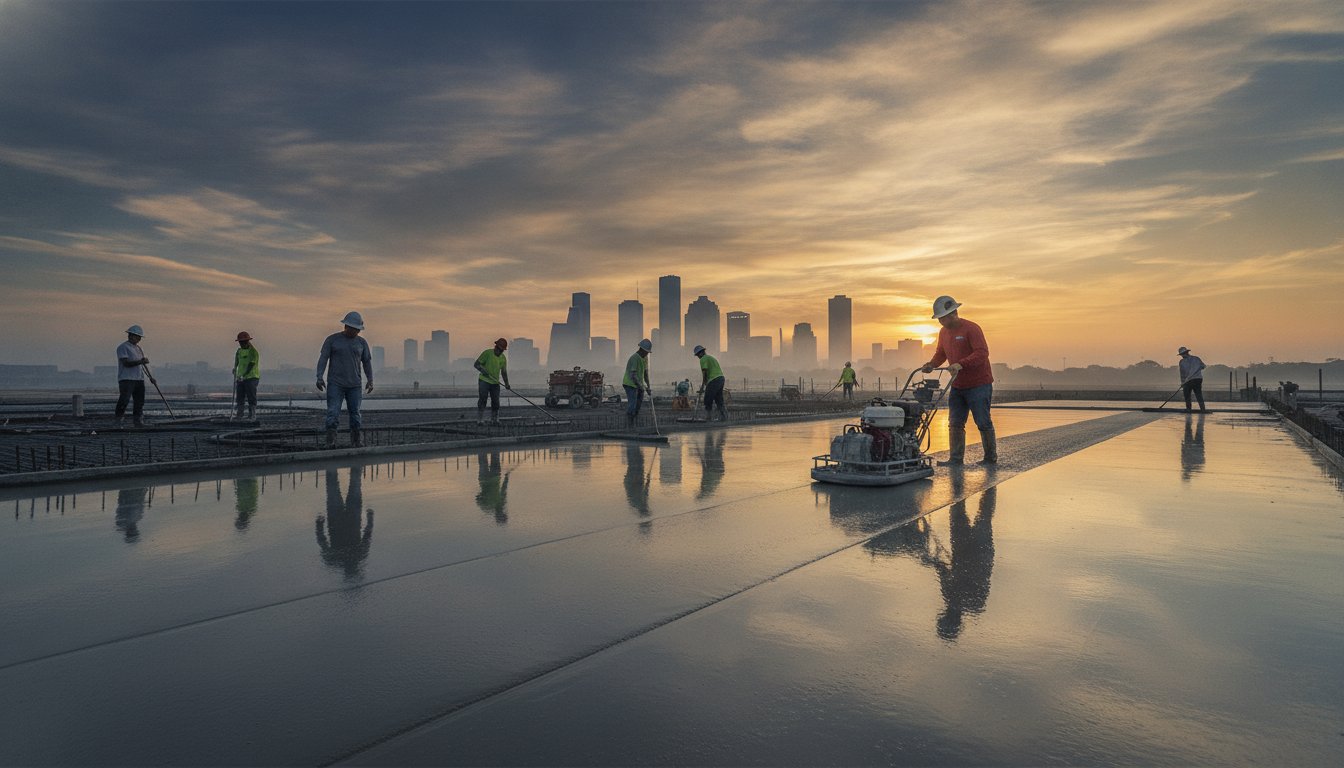
High-performance commercial flatwork is far more than a simple surface treatment. It's a critical engineering requirement for any functional business environment. In technical terms, a Concrete slab serves as the primary horizontal element for most developments, but the standards applied by a commercial concrete flatwork contractor Houston must exceed basic residential specifications. While a residential driveway might only support a few thousand pounds, commercial paving and slabs must withstand constant cycles of heavy freight, industrial machinery, and high-volume pedestrian traffic without structural failure.
This concrete represents the face of your commercial development. It's the first point of contact for clients, tenants, and visitors. High-quality flatwork preserves property value by preventing the premature degradation that leads to costly repairs and safety hazards. You can see the impact of this precision across various integrated construction projects where durability and finish are held to the highest standards. When a surface is poured with technical proficiency, it suggests a deep-rooted commitment to professional stability and long-term viability.
Common Types of Commercial Flatwork
Commercial projects demand specialized horizontal surfaces tailored to specific operational needs. Each application requires a unique approach to mix design and reinforcement.
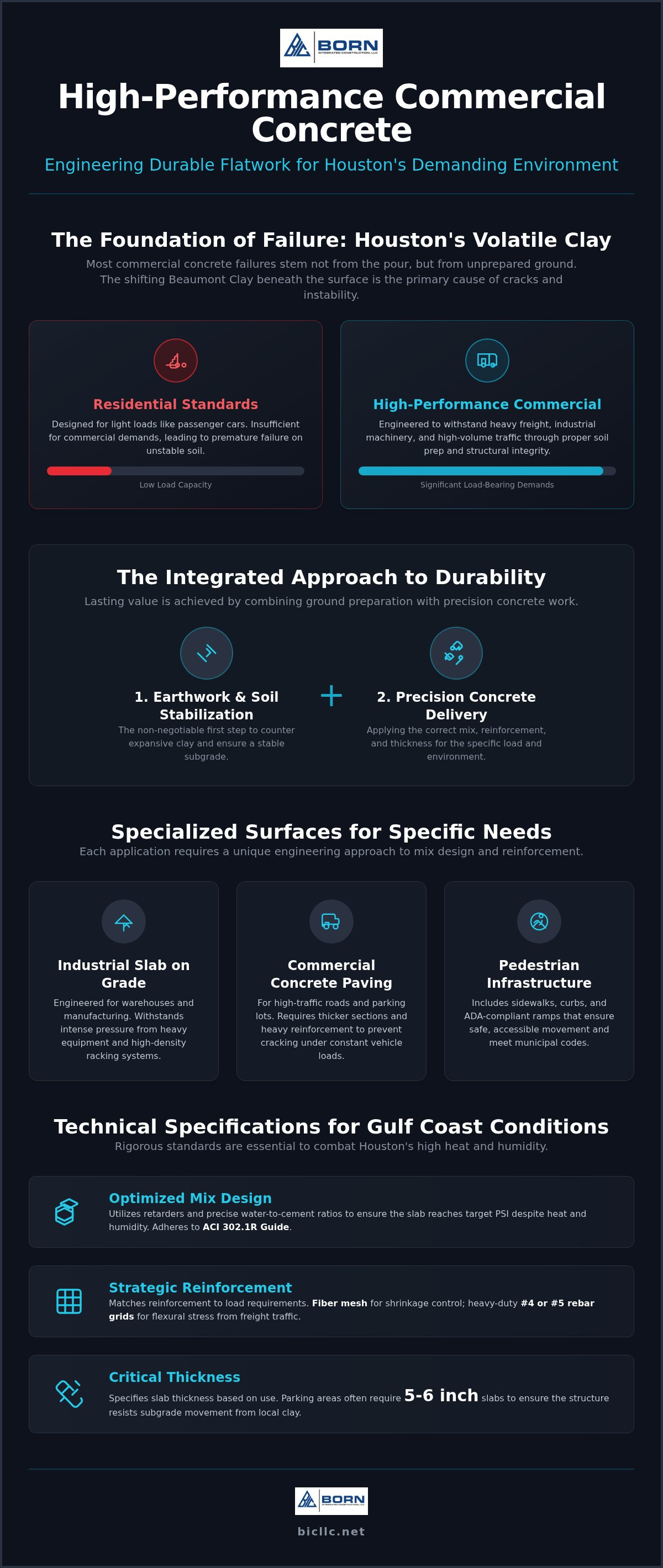
- Industrial slab on grade: These are engineered for warehouses and manufacturing facilities where heavy equipment and racking systems exert intense pressure on the floor.
- Commercial concrete paving: High-traffic roads and parking areas require thicker sections and specific reinforcement to prevent cracking under constant vehicle loads.
- Pedestrian infrastructure: This includes sidewalks, curbs, and ADA-compliant ramps that ensure safe, accessible movement across the property while maintaining municipal compliance.
The Structural Role of Flatwork in Site Development
Flatwork doesn't exist in isolation; it's part of a complex civil ecosystem. A professional commercial concrete flatwork contractor Houston ensures that every pour integrates seamlessly with the site's drainage systems and detention ponds. This coordination is vital at transition points where paving meets structural Cast-in-Place (CIP) elements like retaining walls or podium decks. Flatwork acts as a structural component that manages both load distribution and site water runoff. Proper integration prevents water from undermining the subgrade, which is the leading cause of surface failure in the Gulf Coast region. By focusing on these technical details, a contractor establishes a foundation that supports both the physical load and the long-term success of the development.
Technical Specifications for Durable Houston Concrete Projects
Houston's environmental conditions demand rigorous adherence to technical standards. High ambient temperatures and Gulf Coast humidity can compromise the curing process if the mix design isn't precisely managed. A seasoned commercial concrete flatwork contractor Houston utilizes retarders and specific water-to-cement ratios to ensure the slab reaches its intended PSI before the heat causes surface crusting. Adhering to the ACI 302.1R Guide provides the necessary framework for achieving a flat, level, and durable finish in these challenging conditions. Proper mix design is the first step in ensuring the long-term viability of the infrastructure.
Reinforcement strategies must match the specific load requirements of the site. While fiber mesh offers excellent resistance to plastic shrinkage, heavy-duty commercial zones typically require #4 or #5 rebar grids to handle the flexural stresses of freight traffic. Thickness is equally critical. We often specify five to six-inch slabs for parking areas to ensure the structure doesn't succumb to the subgrade movement common in local clay formations. Matching the concrete's strength to expected vehicle weights prevents premature fatigue and structural failure.
Uncontrolled cracking is often the result of poor timing in jointing. Saw-cutting must occur within a narrow window as the concrete gains strength. Precise joint placement creates intentional weak points, directing the inevitable shrinkage along clean lines rather than allowing random fractures to mar the surface. This level of detail is what separates a standard pour from a professional installation. You can learn more about our commitment to operational precision and how it translates to long-term reliability.
Slab on Grade vs. Podium Slabs
Slab on grade is the standard for ground-level efficiency, providing a robust foundation for warehouses and retail centers. However, as Houston developments become more vertical, the role of podium slabs has increased. These structural elements are vital for midrise and mixed-use projects where concrete must support multiple levels of wood or steel framing above. Choosing an expert podium slab contractor in Houston ensures that these complex structural transitions are handled with the necessary engineering oversight, a capability you can see reflected in our completed civil projects.
The Impact of Proper Finishing Techniques
The final finish determines the slab's functionality. Hard-trowel finishes are the standard for industrial interiors, creating a dense, easy-to-clean surface that resists dusting. Conversely, broom finishes are essential for exterior sidewalks and parking lots to provide a slip-resistant texture. Application of curing compounds is another non-negotiable step; these membranes retain moisture, allowing the concrete to hydrate fully. Precision in these finishing techniques reduces long-term maintenance costs and ensures the surface remains safe for its entire service life.
Houston’s Environmental Challenges: Soil Stabilization and Drainage
Houston’s Beaumont Clay, often referred to as "Houston Gumbo," represents the primary adversary of durable infrastructure in the region. These expansive soils swell significantly when wet and shrink during dry periods, creating a cycle of movement that can easily destroy unreinforced or poorly prepared concrete. A seasoned commercial concrete flatwork contractor Houston recognizes that the quality of the surface pour is entirely dependent on the stability of the ground beneath it. By strictly following American Concrete Institute (ACI) standards for subgrade preparation, we establish a foundation that mitigates the risks inherent in our local geology.
Site preparation isn't merely about clearing land; it's a precise civil engineering task. Mass soil excavation must be coordinated with the installation of underground utilities to prevent future settlement issues. If utility trenches aren't backfilled and compacted with the same rigor as the rest of the site, the resulting soft spots will cause the surface flatwork to crack or sink. This integrated approach ensures that the final horizontal surfaces remain level and structurally sound for their entire service life.
The Process of Paving Stabilization
Chemical stabilization is a non-negotiable step for most Texas commercial projects. This process typically involves mixing lime or cement into the subgrade to neutralize the soil's expansive properties. By altering the chemical makeup of the clay, we reduce its plasticity and create a rigid, weather-resistant platform. Mechanical compaction follows, where we utilize heavy machinery to reach specific density requirements. Understanding Why Paving Stabilization is Critical for Texas Soil helps developers see the long-term value in these early-stage investments. We don't move forward with concrete placement until the subgrade is verified as ready to support the design loads.
Managing Stormwater and Site Drainage
Efficient drainage is the second pillar of flatwork longevity. In a city prone to heavy rainfall, detention ponds and integrated storm sewer systems are essential to prevent water from saturating the subgrade. When water sits against a concrete edge or seeps under a slab, it softens the stabilized soil and leads to structural failure. Born Integrated Construction manages the "Turn Key Civil" cycle to ensure that paving and drainage work in tandem. We align the slopes of parking lots and sidewalks with the site's runoff plan, ensuring that every gallon of water is directed away from the infrastructure. This seamless transition from earthwork to finish creates a cohesive system that protects your investment from Houston’s unique environmental demands.
Choosing the Right Commercial Concrete Contractor in Houston
Selecting a commercial concrete flatwork contractor Houston isn't a task to be taken lightly. The complexity of local soil and municipal codes demands a partner who understands the technical nuances of structural concrete. A disciplined professional doesn't just offer a quote; they provide a comprehensive plan that accounts for every phase of development. This methodical approach ensures that the project moves from the initial bid to the final pour with professional stability and transparency.
Vetting a potential partner involves five essential steps:
- Step 1: Evaluate their technical capacity for structural concrete and CIP projects to ensure they can handle high-load requirements.
- Step 2: Verify safety records and insurance coverage, which is critical for mitigating liability on large-scale sites.
- Step 3: Analyze the contractor's ability to handle integrated civil site work, including mass excavation and soil stabilization.
- Step 4: Check references to confirm their reliability in meeting project deadlines and adhering to established budgets.
- Step 5: Assess the transparency of their bidding process to ensure material costs are clearly defined without hidden fees.
The Importance of Safety and Integrity
A steadfast commitment to safety is the hallmark of a reliable partner. It protects the physical well-being of the workforce and reduces the long-term liability for developers. When you evaluate a contractor's professional stability, you're looking for a track record of high standards and long-term viability. Ethical conduct in vendor relationships is equally important; it ensures that the materials delivered to your site meet the precise specifications required for durable infrastructure. A partner who prioritizes integrity won't compromise on the quality of the mix or the depth of the reinforcement.
Capacity for Large-Scale Infrastructure
Executing large-scale infrastructure requires more than just labor; it requires the right equipment and logistical expertise. A dependable commercial concrete flatwork contractor Houston should own their machinery for mass excavation and paving to maintain control over the project timeline. This ownership allows for a seamless transition between earthwork and pouring, which is vital for complex structures like multi-level CIP garages or high-rise foundations. We believe in the persona of the quiet leader. This means focusing on execution over hyperbole and delivering proven results through unwavering consistency. This disciplined approach ensures that every detail is managed with meticulous precision. If you're ready to partner with a team that values substance and reliability, learn more about our integrated civil services today.
Born Integrated Construction: Steadfast Reliability in Houston Flatwork
Reliability, integrity, and efficiency aren't just abstract values; they're the operational pillars of our organization. As a dedicated commercial concrete flatwork contractor Houston, we recognize that project success depends on the meticulous management of every detail. Our grounded approach prioritizes professional stability and a deep-rooted commitment to high standards. We don't rely on hyperbole to prove our worth. Instead, our reputation is built on the enduring nature of our professional output and a proven ability to deliver results that withstand the environmental rigors of the Gulf Coast.
The "Born Integrated" name reflects our philosophy of a seamless transition from site preparation to the final structural finish. By managing the entire cycle, we eliminate the coordination gaps that often lead to project delays. This integrated method ensures that the soil stabilization and mass excavation phases align perfectly with the concrete construction requirements. We cultivate strong relationships with both customers and vendors, which allows us to maintain consistent material quality and operational precision throughout the Greater Houston area.
Our Full Range of Concrete Services
Our technical capabilities extend far beyond simple paving. We provide a comprehensive suite of services designed to meet the complex needs of modern commercial infrastructure. Whether the project requires basic pedestrian infrastructure or sophisticated structural elements, we execute each task with the same level of disciplined professionalism.
- Slabs and Paving: High-performance slab on grade and concrete paving engineered for industrial loads.
- Structural Foundations: Specialized expertise in CIP midrise and highrise foundations that require exact engineering tolerances.
- Parking Solutions: Construction of CIP garages, precast garage foundations, and structured concrete parking garages.
- Site Infrastructure: Sidewalks, flatwork, retaining walls, and ADA-compliant ramps.
You can view our completed projects and civil site work to see how these services integrate into large-scale developments.
Partnering for Your Next Development
Developers across Texas trust us for their most critical infrastructure needs because we act as a dependable partner rather than just another subcontractor. We take pride in our role as a quiet leader in the industry, focusing on execution and safety over style. Our goal is to deliver cost-effective, high-quality concrete solutions that provide long-term viability for your investment. This sense of duty drives us to maintain transparency in our bidding and consistency in our physical operations. You can learn more about our mission and our commitment to ethical conduct by visiting our page About Born Integrated Construction. We're ready to establish a lasting foundation for your next commercial project.
Establishing a Foundation for Long-Term Infrastructure Success
Securing durable infrastructure in the Gulf Coast region requires more than a standard pour. It demands a technical understanding of Beaumont Clay and a disciplined approach to site stabilization. By integrating earthwork with structural concrete, developers avoid the common pitfalls of settlement and premature cracking. This methodical coordination ensures every horizontal surface meets strict load-bearing requirements and municipal codes. It's a process that values substance over style to deliver proven results. We don't just pour concrete; we engineer stability for the life of the project.
As a leading commercial concrete flatwork contractor Houston, we prioritize the enduring nature of our work through operational precision. Born Integrated Construction remains specialized in Turn Key Civil and Structural Concrete solutions. Our steadfast commitment to safety, integrity, and efficiency guides every project across Houston, Austin, San Antonio, and Dallas. We focus on building foundations that support the long-term viability of your professional output. Partner with Born Integrated Construction for your next Houston development to ensure your site is managed with meticulous detail. We look forward to establishing a reliable partnership that supports your growth.
Frequently Asked Questions
What is the difference between residential flatwork and commercial flatwork?
Commercial flatwork is distinguished by its significantly higher load-bearing requirements and rigorous technical standards. While residential work often focuses on aesthetic driveways, a commercial concrete flatwork contractor Houston must engineer surfaces to withstand heavy freight and constant industrial traffic. These projects utilize specialized mix designs with higher PSI ratings and thicker sections. They also incorporate advanced reinforcement strategies to ensure the long-term viability of the infrastructure under extreme operational stress.
How does Houston’s soil affect the longevity of concrete paving?
Houston's expansive clay soil, often called Beaumont Clay, undergoes significant volume changes based on moisture levels. This movement exerts intense pressure on concrete slabs, leading to spiderweb cracks and structural shifting if the subgrade isn't properly prepared. Professional contractors must account for this geological reality by implementing specific stabilization techniques. Without these measures, the longevity of concrete paving is severely compromised, resulting in premature failure and high maintenance costs for property owners.
Why is soil stabilization necessary before pouring a commercial slab?
Soil stabilization is a non-negotiable step that neutralizes the expansive properties of local clay formations. By mixing chemical agents like lime or cement into the subgrade, we create a rigid and predictable platform for the concrete. This process prevents the ground from swelling or shrinking, which is the leading cause of foundation movement in Texas. It's a critical component of an integrated civil approach that ensures the structural integrity of every commercial slab.
What is Cast-in-Place (CIP) concrete and when is it used for flatwork?
Cast-in-Place (CIP) concrete is poured directly into forms on the project site rather than being pre-cast in a factory. It's the primary method for constructing complex, high-strength elements such as podium slabs, CIP garages, and midrise foundations. This technique allows for seamless integration with the site's unique dimensions and load requirements. We utilize CIP methods whenever a project demands maximum structural flexibility and the highest level of on-site precision for durable infrastructure.
How long does a commercial concrete parking lot typically last in Texas?
A well-engineered commercial concrete parking lot in Texas typically lasts between 20 and 30 years when properly maintained. The exact lifespan depends heavily on the quality of the initial site preparation and the thickness of the slab. Our focus on soil stabilization and precise jointing helps mitigate the damage caused by extreme Gulf Coast heat and soil movement. Regular inspections and managing water runoff through integrated drainage systems further extend the service life of these surfaces.
Can you handle both the excavation and the concrete pouring for a project?
Yes, we operate as a Turn Key Civil partner, managing the entire lifecycle from mass soil excavation to the final structural finish. This integrated approach allows us to control the quality of the subgrade before the first yard of concrete is ever poured. By handling earthwork, underground utilities, and paving stabilization in-house, we eliminate the coordination errors that often occur between multiple subcontractors. This results in a more efficient timeline and a more stable end product.
What safety standards should I look for in a Houston concrete contractor?
You should prioritize a contractor who demonstrates a steadfast commitment to OSHA compliance and ACI standards. Reliability in safety is a direct indicator of a firm's overall professional stability and operational precision. Look for a partner who maintains transparency in their safety records and carries comprehensive insurance for large-scale sites. A disciplined professional who values substance over style will always lead with proven safety results and a focus on reducing liability for developers.
How do detention ponds integrate with commercial flatwork design?
Detention ponds are essential for managing stormwater runoff and protecting the integrity of adjacent flatwork. These systems are designed to collect excess water during heavy rainfall, preventing it from saturating the stabilized subgrade beneath your parking lots and sidewalks. If water is allowed to pool against concrete edges, it can undermine the foundation and cause the surface to fail. Proper integration ensures that all site drainage aligns perfectly with the final paving elevations.