Thin Shell Concrete Parking Garages in Houston & Austin
The standard industry preference for precast concrete systems might actually be the most costly decision a Texas developer makes when long-term maintenance and structural longevity are prioritized. In markets like Houston and Austin, the combination of extreme thermal expansion and highly expansive soils creates a volatile environment that quickly exposes the vulnerabilities of jointed structures. Many developers find that thin shell cast-in-place concrete parking garages offer a more stable, monolithic alternative that avoids the inherent weaknesses of traditional precast segments.
Managing the high maintenance costs and persistent water leakage through garage decks is a common burden, particularly when dealing with Houston's "gumbo" clay or the shifting limestone in Austin. We recognize the need for a structure that remains steadfast under these pressures. This article demonstrates how thin shell cast-in-place concrete provides the ultimate balance of structural efficiency, water-tightness, and long-term ROI for Texas developments. We will preview the technical advantages of monolithic construction and explain how it mitigates the risks of foundation shifting and thermal stress.
Key Takeaways
- Understand how high-strength concrete and post-tensioning allow for thinner deck profiles without compromising structural integrity or load-bearing capacity.
- Discover why thin shell cast-in-place concrete parking garages offer superior water-tightness and significantly lower maintenance costs compared to joint-heavy precast systems.
- Learn how monolithic construction mitigates the risks of foundation shifting and thermal expansion caused by the challenging expansive soils in Houston and Austin.
- Evaluate the 30-year operational savings gained by choosing a structure that eliminates the need for recurring joint caulking and recurring sealant replacements.
- Explore the benefits of a turnkey approach to civil and structural concrete that prioritizes safety and long-term viability in complex parking developments.
Understanding Thin Shell Cast-in-Place Concrete for Parking Garages
Thin shell cast-in-place (CIP) concrete represents a sophisticated departure from traditional heavy-slab construction. This method utilizes high-strength concrete mixes combined with optimized structural geometry to create decks that are significantly thinner than standard pours. While the name might suggest a lack of substance, the engineering behind thin-shell structures relies on curved or folded geometries that distribute loads through membrane stresses rather than simple bending. It's a deliberate engineering choice. This specialized design allows thin shell cast-in-place concrete parking garages to maintain exceptional load-bearing capacity while reducing the overall volume of material required for the build.
The integration of post-tensioning is vital to this process. By placing high-strength steel tendons within the formwork and tensioning them after the concrete reaches a specific strength, we introduce internal compressive forces that counteract the tensile stresses of heavy vehicle loads. This active reinforcement allows for lighter, longer spans without the need for thick, cumbersome beams. Modern developments in 2026 have introduced high-efficiency formwork systems that allow for faster pouring cycles. These advancements make the CIP method more competitive with off-site fabrication timelines while retaining the superior structural integrity of on-site execution.
The Monolithic Advantage: A Seamless Structural System
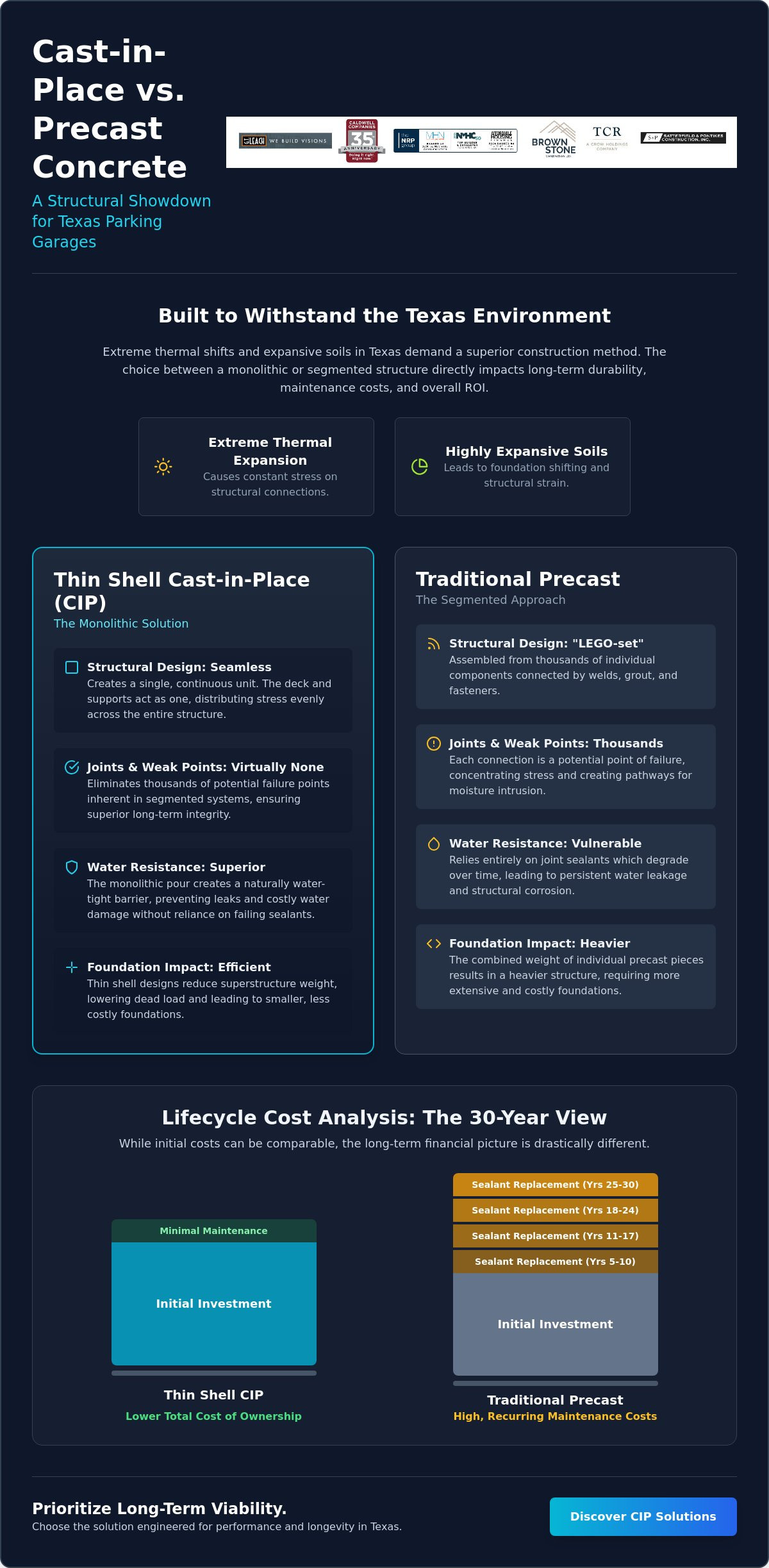
A primary concern for Texas developers is the long-term performance of joints. Traditional precast systems function like a "LEGO-set" where thousands of individual components are connected, creating thousands of potential failure points. In contrast, a monolithic pour creates a seamless, continuous unit where the deck and supporting elements act as one. This single-pour system distributes thermal and seismic stresses across the entire structure rather than concentrating them at vulnerable connections. Monolithic CIP is the gold standard for structural continuity.
Weight Reduction and Material Efficiency
The dead load of a parking structure significantly influences the design of its foundation. Thin shell designs reduce the weight of the superstructure, which directly lowers the requirements for deep pier foundations or extensive mass soil excavation. This efficiency is particularly valuable in the varied soil profiles found in Houston and Austin. By using less concrete to achieve the same structural capacity, developers realize tangible benefits:
- Lowered foundation costs due to reduced structural weight.
- Minimized material waste during the construction phase.
- Improved sustainability profiles through reduced carbon footprints.
- Greater flexibility in architectural design and floor-to-ceiling heights.
Thin Shell CIP vs. Precast: Evaluating Structural Performance
The choice between cast-in-place and precast systems often comes down to a fundamental comparison of structural continuity. Precast structures rely on thousands of individual components connected by weld plates, grouted joints, and mechanical fasteners. Each of these connections represents a potential point of failure or a path for moisture. Thin shell cast-in-place concrete parking garages eliminate these vulnerabilities by creating a single, continuous structural frame. This monolithic nature provides inherent rigidity. It's particularly effective at managing lateral loads from wind or seismic events, as the structure doesn't rely on the friction or connections of separate segments to maintain its integrity.
Maintenance cycles differ drastically between these two methods. In a precast system, joint sealants typically require replacement every five to seven years to prevent degradation. For a large-scale development, this represents a significant recurring expense over a 30-year lifecycle. Developers who prioritize durable concrete parking structures often select CIP to avoid these predictable costs. Beyond durability, on-site forming offers superior aesthetic flexibility. It allows for custom architectural curves and seamless integration with complex building footprints that standard plant-cast molds cannot easily accommodate.
Waterproofing and Corrosion Resistance
Water is the primary enemy of structural concrete. In precast garages, joints often act as conduits for chloride-laden water to reach the internal steel reinforcement. A monolithic CIP deck functions more like a solid roof. It sheds water effectively and lacks the seams that allow moisture to seep into the structural core. This provides superior protection for the internal rebar, ensuring the structure remains stable for decades. If you're planning a new project, consulting with a structural partner early can help identify the most effective long-term waterproofing strategy.
Construction Speed vs. Long-Term Reliability
The belief that precast is always faster is often a misconception. While on-site assembly is quick, the hidden time cost lies in plant fabrication lead times, which can stretch for months before a single component arrives at the site. Modern CIP garage construction techniques have narrowed this gap. Advanced formwork systems and high-early-strength concrete mixes allow for rapid floor cycles. In 2026, savvy developers are increasingly prioritizing lifecycle value over marginal gains in initial speed. They understand that thin shell cast-in-place concrete parking garages offer a superior return on investment by drastically reducing the operational expenses associated with joint failure and waterproofing repairs.
Engineering for the Texas Environment: Soil and Thermal Resilience
Texas soil presents a unique set of challenges that demand more than standard engineering solutions. The "Blackland" clay found in Central Texas and the "gumbo" clays of the Gulf Coast are highly expansive. They undergo dramatic volume changes based on moisture levels. This constant movement often leads to differential settlement, a condition where parts of a foundation shift at different rates. Thin shell cast-in-place concrete parking garages offer a more resilient solution to this problem. Their monolithic nature allows the entire structure to act as a single, rigid unit that effectively absorbs and redistributes the stresses of soil movement, preventing the "stepping" or joint separation common in precast systems.
Managing the thermal stress of 100°F+ Texas summers is another critical priority for structural longevity. Without a continuous structural frame, the repeated expansion and contraction cycles can lead to debilitating cracks and joint failure. The thermal resilience of thin shell cast-in-place concrete parking garages ensures that the structure remains water-tight and stable even after years of extreme temperature fluctuations. Ensuring the long-term viability of these structures begins with the ground itself. Integrating robust paving stabilization techniques under the garage footprint provides a predictable, non-reactive base that complements the structural integrity of the concrete above.
Soil Stabilization and Foundation Integrity
Soil stabilization is the first line of defense against foundation heave. At Born Integrated Construction, we prioritize precision in earthwork to ensure the subgrade is properly prepared before the first yard of concrete is poured. This process often involves lime or cement stabilization to neutralize the reactive properties of the clay. We meticulously manage moisture content during this phase to prevent future soil expansion. This disciplined approach to site preparation ensures that the garage foundation remains steadfast despite the volatile nature of Texas soils.
Regional Climate Adaptation
The Texas climate requires specific concrete mix designs that can withstand high heat and humidity. In environments like Austin or Houston, the curing process must be carefully controlled to prevent shrinkage cracks. We employ specialized curing protocols and chemical additives to ensure the concrete reaches its design strength without losing moisture too rapidly. The local Texas climate dictates specific CIP additive requirements to control set times and improve long-term durability in extreme heat. These technical adjustments are essential for delivering a product that meets our high standards for reliability and professional stability.
Lifecycle Cost Analysis: Why Monolithic CIP Structures Outlast Alternatives
Evaluating the financial viability of a parking structure requires a shift in perspective from initial capital expenditure (Capex) to 30-year operational expenditure (Opex). While some construction methods might present a lower initial bid, the real cost of ownership is often hidden in recurring maintenance cycles. Thin shell cast-in-place concrete parking garages offer a distinct advantage by virtually eliminating the most significant recurring maintenance cost in the industry: joint repair. By creating a continuous structural unit, developers avoid the thousands of linear feet of caulking and sealants that define segmented structures.
The "soft costs" of garage downtime are frequently overlooked during the planning phase. In a precast system, the mandatory 5 to 7-year joint maintenance cycles often require closing entire levels of the garage. This results in lost revenue and tenant dissatisfaction. Monolithic structures avoid these disruptions, ensuring that the asset remains fully operational and generating value. Institutional investors and real estate investment trusts (REITs) increasingly prefer CIP structures for this reason. They value the long-term stability and the reduced risk of structural degradation that could impact resale value. To explore how these structures fit into your long-term asset strategy, you can contact our structural concrete team for a detailed consultation.
Maintenance Schedules: 2026 Standards
Modern maintenance for thin shell concrete has evolved to focus on preservation rather than repair. Current 2026 standards prioritize the application of advanced penetrating sealers that move deep into the concrete matrix to block chloride and moisture. Because there are no joints to fail, the primary task is a simple periodic re-application of these sealers. This approach prevents the "spalling" or concrete chipping typically found at the connection points of precast beams. A monolithic design ensures that the reinforcement remains protected within a seamless environment for decades.
Insurance and Liability Considerations
Risk management is a core pillar of professional property management. Monolithic CIP structures provide inherent fire resistance due to their thick-section continuity, which can lead to more favorable insurance premiums compared to structures with exposed steel connections. Additionally, the lack of joint transitions across the driving and walking surfaces significantly reduces slip-and-fall risks. There are no uneven edges or failing sealants to create trip hazards. When you work with a single-source CIP contractor, you also benefit from a unified structural warranty, providing a clear line of accountability for the integrity of the entire garage.
Implementing Thin Shell CIP Solutions with Born Integrated Construction
The successful execution of a parking structure requires a transition from engineering theory to disciplined field application. Born Integrated Construction provides a turnkey solution for thin shell cast-in-place concrete parking garages by managing the entire project lifecycle. This process begins with a deep understanding of the structural requirements and extends through every phase of the build. We prioritize substance over style, focusing on the meticulous management of details that ensure a garage remains functional for decades. Our approach is grounded in professional stability, providing developers with a dependable partner who understands the nuances of the Texas market.
The transition from mass excavation to structural CIP is often where project schedules face the most risk. We eliminate this friction by integrating our civil and structural capabilities. Our expertise in earthwork ensures that the foundation for the thin shell cast-in-place concrete parking garages is as steadfast as the structure itself. By controlling the site preparation, we ensure the subgrade is perfectly stabilized to support a monolithic frame. This unified management style reduces the number of handoffs between contractors, which minimizes errors and keeps the project on a predictable path toward completion.
Our Integrated Civil and Concrete Process
Managing earthwork and concrete under one roof allows us to streamline the construction schedule significantly. This integrated model provides several key advantages for Texas developments:
- Seamless coordination between mass soil excavation and foundation pours.
- Meticulous quality control through consistent on-site testing and oversight.
- Enhanced safety protocols that cover the entire project scope from ground-breaking to topping out.
- Established relationships with local vendors from Conroe to San Antonio that ensure 2026 project stability.
Start Your 2026 Development with Confidence
Early planning is the most effective way to maximize the structural and financial benefits of a monolithic CIP system. We offer consultation services to help developers evaluate the feasibility of thin shell designs during the initial design phase. This proactive engagement allows us to identify potential soil challenges or geometric optimizations before they impact the budget. We believe in building lasting foundations, both in the concrete we pour and the professional relationships we maintain.
Securing a comprehensive quote for your next project involves a thorough analysis of site-specific data and structural goals. We provide a clear, matter-of-fact delivery of costs and timelines, avoiding hyperbole in favor of realistic assessments. Partner with Born Integrated Construction for your next Texas parking structure to ensure your asset is built with the precision and unwavering consistency that your investment deserves.
Securing the Future of Texas Parking Infrastructure
Selecting the right structural system is a decision that defines the long-term viability of a development. The monolithic nature of thin shell cast-in-place concrete parking garages provides a level of structural continuity that segmented precast systems can't match. By eliminating thousands of linear feet of joints, developers effectively remove the primary cause of water infiltration and recurring maintenance expenses. It's an approach that ensures a structure remains steadfast despite the expansive soils and intense thermal stresses of the Texas climate.
Success in these complex builds requires a partner who values substance and meticulous execution. Our Texas-based expertise across Houston, Austin, and Dallas allows us to navigate local soil conditions with precision. We operate under a comprehensive safety-first model, providing integrated civil and structural concrete services that streamline the entire construction lifecycle. If you're ready to build a lasting foundation for your next project, Contact Born Integrated Construction for a Structural Concrete Consultation. We look forward to establishing a reliable path forward for your development.
Frequently Asked Questions
What exactly is a thin shell cast-in-place concrete garage?
A thin shell cast-in-place concrete garage is a structure poured on-site using high-strength concrete and optimized structural geometry. This method allows for thinner, lighter deck profiles without sacrificing load-bearing capacity. By utilizing advanced formwork and post-tensioning, we create a seamless, monolithic structure. These thin shell cast-in-place concrete parking garages offer superior durability because they eliminate the thousands of joints found in traditional precast construction.
How does thin shell CIP compare to precast in terms of construction time?
While precast components are assembled quickly on-site, the total project timeline often favors cast-in-place when plant lead times are considered. Precast fabrication can take months before a single piece arrives at the site. Modern CIP techniques use high-early-strength concrete and efficient formwork cycles to narrow the gap. This allows the structural build to begin immediately following mass soil excavation, providing a more predictable schedule for Texas developers.
Why is monolithic concrete better for Texas soil conditions?
Monolithic construction is essential for managing the expansive clays found in Houston and Austin. These thin shell cast-in-place concrete parking garages act as a single, rigid unit that absorbs and redistributes the stresses of soil movement. Unlike precast systems that can separate at the joints during differential settlement, a cast-in-place frame maintains its structural integrity. This provides a more dependable foundation for long-term urban developments.
Do thin shell garages require special maintenance?
Thin shell garages actually require less maintenance than traditional jointed systems. Because the structure is monolithic, owners avoid the recurring costs of replacing joint sealants and caulking every five to seven years. Maintenance is typically limited to the periodic application of penetrating sealers to protect the concrete matrix. This streamlined approach reduces long-term operational expenses and prevents the structural degradation often seen at connection points in segmented garages.
Can thin shell CIP handle the weight of heavy SUVs and electric vehicles?
Yes, these structures are specifically engineered to manage high point loads from modern, heavier vehicles. The combination of high-strength concrete and post-tensioning creates an active reinforcement system that handles tensile stresses more effectively than mild steel alone. This ensures the garage can accommodate the increased weight of electric vehicle batteries and large SUVs without compromising the deck's integrity or causing excessive deflection over long spans.
Is cast-in-place concrete more expensive than precast for parking structures?
Initial capital costs for cast-in-place may be higher in some scenarios, but the 30-year lifecycle cost is often significantly lower. The primary savings come from eliminating joint maintenance and reducing the risk of water-driven corrosion. When developers account for the "soft costs" of closing garage levels for repairs, the monolithic CIP approach provides a superior return on investment. It remains the preferred choice for institutional investors seeking long-term asset stability.
What are the waterproofing benefits of a joint-free concrete deck?
A joint-free deck functions as a continuous, solid roof that naturally sheds water. In precast systems, joints are the primary entry point for moisture and chlorides which eventually cause rebar corrosion. A monolithic pour eliminates these seams entirely, creating a water-tight environment that protects the internal structural steel. This inherent waterproofing is vital for the longevity of the structure, particularly in the high-humidity environments of the Texas Gulf Coast.
How does post-tensioning work in a thin shell garage design?
Post-tensioning involves placing high-strength steel tendons inside the concrete forms before the pour. Once the concrete reaches a specific strength, these tendons are tensioned with hydraulic jacks and anchored. This process introduces internal compressive forces that counteract the weight of vehicles and the structure itself. It allows engineers to design thinner slabs and longer spans, which reduces the overall material volume and structural weight of the garage.