Thin Shell Cast-in-Place Concrete for Houston Residential
What if the key to building a more resilient Houston residential development wasn't adding more mass, but strategically removing it? Developers across the Texas coast understand the pressure of rising ready-mix prices, which have reached approximately $181.91 per cubic yard in the Houston metro as of June 2026. You're likely balancing these material costs against the demand for structures that can withstand the region's notorious Beaumont clay and seasonal volatility. Utilizing thin shell cast-in-place concrete residential buildings allows you to achieve a superior strength-to-weight ratio that addresses both budgetary and structural requirements.
We agree that maintaining high standards shouldn't mean accepting slow construction timelines or excessive material waste. Reliability in the field requires a disciplined approach to execution and a meticulous management of details. This guide will demonstrate how thin shell cast-in-place concrete optimizes structural performance while reducing the volume of raw materials required. We'll examine how this approach accelerates floor-to-floor cycle times and provides the enduring durability necessary for high-density housing in the Gulf Coast climate.
Key Takeaways
- Learn how thin shell cast-in-place concrete residential buildings utilize monolithic structural systems to optimize verticality and efficiency in modern developments.
- Explore the significant material and labor advantages of reducing concrete volume by up to 40% per floor while accelerating formwork transition cycles.
- Identify the specific engineering requirements for managing expansive clay soils in Texas through proper paving stabilization and site preparation before structural pouring.
- Compare the weight-to-strength ratios and acoustic performance of thin shell designs against traditional cast-in-place methods for multi-story housing.
- Understand the importance of a disciplined, safety-first approach to structural concrete for ensuring the long-term durability and viability of residential shells.
What is Thin Shell Cast-in-Place Concrete for Residential Buildings?
Thin shell cast-in-place concrete is a specialized structural system that uses a monolithic pour to create reinforced slabs and walls with a significantly reduced profile. Historically, these designs were utilized primarily for large-span industrial roofs or stadiums. In 2026, the Texas construction industry has shifted toward applying these principles to high-efficiency residential verticality. This method relies on high-strength concrete mixes and precision-engineered formwork to deliver a shell that's both lightweight and incredibly rigid. To better understand the foundational physics, one can look into the broader definition of What is Thin-Shell Concrete? and how it utilizes geometry to resist external forces.
The Monolithic Advantage in Modern Residential
A primary benefit of thin shell cast-in-place concrete residential buildings is the single-pour approach. By casting walls and slabs simultaneously, we eliminate the cold joints that often serve as points of moisture ingress or structural vulnerability. This method allows for the seamless integration of mechanical, electrical, and plumbing (MEP) conduits directly into the casting process. For high-density multi-family housing, this integrated approach ensures a more secure building envelope and a more predictable construction sequence. It's a disciplined way to build that prioritizes long-term viability over temporary shortcuts.
Core Differences from Traditional CIP
While traditional cast-in-place (CIP) concrete remains a staple of Texas construction, thin shell methods offer distinct operational differences that affect both the build process and the final result:
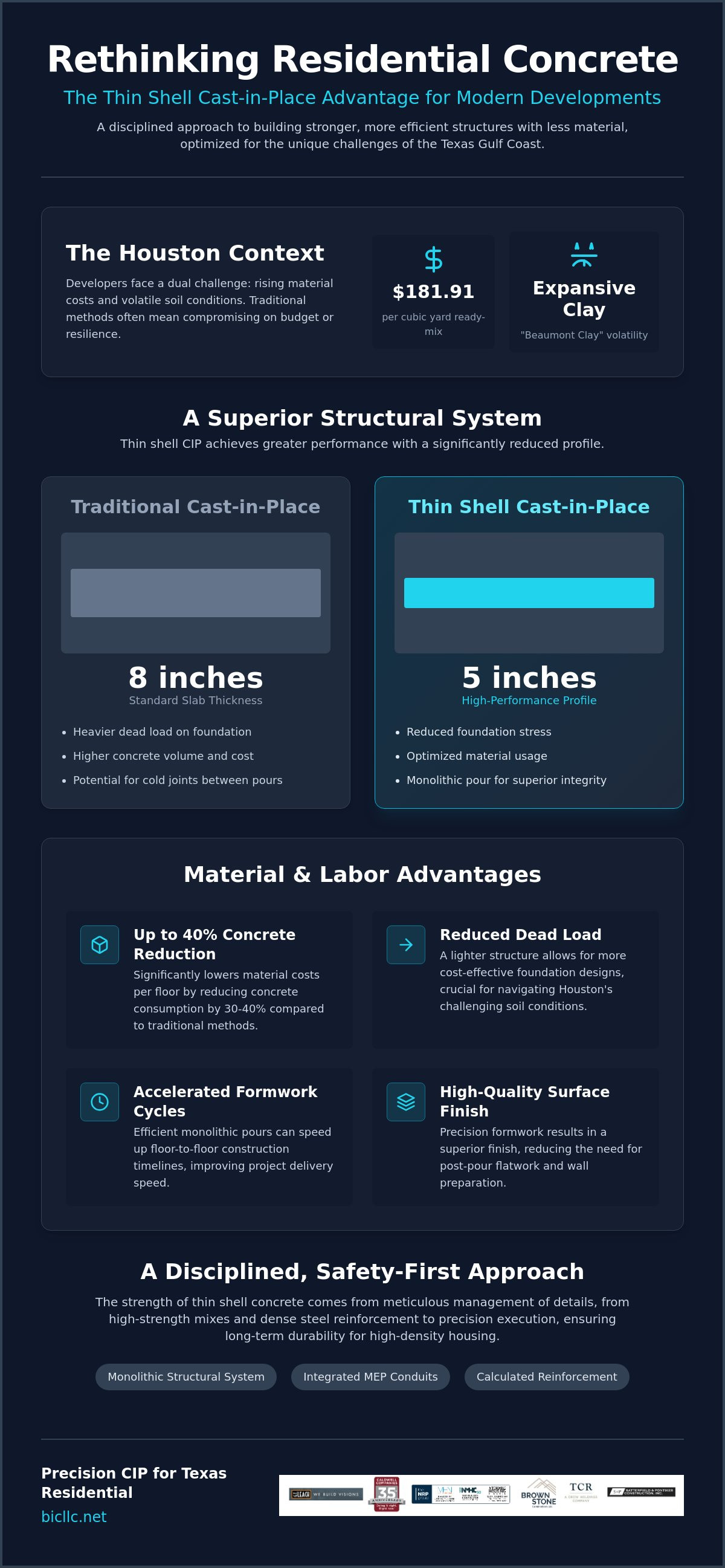
- Weight Reduction: A standard residential floor slab often measures 8 inches in thickness. A thin shell alternative can achieve the same structural performance with a 5-inch profile. This reduces the total dead load on the foundation, which is a critical consideration in volatile soil environments.
- Reinforcement Patterns: Unlike standard slabs that may rely heavily on post-tensioning, thin shell designs often utilize dense grids of mild steel reinforcement. This provides consistent tensile strength throughout the structure.
- Surface Finish Quality: The precision of the formwork used in thin shell casting results in a superior surface finish. This often reduces the labor required for post-pour flatwork or wall preparation, leading to a more efficient transition to interior finishes.
It's a common misconception that a thinner profile equates to a weaker structure. In reality, the strength of thin shell cast-in-place concrete residential buildings comes from the interaction between high-strength concrete and calculated reinforcement patterns. The physics of load distribution allow these structures to handle significant stress with less material. This efficiency is critical for developers who need to manage costs without compromising the safety or integrity of the final build. By focusing on execution and the meticulous management of details, this method provides a reliable foundation for modern residential living.
Structural Efficiency and Cost Benefits for 2026 Projects
Optimizing the structural frame is a primary objective for any developer facing the rising costs of Houston's construction market. Thin shell cast-in-place concrete residential buildings offer a disciplined solution by significantly reducing the volume of concrete required for each floor. Industry standards indicate that these systems can reduce concrete consumption by 30% to 40% per floor compared to traditional heavy-pour methods. This material reduction is particularly valuable given that Houston ready-mix prices average approximately $181.91 per cubic yard as of June 2026. Beyond immediate material savings, the lighter weight of a thin-shell structure reduces the dead load on the building's foundation. This allows for more cost-effective structural concrete designs, such as optimized slab on grade foundations, which are essential for navigating the challenges of Houston's expansive Beaumont clay soils.
Research into the historical and modern application of these structures highlights their Structural Efficiency and Cost Benefits, proving that minimalist design doesn't sacrifice long-term viability. These buildings provide robust resistance to environmental stresses common in the Southern United States, including high wind loads and fire risks. The steadfast nature of reinforced concrete ensures that the finished product remains a durable asset for decades. By focusing on the meticulous management of material volume, developers can achieve a high standard of craftsmanship while maintaining professional stability in their project budgets.
Accelerating Construction Timelines
Speed in construction is often as critical as the cost of materials. The use of portable metal and plastic composite forms allows for rapid assembly and disassembly, shortening the cycle time per floor. Because the monolithic pour combines walls and slabs into a single operation, secondary site work is minimized. This efficiency is vital for meeting the high demand for Texas housing in 2026, where project delivery speed can determine the overall financial success of a multi-family development. It's a methodical approach that ensures safety and consistency throughout the vertical build.
Material Minimalism and Sustainability
Sustainability in 2026 is driven by operational precision rather than hyperbole. Lower cement consumption directly reduces the carbon footprint of the project. It also results in fewer truck deliveries, lowering transportation costs and site congestion on busy Texas job sites. In a 10-story residential project, the cumulative reduction of concrete volume translates directly into substantial savings on raw materials and logistical overhead without compromising the building's structural integrity.
Optimizing Thin Shell CIP for Texas Soil and Climate
Building in Texas requires an intimate knowledge of the land and its seasonal volatility. The expansive clay soils characteristic of Houston, Dallas, and Austin present unique challenges for vertical structures. For thin shell cast-in-place concrete residential buildings, the lighter dead load is a distinct advantage, but it must be paired with precise site preparation. We emphasize a methodical approach to ground stability to ensure long-term viability and structural security. Optimizing for Texas Soil and Climate requires more than just structural engineering; it demands a deep-rooted commitment to civil site work. Every project begins with a focus on the meticulous management of the subsurface environment.
Before the first yard of structural concrete is placed, we focus on paving stabilization. This foundational step mitigates the risk of soil movement that could compromise the monolithic shell. In cities like San Antonio and Fort Worth, adhering to local building codes involves demonstrating how these structures manage both seismic and wind loads within the context of specific local soil profiles. We don't take shortcuts when it comes to safety. Our disciplined execution ensures that each pour meets the rigorous standards required for high-density housing in the Gulf Coast region.
Foundation Synergy: Shells and Soil
The interaction between thin-shell weights and soil stabilization techniques is a delicate balance. While the reduced mass of the building exerts less pressure on the clay, it also makes the structure more susceptible to heave if the soil isn't properly treated. Preventing differential settlement in monolithic residential structures is paramount for maintaining the integrity of the building envelope. Integrated civil site work ensures that thin shell cast-in-place concrete residential buildings and their foundations act as a single, harmonious unit. This steadfast approach protects the investment from the natural shifts of the Texas earth.
Climate-Responsive Concrete Mixes
Managing the hydration of concrete in the extreme heat of a Texas summer requires operational precision. We customize concrete additives based on the specific microclimate, adjusting for the high humidity of Beaumont or the arid heat of Austin. Monitoring hydration rates in thin sections is critical to reaching full design strength without surface cracking. Best practices for summer pours in North and Central Texas include timing the pour for cooler hours and utilizing curing compounds that maintain moisture within the shell. It's a professional standard that guarantees a durable and high-quality end result.
Thin-Shell vs. Traditional CIP: A Residential Comparison
Choosing between traditional methods and modern structural efficiency requires a thorough understanding of performance metrics. While standard cast-in-place (CIP) concrete remains a baseline for many Texas developments, thin shell cast-in-place concrete residential buildings provide a superior weight-to-strength ratio. This efficiency is paramount for multi-story developments where reducing the dead load of the structure minimizes the cumulative stress on lower levels and the foundation. Traditional CIP often relies on sheer mass for stability, but thin-shell designs use high-density mixes to achieve equal or greater rigidity with a smaller footprint. This shift allows developers to maximize interior floor space and potentially reduce the size of vertical support columns throughout the building.
Thermal mass is another critical factor in the Houston climate. Even with a reduced profile, the density of the concrete acts as a steadfast thermal buffer. It absorbs heat during the peak of the day and releases it slowly as temperatures drop, which is essential for meeting Texas cooling requirements. This characteristic improves the overall energy efficiency of the building envelope compared to lightweight wood-frame alternatives. While the initial investment in specialized formwork may be higher than traditional plywood methods, the per-pour savings in material and labor often offset these costs within the first few levels of a midrise structure.
Acoustics and Fire Safety in Residential Shells
A common concern for developers is whether a thinner shell compromises the living experience in luxury residential units. In reality, high-density concrete provides excellent acoustic performance, often exceeding the Sound Transmission Class (STC) ratings of thicker, less dense materials. These monolithic shells create a quiet environment by minimizing the vibration and sound transfer between units. From a safety perspective, the fire resistance ratings of reinforced concrete are inherently superior to wood-frame construction. This provides a sense of security for residents and long-term viability for the property owner.
Implementation Framework for Developers
Thin-shell methods are particularly effective for midrise projects ranging from 4 to 12 stories. These structures often benefit from integration with podium slab construction, allowing for mixed-use retail or parking on the lower levels with efficient residential shells above. When evaluating a site in urban Houston, developers must consider site access for the delivery and staging of specialized formwork. A disciplined approach to logistics ensures that the construction rhythm remains steady and predictable. If you are planning a multi-story project, our team provides the structural concrete expertise needed to execute these complex shells with precision and reliability.
The Born Integrated Approach: Precision CIP for Texas Residential
Reliability is the cornerstone of our operations. We prioritize professional stability and a deep-rooted commitment to high standards in every project we undertake. Executing thin shell cast-in-place concrete residential buildings requires a disciplined partner who values substance over style. By focusing on operational precision, we leverage structural efficiency to deliver residential shells that are both cost-effective and enduring. Our team manages every detail with a strong sense of duty, ensuring that the final output reflects our pride in craftsmanship and long-term viability.
We believe that a building's integrity is established long before the vertical construction begins. Our approach is grounded in the meticulous management of details, from the initial site assessment to the final monolithic pour. This steadfast focus allows us to provide a reassuring and serious partnership for developers who require security and confidence in their structural concrete contractor. We don't seek to disrupt; we seek to lead through proven results and unwavering consistency.
Integrated Civil and Structural Solutions
A stable structure begins with expert earthwork. Our turn-key civil services encompass everything from mass soil excavation to the creation of detention ponds and paving stabilization. This integrated approach ensures that the ground beneath a monolithic shell is properly prepared to handle the specific challenges of Texas soil. By managing both the civil site work and the structural concrete, we eliminate the logistical friction that often occurs between separate contractors. This coordination is essential for meeting 2026 delivery timelines while maintaining our rigorous standards for safety and quality.
Our project management style is methodical and highly organized. We follow a logical progression that allows for a steady and unhurried flow of work, ensuring that each phase is completed with thoroughness. This transparency in communication suggests a business that is as organized in its professional output as it is in its physical operations. It's this disciplined framework that allows us to deliver consistent value to our partners.
Partnering for Residential Success in Texas
Born Integrated Construction serves a broad geographic range, supporting developers from The Woodlands to San Marcos and Boerne. We focus on the high-register professional standards required for high-rise and mid-rise residential CIP. Our seasoned experts act as dependable partners, focusing on the acts of establishing and maintaining quality throughout the build cycle. We take pride in the enduring nature of our work and the lasting foundations we build for the communities of North and Central Texas.
Managing the technical proficiency required for thin shell cast-in-place concrete residential buildings demands a quiet leader who leads through execution. We invite developers to contact Born Integrated Construction for a structural consultation to discuss how our integrated approach can benefit your next project. Our focus remains on safety, the meticulous management of details, and the delivery of a superior end result.
Securing the Future of Texas Residential Construction
The transition to thin shell cast-in-place concrete residential buildings marks a significant advancement in structural efficiency for the Texas market. By optimizing material volume, developers can achieve substantial savings while maintaining the rigid standards necessary for multi-story success. This approach addresses the complexities of expansive soil and Gulf Coast weather through a monolithic design that prioritizes durability and long-term viability. The resulting structures offer superior acoustic performance and fire resistance, ensuring a secure environment for residents.
Born Integrated Construction remains a steadfast partner for developers seeking reliability and operational precision. Our comprehensive civil site work and foundation expertise provide the security needed for complex midrise and highrise CIP projects. With a proven track record across the Houston and North Texas markets, we focus on the meticulous management of every detail. We specialize in CIP garages and residential structures that are built to endure. We invite you to Request a Structural Concrete Consultation from Born Integrated Construction to explore how our expertise can support your project goals. We look forward to helping you build a lasting legacy in the Texas residential landscape.
Frequently Asked Questions
Is thin shell concrete strong enough for high-rise residential buildings?
Yes. Thin shell concrete is highly effective for high-rise structures due to its superior weight-to-strength ratio. These systems utilize high-strength concrete mixes and dense reinforcement grids to handle significant vertical and lateral loads. By reducing the dead load of the building, it minimizes the stress on lower structural elements and the foundation. This disciplined engineering approach ensures a rigid building frame that meets the safety requirements of modern multi-story developments.
How does thin shell cast-in-place concrete reduce construction time?
This method accelerates construction timelines by utilizing monolithic pours that combine walls and slabs into a single operation. This approach eliminates the need for sequential pours and reduces secondary site work. The use of precision-engineered portable metal and plastic composite forms allows for faster assembly and disassembly cycles. These efficiencies help developers meet the high demand for housing in the 2026 Texas market by shortening the floor-to-floor transition period.
What are the cost differences between thin shell and traditional CIP?
The primary cost advantage of thin shell cast-in-place concrete residential buildings is the significant reduction in raw material consumption. While the initial investment in specialized formwork may be higher, the reduction in concrete volume by up to 40% per floor offers substantial long-term savings. Lighter structures also allow for more economical foundation designs. These material and logistical efficiencies often offset the specialized equipment costs within the first few levels of a midrise project.
Does a thinner concrete shell affect the soundproofing between apartments?
A thinner shell doesn't compromise acoustic performance when high-density concrete is utilized. The density of the material effectively blocks sound transmission between units, often meeting or exceeding standard Sound Transmission Class (STC) ratings. This monolithic structure minimizes vibrations and noise leaks that are common in wood-frame or less dense building materials. Residents in luxury developments can expect a quiet and secure living environment despite the reduced structural profile.
How does Texas soil affect the foundation of a thin shell building?
Houston's expansive Beaumont clay soil requires a foundation that can withstand significant swelling and shrinking. The reduced weight of a thin-shell structure is beneficial as it exerts less pressure on the soil, but it still requires meticulous site preparation. We prioritize paving stabilization and integrated civil site work to prevent differential settlement. This steadfast approach ensures that the monolithic building remains stable and secure regardless of seasonal soil volatility.
Can thin shell concrete be used for residential podium decks?
Thin shell concrete is an excellent choice for residential podium decks, particularly in mixed-use developments. It provides a robust and fire-resistant transition between lower-level retail or parking spaces and the residential units above. The monolithic nature of the pour ensures a seamless building envelope that resists moisture and environmental stress. This application allows for high-efficiency verticality while maintaining the structural integrity required for complex urban housing projects in the Texas market.
What type of formwork is required for thin shell cast-in-place projects?
These projects require precision-engineered formwork systems, typically made from portable metal and plastic composites. Unlike traditional plywood forms, these systems are designed for rapid assembly and high-cycle durability. The precision of these forms results in a superior surface finish that reduces the need for extensive post-pour flatwork. This methodical management of equipment is critical for maintaining a steady construction rhythm and ensuring the meticulous execution of the building's design.
Are there specific building codes in Texas for thin shell concrete construction?
Construction in Texas follows the American Concrete Institute's ACI 318.2-19 standards for thin shell concrete. Local municipalities like Houston currently enforce the 2021 International Building Code (IBC) with city-specific amendments. These codes dictate the specific design and reinforcement requirements necessary to ensure safety and structural integrity. Our commitment to ethical conduct and technical proficiency ensures that every build adheres to these rigorous standards for the Gulf Coast region.