Slab on Grade Concrete Services in Houston & Austin, TX
A foundation's longevity in the Texas heat isn't just about the concrete mix; it's about the mastery of the ground beneath it. In regions like Houston and Austin, the structural integrity of your build depends on how well your contractor accounts for the state's notorious expansive clay. You've likely seen the results of poor planning: foundation cracks that appear within months and project timelines that slip because site prep wasn't aligned with the pour. Securing reliable slab on grade concrete services Texas requires more than just a crew. It demands a partner who understands that a durable foundation is the result of disciplined engineering and steady coordination.
We agree that a lack of synchronization between mass excavation and concrete placement is a risk you can't afford. This article serves as your comprehensive guide to selecting and executing high-performance slab on grade foundations that meet rigorous ACI standards while navigating local regulatory shifts, such as Austin's transition to the 2024 International Building Code starting July 10, 2025. We'll examine the technical requirements for soil stabilization, the commercial realities of current labor markets, and the precise management steps necessary to deliver a stable, enduring result for your commercial project.
Key Takeaways
- Understand how mass soil excavation and replacement techniques mitigate the risks of expansive "Texas Gumbo" clay to ensure foundation stability.
- Compare the structural applications of slab on grade versus podium slabs to select the most efficient system for your project's density requirements.
- Learn the technical requirements for high-performance slab on grade concrete services Texas that meet ACI standards and local building codes.
- Identify critical contractor evaluation metrics, such as safety protocols and the operational capacity of their mass excavation fleet.
- Gain a technical perspective on coordinating site preparation with the final pour to maintain project timelines and structural integrity.
Understanding Commercial Slab on Grade Concrete Services in Texas
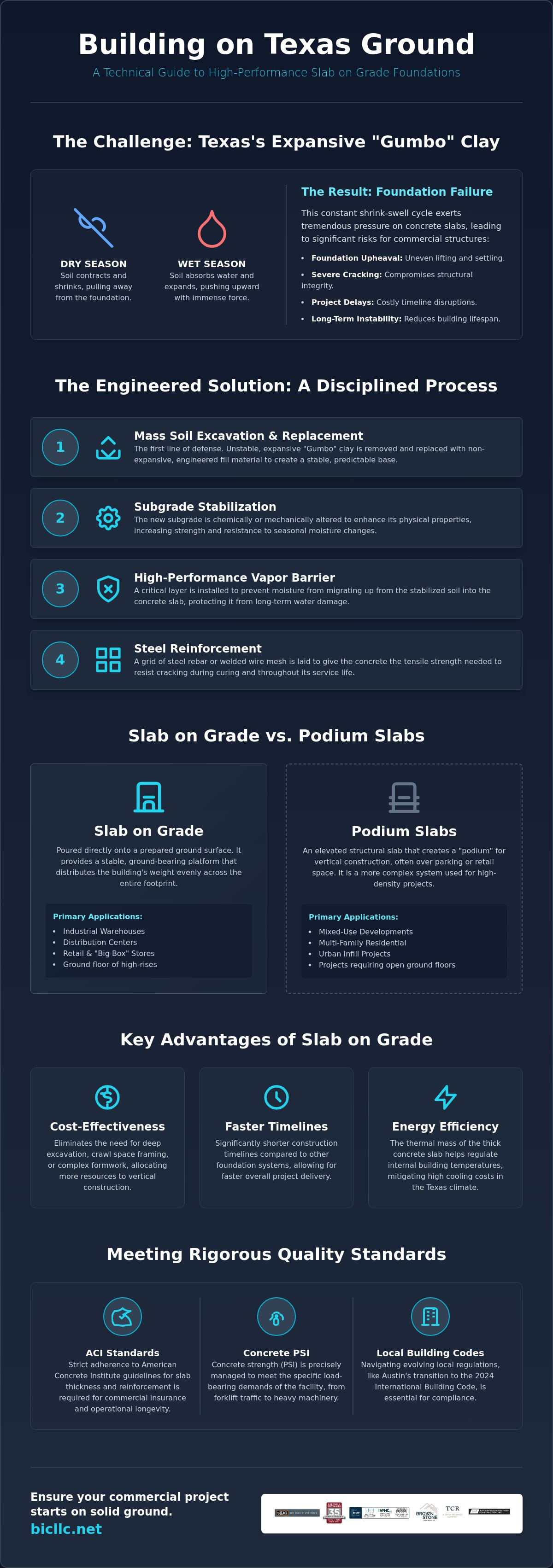
A Slab-on-grade foundation is a structural system where the concrete is poured directly onto a prepared soil surface. This method is the primary choice for commercial developments across the state because it offers a stable, ground-bearing platform that distributes weight evenly. In a region where soil movement is constant, professional slab on grade concrete services Texas provide the technical oversight needed to ensure these foundations don't fail under environmental pressure. It's a foundational choice that prioritizes long-term stability over temporary speed.
The structural integrity of a commercial slab relies on several critical components. A high-performance vapor barrier is installed to prevent moisture migration from the soil into the concrete. Reinforcement, typically through a grid of steel rebar or welded wire mesh, gives the slab the tensile strength required to resist cracking during the curing process and throughout its service life. For commercial and industrial loads, concrete PSI requirements are strictly managed to meet the specific demands of the facility. Adhering to the 2026 ACI (American Concrete Institute) standards is not just a matter of quality; it's a requirement for commercial insurance and operational longevity. These standards ensure that the slab's thickness and reinforcement are sufficient for the intended use.
Primary Applications for Slab on Grade in Commercial Construction
Industrial warehouses and distribution centers depend on slab on grade foundations to handle heavy machinery and high-volume forklift traffic. These slabs are often engineered with higher load-bearing capacities and specific jointing patterns to prevent edge spalling. Retail developments and "big box" stores also utilize this system for its ability to cover massive footprints efficiently. Additionally, these slabs serve as the base for more complex projects, including CIP (Cast-in-Place) midrise and high-rise structures, where the ground-level slab must support the weight of the entire vertical frame during the initial phases of construction.
The Advantages of Slab on Grade Over Alternative Foundations
Cost-effectiveness remains a primary driver for choosing slab on grade in Texas. Because there's no need for deep excavation for basements or complex crawl space framing, developers can allocate resources toward vertical construction. Construction timelines are significantly shorter, allowing for faster project delivery. From an operational standpoint, the thermal mass of a thick concrete slab helps regulate internal temperatures. This is a key factor in energy-efficient commercial building design, helping to mitigate the high cooling costs associated with the Texas climate.
Engineering Foundations for Texas’s Challenging Soil Conditions
Commercial construction in Texas faces a unique environmental adversary: the soil. In Houston and across the Gulf Coast, the prevalence of "Texas Gumbo," a highly expansive clay, presents a significant risk to structural integrity. These Blackland soils are known for high shrink-swell properties, where the ground expands when wet and contracts when dry. Without proper engineering, this movement leads to foundation upheaval and severe cracking. To mitigate these risks, high-performance slab on grade concrete services Texas must begin with a comprehensive earthwork strategy. Soil stabilization is the chemical or mechanical alteration of soil to enhance its physical properties for construction. By addressing the subgrade before the first yard of concrete is poured, we establish a stable platform that resists the seasonal shifts of the Texas landscape.
Mass soil excavation and replacement are often the first line of defense for large-scale commercial pads. This process involves removing the unstable clay and replacing it with engineered fill material that provides a consistent, non-expansive base. Integrating paving stabilization into the site preparation phase further secures the integrity of the subgrade, ensuring that the foundation and surrounding infrastructure function as a single, durable unit. This coordination between civil site work and structural pouring is what defines a steadfast build.
Soil Stabilization and Mass Excavation
Techniques such as lime or cement stabilization are essential for mitigating clay expansion. Lime is frequently used in the Houston area to chemically alter the clay particles, reducing their affinity for water and increasing the soil's load-bearing capacity. For large commercial footprints, mass excavation ensures that the entire building pad is uniform. Our teams prioritize achieving the precise moisture content and compaction density required by the project's geotechnical report. This methodical approach to site prep prevents the settlement issues that plague less disciplined builds. If you're planning a large-scale industrial project, coordinating these civil site services early is vital for long-term success.
Reinforcement Strategies: Rebar vs. Post-Tensioning
Choosing the right reinforcement method is a critical engineering decision. Post-tension slabs are often favored in active soils because they use high-strength steel cables to compress the concrete, providing superior crack control and flexibility. Conversely, traditional rebar reinforcement remains the standard for heavy-duty industrial loading where the slab must support concentrated weights from racking or machinery. Both systems must be meticulously integrated with the broader structural concrete framing to ensure the foundation can withstand both vertical loads and lateral environmental pressures.
Slab on Grade vs. Podium Slabs: Choosing the Right Structural System
Determining the most efficient structural foundation system requires a clear understanding of the project's vertical requirements and site density. While slab on grade serves as the baseline for ground-level construction, podium slabs offer a structural alternative for multi-level developments. For developers evaluating slab on grade concrete services Texas, the choice often rests on whether the building is expanding horizontally across a large acreage or vertically within constrained urban limits. Slab on grade remains the standard for sprawling Texas developments because it utilizes the earth's bearing capacity directly, minimizing the need for complex structural framing or suspended reinforcement.
Cost analysis consistently shows that slab on grade is the most economical choice for large-scale footprints. It avoids the intensive labor and material costs associated with elevated decks, such as the extensive shoring and specialized formwork required for suspended concrete. However, as land prices in metropolitan areas like Houston and Austin rise, developers frequently transition to more complex systems to maximize their investment. When a project requires a mix of retail on the ground floor and residential units above, partnering with a seasoned podium slab contractor Houston becomes necessary. These professionals handle the transfer of structural loads between different building uses, ensuring the transition from a ground-bearing slab to an elevated structural deck is seamless and safe.
When to Choose Slab on Grade
Slab on grade is the ideal solution for single-story industrial facilities, distribution centers, and large-scale retail hubs. These projects typically have the benefit of site acreage that allows for horizontal expansion rather than vertical stacking. In environments where heavy machinery or high-density storage is required, the slab's direct contact with the subgrade provides the necessary support for massive point loads. Distribution centers in the logistics corridors of Texas rely on this system for its durability and the speed at which a large-scale pad can be delivered. It's the steadfast choice for projects where the primary goal is maximizing ground-level square footage and operational efficiency.
The Role of Podium Slabs in Midrise Construction
Podium slabs are essential for navigating the urban constraints of modern Houston and Austin. These elevated structural decks allow for the integration of parking structures directly beneath residential or office spaces, maximizing the utility of a smaller parcel of land. From a technical perspective, these slabs require meticulous engineering to serve as a rigid foundation for the CIP midrise or high-rise frame above. While more complex than ground-level pours, they provide the structural stability required for the density of high-growth Texas cities. Selecting this system is a strategic decision based on project density, zoning requirements, and the need for multi-functional space.
Selecting a Commercial Concrete Contractor: Safety, Integrity, and Efficiency
Selecting a partner for high-performance foundations requires looking beyond a bottom-line figure. Safety protocols serve as the primary indicator of a contractor's operational discipline. In the demanding environment of large-scale construction, slab on grade concrete services Texas must be executed with a focus on professional stability and long-term viability. A crew that doesn't prioritize a secure job site is far more likely to ignore the rigorous technical specifications required for a durable foundation. This commitment to high standards is what separates a seasoned expert from a temporary workforce.
Technical capacity is another pillar of reliability. You should evaluate whether a contractor owns and maintains their own mass excavation fleet. Delivering efficient slab on grade concrete services Texas requires modern technology and disciplined equipment management. Relying on third-party equipment rentals introduces unnecessary risks to project timelines. When a contractor possesses their own machinery, they maintain full control over scheduling and maintenance, ensuring that site preparation is completed without external delays. This operational precision is vital for meeting the tight schedules of 2026 developments.
Integrity remains the core of every successful project. This means strictly following ACI standards for curing times and vapor barrier installation. Shortcuts in these areas might save a few hours today, but they lead to moisture issues and structural failures tomorrow. A steadfast partner understands that the enduring nature of their work is their greatest asset. If you're looking for a dependable foundation for your next build, contact our team of structural experts to discuss your specific requirements.
The Value of Integrated Civil Site Work
Reducing friction on a job site starts with consolidated management. Hiring a single contractor to handle mass excavation, underground utilities, and concrete placement eliminates the common conflicts between separate crews. This turn-key civil approach ensures that the subgrade is perfectly prepared for the specific requirements of the slab. It also streamlines the installation of storm sewers and sanitary lines, ensuring they're correctly positioned before the foundation work begins. This level of coordination prevents the delays that often arise when site prep and slab crews aren't aligned.
Safety and Compliance Standards
Operational safety is quantified through a contractor’s Experience Modification Rate (EMR). A low EMR demonstrates a consistent history of safe practices and professional stability. Beyond site safety, compliance with Texas-specific environmental regulations is a necessity. This includes the meticulous management of detention ponds and runoff to meet local municipal codes. We maintain transparent communication throughout the process, providing project management that keeps you informed of every milestone and regulatory check. This organized approach creates a sense of security for developers and general contractors alike.
Born Integrated Construction: Steadfast Slab on Grade Solutions
Born Integrated Construction stands as a steadfast leader in the Texas structural concrete market. We prioritize reliability and professional stability in every project, providing a foundation that developers can trust for the long term. Our operations span the major growth corridors of the Texas Triangle, including Houston, Dallas, San Antonio, and Austin, alongside rapidly developing hubs like Conroe. We understand that high-performance slab on grade concrete services Texas require more than just a standard pour; they require a disciplined management of the entire civil and structural lifecycle. This commitment to high standards ensures that our professional output remains viable for decades.
By positioning our approach as "Integrated," we solve the coordination challenges that frequently derail multi-phase developments. We don't just wait for the site to be ready; we actively manage the transition from raw earth to finished slab. This eliminates the technical gaps between excavation and concrete placement, ensuring that the structural integrity of the foundation is never compromised by poor site preparation or misaligned schedules. Our voice is that of a quiet leader who leads through proven results and unwavering consistency across every square foot of concrete we place.
Comprehensive Concrete and Civil Capabilities
Our expertise extends from mass soil excavation to the execution of complex CIP midrise foundations. We provide a full suite of civil services, including the construction of detention ponds, retaining walls, and paving stabilization. This breadth of capability allows us to deliver cost-effective foundations for residential, commercial, and large-scale infrastructure projects. We recognize that the relationship between mass soil excavation and slab performance is absolute. By maintaining control over the earthwork, we ensure the subgrade meets the exact moisture and density requirements necessary for a successful slab on grade concrete services Texas application. This integrated oversight prevents the settlement issues that often arise when these phases are managed by separate, uncoordinated entities.
Partnering for Success in 2026 Developments
Success in 2026 developments requires a partner who values substance over style. Our attentive service and established vendor relationships provide a direct benefit to your project's bottom line by ensuring material consistency and predictable timelines. We focus on the meticulous management of details, from safety protocols to the precise timing of material deliveries. This commitment to operational excellence ensures that your project remains on schedule and within its technical specifications. If you're planning an upcoming development, we invite you to request a consultation to see how our disciplined approach can secure your project's future.
Contact Born Integrated Construction for a project-based quote.
Securing the Future of Your Texas Development
A reliable foundation is the result of disciplined execution and technical foresight. By integrating site preparation with structural pouring, you eliminate the risks associated with uncoordinated project phases and expansive soils. We've explored the necessity of mass excavation for stability and the strategic selection of structural systems to meet the density requirements of modern urban centers. Delivering high-performance slab on grade concrete services Texas requires a partner who values substance and operational precision over temporary speed.
Born Integrated Construction provides the professional stability needed for complex, multi-phase builds. Our team specializes in CIP garages and high-rise foundations, offering integrated turn-key civil and concrete expertise across Houston, Austin, Dallas, and San Antonio. We maintain a deep-rooted commitment to high standards, ensuring that every foundation we pour supports the long-term viability of your investment. It's time to build with a partner who understands the intricate demands of the Texas landscape and possesses the technical capacity to deliver consistent results.
Partner with Born Integrated Construction for Your Next Texas Project
Frequently Asked Questions
What is the typical thickness of a commercial slab on grade in Texas?
Commercial slabs on grade typically range from 6 to 8 inches in thickness, though industrial facilities requiring high load-bearing capacity often exceed 10 inches. The final depth is determined by the facility's intended use and the structural loads it must support. Engineering specifications also account for the subgrade's quality to ensure the concrete remains stable under pressure.
How does Texas soil impact the cost of slab on grade construction?
The prevalence of expansive clay soils across the state requires more intensive site preparation and earthwork, which increases the initial project investment. Because these soils shift with moisture changes, developers must account for the cost of soil replacement or chemical stabilization. These preparatory steps are essential investments that prevent expensive structural repairs and foundation failures later in the building's lifecycle.
What is the difference between a slab on grade and a floating slab?
A slab on grade is a structural foundation poured directly on prepared soil, while a floating slab is a specific type of slab on grade that is not anchored to a perimeter foundation. Floating slabs are generally reserved for smaller, non-structural buildings. In commercial construction, slab on grade concrete services Texas involve reinforcing the slab and often tying it into the broader structural frame for maximum stability.
How long does it take for a commercial concrete slab to cure before building can begin?
Most commercial slabs require a curing period of 7 to 14 days before light construction activity can commence on the surface. While concrete reaches its full design strength at 28 days, vertical framing can often begin once the slab achieves a specific percentage of its rated PSI. We monitor the curing process closely to ensure the foundation is structurally sound before any vertical loads are applied.
Do I need soil stabilization for a commercial concrete parking lot in Houston?
Yes, soil stabilization is a standard requirement for commercial parking lots in the Houston area due to the "Texas Gumbo" clay. Without lime or cement stabilization, the pavement will likely suffer from upheaval and premature cracking as the soil expands. Professional slab on grade concrete services Texas prioritize this stabilization phase to ensure the parking surface remains level and durable for years of heavy traffic.
Can a slab on grade foundation support a midrise building?
A slab on grade foundation can support a midrise structure when it is engineered as the base for a reinforced concrete frame or integrated with deep pier systems. For projects with higher density or underground parking requirements, a podium slab may be a more appropriate choice. The decision depends on the building's total weight, height, and the specific geotechnical reports for the site.
What reinforcement is best for heavy industrial slab on grade projects?
Heavy industrial projects typically utilize high-density rebar grids or post-tensioned cables to handle concentrated loads from machinery and racking. Fiber-reinforced concrete is also frequently used to improve the slab's impact resistance and minimize surface cracking. The choice of reinforcement is a critical engineering decision that ensures the floor can withstand the daily rigors of a high-volume industrial environment.
How does Born Integrated Construction handle underground utility coordination with slab work?
We manage underground utility coordination through our integrated civil site work phase, ensuring all plumbing and electrical lines are accurately placed before the pour. By handling both the earthwork and the concrete construction, we eliminate the communication errors that often occur between separate contractors. This disciplined approach ensures that all penetrations and conduits align perfectly with the structural slab's design.