
Commercial Concrete Paving Contractor in San Antonio: Buying Guide

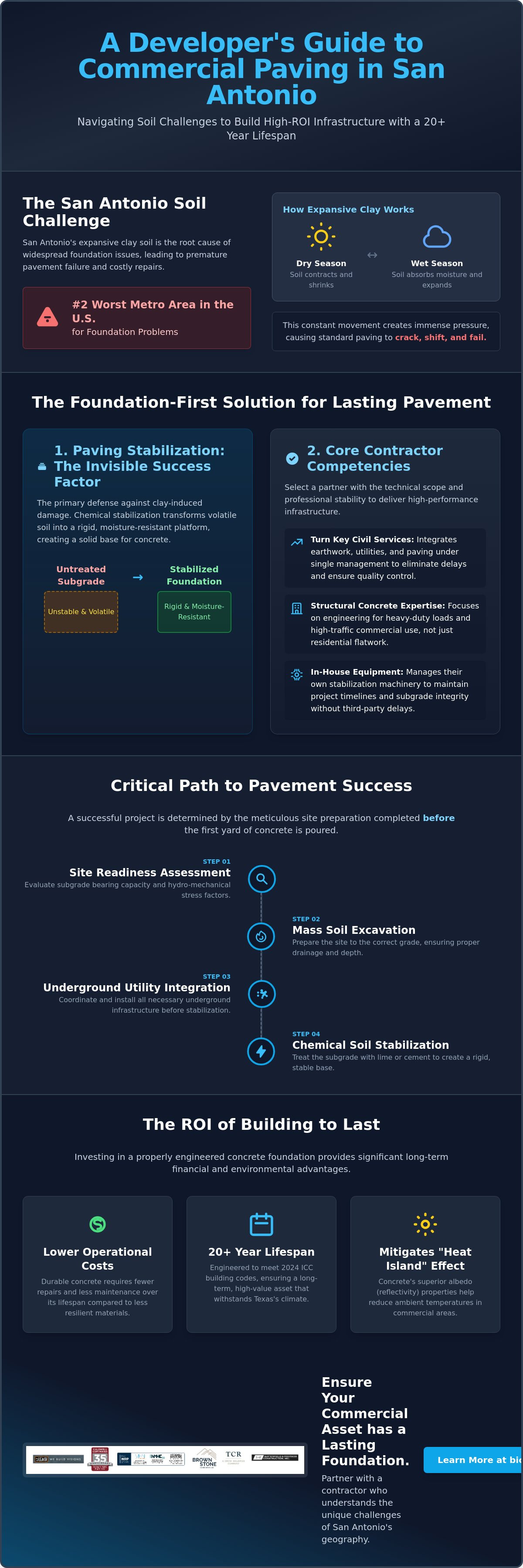
San Antonio currently ranks as the second-worst metropolitan area in the United States for foundation problems. This statistic isn't a reflection of poor intent, but rather a direct consequence of the expansive clay soil that defines our local geography. When you're searching for a concrete paving contractor San Antonio developers can trust, the primary concern isn't just the concrete mix; it's the stability of the ground beneath it. You likely already know that standard paving methods often fail in this region, leading to premature cracking, uncoordinated utility delays, and significant infrastructure costs.
This 2026 buying guide provides the technical framework necessary to evaluate and select a partner capable of delivering heavy-duty, high-ROI infrastructure. You'll learn how to identify a contractor who prioritizes structural integrity and professional stability for high-traffic commercial areas. We will examine the critical role of soil stabilization, the necessity of turnkey site preparation, and how to ensure your project aligns with the latest 2024 ICC building codes to achieve a lifespan of 20 years or more. Our focus is on providing the clarity you need to establish a lasting foundation for your commercial assets.
Key Takeaways
- Understand how San Antonio’s expansive clay soils necessitate specialized stabilization techniques to prevent premature pavement failure and structural instability.
- Learn how to evaluate a concrete paving contractor San Antonio developers rely on by reviewing their capacity for Turn Key Civil services and structural concrete expertise.
- Discover the long-term financial advantages of concrete, including lower operational expenditures and its ability to mitigate the local "heat island" effect through superior albedo properties.
- Identify the critical project milestones, such as mass soil excavation and underground utility integration, that must be completed before the first yard of concrete is poured.
- Gain insights into why a partner committed to professional stability and meticulous site readiness is essential for delivering high-ROI commercial infrastructure.
Table of Contents
-
Core Competencies of a Professional Concrete Paving Contractor
-
Concrete vs. Asphalt: Evaluating Lifecycle Costs for Texas Developments
-
Steps to Ensure a Successful Concrete Paving Project in San Antonio
-
Why Born Integrated Construction is the Partner for San Antonio Infrastructure
Navigating San Antonio Soil Challenges for Concrete Paving
San Antonio is built on some of the most volatile soils in the United States. The region's geography is dominated by Eagle Ford Shale and various Blackland Prairie clays that possess high plasticity. These soils expand significantly when they absorb moisture and contract during the intense droughts typical of South Texas. This constant movement exerts immense upward and downward pressure on any structure built upon it. A standard Asphalt Concrete surface or a generic concrete specification often fails because it doesn't account for this subsurface volatility. When selecting a concrete paving contractor San Antonio businesses must prioritize a partner who understands that a project's success is determined by the earthwork and site preparation performed before the first yard of concrete is poured.
Commercial paving is not merely a larger version of residential flatwork. It's a structural element designed to withstand thousands of load repetitions from heavy freight and delivery vehicles. Residential projects rarely account for the subgrade's bearing capacity or the long-term impact of hydro-mechanical stress. In contrast, commercial infrastructure requires a rigorous site readiness assessment and high-strength concrete mixes tailored to the specific environmental stressors of San Antonio. Without this engineering focus, even the highest quality concrete will succumb to the soil's natural movement.
The Impact of Expansive Clay on Commercial Pavement
The shifting nature of clay soil creates internal stress that manifests as surface cracking, joint separation, and eventually, structural failure. In San Antonio, commercial infrastructure demands structural concrete engineering rather than simple pouring. This often involves deep-ribbed slab designs or heavily reinforced sections to distribute heavy-duty traffic loads across unstable ground. For commercial-grade roads, the soil's plasticity index directly dictates the thickness and PSI requirements of the slab to prevent structural failure. Proper moisture control during the earthwork phase is also essential to ensure the soil doesn't reach its maximum swell potential after the pavement is in place.
Paving Stabilization: The Invisible Success Factor
Chemical soil stabilization is the primary defense against clay-induced damage. By treating the subgrade with lime or cement, we transform volatile soil into a rigid, moisture-resistant platform. This process of paving stabilization creates a consistent foundation that significantly extends the lifecycle of the pavement. A professional concrete paving contractor San Antonio depends on should manage their own stabilization equipment. This control ensures that the transition from earthwork to paving is seamless. It also prevents the subgrade from being compromised by weather delays or uncoordinated third-party schedules, maintaining the integrity of the professional output from the ground up.
Core Competencies of a Professional Concrete Paving Contractor
A qualified concrete paving contractor San Antonio developers partner with must demonstrate a technical scope that extends far beyond standard flatwork. While many firms can pour a sidewalk, few possess the specialized equipment and engineering staff required for heavy-duty structural slabs and Cast-in-Place (CIP) infrastructure. Evaluating a contractor's technical capacity involves looking at their history with high-load environments. A partner who understands the benefits of concrete pavement in a commercial context will prioritize the structural integrity of the slab over its cosmetic appearance. This technical depth ensures that the finished product can support the constant stress of heavy machinery and freight traffic without compromising the foundation.
The most effective infrastructure projects utilize a "Turn Key Civil" approach. This model integrates earthwork, mass soil excavation, and paving under a single point of management. When one firm handles the entire scope, the risks associated with uncoordinated utility phases and site preparation are significantly reduced. This organizational precision leads to higher project efficiency and a more predictable delivery schedule. It's a grounded, steadfast method that prioritizes professional stability over the fragmented nature of traditional subcontracting. Reliability in this industry is built on a foundation of established vendor relationships and a proven ability to manage complex logistics without interruption.
Structural vs. Ornamental Concrete Capabilities
Identifying the difference between a "finisher" and a structural concrete firm is vital for high-traffic developments. A contractor who operates with the engineering logic of a podium slab contractor Houston developers trust will bring a higher level of precision to San Antonio paving. Ornamental finishers often prioritize surface texture, but structural firms focus on precise mix designs and high-grade materials that meet specific PSI requirements for commercial loads. This focus on durability ensures the pavement remains functional for decades, rather than just a few years. Before signing a contract, verify that the firm has the internal capacity to manage structural concrete projects of significant scale.
Operational Efficiency and Safety Standards
Safety is a direct indicator of a contractor's operational discipline. A low Experience Modification Rate (EMR) isn't just a number; it's a reflection of a firm's commitment to protecting the project site and the client's insurance interests. A steadfast approach to safety prevents costly site shutdowns and legal complications that can derail a development. You should also inquire about a contractor's internal quality control (QC) process. A dependable concrete paving contractor San Antonio trusts will have documented procedures for testing slump, air content, and compressive strength on every major pour. This meticulous management of details is what separates a seasoned expert from a general laborer.
Concrete vs. Asphalt: Evaluating Lifecycle Costs for Texas Developments
Selecting the right material for a commercial development is often a decision between immediate cost savings and long-term structural stability. While asphalt typically presents a lower initial capital expenditure (CapEx), it necessitates a more frequent and costly cycle of operational expenditure (OpEx) for maintenance. A professional concrete paving contractor San Antonio developers rely on will frame this choice as a matter of lifecycle value. Concrete is not merely a surface; it's a rigid structural system designed to withstand decades of heavy-duty use. This endurance is particularly critical for logistics hubs and retail centers where the constant movement of heavy freight would rapidly degrade a less robust material.
The load-bearing capacity of concrete far exceeds that of asphalt. Asphalt is categorized as a flexible pavement, meaning it relies on the layers beneath it to support weight. Over time, this flexibility leads to deformation under heavy loads. Concrete, as a rigid pavement, distributes traffic loads over a much wider area of the subgrade. This fundamental difference in engineering ensures that concrete surfaces remain level and functional for 20 years or more with minimal intervention. It's a steadfast approach to infrastructure that prioritizes reliability and professional stability over short-term budget fixes.
The ROI of Concrete Paving in High-Traffic Areas
The "break-even" point for concrete often occurs much sooner than many developers anticipate. When you factor in the costs of asphalt sealcoating, patching, and resurfacing every five to seven years, concrete becomes the more economical choice by the second decade of service. Beyond maintenance, concrete parking lots enhance the overall property value of a development. The natural reflectivity of the material, known as the albedo effect, also provides a significant operational advantage. Concrete surfaces stay cooler than dark asphalt, which absorbs solar radiation and contributes to the San Antonio "Heat Island" effect. This reflectivity doesn't just lower ambient temperatures; it also reduces the energy required for site lighting. Developers can often achieve the same levels of visibility with fewer light fixtures, further improving the project's long-term ROI.
Durability in the Texas Heat
San Antonio’s climate presents a unique challenge for pavement. When temperatures exceed 100°F, asphalt binders soften, making the surface susceptible to "shoving" and "rutting" under the weight of heavy trucks. Shoving occurs when the surface ripples at intersections or loading zones, while rutting creates permanent depressions in travel paths. Concrete remains structurally sound regardless of the ambient heat. It also provides superior resistance to chemical spills, such as oil or fuel, which can dissolve the binders in asphalt. For 2026 and the years following, the structural integrity of concrete ensures that commercial infrastructure remains a durable asset rather than a recurring liability.
Steps to Ensure a Successful Concrete Paving Project in San Antonio
A successful project delivery in San Antonio is rarely the result of a single phase; it's the product of a methodical and disciplined sequence of operations. A concrete paving contractor San Antonio firms rely on must be more than a vendor of materials. They must act as a civil partner capable of managing the complex transition from raw land to a finished, high-traffic slab on grade. This process requires a grounded approach that prioritizes site readiness and the meticulous coordination of subsurface infrastructure before any pouring begins. Meticulous management during these early stages prevents the structural failures that often plague uncoordinated developments.
Managing the interface between horizontal paving and vertical elements, such as CIP garages or retaining walls, is equally vital. Precise elevation control and the careful placement of expansion joints ensure that different structural components work in harmony. This level of technical proficiency protects the long-term viability of the asset and maintains the professional stability of the entire site. For developers seeking a disciplined partner to manage these complexities, our Turn Key Civil solutions offer a streamlined path to a successful project delivery without the delays caused by fragmented subcontracting.
Site Preparation and Earthwork
Mass soil excavation serves as the fundamental first step in any professional paving contract. This phase involves the removal of organic materials and volatile topsoil to reach a competent subgrade that can support commercial weight. Achieving proper compaction and maintaining strict moisture control are essential to prevent the future settlement of the slab. Detention pond construction must be synchronized with the paving schedule to provide immediate runoff management and prevent subgrade saturation during the construction cycle. This synchronization ensures that the site remains stable and accessible, even during the unpredictable weather patterns of South Texas. Without this coordination, pooled water can compromise the subgrade's integrity before the concrete even cures.
Underground Utility Coordination
Installing concrete over poorly consolidated utility trenches is a common cause of premature pavement failure. Storm sewers, sanitary lines, and domestic water systems must be fully tested and backfilled to engineering specifications before paving commences. An "Integrated" contractor significantly reduces the risk of utility strikes and the expensive rework that occurs when different phases are uncoordinated. This is especially important when coordinating domestic water systems with fire lane paving requirements, as these areas must remain unobstructed and structurally sound for emergency vehicle access at all times. A steadfast focus on these "invisible" details is what defines a truly seasoned expert in the San Antonio market. Meticulous management of utility depths and backfill compaction ensures the slab above remains level for its entire intended lifespan.
Why Born Integrated Construction is the Partner for San Antonio Infrastructure
Establishing a reliable foundation for commercial growth requires more than just technical skill; it demands a partner who operates with unwavering integrity and professional stability. As a seasoned concrete paving contractor San Antonio developers can depend on, Born Integrated Construction prioritizes substance over style. We understand that the long-term viability of a project depends on the meticulous management of every detail, from the initial earthwork to the final structural pour. Our Turn Key Civil model ensures that every phase of your project is managed with operational precision, eliminating the friction often found in fragmented construction schedules.
Our diverse project scope allows us to support developments at every scale. Whether your project requires heavy-duty parking lot paving, post-tension slabs, or complex CIP midrise foundations, our team provides the technical proficiency required for high-traffic environments. We maintain strong, established relationships with local vendors to ensure material consistency and schedule reliability. This grounded approach to logistics allows us to deliver consistent value, ensuring that the structural integrity of your infrastructure remains uncompromised for decades to come.
A Steadfast Approach to Commercial Paving
Our history in Texas infrastructure is defined by a commitment to high standards and proven results. Developers choose us for high-stakes projects, such as CIP garages and structural concrete parking structures, because we value the enduring nature of our work. The Born Integrated promise isn't built on innovation for innovation's sake, but on a disciplined execution of the craft. We take pride in delivering cost-effective solutions that don't sacrifice quality for speed. Every project we undertake is an opportunity to reinforce our reputation as a quiet leader in the San Antonio market, leading through craftsmanship and unwavering consistency.
Ready to Start Your San Antonio Project?
Engagement with our team begins with a thorough understanding of your project's technical scope. We provide comprehensive, project-based fee estimates that reflect the true requirements of San Antonio’s unique soil and regulatory environment. Our service area is extensive, covering downtown San Antonio and extending to surrounding regions, including Boerne and New Braunfels. This regional expertise ensures that we're familiar with local building codes and environmental challenges specific to South Texas.
If you're seeking a concrete paving contractor San Antonio businesses trust for structural reliability and professional stability, we invite you to discuss your upcoming development with our team. We focus on building lasting foundations, both in the literal structures we pour and the professional partnerships we cultivate. Contact Born Integrated Construction today to secure a partner dedicated to the long-term success of your commercial infrastructure.
Securing the Future of Your San Antonio Infrastructure
Achieving a 20-year lifespan for commercial pavement in South Texas requires a disciplined approach to both engineering and execution. Success isn't found in surface-level aesthetics; it's found in the rigorous stabilization of expansive clay soils and the seamless integration of civil site work. By prioritizing structural concrete over flexible alternatives, you establish a high-ROI asset that resists the unique thermal and mechanical stresses of the region.
Selecting a concrete paving contractor San Antonio businesses can rely on is the most critical decision in the pre-construction phase. A partner who manages mass soil excavation, utility coordination, and structural pours under a single umbrella reduces operational risk and ensures project consistency. Born Integrated Construction provides this steadfast stability, specializing in CIP garages and structural concrete with a serious commitment to safety and operational precision. We invite you to partner with Born Integrated Construction for your next San Antonio project to ensure your infrastructure is built on a foundation of professional integrity. We look forward to establishing a durable, high-performance solution for your commercial development.
Frequently Asked Questions
Why is concrete paving preferred over asphalt for San Antonio commercial sites?
Concrete is preferred because it is a rigid pavement that does not soften under the intense South Texas heat. While asphalt binders can become pliable when temperatures exceed 100°F, concrete maintains its structural integrity and load-bearing capacity. This prevents the shoving and rutting commonly seen at San Antonio intersections and loading docks, providing a more stable surface for heavy-duty commercial traffic.
How long does a commercial concrete parking lot take to cure before use?
Most commercial slabs require approximately seven days of curing before they can support standard vehicle traffic. Achieving full design strength typically takes 28 days, though high-early strength mix designs can accelerate this timeline for critical access areas. A professional concrete paving contractor San Antonio developers trust will monitor compressive strength tests to ensure the pavement is ready for heavy freight without risking structural damage.
What is the ideal thickness for a heavy-duty concrete road in Texas?
Heavy-duty commercial roads typically require a thickness between 8 and 10 inches to support constant freight loads. The specific depth is determined by an engineering analysis of the expected traffic volume and the California Bearing Ratio of the stabilized subgrade. Thinner slabs, usually 6 inches, are often reserved for light-duty passenger vehicle parking where heavy truck traffic is restricted.
Can a concrete paving contractor also handle my site excavation and utility work?
Yes, contractors who provide Turn Key Civil services manage the entire scope from mass soil excavation to final paving. This integrated approach ensures that underground utilities and storm sewers are properly installed and compacted before the slab is poured. Centralizing these services under one firm reduces the risk of uncoordinated schedules and utility strikes, which are common causes of project delays.
What kind of maintenance does a commercial concrete lot require in San Antonio?
Maintenance for concrete is minimal and focuses primarily on joint sealing and moisture management. It's essential to inspect and reseal expansion joints every few years to prevent water from infiltrating the subgrade and causing soil expansion. Unlike asphalt, concrete does not require regular sealcoating or frequent resurfacing, which contributes to its superior long-term value for commercial property owners.
How does soil stabilization prevent concrete from cracking in South Texas?
Soil stabilization chemically modifies the expansive clay by introducing lime or cement to reduce its plasticity. This process creates a moisture-resistant, non-expansive platform that remains stable regardless of weather changes. By neutralizing the soil's tendency to swell and shrink, stabilization removes the primary source of upward pressure that causes concrete slabs to crack and shift in the San Antonio region.
What is the difference between cast-in-place and precast garage foundations?
Cast-in-place foundations are poured directly on the project site, creating a monolithic structure with superior structural continuity. Precast foundations involve components fabricated off-site and then assembled at the development. For multi-level parking structures in San Antonio, cast-in-place methods are often favored for their ability to integrate seamlessly with complex structural slabs and handle high-load requirements with greater precision.
Is concrete paving more expensive than asphalt in the long run?
Concrete is significantly more cost-effective over a 20-year lifecycle despite having a higher initial installation cost. Asphalt requires resurfacing and extensive repairs every five to seven years, which quickly exceeds the one-time investment of a durable concrete slab. When you partner with an experienced concrete paving contractor San Antonio firms rely on, you're investing in a permanent asset that minimizes recurring operational expenditures.