Commercial Concrete Paving in Austin TX: A Developer’s Buying Guide for 2026
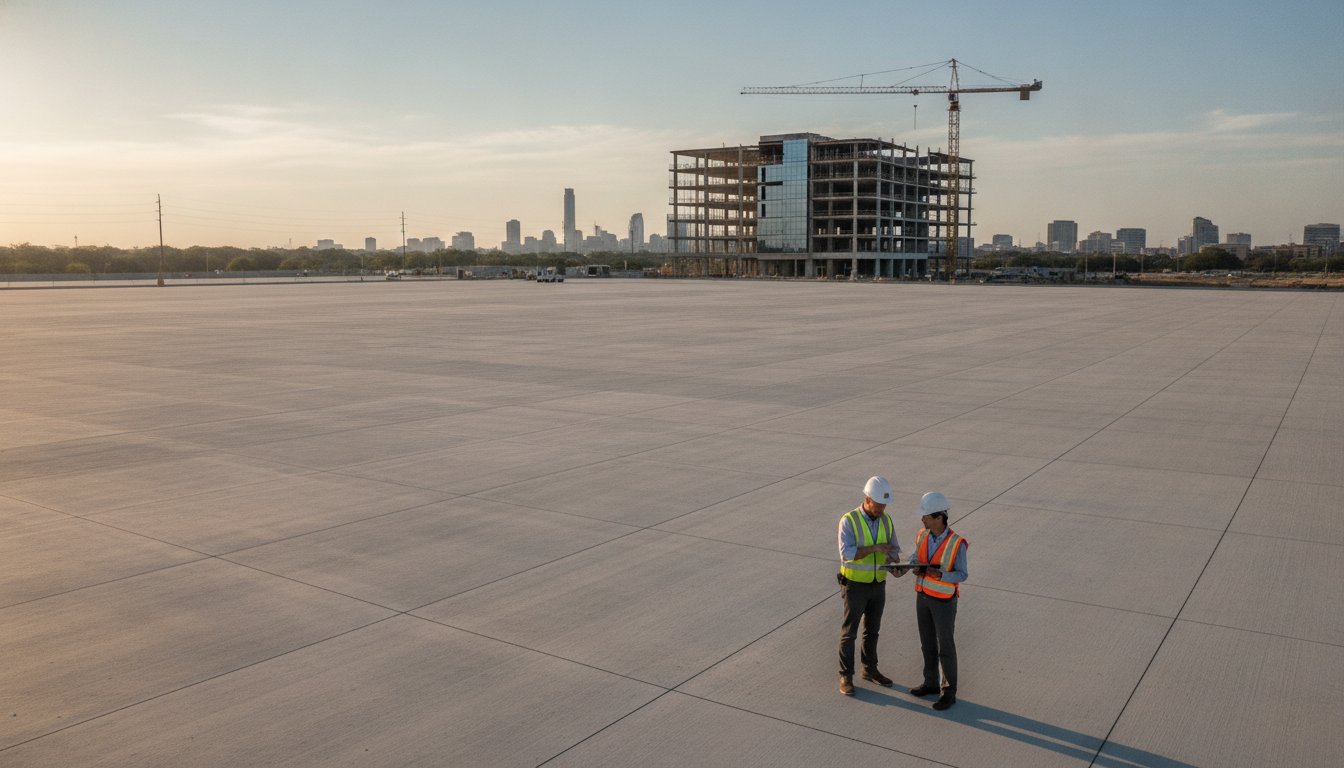
In the Austin development market, a pavement's failure isn't usually a surface issue; it's a structural one dictated by the expansive clay beneath the site. Selecting a partner for commercial concrete paving Austin TX requires more than a simple quote for material and labor. It demands a technical understanding of how soil stabilization and proper drainage prevent premature cracking and costly site failures. You're likely aware that the most expensive pavement is the one you're forced to replace after only five years of service.
We understand that a successful project relies on precision and a commitment to long-term viability. This guide provides the technical specifications and soil stabilization strategies needed to secure a 30-year return on investment and avoid the common pitfalls of Central Texas site work. We'll examine how to integrate your paving with detention requirements and broader civil infrastructure to ensure your project remains on schedule and structurally sound. You'll gain a clear path toward a durable, low-maintenance asset that serves as a permanent foundation for your commercial investment.
Key Takeaways
- Analyze the life-cycle costs and long-term financial advantages of choosing concrete over asphalt to achieve a 30-year durability standard.
- Determine the essential technical requirements for commercial concrete paving Austin TX, including the necessity of 4,000+ PSI mixes and advanced reinforcement.
- Understand the critical role of mass soil excavation and stabilization in managing the unique challenges of Austin’s expansive clay subgrades.
- Evaluate potential partners based on their experience with complex structural concrete projects and their commitment to verified safety protocols.
- Learn how integrating paving with site-wide civil work, such as detention ponds and earthwork, can improve overall project efficiency and reliability.
Evaluating Commercial Concrete Paving in Austin: The Long-Term ROI
Austin’s commercial landscape demands infrastructure that withstands both extreme thermal stress and high-volume traffic. While initial bids for asphalt often appear lower, a professional evaluation of commercial concrete paving Austin TX reveals a different financial reality. Concrete provides a rigid, durable surface that maintains its integrity for decades. Flexible pavements often succumb to the city's intense UV exposure and heavy loads within ten years. Selecting the appropriate pavement materials and construction methods is a foundational decision for any Austin developer. While asphalt is categorized as a flexible pavement, concrete acts as a rigid slab that distributes loads over a wider area of the subgrade.
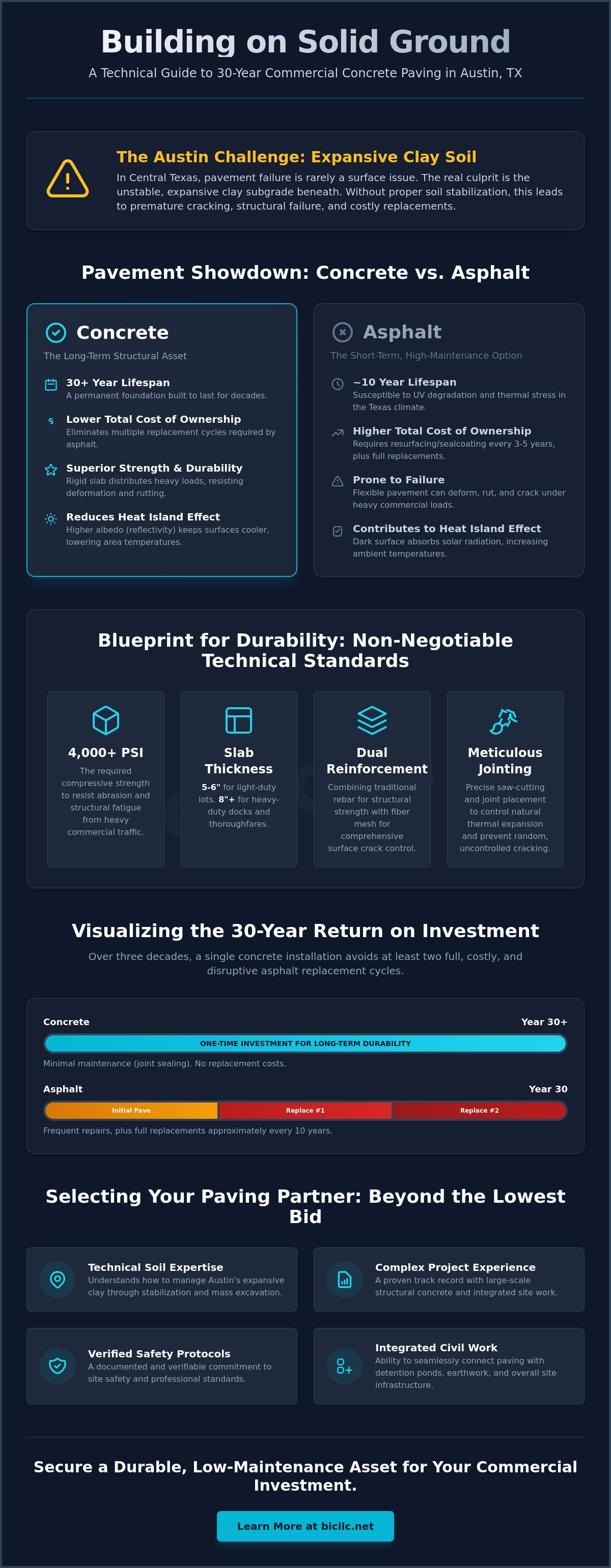
Concrete’s 30-year life cycle fundamentally changes the capital expenditure outlook for developers. Asphalt typically requires resurfacing and sealcoating every three to five years to combat oxidation and rutting. In contrast, concrete maintenance is largely limited to periodic joint sealing. This stability is critical for industrial hubs and loading docks. The shear forces of heavy machinery would otherwise deform a less resilient surface, leading to structural failure and safety hazards. Additionally, the "Heat Island" effect is a significant consideration in Central Texas. Lighter-colored concrete surfaces have a higher albedo, reflecting more solar radiation than dark asphalt. This choice reduces ambient temperatures around commercial structures, which can lower cooling costs for adjacent buildings.
Initial Investment vs. Total Cost of Ownership
When breaking down the cost-per-year over three decades, concrete’s value becomes clear. Austin’s climate causes rapid asphalt oxidation, leading to brittle surfaces and frequent repairs. Concrete’s controlled thermal expansion and high compressive strength ensure it remains a permanent asset. This longevity directly impacts property value. Prospective buyers recognize the reduced liability of a well-maintained concrete parking structure or lot, making it a superior choice for long-term viability.
Operational Efficiency and Reduced Downtime
A durable pavement solution prevents the business interruptions that accompany frequent maintenance cycles. Beyond structural benefits, concrete’s light-reflective properties improve site safety and reduce the demand for outdoor lighting. This operational efficiency contributes to a lower total cost of ownership while enhancing the professional appearance of the development. It's a matter of choosing a foundation that supports your operations without constant intervention. When measured over a 30-year lifespan, the return on investment for concrete paving is realized through the elimination of two full replacement cycles and the significant reduction of annual maintenance expenses compared to flexible pavement alternatives.
Technical Standards for Austin Commercial Concrete Roads and Parking
Establishing technical baselines for commercial concrete paving Austin TX ensures the structure survives the city's unique environmental pressures. We start with compressive strength. While standard mixes might suffice for residential work, 4,000 PSI is the non-negotiable baseline for commercial and industrial applications. This strength provides the necessary resistance to the abrasive forces of heavy delivery trucks and high-frequency traffic. It's a standard that prevents the surface scaling and structural fatigue common in lower-grade installations.
Strategic reinforcement is the next pillar of structural integrity. While fiber mesh offers benefits for controlling plastic shrinkage, traditional rebar remains the standard for high-stress areas. We often utilize a combination of both to provide comprehensive crack control. Proper slab thickness is equally vital. Light-duty parking areas typically require a 5-inch to 6-inch pour, whereas heavy-duty thoroughfares and loading docks often demand 8 inches or more to prevent shear failure. These specifications aren't suggestions; they're requirements for a pavement that doesn't fail under load.
Large-scale developments also require meticulous joint design. Without precise saw-cutting and joint placement, the slab will naturally relieve stress through random cracking. Following a Standard Practice for Concrete Pavement Construction ensures that these joints are placed at intervals that account for thermal expansion and contraction. This methodical approach to jointing protects the developer's investment by controlling where the concrete moves, rather than allowing it to break unpredictably.
Material Composition and Mix Design
The durability of Austin concrete is heavily influenced by the quality of local aggregates. We prioritize sources that offer low absorption rates to minimize the risk of damage during rare but intense Central Texas winter events. Air entrainment is another essential additive. It creates microscopic voids that allow for internal expansion without compromising the surface. Maintaining a consistent water-cement ratio and slump is paramount during the pour to ensure the final product meets the design's structural specifications.
ADA Compliance and Pedestrian Safety
A professional paving plan must integrate seamlessly with pedestrian infrastructure. This includes the precise placement of ADA-compliant ramps and sidewalks and flatwork. Surface finishes are chosen to balance professional aesthetics with slip resistance. A medium broom finish is often the preferred choice for commercial walkways, providing a safe, high-traction surface that complements the main paving project. If your project requires this level of technical precision, exploring our structural concrete solutions can help align your site work with long-term performance goals.
Why Site Preparation and Soil Stabilization are Non-Negotiable
Austin’s geological profile is the primary antagonist of durable infrastructure. For projects involving commercial concrete paving Austin TX, the site's success is determined months before the first mixer truck arrives. The expansive clay soils characteristic of the Blackland Prairie swell and shrink significantly with moisture changes, exerting immense upward pressure on rigid slabs. Without proper mass soil excavation and subgrade treatment, even the highest-quality concrete will eventually buckle. We view site preparation as a structural requirement, not a mere preliminary task.
Establishing a stable subgrade often requires chemical stabilization. Depending on the soil's specific chemical makeup, we utilize lime or cement to neutralize the soil's reactive properties. This process creates a rigid, semi-impermeable layer that protects the pavement from the cyclical movement of the underlying earth. It's a standard practice supported by organizations like the American Concrete Institute certifications and guidelines, which emphasize that a pavement is only as reliable as the ground supporting it. Proper execution here prevents the "ghosting" of cracks that often appear when surface-level repairs ignore the underlying soil issues.
The Foundation of Paving Longevity
Paving stabilization represents the most critical phase of the construction schedule. If the sub-base is compromised by poor drainage or insufficient compaction, the concrete above it will lack uniform support. This leads to sub-base erosion and eventual structural failure. We ensure site readiness by verifying that every square foot of the subgrade meets the project's engineering requirements. This disciplined approach eliminates the variables that lead to premature cracking and costly post-construction repairs. It's about establishing a predictable environment for the concrete to cure and perform.
Integrated Civil Solutions
Longevity is a product of how well the paving integrates with the site’s broader civil infrastructure. Coordinating the installation of underground utilities and storm sewers is essential to prevent future excavation that would compromise the new pavement. The construction of detention ponds must be synchronized with the paving schedule to manage runoff and mitigate hydrostatic pressure. Injecting lime into high-plasticity clay initiates a chemical reaction that reduces the Plasticity Index (PI) by as much as 15 to 20 points, transforming an expansive soil into a stable, workable foundation. This level of coordination ensures that water is moved away from the pavement structure, preserving the integrity of the sub-base for the duration of its 30-year design life.
Selecting an Austin Paving Partner: Beyond the Lowest Bid
Selecting a contractor for commercial concrete paving Austin TX involves more than reviewing a line-item bid. In a market defined by rapid growth and geological volatility, the lowest price often masks a lack of technical depth. A developer's risk is mitigated by partnering with a firm that views paving as an extension of structural engineering rather than a simple finishing trade. This requires verifying a contractor's safety record through EMR ratings and assessing their ability to self-perform complex tasks like mass soil excavation. When a contractor owns their equipment and manages their own crews, they maintain tighter control over the project timeline and the quality of the final product.
Proficiency in paving is often a byproduct of a contractor's broader expertise in structural concrete. If a firm successfully executes complex podium slab construction or multi-level CIP garages, they possess the logistical discipline required for high-performance paving. These projects demand precise management of reinforcements and mix designs that exceed the requirements of standard flatwork. A partner who manages the entire vertical and horizontal concrete scope reduces the friction of handoffs between different trades. This continuity is essential for maintaining the structural standards established during the site preparation phase.
Structural Expertise and Integrated Services
Consolidating site work, foundations, and paving under a single entity ensures continuity of responsibility. When one firm handles the mass soil excavation and the final pour, there is no ambiguity regarding subgrade readiness or compaction standards. This integrated approach is particularly beneficial for mixed-use developments where paving must transition smoothly into structural podium decks or retaining walls. It establishes a single point of accountability for the project's structural integrity, ensuring that the foundation and the surface perform as a unified system.
Efficiency and Project Management
Meeting the aggressive 2026 development schedules in Austin requires proactive site management and robust vendor relationships. A contractor with established supply chains can better navigate material lead times and labor shortages that often stall smaller operations. Integrity in change-order management and transparent billing practices are just as vital as technical skill. We believe that professional stability is demonstrated through a consistent safety record and a history of delivering multi-phase infrastructure projects on time. For a partner committed to these standards, you can view our full range of turnkey civil and concrete services to see how we manage large-scale site requirements.
Born Integrated Construction: Steadfast Paving Solutions for Austin
Born Integrated Construction operates with a commitment to stability that mirrors the structures we build. For developers seeking commercial concrete paving Austin TX, we provide a unified operational model that eliminates the fragmentation common in large-scale civil projects. Our scope is comprehensive, encompassing everything from initial mass soil excavation and earthwork to the final placement of structural concrete. We understand that in the Austin market, reliability is the most valuable currency. By self-performing critical phases of the work, we maintain a level of precision and safety that fragmented management simply cannot replicate.
Our approach is rooted in the belief that every paving project is a structural challenge. Whether we're constructing heavy-duty roads for industrial hubs or intricate parking structures, our team applies the same rigorous standards used in high-rise foundations. This ensures that your investment is protected from the environmental and operational stresses unique to Central Texas. We don't just deliver a surface; we establish a permanent asset designed for a 30-year operational life. This focus on durability and technical proficiency is why Austin developers depend on our integrated civil and concrete solutions.
The BIC Difference: Precision and Reliability
The technical proficiency we bring to complex projects, such as multi-level CIP garages and podium slabs, directly informs our paving quality. We've proven our performance across various infrastructure needs, maintaining a steadfast commitment to safety and operational integrity. Our relationships with local vendors and customers are built on transparency and consistent delivery. This professional stability allows us to navigate the complexities of the 2026 development landscape with confidence, ensuring your project remains on schedule and within its technical specifications.
Partnering for Your Next Austin Development
A successful development begins with a partner who understands the relationship between site stabilization and long-term durability. We consult on every phase of the civil work, ensuring that drainage, detention ponds, and soil preparation are perfectly aligned with the final paving plan. This integrated perspective streamlines the transition from raw earth to finished structural concrete, reducing the risk of delays and cost overruns. If you're planning a project and require a partner who values substance and execution, we invite you to request a consultation for your Austin commercial paving project. Together, we can build a foundation that lasts for decades.
Securing Your Project’s Long-Term Viability
Austin’s development landscape in 2026 requires more than surface-level solutions. A successful project involving commercial concrete paving Austin TX relies on the synergy between precise soil stabilization and high-strength material specifications. By prioritizing a 30-year life cycle over lower initial bids, you ensure your infrastructure remains a permanent asset rather than a recurring liability. We've explored how 4,000 PSI concrete and integrated drainage systems protect your site from the city's unique geological pressures.
Born Integrated Construction stands as a dependable partner for developers who value operational precision and technical proficiency. We are specialists in CIP structural concrete and heavy-duty paving, providing integrated civil site work and utility capabilities that streamline complex schedules. Our steadfast commitment to safety and project integrity ensures your development is built on a foundation of reliability. We look forward to helping you establish a lasting legacy in Central Texas through meticulous execution and unwavering standards.
Request a Professional Quote for Your Austin Paving Project
Frequently Asked Questions
Why is concrete paving preferred over asphalt for Austin commercial projects?
Concrete is preferred primarily for its 30-year design life and its superior resistance to Central Texas heat. It acts as a rigid slab that distributes weight across a broad area, preventing the rutting and surface deformation common in flexible asphalt. While asphalt requires resurfacing every few years due to UV damage, concrete remains structurally sound with minimal intervention.
How does soil stabilization affect the cost of commercial paving in Texas?
Soil stabilization represents an upfront investment that prevents the far greater expense of premature structural failure. By treating reactive clay with lime or cement, developers establish a predictable platform that protects the slab from the region's intense soil movement. This step is a technical necessity for ensuring the long-term ROI of commercial concrete paving Austin TX.
What is the typical thickness for a commercial concrete parking lot?
Standard commercial parking lots typically require a slab thickness of five to six inches for light-duty traffic. Areas designated for heavy-duty use, such as loading docks or fire lanes, often demand eight inches or more to support the weight of industrial vehicles. These specifications are determined by engineering requirements and the load-bearing capacity of the stabilized subgrade.
How long does a commercial concrete paving project take to complete in Austin?
Project timelines vary by site size, but a multi-phase installation often spans several weeks from initial excavation to the final cure. This duration includes time for mass soil excavation, stabilization, and the essential seven-day curing period required before the surface can support heavy vehicle traffic. Proper coordination with civil site work is the most effective way to maintain an efficient schedule.
Can concrete paving be integrated with detention pond construction?
Yes, integrating paving with detention pond construction is a standard practice that improves site drainage and overall infrastructure reliability. By managing stormwater runoff through integrated civil solutions, developers protect the pavement's sub-base from water infiltration and hydrostatic pressure. This coordination ensures that the entire site functions as a unified system for the duration of its operational life.
What are the maintenance requirements for commercial concrete paving?
Maintenance is minimal and focuses primarily on periodic joint sealing to prevent water from reaching the subgrade. Unlike asphalt, which requires frequent sealcoating and resurfacing, concrete only needs occasional inspections to ensure the joints remain intact. This low-maintenance profile significantly reduces the total cost of ownership for commercial assets over several decades.
How do you handle paving on the expansive clay soil common in Austin?
Managing expansive clay requires a disciplined approach to mass soil excavation and chemical stabilization. We remove reactive materials and treat the remaining subgrade with lime to reduce its plasticity index, creating a non-reactive foundation. This process prevents the seasonal swelling and shrinking that would otherwise compromise the integrity of the commercial concrete paving Austin TX.