Midrise Concrete Construction in Texas: 2026 Trends and Structural Advantages
In 2026, choosing combustible materials for Texas developments is no longer a design preference; it's a financial liability that many developers can't afford to carry. You've likely felt the pressure of rising insurance premiums and the difficulty of finding specialized framing crews in a market where skilled labor remains scarce. Between the constant threat of foundation movement from expansive soils and the demand for higher urban density, the traditional path to project completion feels increasingly fragile. This article demonstrates why concrete is now the strategic standard for midrise concrete construction Texas, offering a path to lower long-term maintenance and superior fire ratings for tenants.
You'll discover how to navigate the 2026 regulatory landscape, including the adoption of the 2024 International Building Code, and why structural concrete provides the steadfast reliability your investment requires. We will examine the specific structural advantages of cast-in-place systems and how they mitigate the most persistent risks in the current Texas market. By focusing on durability and operational precision, you can establish a project that maintains its value well beyond the initial construction phase.
Key Takeaways
- Analyze the market forces driving urban densification and why institutional investors are prioritizing concrete assets for long-term stability in 2026.
- Examine the structural advantages of midrise concrete construction Texas, including its ability to withstand Gulf Coast wind loads and provide superior sound isolation for luxury tenants.
- Compare the technical efficiencies of Podium Slabs and Cast-in-Place solutions to determine the most effective structural system for multi-story residential and hotel developments.
- Discover how non-combustible construction helps developers manage the 2026 insurance crisis and ensure full compliance with the updated 2024 International Building Code.
- Learn how integrating earthwork with structural concrete services can reduce project timelines and mitigate risks associated with expansive Texas clay soils.
The Shift Toward Mid-Rise Concrete in Texas: 2026 Market Drivers
The Texas construction market is currently undergoing a fundamental transformation. For decades, the state was defined by horizontal expansion and garden-style wood-frame apartments. In 2026, the economic and regulatory environment favors verticality. Major metropolitan centers like Austin and Houston are seeing a rapid increase in taller mid-rise profiles that range from six to ten stories. The change isn't merely aesthetic. It's a calculated response to land scarcity and the need for higher urban density. Structural concrete provides the necessary stability to support these taller structures while maintaining a footprint that fits within constrained urban lots.
Institutional investors have led this "flight to quality." They recognize that concrete assets offer a level of permanence that alternative materials can't match. In the 2026 market, where insurance premiums for combustible construction are reaching record highs, concrete represents a secure investment. It's a reliable hedge against rising operational costs. The shift toward mixed-use developments also plays a role. Integrating retail on the ground floor with residential units above requires the strength and fire separation that only structural concrete can deliver. This integration supports the "lock-and-go" semi-urban lifestyle that's increasingly popular among Texas professionals who value walking proximity to amenities.
Urban Infill and the Demand for Density
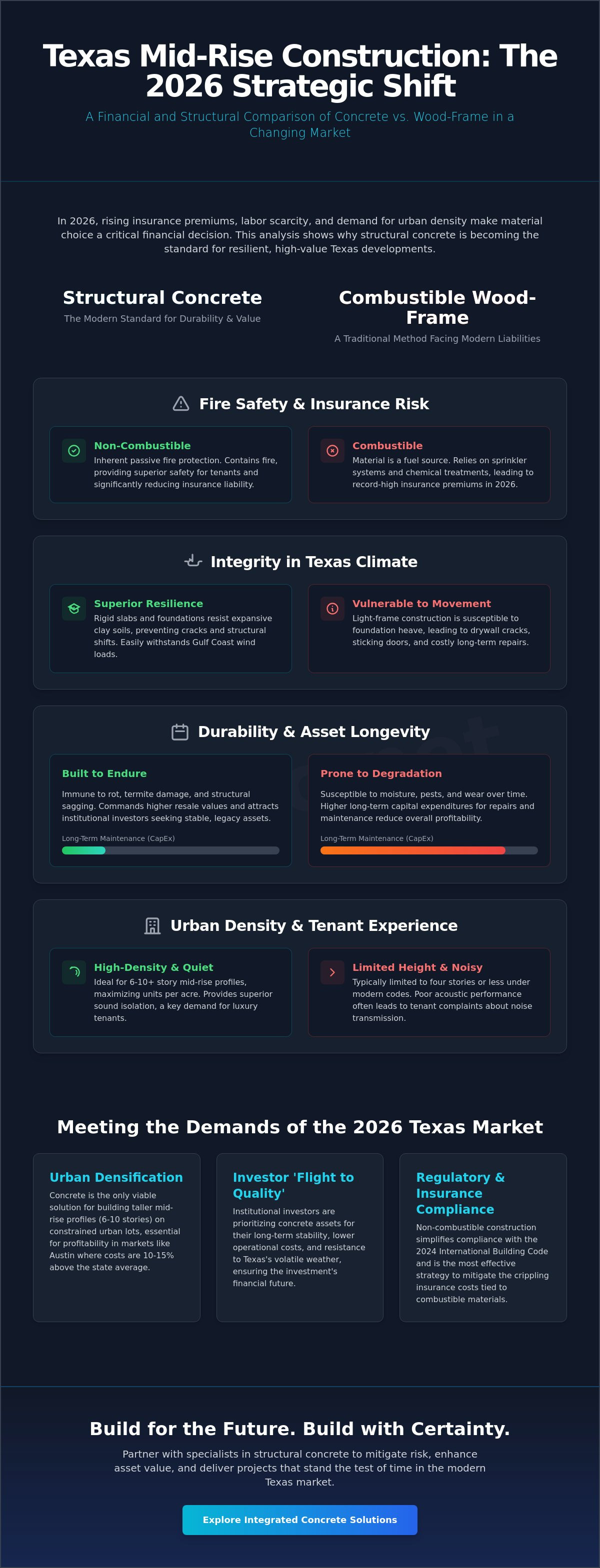
The transition from sprawling garden-style complexes to high-density infill projects is a direct response to the 2026 economic reality. In Austin, where construction costs are 10-15% above the state average, developers must maximize units per acre to remain profitable. Concrete enables this density by allowing for more stories and tighter building envelopes. It also simplifies compliance with 2026 municipal zoning requirements that often mandate non-combustible materials for buildings exceeding four stories. When planning these developments, engineers often reference common concrete slab designs to determine the best approach for ground-bearing and suspended structures. This technical precision ensures that the building can support the increased loads of a ten-story profile without compromising the integrity of the site.
Investor Sentiment and Asset Longevity
Concrete structures command higher resale values in the Texas market because they're built to endure. Property managers find that the long-term capital expenditure (CapEx) for concrete buildings is significantly lower than that of wood-frame alternatives. There's no risk of rot, termite damage, or significant structural sagging over time. This durability is particularly important given the weather volatility seen across the state. From Gulf Coast hurricanes to North Texas hailstorms, concrete provides a level of protection that safeguards the investment. For those involved in midrise concrete construction Texas, the focus is on creating a legacy asset that remains functional and attractive for decades. The stability of concrete doesn't just protect the building; it protects the financial future of the development.
Structural Superiority: Concrete vs. Wood-Frame in the Texas Climate
Texas environmental conditions demand a structural response that exceeds basic code compliance. While light-frame construction remains common for low-density projects, midrise concrete construction Texas offers a level of stability that wood cannot replicate. This is especially true when dealing with the state's notorious expansive clay soils. Concrete slabs and deep pier foundations provide a rigid base that resists the seasonal heave and contraction of the earth. This structural integrity prevents the cosmetic and functional failures, such as cracked drywall or sticking doors, that often plague lighter buildings over time.
Fire safety remains a primary concern for developers in 2026. Concrete is naturally non-combustible. It provides a passive fire protection system that doesn't rely solely on mechanical sprinklers or chemical treatments. This inherent safety simplifies the design process and ensures long-term security for occupants. For those seeking reliable structural concrete solutions, the shift toward non-combustible materials is a matter of professional responsibility and risk management.
High-Wind Performance and Coastal Resilience
Coastal regions and tornado-prone areas of North Texas require exceptional lateral load resistance. The 2024 International Building Code, adopted by several Texas building codes jurisdictions, introduces more stringent requirements for wind and tornado loads in certain high-risk zones. Concrete structures provide the mass necessary to remain steadfast during extreme weather events. Wind-load resistance in concrete structures is achieved through the inherent mass and stiffness of the material, which effectively counters lateral forces without the significant deflection found in lighter framing systems. This rigidity ensures that the building envelope remains intact, protecting the interior and reducing post-storm repair costs.
Sound Transmission Class (STC) and Tenant Satisfaction
In the luxury mid-rise market, quiet is a premium commodity. Concrete floors effectively eliminate the vibration and footfall noise that often lead to tenant complaints in wood-frame buildings. A standard concrete podium slab typically achieves a higher Sound Transmission Class (STC) rating than engineered wood joists without the need for complex, multi-layered acoustic treatments. This density creates a superior acoustic barrier that is difficult to achieve with lighter materials.
- Reduced Vibration: Concrete's mass dampens low-frequency sounds and mechanical vibrations.
- Tenant Retention: Quiet living spaces lead to longer lease terms and higher renewal rates in competitive markets.
- Structural Permanence: Unlike wood, concrete doesn't develop creaks or "squeaky floors" as the building settles.
Investing in a quiet building is a financial strategy that pays dividends through reduced turnover and higher rental premiums. It establishes a sense of quality that tenants can feel immediately, reinforcing the asset's market position as a premium offering.
Innovative Systems: Podium Slabs and CIP Concrete Solutions
The evolution of midrise concrete construction Texas is best exemplified by the widespread adoption of "Type 1" podium systems. These structural designs are essential for 2026 mixed-use projects where retail spaces sit beneath several stories of residential units. By utilizing a heavy-duty concrete transfer slab, developers can transition from the open-concept requirements of a storefront to the load-bearing walls of housing above. This method ensures that fire safety and structural loads are managed within a single, integrated system. Industry organizations like the Cement Council of Texas provide ongoing research into how these cement-based systems contribute to the state's infrastructure resilience.
A successful project requires more than just a visible structure. It demands the integration of structural concrete with underground utility systems and mass soil excavation. By coordinating the pour of post-tension slabs with detention ponds and utility trenching, developers can avoid the scheduling conflicts that often delay mid-rise projects. This methodical approach ensures that the foundation and the civil infrastructure work in unison. It's about building a lasting asset that functions as well below the surface as it does above.
The Role of Podium Slabs in Mixed-Use
Podium decks act as a critical fire-rated barrier. They allow for the use of different framing types above while the base remains non-combustible. This flexibility is a primary driver for urban densification. It creates a secure foundation for multi-story residential over retail. For a detailed breakdown of these structural requirements, see The Essential Guide to Podium Slab Construction for Texas Mid-Rise Developments. These slabs don't just support weight; they define the building's commercial viability by enabling high-ceiling retail environments that attract premium tenants.
Cast-in-Place (CIP) Efficiency for 2026
Cast-in-Place (CIP) concrete continues to outperform precast options in the tight urban footprints of Dallas and Houston. While precast offers certain speed advantages in open areas, CIP provides the adaptability needed for complex lot lines and integrated parking garage foundations. Modern formwork systems have significantly accelerated the CIP timeline in 2026. These systems allow for faster pour cycles and more precise execution. Additionally, thin shell cast-in-place concrete residential buildings are gaining popularity. This approach reduces the thickness of structural elements to maximize interior space and ceiling heights. It provides a more spacious feel for tenants without sacrificing strength or durability.
- Precision: CIP allows for on-site adjustments to accommodate unique architectural features.
- Structural Integrity: Monolithic pours create a continuous structure that is highly resistant to seismic and wind loads.
- Versatility: Ideal for projects with integrated CIP concrete parking structures and varied elevations.
Navigating the 2026 Insurance and Regulatory Landscape
The financial feasibility of a project in 2026 depends heavily on its risk profile. While wood-frame construction might appear cost-effective on an initial spreadsheet, the hidden costs of insurance and regulatory hurdles often erase those perceived gains. Developers are increasingly selecting midrise concrete construction Texas to secure more favorable lending terms and lower long-term overhead. In a market where commercial construction loan rates typically range from 6.5% to 9.5%, the ability to present a low-risk, non-combustible asset to lenders is a significant advantage. Structural integrity reports that highlight the durability of concrete can facilitate smoother financing cycles and better terms from institutional banks.
Sustainability mandates are also reshaping the Texas market. Cities like Austin and Houston are enforcing stricter energy codes, including the 2024 International Energy Conservation Code (IECC). These regulations drive higher insulation values and tighter building envelopes. Concrete's thermal mass and airtightness help developers meet these requirements without the need for excessive add-on systems. In Houston, new mandates for green roofs or solar readiness for large commercial buildings further favor the load-bearing capacity of concrete roof slabs. If you are preparing for a project that must meet these rigorous standards, it is essential to work with a partner who understands structural concrete requirements and local amendments.
The "Concrete Dividend" in Insurance Savings
The 2026 insurance market has reached a critical tipping point. Builder's risk insurance during the construction phase is substantially higher for combustible materials due to the increased threat of total loss. Concrete provides a "dividend" that pays out throughout the entire life of the asset. Non-combustible concrete construction typically lowers annual property insurance premiums by a significant margin when compared to traditional wood-frame developments because it drastically reduces fire and wind-related risks. This reduction in operating expenses directly increases the property's Net Operating Income (NOI) and overall market valuation.
Regulatory Compliance and 2024 IBC Standards
Many Texas jurisdictions are currently adopting the 2024 International Building Code (IBC). A notable change in this cycle includes the introduction of tornado load requirements for certain high-risk commercial structures in tornado-prone regions. Reinforced concrete is uniquely suited to meet these lateral load demands. While cities like Austin and Dallas maintain local amendments to the 2021 IBC, the move toward stricter fire-separation and structural resilience is clear. Ensuring project safety through rigorous testing and inspection protocols is no longer optional; it is a foundational requirement for modern Texas mid-rise development.
- Fire-Separation: Concrete naturally meets the most stringent fire-rating requirements for urban infill.
- Tornado Loads: Mass and stiffness in concrete systems provide the necessary resistance for 2024 IBC compliance.
- Inspection Ease: Concrete structures offer transparent quality control through standardized cylinder testing and slump checks.
Partnering for Execution: Integrated Concrete and Civil Solutions
Success in midrise concrete construction Texas requires more than just high-quality materials. It demands a seamless transition between civil engineering and structural execution. When a single partner manages mass soil excavation, underground utilities, and structural concrete, the project avoids the fragmentation that leads to costly delays. This integrated approach ensures that the foundation is perfectly aligned with the site's civil infrastructure from day one. It creates a unified chain of responsibility that is essential for maintaining project timelines in a competitive market.
Managing the volatile nature of Texas clay requires more than just standard foundation work. Professional soil stabilization and paving stabilization are necessary to prevent the structural issues discussed earlier in this article. By integrating these civil services with the structural pour, developers can ensure that the ground is properly prepared to support the immense weight of a six to ten story building. This methodical coordination reduces the risk of future settlement and ensures the long-term viability of the asset.
The Integrated Workflow Advantage
Coordinating site preparation with foundation slabs prevents the structural delays often caused by hand-off errors between different subcontractors. In 2026, where labor shortages drive up costs, managing the transition from underground utilities to the first floor pour under one roof is a significant efficiency gain. For example, integrated workflows on recent Texas projects have allowed for the simultaneous management of detention ponds and mass soil excavation, which ensured the structural slab was poured without the typical scheduling conflicts. This precision is vital when executing large-scale mid-rise pours that require constant monitoring and logistical synchronization.
- Risk Mitigation: Single-source responsibility for earthwork and concrete eliminates gaps in the scope of work.
- Schedule Compression: Overlapping civil and structural phases reduces the total construction duration.
- Technical Consistency: Uniform standards for safety and quality are maintained from the first dig to the final topping out.
Born Integrated Construction: Your Steadfast Texas Partner
Reliability and efficiency are the non-negotiables of modern development. Born Integrated Construction acts as a disciplined professional partner, focusing on the meticulous management of every detail from the initial earthwork to the final structural finish. Our approach is characterized by a strong sense of duty and a focus on building lasting foundations. We don't just provide labor; we deliver a turn key civil and structural solution that prioritizes safety and operational precision.
Our team understands the complexities of the Texas landscape, from the regulatory requirements of major municipalities to the technical demands of post tension slabs and podium decks. We project the image of a seasoned expert who values substance over style, ensuring that every project meets our deep-rooted commitment to high standards. When you partner with us, you're choosing a master of the craft focused on consistent value and unwavering execution.
Partner with Born Integrated Construction for your next mid-rise project to ensure your development is built with the reliability and professional stability it deserves.
Establishing Permanent Value for the Texas Urban Landscape
The shift toward midrise concrete construction Texas is driven by a clear need for financial security and structural permanence. By selecting non-combustible materials, developers don't just meet the requirements of the 2024 International Building Code; they insulate their investments from a volatile insurance market and rising operational costs. The integration of civil earthwork with structural concrete execution ensures that expansive soil risks are managed before the first yard of concrete is poured. This methodical approach creates a unified chain of responsibility that protects the asset's long-term viability.
Born Integrated Construction remains a steadfast partner for developers who prioritize reliability and operational precision. We specialize in CIP Midrise and Highrise structures, utilizing comprehensive safety and integrity protocols to deliver consistent results on every site. Our expertise in Texas expansive soil stabilization provides the secure foundation necessary for high-density urban projects. When you value substance and meticulous management, you create a building that stands the test of time. Contact Born Integrated Construction for a Structural Concrete Quote to begin building your next project with confidence. We look forward to helping you establish a lasting legacy in the Texas market.
Frequently Asked Questions
Is concrete construction more expensive than wood for a 5-story building in Texas?
Concrete generally requires a higher upfront investment than wood for a five-story project. However, this initial cost is often offset by substantial savings in insurance premiums and reduced long-term maintenance. In the 2026 market, the rising price of combustible construction insurance makes concrete a more competitive choice. When you account for the structural longevity and higher resale value of the asset, the lifecycle cost of concrete often proves more favorable for developers.
How does the 2024 IBC affect concrete mid-rise construction in Houston?
The adoption of the 2024 International Building Code (IBC) introduces more rigorous standards for structural resilience, particularly regarding tornado load requirements in certain regions. Concrete's inherent non-combustible nature and mass simplify compliance with these updated safety protocols. This ensures that midrise concrete construction Texas projects meet the highest safety benchmarks without requiring the complex fire-suppression systems often needed for combustible materials. Houston's local amendments continue to favor these durable, non-combustible systems.
Why are insurance premiums lower for concrete mid-rise structures?
Insurance premiums are lower because concrete is a non-combustible material that drastically reduces the risk of a total fire loss. During the construction phase, builder's risk insurance is significantly more affordable for concrete structures compared to wood-frame builds. Once the building is occupied, the reduced risk of fire spread and wind damage allows carriers to offer lower annual property rates. This reduction in risk provides a predictable financial advantage that enhances the property's net operating income.
Can concrete construction meet tight timelines for Texas developers?
Concrete construction can meet demanding schedules through the use of modern formwork systems and integrated project management. While wood might offer faster assembly for very low-rise buildings, the efficiency of cast-in-place cycles for mid-rise structures has improved significantly. By coordinating the structural pour with site preparation and civil work, developers can avoid the delays associated with multi-trade handoffs. This methodical approach ensures that the building reaches the topping-out phase with consistency and precision.
What is the role of soil stabilization in mid-rise concrete foundations?
Soil stabilization is a critical step in managing the expansive clay soils found throughout Texas. It involves chemical or mechanical treatments that create a stable base for the foundation, preventing the seasonal heave and contraction that causes structural movement. For mid-rise buildings, this process ensures that the heavy loads of the structure are supported by ground that won't shift. Proper stabilization protects the integrity of the concrete slabs and prevents future cosmetic or functional damage to the building.
How does concrete improve sound insulation in multi-family mid-rise buildings?
Concrete provides superior sound insulation due to its high mass and density. It effectively dampens airborne noise and reduces the transmission of low-frequency vibrations, such as footfall or mechanical sounds. Unlike wood-frame construction, concrete floors don't develop the squeaks and creaks that often lead to tenant complaints. This acoustic performance is a major differentiator for luxury developments where quiet living spaces are a primary requirement for tenant retention and satisfaction.
What are the environmental benefits of using concrete for Texas mid-rise projects in 2026?
Concrete offers significant environmental benefits through its thermal mass and long-term durability. It helps regulate indoor temperatures, which reduces the energy required for cooling during intense Texas summers. Additionally, the longevity of a concrete structure means it doesn't need to be replaced as frequently as shorter-lived materials, reducing the total environmental footprint over the building's lifecycle. Modern concrete mixes also allow for the integration of sustainable materials to meet 2026 carbon footprint requirements in major cities.
How do integrated civil and concrete services reduce project risk?
Integrated services reduce risk by establishing a single point of responsibility for both the earthwork and the structural frame. This coordination ensures that underground utilities, detention ponds, and foundations are executed in a logical sequence. It eliminates the communication gaps that often occur between separate excavation and concrete contractors. By managing the entire transition from the ground up, a single partner can maintain higher safety standards and ensure that the midrise concrete construction Texas project stays on its critical path.