The Comprehensive Guide to Foundation Slab Construction for Commercial Developments
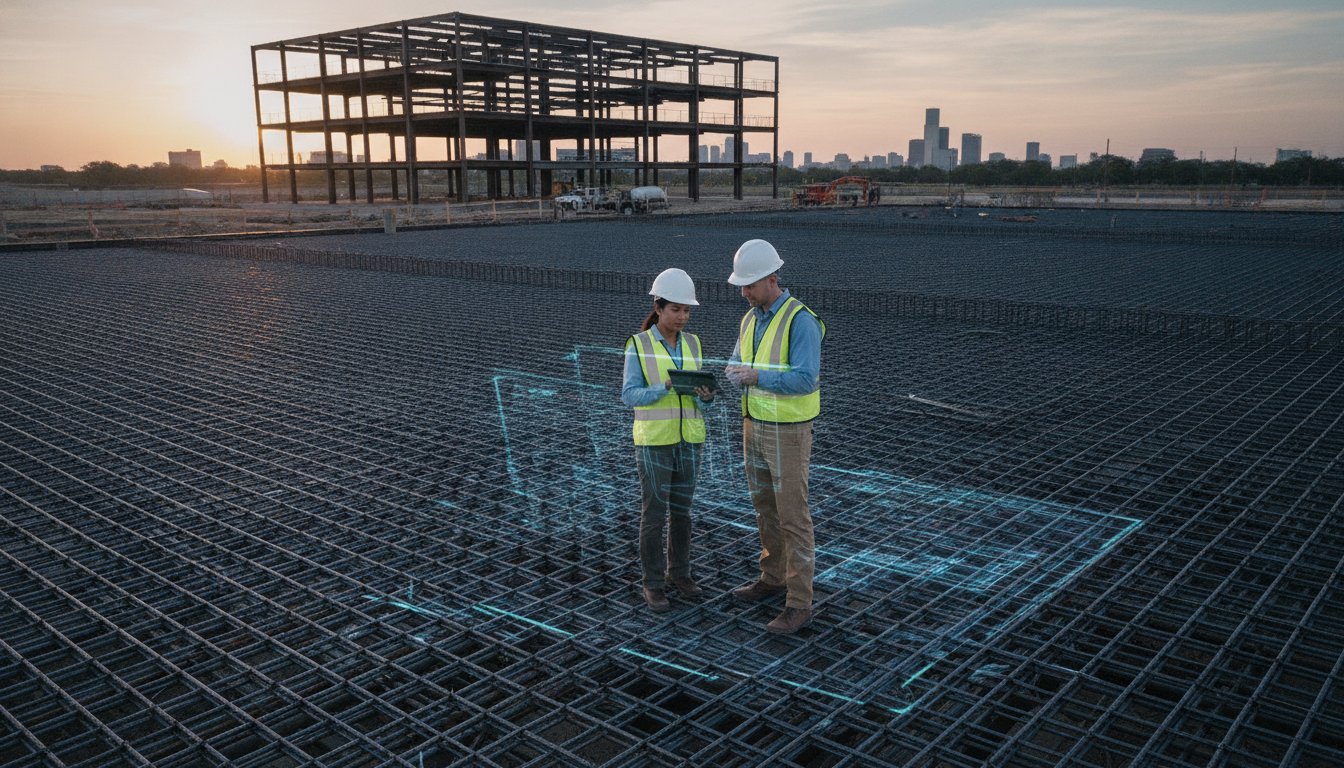
A commercial development's resilience is defined by the ground beneath it, yet many projects face structural risks before the first column is placed. In Texas, expansive clay creates a geological environment where a standard foundation slab can quickly become a liability if site preparation isn't handled with operational precision. You've likely seen how unpredictable soil movement leads to costly delays and instability, forcing a difficult choice between immediate cost-efficiency and the long-term viability of the structure.
Establishing a stable base requires more than just pouring concrete; it demands a commitment to technical standards and disciplined engineering. This guide offers an authoritative overview of foundation slab types, including the critical distinctions between slab-on-grade and podium slabs, tailored for the 2026 regulatory environment. You'll gain a clear understanding of the engineering requirements necessary to manage regional soil challenges and the knowledge to select a partner who prioritizes professional stability and proven results.
Key Takeaways
- Distinguish between standard slab-on-grade and complex podium systems to determine the most stable structural approach for your building's specific load requirements.
- Identify the critical site preparation and soil stabilization techniques required to mitigate risks posed by expansive clay before the foundation slab is poured.
- Evaluate the structural advantages of cast-in-place concrete and specific reinforcement strategies to ensure the long-term durability of mid-rise and high-rise developments.
- Understand how integrating turnkey civil and concrete services reduces project friction while maintaining the meticulous management of details essential for safety and structural integrity.
- Review the latest 2026 structural standards to ensure your development complies with evolving local amendments and accessibility requirements across major Texas jurisdictions.
What is a Foundation Slab in Commercial Construction?
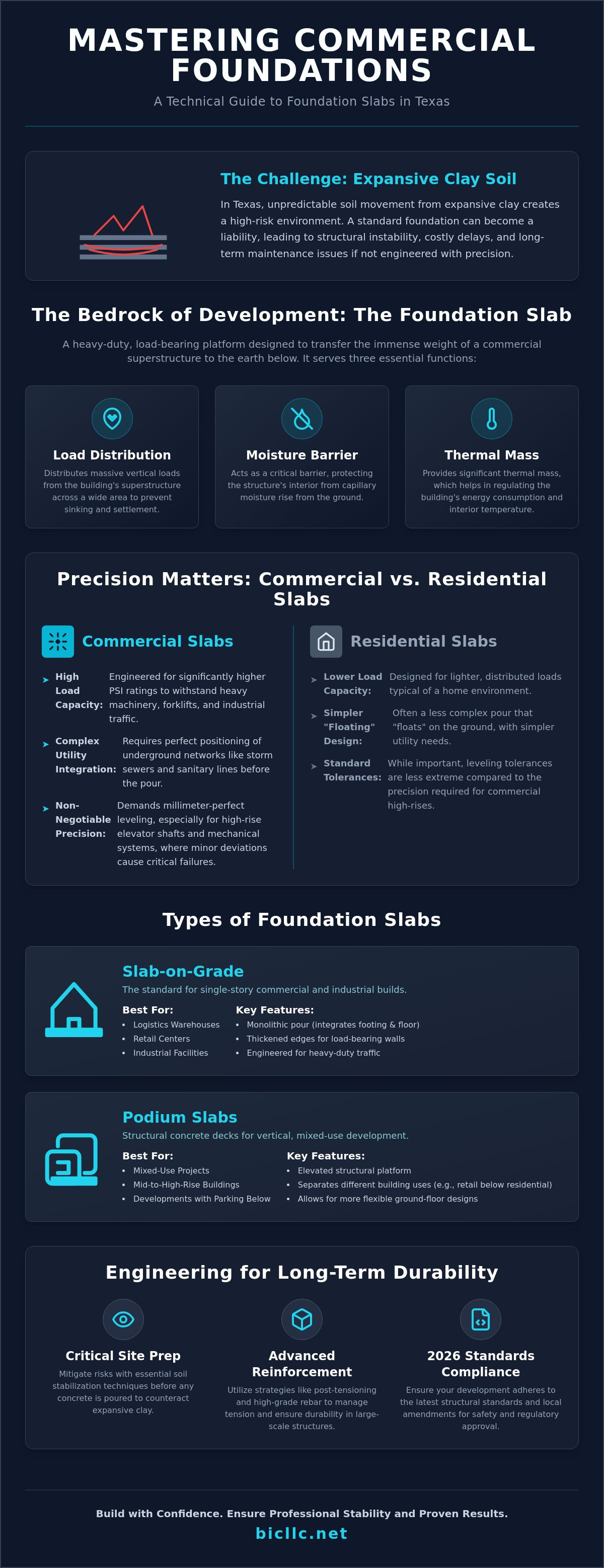
A Concrete slab foundation is the technical bedrock of any large-scale development. It's a structural element where concrete is poured directly onto a subgrade that has been meticulously prepared to handle specific load requirements. In commercial construction, this isn't a simple "floating" surface like those found in basic residential builds. It's a heavy-duty, load-bearing platform designed to transfer the immense weight of the building's superstructure to the earth below. A commercial foundation slab serves three essential functions: it distributes vertical loads across a wider area, acts as a critical moisture barrier to protect the building's interior, and provides thermal mass that assists in regulating energy consumption.
The choice of foundation dictates the building's entire lifecycle and long-term maintenance budget. A precision-engineered pour prevents the structural movement that often leads to cracked walls, misaligned doors, and mechanical failures. In the demanding geological environment of Texas, establishing this stability from day one is the only way to ensure the enduring nature of the professional output and the security of the investment.
The Role of Structural Concrete in Modern Development
In 2026 urban projects, structural concrete must support increasingly dense vertical loads while maintaining total stability. The foundation acts as the pivot point where mass earthwork ends and structural framing begins. This transition requires disciplined execution and the integration of high-performance components. Modern developments rely on heavy-duty vapor barriers to stop capillary moisture rise and strategic reinforcement, such as post-tensioning or high-grade rebar, to manage tension. Every foundation slab we establish adheres to rigorous concrete grades that meet or exceed local 2021 or 2015 IBC amendments, ensuring the structure remains steadfast against both lateral and vertical forces over many decades.
Why Commercial Slabs Differ from Residential Pours
The primary distinction between commercial and residential slabs is found in operational precision and load capacity. Commercial environments demand significantly higher PSI (pounds per square inch) ratings to withstand the constant stress of heavy-duty traffic, forklifts, and industrial machinery. These slabs also require complex integration with underground utility networks, such as storm sewers and sanitary lines, which must be perfectly positioned before the first drop of concrete. Precision leveling is another non-negotiable standard. For high-rise elevator shafts and stairwells, even a minor deviation in the slab can cause critical alignment issues during the mechanical phases. Every millimeter matters in commercial execution. High standards in the initial pour eliminate the project friction that arises from poor site preparation or substandard materials.
Types of Foundation Slabs: From Slab-on-Grade to Podium Systems
Selecting the correct foundation slab is a technical decision that determines the structural integrity and cost-efficiency of a commercial project. In Texas, where soil conditions vary from stable limestone to volatile clay, the choice between slab-on-grade, podium, or post-tensioned systems depends on the specific load requirements and geological data of the site. Each system offers distinct advantages for different building heights and usage profiles, and a disciplined approach to selection prevents future maintenance liabilities.
Slab-on-Grade Applications in Texas
Slab-on-grade is the standard for logistics warehouses, retail centers, and single-story industrial builds. We typically implement either monolithic pours or independent stem wall foundations depending on the soil report. Monolithic slabs integrate the footing and the floor into a single pour, while independent stem walls allow for more complex structural movement. Thickened edges are a vital engineering requirement for these slabs, as they provide the necessary support for perimeter load-bearing walls. Utilizing established standards for slab thickness design ensures the floor can withstand the stress of heavy-duty commercial traffic. For developers seeking reliable execution, our slab on grade concrete services Texas deliver the operational precision required for these high-traffic environments.
The Rise of Podium Slabs in Mixed-Use Projects
Podium slabs serve as structural concrete decks that facilitate mixed-use density in urban centers. These systems allow for ground-floor retail or parking structures to support several stories of wood or steel framing above. In Houston, the demand for fire-rated concrete podiums has grown as developers seek to maximize vertical space while adhering to strict safety codes. As a seasoned podium slab contractor Houston, we focus on the meticulous management of details required to ensure these decks provide a steadfast platform for multi-story residential units.
Post-Tensioning for Large Commercial Footprints
Post-tensioning is an advanced engineering solution often required in Dallas and San Antonio to manage expansive soil movement. This method utilizes high-strength steel tendons that are stressed after the concrete has reached a specific strength. Post-tensioning creates active compression within the concrete to counteract tensile forces, which significantly reduces the risk of cracking and structural failure. This technique allows for a thinner foundation slab without compromising the load capacity. It's particularly effective for large-scale parking structures where long-term durability and minimal maintenance are the primary goals. For projects requiring this level of technical proficiency, partnering with an expert in structural concrete ensures a reliable and steadfast result.
Mat Foundations for High-Rise Stability
For high-rise developments or heavy industrial facilities, mat foundations provide the highest level of load distribution. These thick, heavily reinforced slabs act as a single, continuous unit that supports the entire building's weight across the project's footprint. This approach is essential when the soil's bearing capacity is low or when the vertical loads are exceptionally high. Every mat foundation we establish is a testament to our pride in craftsmanship and our focus on building lasting foundations that stand the test of time.
Navigating Soil Stabilization and Site Prep for Texas Foundations
Texas soil presents a unique set of engineering challenges that can compromise a commercial foundation slab if not addressed with technical precision. Expansive clay, frequently found throughout the state, is the primary adversary of structural stability. These soils undergo significant volume changes based on moisture content, leading to the heave and subsidence that often cause structural failure. Relying on simple leveling is insufficient for commercial loads. Establishing a steadfast base requires a comprehensive approach to site preparation, beginning with the removal of unsuitable materials and the introduction of engineered fill.
Mass soil excavation serves as the first line of defense. By removing highly plastic clay and replacing it with select, non-expansive fill, we create a stable platform that minimizes the risk of movement. In cases where total removal isn't feasible, chemical stabilization offers a reliable alternative. Incorporating lime or fly ash into the subgrade modifies the soil's chemical structure, effectively reducing its plasticity index. This process transforms volatile earth into a stable, workable foundation that supports the enduring nature of the concrete pour.
Mass Excavation and Grading Standards
Achieving 95% Proctor density during the compaction process is a non-negotiable standard for any large-scale development. Compaction testing ensures the subgrade can support the vertical loads of the building without settling. Professional earthwork also focuses on meticulous grading to manage site drainage. Preventing water from ponding near the slab edge is critical, as localized moisture leads to uneven soil expansion and subsequent slab heaving. A disciplined focus on these details during the early phases of construction prevents the structural risks that often emerge years after completion.
Integrated Civil Solutions for Infrastructure
The integrity of a foundation slab is often determined by the infrastructure buried beneath it. Coordinating the installation of underground utilities, such as sanitary lines and storm sewers, must occur before the concrete is placed. This integrated approach ensures that the site's moisture management system is fully operational. Detention ponds play a vital role in this framework, as they regulate runoff and protect the foundation from the surge of Texas flash floods. For those planning complex projects, our concrete construction for mixed-use development insights provide a deeper look at how these civil elements work in tandem with structural concrete to ensure project success.
Engineering for Durability: Reinforcement and Structural Standards
Commercial developments require a foundation slab that can withstand extreme tension and compression without compromising the building's integrity. While wire mesh might suffice for light-duty flatwork, heavy-duty commercial loads demand the disciplined use of rebar reinforcement. Rebar provides superior structural stability by distributing stress across the concrete matrix, which is essential for preventing the structural risks mentioned in earlier sections. Proper joint design is equally vital; it dictates where the concrete will crack, ensuring that inevitable shrinkage doesn't lead to random, uncontrolled fissures. Curing protocols are the final step in this methodical process. By maintaining moisture retention through proper curing covers or chemical compounds, we ensure the concrete reaches its maximum design PSI and maintains long-term durability.
Cast-in-Place (CIP) vs. Precast Foundations
Cast-in-Place (CIP) concrete remains the gold standard for custom mid-rise and high-rise foundations because it offers monolithic strength and the flexibility to adapt to complex site footprints. Precast garage foundations provide speed of installation, but they often lack the structural continuity and load-bearing capacity of a CIP system. For developers who prioritize reliability and the meticulous management of details, our CIP garage construction Texas guide details why this method is the preferred choice for high-stress urban environments. The seamless nature of a CIP pour eliminates the joints that can become weak points in precast structures over time.
High-Rise and Mid-Rise Foundation Specifics
High-rise foundations frequently require deep foundation integration where the slab ties directly into drilled piers or driven piles. In these massive concrete pours, managing thermal cracking is a critical concern due to the high internal temperatures generated during the hydration process. Under 2026 engineering standards, a lower concrete slump generally correlates with increased structural strength and reduced long-term shrinkage, provided the mix design allows for full consolidation without voids. This balance of workability and strength is essential for the enduring nature of the professional output. If your next project requires this level of technical proficiency, contact us to learn more about our structural concrete capabilities.
Partnering for Success: Executing Large-Scale Foundation Projects
Success in large-scale construction depends on the seamless transition between civil earthwork and structural concrete placement. While the technical specifications of a foundation slab are paramount, the unseen ingredients of safety and integrity determine the project's ultimate outcome. Turnkey civil and concrete services eliminate the administrative friction that often occurs when multiple contractors manage overlapping scopes. By consolidating mass excavation, soil stabilization, and structural pours under a single point of accountability, developers ensure that the meticulous standards established in the planning phase are maintained through to completion. This integrated strategy reduces delays and ensures that the final product meets the enduring standards required for 2026 developments.
The Born Integrated Approach to Quality
At Born Integrated Construction, we prioritize long-term viability over short-term cost-cutting measures. Our approach is defined by a deep-rooted commitment to high standards and the belief that a project's success is measured by its performance over decades, not just the day of the pour. This philosophy extends to our attentive service, where we focus on building steadfast relationships with vendors and developers through transparent communication and professional stability. Safety is not a checkbox; it's an operational pillar. We maintain rigorous safety protocols on every active commercial job site to protect our personnel and the integrity of the professional output, creating a sense of security for every stakeholder involved.
Planning Your 2026 Development
Budgeting for a foundation slab in the 2026 Texas market requires a perspective that looks beyond the initial cost per square foot. Factors such as fluctuating rebar prices and the specific soil stabilization needs discussed in previous sections must be accounted for early in the process. Early-stage collaboration between civil and structural teams is the most effective way to identify potential site challenges before they impact the construction timeline. This proactive management allows projects to stay on schedule despite the complexities of modern urban development. It's this level of execution that transforms a technical drawing into a lasting structural asset. If you are ready to establish a stable base for your next project, contact Born Integrated Construction for a professional consultation on your next foundation slab project.
Establishing Long-Term Structural Viability
A successful commercial development depends on the steadfast execution of its base. We've explored how technical standards in site preparation and the strategic selection of a foundation slab mitigate the risks of Texas soil movement. Prioritizing disciplined engineering and high-performance reinforcement ensures the enduring nature of the structure for years to come. By integrating civil earthwork with structural concrete, developers can reduce project friction and maintain the meticulous standards required for modern urban centers.
Born Integrated Construction specializes in complex CIP and podium slab construction for developments across Houston, Austin, Dallas, and San Antonio. Our focus on safety, integrity, and efficiency allows us to deliver consistent value through every phase of the build. Request a Turnkey Civil and Concrete Bid from Born Integrated Construction to ensure your next project is built on a foundation of professional stability and proven results. We look forward to establishing a reliable partnership for your upcoming 2026 development needs.
Frequently Asked Questions
What is the difference between a slab foundation and a crawl space?
A slab foundation consists of a structural concrete layer poured directly onto a prepared subgrade, whereas a crawl space utilizes a raised floor supported by piers or stem walls. Commercial developments almost exclusively favor the slab foundation for its superior load-bearing capacity and cost-efficiency. Crawl spaces are more common in residential settings where access to plumbing beneath the floor is prioritized over the heavy weight distribution required for industrial or retail use.
How thick should a commercial foundation slab be for heavy machinery?
Commercial slabs for heavy machinery typically range from 6 to 12 inches in thickness, depending on the specific equipment's static and dynamic loads. While a standard industrial floor might be 6 inches, upgrading to an 8 or 10-inch slab increases the load capacity significantly to prevent structural failure. Precision engineering ensures the foundation slab can withstand localized stress without cracking under the weight of consistent industrial operations.
Does a foundation slab need a vapor barrier in Texas climates?
A high-performance vapor barrier is an essential requirement for Texas construction to prevent capillary moisture rise from the soil. Texas climates often experience high humidity and fluctuating groundwater levels, which can lead to moisture migrating through the concrete and damaging floor finishes or sensitive equipment. Installing a heavy-duty, puncture-resistant barrier before the pour is a standard practice for maintaining the long-term integrity and professional stability of the building.
How long does it take for a commercial concrete slab to cure before building?
Most commercial concrete slabs require a minimum of 7 to 28 days to cure before they can support heavy structural loads. While concrete reaches approximately 70% of its design strength within the first week, waiting for the full 28-day cycle ensures the material has achieved its maximum PSI. Curing protocols, such as moisture retention covers, are utilized during this period to ensure the enduring nature of the professional output and the security of the structure.
What are the common causes of foundation slab cracking in Houston?
Foundation cracking in Houston is primarily caused by the volumetric changes in expansive clay soil and the region's high water table. When the soil becomes saturated or excessively dry, it shifts, placing immense tensile stress on the concrete. Other factors include improper joint placement and rapid moisture loss during the initial curing phase. Disciplined site preparation and professional earthwork are the most effective ways to mitigate these regional geological challenges.
Can you pour a foundation slab over existing soil without stabilization?
Pouring a commercial slab over existing soil without stabilization is generally not recommended due to the risk of uneven settlement and structural movement. In Texas, native soils often lack the bearing capacity required for large-scale developments. We prioritize mass soil excavation or chemical modification with lime to create a stable subgrade. Bypassing these steps frequently leads to costly structural repairs and project delays that compromise the long-term viability of the investment.
What is a post-tensioned foundation slab and when is it required?
A post-tensioned foundation slab uses high-strength steel tendons that are stressed after the concrete has hardened to provide active compression. This system is often required on sites with highly expansive soils or for large-scale parking structures where minimizing joints and cracking is a priority. It allows for a thinner slab profile while maintaining superior structural performance, making it a reliable and steadfast solution for the complex geological conditions found in Dallas and San Antonio.
How much does a commercial slab foundation cost per square foot in 2026?
National averages for a basic commercial slab in 2026 range from $6 to $9 per square foot for light use, while reinforced slabs for heavier loads average $8 to $12. Specialty industrial slabs with increased thickness can cost $18 or more per square foot. These figures reflect the rising costs of ready-mix concrete and rebar seen throughout the first half of the year. Developers should account for these market trends early in the budgeting phase to ensure project stability.