Large-Scale Mass Soil Excavation for Site Readiness
In the Greater Houston area, the ground beneath a commercial site is rarely a passive participant; it is a complex variable that requires meticulous management. You likely recognize that the region's expansive "Black Gumbo" clay and high water tables present immediate risks to structural integrity and project timelines. Without a disciplined approach to earthwork, these geological conditions often lead to costly dewatering delays and compromised foundations that threaten long-term viability.
Our objective is to help you master these complexities by providing a clear roadmap for achieving site readiness through professional mass excavation. Partnering with a qualified mass soil excavation contractor Houston ensures your project meets the rigorous standards of the 2021 International Building Code while navigating the latest 2026 local drainage amendments. This article examines the technical requirements for stabilizing unstable Gulf Coast soils, the necessity of compliant detention pond construction, and the strategic risk mitigation steps required to deliver a graded site ready for utility and concrete work. By prioritizing precision during the excavation phase, you establish a steadfast foundation for the enduring success of your development.
Key Takeaways
- Understand the technical distinction between mass excavation and general grading to ensure your site reaches the precise design grade required for commercial foundations.
- Learn how disciplined surveying benchmarks and professional dewatering systems mitigate the risks posed by Houston's high water table and expansive clay soils.
- Discover why a specialized mass soil excavation contractor Houston is vital for integrating essential drainage solutions, such as detention ponds, into your site plan.
- Identify the critical criteria for evaluating excavation partners, focusing on heavy equipment fleet capacity and a steadfast commitment to OSHA safety standards.
- Explore the operational advantages of an integrated approach that coordinates large-scale earthwork with utility installation and final structural concrete paving.
What is Mass Soil Excavation and Why is it Critical in Houston?
Mass soil excavation is a foundational phase of civil engineering that involves the large-scale removal, movement, or addition of earth to achieve a precise design grade. While general grading often focuses on surface-level smoothing, mass excavation addresses the structural volume and depth required to support heavy commercial loads. This discipline is a core component of Earthworks (engineering), where the objective is to create a stable platform for subsequent construction. For developers, engaging a seasoned mass soil excavation contractor Houston is not merely a logistical step; it's a strategic investment in the long-term viability of the structure.
The success of any commercial or industrial project depends on the stability of the site before the first yard of concrete is poured. Professional soil analysis must be completed before the first bucket hits the ground to inform the depth of the cut and the type of fill material required. This data-driven approach ensures that the subgrade can withstand the specific pressures of the intended development. Without this initial precision, even the most robust foundations are at risk of failure due to shifting soil conditions.
Navigating Houston’s Expansive Clay Soils
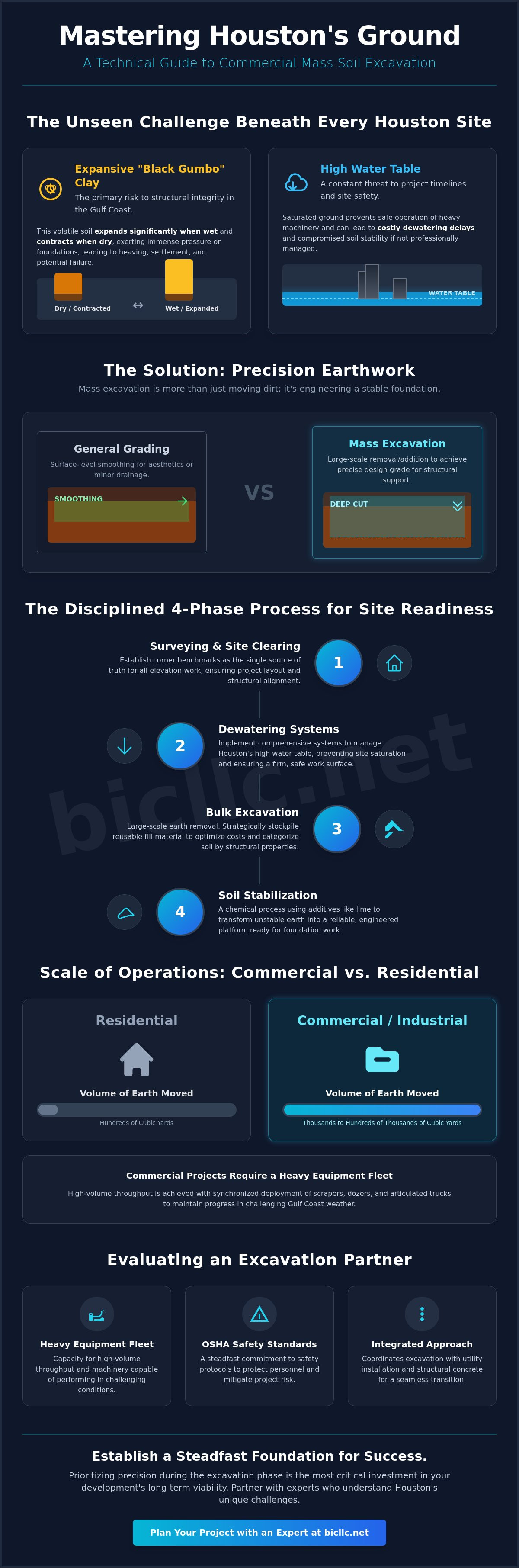
Houston's geology is dominated by "Black Gumbo," a highly expansive clay known for its extreme shrink-swell capacity. This material expands significantly when wet and contracts as it dries, creating immense pressure on foundations. Mass excavation allows us to remove these unsuitable materials and replace them with engineered fill that provides a predictable, stable base. Expansive clay is the primary risk factor for Houston structural integrity. By addressing these soil properties during the excavation phase, we mitigate the risk of future foundation heaving or settlement.
The Scale of Commercial vs. Residential Earthwork
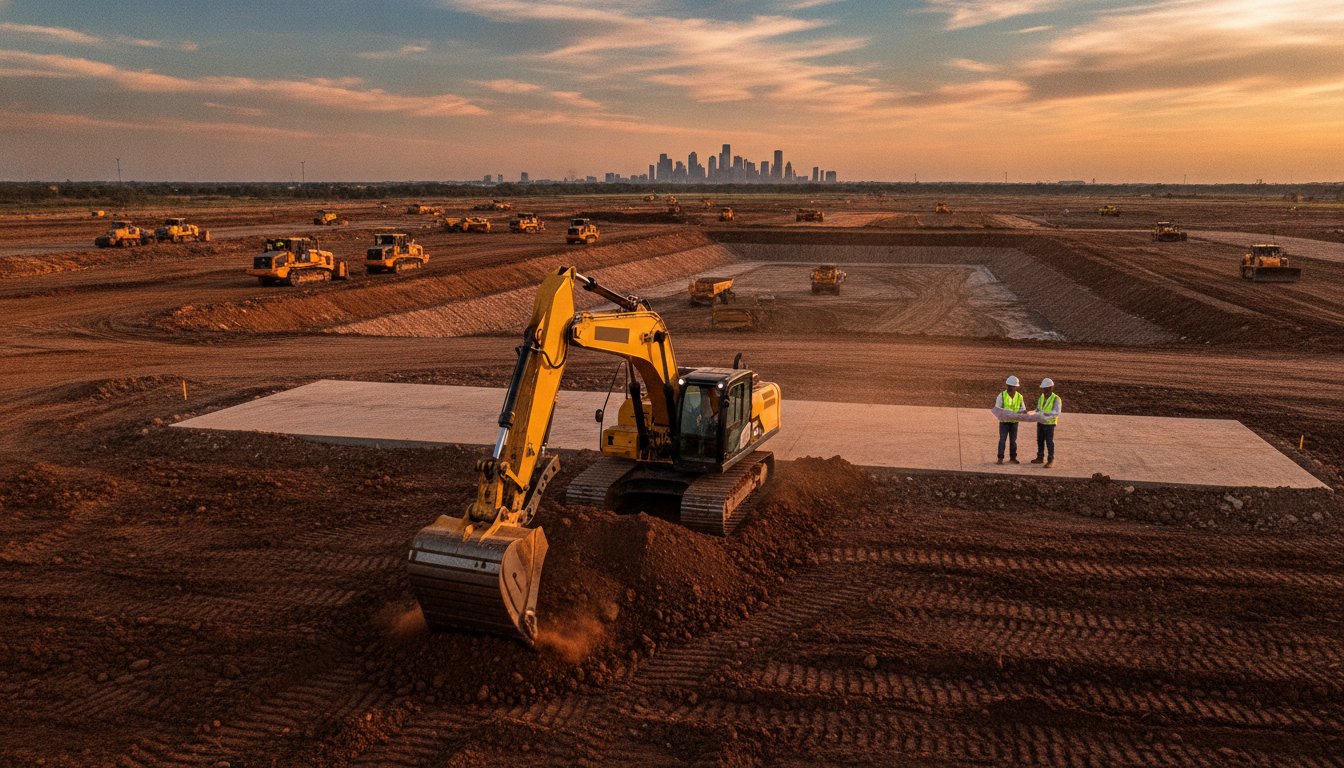
The logistical demands of commercial site readiness far exceed those of residential projects. High-rise foundations and large industrial warehouses require moving thousands of cubic yards of soil with surgical precision. This scale necessitates a heavy equipment fleet capable of high-volume throughput, including scrapers, dozers, and articulated trucks. Managing this volume requires a steadfast commitment to logistical planning:
- Volume Management: Accounting for every cubic yard of earth to minimize waste and haul-off costs.
- Equipment Synchronization: Deploying the right machinery to maintain steady progress in challenging Gulf Coast weather.
- Site Integration: Coordinating excavation with future utility and paving requirements.
Born Integrated Construction manages large-scale site readiness for diverse developments by focusing on meticulous logistical planning. We ensure that every yard of earth is accounted for, whether it's being staged for reuse or hauled off-site. Our integrated approach ensures that the transition from mass soil excavation to structural concrete is seamless and efficient, providing a reliable foundation for Houston's growing infrastructure.
The Technical Process: From Surveying to Soil Stabilization
A professional mass soil excavation contractor Houston follows a methodical progression to ensure site stability. This process begins with Phase 1: precise site clearing and the establishment of corner benchmarks. These markers serve as the singular point of truth for all subsequent elevation work. Benchmarks ensure consistency. Without them, cumulative errors can compromise the entire project layout and structural alignment.
Houston's high water table necessitates Phase 2: implementing comprehensive dewatering systems. This step is critical. It prevents site saturation and ensures that heavy machinery can operate safely on a firm surface. Following dewatering, Phase 3 involves bulk excavation. During this stage, we strategically stockpile reusable fill material to optimize project costs and minimize haul-off. We categorize soil by its structural properties. This ensures that only the most stable materials are reused in load-bearing areas.
Phase 4 focuses on soil stabilization, a chemical process that transforms unstable earth into a reliable platform. We use additives like lime or fly ash to modify the soil's chemical structure. It's a disciplined approach. Finally, Phase 5 concludes with final grading and rigorous density testing. These tests, often performed by third-party laboratories, confirm the subgrade meets civil engineering specifications before any concrete is poured.
Surveying and Benchmarking for Precision
Modern earthwork relies on GPS-guided equipment to maintain tight tolerances. This technology allows operators to achieve vertical accuracy within fractions of an inch. It's about precision. Such accuracy is vital when coordinating with a storm sewer installation contractor Texas, as even minor elevation errors can lead to drainage failures. Adhering to TxDOT Houston District drainage guidelines ensures the site remains compliant and functional.
Soil Stabilization Techniques in the Gulf Coast
Stabilization is the process of reducing the plasticity index of clay-heavy Texas soils. Lime stabilization is often preferred for high-plasticity "Black Gumbo" because it chemically reacts with the clay to create a durable, stone-like layer. In contrast, cement treatment is typically reserved for sandier soils. This curing process creates a workable, firm subgrade. It's essential for long-term structural concrete performance. By managing soil chemistry, we provide a steadfast foundation that resists the shifting nature of the Gulf Coast terrain.
Grading and Drainage: The Role of Detention Ponds in Site Readiness
In the low-lying topography of the Texas Gulf Coast, drainage is the primary priority during the mass excavation phase. Effective water management isn't an afterthought; it's a structural requirement. Poorly executed grading leads to standing water and subgrade saturation, which can compromise the integrity of the soil stabilization efforts discussed previously. A professional mass soil excavation contractor Houston integrates drainage solutions into the initial earthwork plan to ensure the site remains workable even after heavy rain events.
A critical component of this integration is detention pond construction Texas. These basins are engineered to capture and slowly release stormwater, preventing site flooding and meeting municipal requirements. The excavation process involves more than just digging a hole; it requires the precise creation of protection bunds and perimeter drains to direct runoff. According to academic research on mass excavation, the coordination of these volume-heavy tasks is essential for minimizing site disturbance and maintaining the overall mass haul balance.
Detention Pond Excavation and Design
Developers must choose between dry detention basins, which remain empty except during rain, and wet retention basins that maintain a permanent pool. Local municipal codes in Houston dictate specific excavation depths and side-slope ratios, typically requiring a 4:1 or 3:1 slope for safety and stability. It's a matter of compliance and long-term safety. The placement of the outlet structure during the excavation phase is vital. It must be positioned at the lowest point of the basin to ensure complete drainage and prevent stagnant water, which can lead to maintenance issues or regulatory penalties.
Stormwater Management and Underground Utilities
Mass excavation does more than prepare the surface; it creates the necessary "envelope" for the site's underground infrastructure. This phase must be closely coordinated with domestic water line installation Texas to ensure that utility corridors are properly graded and cleared. It's a matter of logistical precision. All trenches must be shored and dewatered according to OSHA standards to allow for safe pipe laying. By managing the earthwork and utility paths simultaneously, we reduce the risk of utility strikes and ensure that the subgrade remains firm for the final concrete paving. This disciplined approach prevents the soil shifting that often plagues rushed developments.
Evaluating a Houston Mass Soil Excavation Contractor
Selecting a partner for large-scale earthwork requires a vetting process that goes beyond a simple cost analysis. A reliable mass soil excavation contractor Houston must demonstrate operational stability through tangible assets and a proven safety record. Because mass excavation serves as the foundation for all subsequent trades, any deficiency in the contractor's equipment or expertise can create a ripple effect of delays and structural risks across the entire project lifecycle.
Experience with regional geology is a critical differentiator. While previous sections detailed the technical challenges of "Black Gumbo" clay, an effective contractor must show a history of successfully navigating these conditions on similar commercial scales. They should possess the technical proficiency to adjust stabilization methods based on real-time moisture readings and soil density tests. Furthermore, a contractor with turnkey capabilities offers a distinct advantage by managing the transition from bulk earthwork to structural concrete. This integration ensures that the integrity of the stabilized subgrade is preserved and paved before environmental exposure can cause degradation.
Fleet Capability and Resource Management
Ownership of a heavy equipment fleet is a primary indicator of a contractor's ability to maintain a schedule. In a high-demand market, relying on rented machinery often leads to project delays when equipment providers cannot meet sudden needs. We utilize GPS-integrated machinery to ensure that every cut and fill operation aligns with the digital civil engineering model. This precision reduces material waste and virtually eliminates the need for rework. Fleet reliability is the backbone of meeting aggressive project timelines.
- Asset Control: In-house maintenance teams ensure machinery stays operational without waiting for third-party service.
- Technological Precision: GPS-guided dozers and excavators maintain tight tolerances for vertical accuracy.
- Scalability: The ability to deploy additional scrapers or articulated trucks as site conditions dictate.
Safety Protocols and Risk Mitigation
Safety is a disciplined practice that requires more than just basic compliance. On large excavation sites, we prioritize daily safety briefings and the presence of dedicated safety officers to monitor high-risk activities. Managing the risks of trench collapses and utility strikes requires a steadfast commitment to "Call Before You Dig" protocols and rigorous shoring standards. Reviewing a contractor's Experience Modification Rate (EMR) provides a clear metric of their historical safety performance. Professional insurance and bonding act as essential safeguards, protecting the developer from site-related liabilities and ensuring the project's long-term security.
For developers seeking a partner who values substance over style and delivers proven results, Born Integrated Construction provides the steadfast civil site work expertise necessary for complex Houston developments.
Born Integrated Construction: Leading Houston Site Preparation
Born Integrated Construction operates with a deep-rooted commitment to high standards and long-term viability. We don't just move dirt; we establish the physical foundations that support Houston's commercial growth. As a seasoned mass soil excavation contractor Houston, our team manages the meticulous details of site preparation to ensure every project begins with structural security. We act as a dependable partner for developers who value substance over style and require unwavering consistency in execution.
Our integrated approach eliminates the friction often found between separate excavation and paving phases. By coordinating large-scale earthwork with commercial concrete paving Conroe, we ensure that stabilized subgrades are protected and paved according to current 2026 engineering standards. This synchronization reduces the risk of soil degradation and maintains the schedule for subsequent trades. We take pride in the enduring nature of our professional output, creating a voice of authority in the Houston civil market through proven results.
The Advantage of Turnkey Civil Solutions
Managing multiple vendors on a high-volume site often leads to communication gaps and scheduling conflicts. Born Integrated Construction provides a single point of accountability for the entire site readiness scope. We handle everything from mass soil excavation and detention pond construction to high-rise concrete foundations. This turnkey capability offers developers peace of mind, knowing that the team stabilizing the soil is the same team responsible for the structural concrete. It's a disciplined model that prioritizes operational precision and safety above all else. By reducing the number of contractors on-site, we streamline the inspection workflows and ensure compliance with all Harris County and City of Houston regulations.
Get Started with Your Houston Development
The most effective way to mitigate risk and optimize excavation costs is through early-stage consultation. We invite developers to discuss their upcoming site readiness needs with our specialists to establish a clear hierarchy of project priorities. Our bidding process is thorough and transparent, providing a comprehensive overview of the technical scope required for your specific site. Whether you're navigating the 2021 International Building Code or the latest local drainage amendments, we provide the expertise needed to deliver a graded, stable site ready for utility work. Our methodical approach ensures that your project remains on a steady and predictable path toward completion.
Contact Born Integrated Construction for your next mass excavation project to secure a partner focused on safety, efficiency, and steadfast reliability.
Securing the Future of Your Commercial Development
A stable site is the most critical asset for any commercial project in the Texas Gulf Coast. We have explored how disciplined mass excavation manages the volatile nature of local soils and ensures compliance with evolving drainage regulations. Achieving site readiness requires more than just moving earth; it demands a technical understanding of soil chemistry and topographical precision. By addressing these factors early, you protect the structural integrity of your future foundation and minimize the risk of costly dewatering delays.
Selecting an experienced mass soil excavation contractor Houston provides the operational stability needed to navigate these complexities. Born Integrated Construction offers turnkey civil and structural concrete solutions backed by decades of regional expertise. Our approach is grounded in safety and professional integrity, ensuring that every yard of earth moved contributes to the long-term viability of your development. We invite you to build on a foundation of reliability and craftsmanship. Partner with Born Integrated Construction for Professional Site Readiness and ensure your project starts with the precision it deserves.
Frequently Asked Questions
What is the difference between mass excavation and grading?
Mass excavation is the heavy movement of earth to reach a specific structural volume, whereas grading focuses on the final surface contours. A qualified mass soil excavation contractor Houston manages the deep cuts and fills necessary to establish a site's primary engineering grade. Grading follows this phase to prepare for paving and landscaping. It's a matter of volume versus surface finishing.
How does Houston soil affect the cost of mass excavation?
Houston's expansive clay soils increase project complexity and costs due to their high moisture retention and plasticity. These soils often require significant haul-off of unsuitable material and the importation of select fill to prevent foundation heaving. The need for chemical additives like lime to stabilize the subgrade also adds to the logistical and material expenses required for a stable site.
Why is dewatering necessary for excavation projects in Houston?
Dewatering is essential because it lowers the local water table to allow for safe, dry excavation below the surface level. In Houston's saturated environment, excess groundwater can destabilize trench walls and turn the subgrade into unworkable mud. Proper dewatering ensures that the earthwork remains on schedule and that the structural integrity of the soil is maintained throughout the process.
What equipment is typically used for large-scale mass soil excavation?
High-volume earthwork requires a specialized fleet including scrapers, articulated trucks, and GPS-guided dozers. Utilizing a mass soil excavation contractor Houston with an in-house fleet ensures that these machines are available when needed. GPS technology allows for vertical accuracy within fractions of an inch, which reduces material waste and virtually eliminates the need for rework on complex commercial sites.
How long does a typical mass excavation phase take for a commercial site?
The duration of the excavation phase depends on the total volume of earth to be moved and the prevailing weather conditions. For a standard commercial site, this process typically ranges from three to eight weeks. Complex sites with significant dewatering needs or large detention ponds may require additional time to ensure all civil specifications and density tests are met properly.
Do I need a separate contractor for detention pond excavation?
It's more efficient to use a single contractor for both site earthwork and detention pond excavation. An integrated approach allows the contractor to use excavated material from the pond as fill for other site areas, which optimizes the mass haul balance. This coordination also ensures that all drainage systems are perfectly synchronized with the final structural site grade.
What are the environmental regulations for soil removal in Texas?
Soil removal in Texas is governed by TCEQ guidelines and local municipal codes regarding disposal and runoff. If the soil is being moved off-site, it must be taken to a licensed facility that can accept the specific material type. Contractors must also implement erosion control measures to prevent silt from entering public storm sewers during the excavation and hauling process.
How does soil stabilization improve the longevity of concrete paving?
Soil stabilization improves longevity by chemically altering the clay to create a durable, non-expansive base. This process significantly reduces the soil's tendency to shrink and swell with moisture changes. By providing a steadfast platform, stabilization ensures that the concrete paving remains level and resists the structural cracking caused by subgrade movement over the long term.