2026 Structural Trends: Mixed-Use Concrete Construction and Turn-Key Civil Solutions
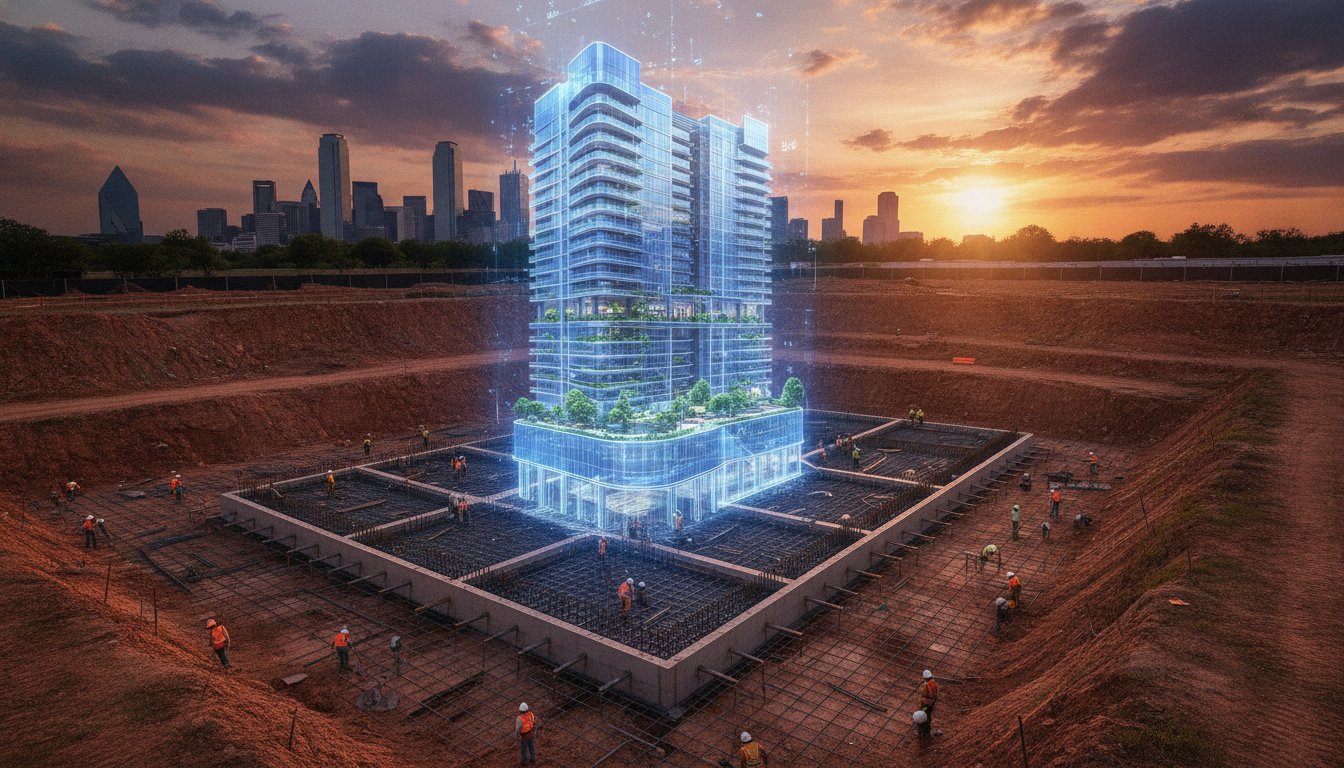
What if the most critical component of your mixed-use development isn't the architectural facade, but the subterranean stabilization and structural interface that holds it together? In 2026, the success of Texas projects depends on more than just aesthetics; it requires a foundation that can withstand the state's notorious expansive clay soils while managing the complex load requirements of retail and residential integration. Partnering with a seasoned turn key civil contractor Texas developers trust is no longer a luxury but a strategic necessity to ensure long-term structural integrity and operational efficiency.
You likely recognize that balancing commercial foot traffic with residential quietude is a logistical hurdle that begins with the very first pour. We agree that the complexity of modern mixed-use structures demands a level of precision that transcends standard building practices. This article promises to reveal how advanced concrete techniques like podium slabs and cast-in-place (CIP) structures are redefining durability in our major metros. You'll gain a clear understanding of the best slab types for your specific project, the vital role of soil stabilization, and how to identify a reliable partner to manage your civil and structural needs from mass excavation to the final flatwork.
Key Takeaways
- Concrete remains the superior material for high-density mixed-use projects due to its ability to manage diverse load requirements and provide essential sound dampening between commercial and residential zones.
- Understand the specific applications of podium slabs versus slab on grade foundations to ensure your retail and parking components are structurally sound and cost-effective.
- Cast-in-place (CIP) concrete construction offers the architectural versatility and structural strength required for the unique footprints of modern Texas midrise and high-rise developments.
- Engaging a reliable turn key civil contractor Texas ensures that critical site work, such as mass soil excavation and paving stabilization, is executed to withstand expansive clay soil challenges.
- Learn to evaluate potential structural partners based on their commitment to safety, operational precision, and the meticulous management of complex civil site requirements.
The Rise of Mixed-Use Development: Structural Concrete Challenges in 2026
In Houston, Austin, and Dallas, the urban landscape is shifting toward high-density environments where residential, commercial, and retail spaces coexist within a single footprint. This model, known as mixed-use development, presents unique structural demands that traditional single-purpose buildings don't face. Concrete serves as the primary material for these projects because it provides the necessary compressive strength to support vertical growth while offering the fire resistance required by local municipalities. As of 2026, cities like College Station have already adopted 2024 International Building Codes, emphasizing the need for materials that meet stringent safety standards. Securing a turn key civil contractor Texas developers can rely on is essential for bridging the gap between initial earthwork and final structural execution.
Engineering Implications of Vertical Stacking
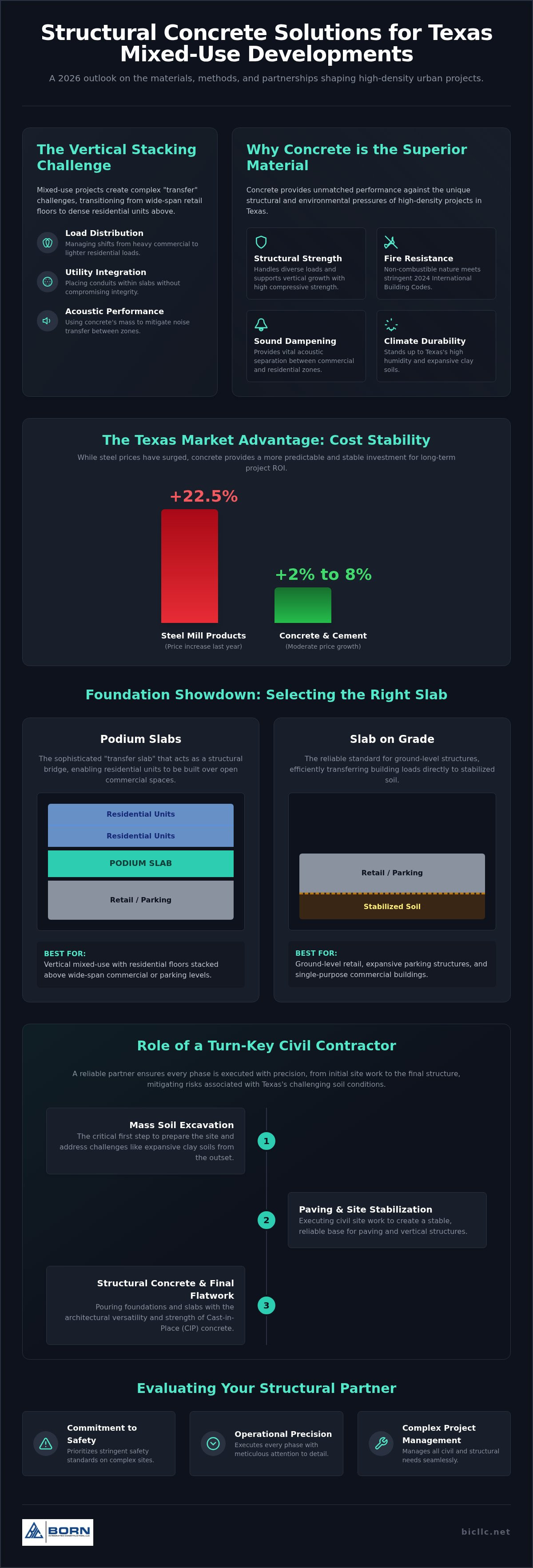
Transitioning from the wide, open spans of a retail ground floor to the dense, partitioned loads of residential units above creates a structural "transfer" challenge. Engineers often utilize concrete podium decks to distribute these varying forces effectively. This vertical stacking also complicates utility corridors; plumbing and electrical systems must pass through structural slabs without compromising integrity. Concrete provides a natural barrier for acoustic separation, which is vital for maintaining privacy in residential zones located directly above high-traffic commercial areas. Key considerations for vertical stacking include:
- Load Distribution: Managing the shift from heavy commercial equipment to lighter residential partitions.
- Utility Integration: Precision placement of sleeves and conduits within cast-in-place slabs.
- Acoustic Performance: Utilizing concrete's mass to mitigate noise transfer between zones.
The Texas Market Advantage for Concrete
Texas developers face specific environmental pressures, including high humidity and expansive clay soils. Concrete's durability against these elements remains unmatched. While steel mill products have seen a 22.5% price increase over the last year, concrete and cement price growth has remained more moderate, ranging between 2% and 8%. This makes concrete a more predictable investment for long-term ROI. You can view examples of these structural solutions in our recent projects. Utilizing advanced cast-in-place (CIP) methods allows for faster execution, which is critical in competitive markets like Austin or Houston. Non-combustible concrete structures also often qualify for lower insurance premiums, adding another layer of financial stability to the project. Partnering with a turn key civil contractor Texas ensures that every phase, from mass soil excavation to the final pour, is handled with the precision required for these high-stakes investments.
Podium Slabs and Slab on Grade: Selecting the Right Foundation
Foundational choices in Texas mixed-use projects are dictated by the specific interplay between commercial utility and residential density. For ground-level retail or expansive parking structures, slab on grade remains a reliable standard. It's efficient and cost-effective when the load can be transferred directly to stabilized soil. However, the complexity increases when residential units are stacked above these open commercial spaces. This vertical transition requires a sophisticated transfer slab, often engineered as a concrete podium deck. These structures act as a structural bridge, distributing the heavy, partitioned loads of several residential floors into the wider column spacing required for retail layouts. Experienced civil engineers meticulously design these interfaces to ensure that the building's integrity isn't compromised at the transition point.
Cost and construction timelines are primary drivers in foundation selection. While slab on grade is generally faster to execute, it doesn't offer the vertical scalability of a podium system. In major Texas metros, the ability to maximize square footage on a limited footprint often justifies the higher initial investment in a podium slab. A turn key civil contractor Texas developers trust will manage the site preparation and the structural pour as a single, cohesive operation. This integrated approach reduces the risk of scheduling conflicts that often arise when transitioning between earthwork and vertical construction.
The Role of Podium Slabs in Midrise Construction
Podium slabs are the backbone of the "five-over-one" or "five-over-two" construction model prevalent in urban centers. This method allows for wood-frame or light-gauge steel residential levels to sit securely atop a fire-rated concrete base. As an Expert Podium Slab Contractor in Houston, we focus on the precision of these decks to ensure they meet both structural and safety requirements. The concrete base provides the necessary fire separation and acoustic dampening, creating a high-quality environment for residents while protecting the commercial assets below.
Post-Tensioning in Mixed-Use Slabs
Post-tensioned (PT) slabs offer a distinct advantage for mixed-use projects that require long spans and open floor plans in the commercial sections. By utilizing high-strength steel tendons to compress the concrete, we can significantly reduce the thickness of the slab. This reduction in material not only lowers the building's overall weight but also creates more vertical clearance for utilities and high ceilings. PT installation requires extreme precision and a disciplined approach to safety. Every tendon must be placed and stressed according to exact engineering specifications to maintain the long-term viability of the structure. Our team prioritizes these technical standards to deliver results that stand the test of time, which you can read about on our about page. Partnering with a turn key civil contractor Texas ensures that these complex structural elements are executed with the steadfast reliability your project demands.
Cast-in-Place (CIP) vs. Precast: Optimizing High-Rise Performance
High-rise performance in Texas metros requires a balance between speed and architectural adaptability. While precast solutions are often marketed for their standardization, cast-in-place (CIP) concrete remains the gold standard for projects with complex geometries. Utilizing a turn key civil contractor Texas developers trust allows for the seamless execution of CIP structures that adapt to the specific site constraints of dense urban centers. Transporting massive precast components through the narrow streets of downtown Austin or Houston often introduces logistical delays and increased costs. CIP eliminates these hurdles by allowing for on-site fabrication that matches the exact architectural footprint of the project.
Structural Framing for Tall Commercial Buildings
CIP columns and core walls provide the essential lateral stability required for tall commercial and residential buildings. These elements create a rigid skeleton that resists wind loads and environmental forces more effectively than many modular alternatives. Managing concrete delivery in congested urban environments is a logistical feat that requires meticulous planning. Our approach to CIP midrise and highrise efficiency focuses on maintaining a steady rhythm of production through:
- Continuous Pours: We ensure a steady supply of ready-mix to maintain structural uniformity and eliminate cold joints.
- Formwork Precision: Utilizing advanced systems allows us to accelerate the vertical cycle time without sacrificing accuracy.
- On-Site Coordination: We manage pump placements and staging areas to minimize neighborhood disruption and maintain safety.
Parking Structure Integration
Integrating parking into the building footprint is a standard requirement for modern mixed-use developments. While precast garage foundations offer speed through standardization, CIP garages provide the flexibility needed for custom urban sites where every inch of space matters. Structured concrete parking garages must be engineered to support the multi-level residential or commercial loads above them. This integration demands a deep understanding of foundational requirements and load-path transitions. You can explore our portfolio of these integrated structures by visiting the BIC Concrete Projects page. A reliable turn key civil contractor Texas provides the oversight necessary to manage these complex interfaces, ensuring that the transition from the parking base to the residential tower is executed without compromise.
Integrating Civil Site Work: The Foundation of Integrity
A building's long-term viability isn't determined by its height, but by the ground it stands on. In high-density Texas developments, mass soil excavation is the first critical step toward establishing a reliable foundation. A turn key civil contractor Texas developers trust understands that site readiness involves more than just moving dirt. It requires a comprehensive strategy to manage detention ponds and complex stormwater runoff, especially on sites with a limited footprint. Proper civil site work creates a stable platform for the structural concrete phases discussed in previous sections, ensuring that the entire project moves forward with technical precision. When the civil and structural scopes are integrated, the risk of site-related delays decreases significantly.
Soil Stabilization for Texas Mixed-Use Sites
Houston and Dallas are notorious for expansive clay soils that shift significantly with moisture changes. Paving stabilization is non-negotiable in these regions to prevent premature cracking and foundation settlement. We utilize both chemical and mechanical stabilization techniques to modify the soil's properties, creating a rigid subgrade for concrete paving and sidewalks. Chemical stabilization often involves the application of lime or fly ash to reduce the soil's plasticity, while mechanical methods focus on the strategic compaction of imported fill. This process is vital for the health of the structure, as it mitigates the risk of soil movement that can compromise even the most robust post-tensioned slabs. Addressing these soil conditions early is the only way to ensure the long-term integrity of the development.
Underground Utility and Infrastructure Planning
Coordinating underground infrastructure with the structural slab is a meticulous task that demands early integration. Storm sewers, sanitary lines, and domestic water systems must be precisely located before any concrete is poured to prevent costly rework or structural interference. Ensuring these utilities are correctly placed within the earthwork phase allows for a seamless transition to the building's vertical components. This level of foresight is a hallmark of BIC's operational philosophy, where we prioritize substance and precision over shortcuts. You can learn more about our commitment to integrated delivery and professional standards on our about page. Proper planning at this stage prevents the need for invasive concrete cutting or core drilling later in the schedule.
By managing both the civil and structural scopes, we eliminate the communication gaps that often lead to infrastructure conflicts on busy job sites. If you're planning a high-density project that requires meticulous site preparation, consider the benefits of a turn key civil contractor Texas partner who prioritizes foundational integrity from day one.
Choosing a Turn Key Civil Contractor in Texas for Mixed-Use Execution
Selecting a partner for a multi-million dollar mixed-use development requires more than a review of a bid sheet. It demands an evaluation of a contractor's ability to maintain professional stability across the entire project lifecycle. A reliable turn key civil contractor Texas developers trust must demonstrate a deep-rooted commitment to high standards, from the initial mass soil excavation to the final structural pour. This integration is vital because it eliminates the friction between separate civil and structural teams, which often leads to scheduling conflicts or infrastructure oversights. When one entity manages the transition from the ground up, the project gains a level of operational precision that fragmented teams can't replicate.
Local expertise is a non-negotiable factor in the Texas market. Each major metro, from Houston to San Antonio, presents unique regulatory and environmental challenges. Whether it's navigating Austin’s specific building codes or managing the high humidity of the Gulf Coast, your contractor must have an established presence and a proven track record in these specific markets. Consistency in execution is what transforms a complex architectural vision into an enduring physical asset. It's about building a foundation that lasts, both literally and figuratively, through disciplined management and technical proficiency.
Safety and Quality Standards in Large-Scale Projects
Safety isn't merely a compliance requirement; it's a core pillar of operational efficiency. High-density urban builds involve congested sites where OSHA compliance and rigorous on-site safety protocols are essential to protect the workforce and the public. Quality assurance must extend to every structural mix and stabilization method used on the site. We prioritize material testing and meticulous detail management to ensure the long-term viability of every structure. This disciplined approach focuses on substance over style, ensuring the enduring nature of the professional output through every phase of construction.
The BIC Advantage: Integrated Civil and Structural Solutions
Our "Born Integrated" philosophy is built on the belief that a single-source partner provides the most reliable path to project success. By streamlining the process with a turn key civil contractor Texas partner like BIC, you gain a dependable expert who acts as a quiet leader throughout the build. We serve Houston, Austin, San Antonio, and surrounding regions with a focus on execution, safety, and unwavering consistency. You can learn more about our values and professional framework by visiting the About Born Integrated Construction page. Choosing an integrated partner ensures that your project is as organized in its physical operations as it is in its foundational planning, providing the security and confidence needed for complex Texas developments.
Establishing Permanent Foundations for Texas Growth
The successful execution of mixed-use projects in 2026 requires a disciplined approach to both the ground beneath and the structure above. We've explored how selecting the appropriate foundation, whether it's a podium deck or a post-tensioned slab, directly impacts the long-term viability of high-density developments. Proper soil stabilization and meticulous utility planning remain the silent guardians of structural integrity. By integrating these civil site work requirements with advanced cast-in-place concrete methods, developers can navigate the complexities of the Texas landscape with confidence.
Securing a reliable turn key civil contractor Texas developers can depend on ensures that safety, operational efficiency, and technical precision are prioritized from mass excavation to the final high-rise pour. BIC specializes in CIP midrise and highrise construction, offering comprehensive civil and structural services across all major Texas markets. Our commitment to steadfast reliability and professional stability provides the security your next project deserves. Partner with BIC for your next turn-key civil project and build with the assurance of proven results.
Frequently Asked Questions
What is the most common foundation for a mixed-use building?
The most common foundation for a mixed-use building is a concrete podium deck integrated with a slab on grade foundation. This structural configuration allows for wide, open spans on the ground floor to accommodate retail or parking, while providing a rigid base for multi-story residential units above. This vertical stacking is particularly effective in urban Texas metros where maximizing square footage on a limited footprint is a primary development objective.
How does podium slab construction differ from traditional slab on grade?
Podium slab construction differs from traditional slab on grade by acting as an elevated transfer deck rather than a ground-level foundation. While slab on grade transfers loads directly to stabilized soil, a podium deck is a structural concrete slab that supports wood-frame or light-gauge steel levels above. This allows for a change in construction material and occupancy type, providing essential fire separation and acoustic dampening between the commercial and residential zones.
Why is soil stabilization necessary for Texas mixed-use developments?
Soil stabilization is necessary for Texas mixed-use developments because of the high concentration of expansive clay soils in regions like Houston and Dallas. These soils expand and contract significantly based on moisture levels, which can lead to foundation movement and structural cracking. Utilizing a turn key civil contractor Texas developers trust ensures that chemical or mechanical stabilization is applied early to create a rigid subgrade, protecting the long-term integrity of the building’s paving and foundation.
Can Cast-in-Place concrete be used for parking garages in mixed-use projects?
Cast-in-Place (CIP) concrete is frequently used for parking garages in mixed-use projects, especially on custom urban sites with irregular footprints. Unlike precast solutions, CIP garages offer the architectural flexibility to maximize parking capacity within tight lot constraints. This method allows for a seamless structural integration with the residential or commercial tower above, ensuring that the parking base provides a stable and fire-resistant foundation for the entire multi-functional development.
What are the benefits of using a turn-key civil and concrete contractor?
The benefits of using a turn key civil contractor Texas partner include streamlined project management and the elimination of communication gaps between separate civil and structural teams. A single-source provider manages everything from mass soil excavation and detention pond installation to the final structural concrete pour. This integrated approach reduces the risk of scheduling delays, ensures that underground utilities are correctly placed, and maintains a consistent standard of safety and quality throughout the build.
How long does a typical structural concrete phase take for a midrise building?
The duration of a typical structural concrete phase for a midrise building varies based on the total square footage and the complexity of the design. Generally, the structural skeleton for a five-to-seven story building takes approximately four to eight months to complete. This timeline includes the initial earthwork, foundation placement, and the vertical cycle for each floor. Factors such as weather conditions and the efficiency of the formwork system also influence the final schedule.
What is the difference between a podium deck and a transfer slab?
A podium deck is a specific type of transfer slab designed to redistribute vertical loads from one structural system to another. While all podium decks are transfer slabs, not all transfer slabs are podiums. A transfer slab is any reinforced concrete slab that carries the load of columns or walls from upper floors and transfers them to a different grid below. In mixed-use projects, this allows for the transition from residential partitions to open commercial retail spaces.
Is structural concrete or wood-framing better for mixed-use residential units?
Structural concrete is often superior for mixed-use residential units due to its inherent fire resistance and acoustic dampening properties. While wood-framing is a cost-effective option for midrise developments under six stories, concrete provides better long-term durability and lower insurance premiums. For high-rise residential towers, cast-in-place concrete is the standard requirement to ensure lateral stability and meet the stringent building codes adopted across major Texas municipalities like Austin and Houston.