Cast-in-Place Concrete Contractor Houston: Structural CIP Solutions for 2026
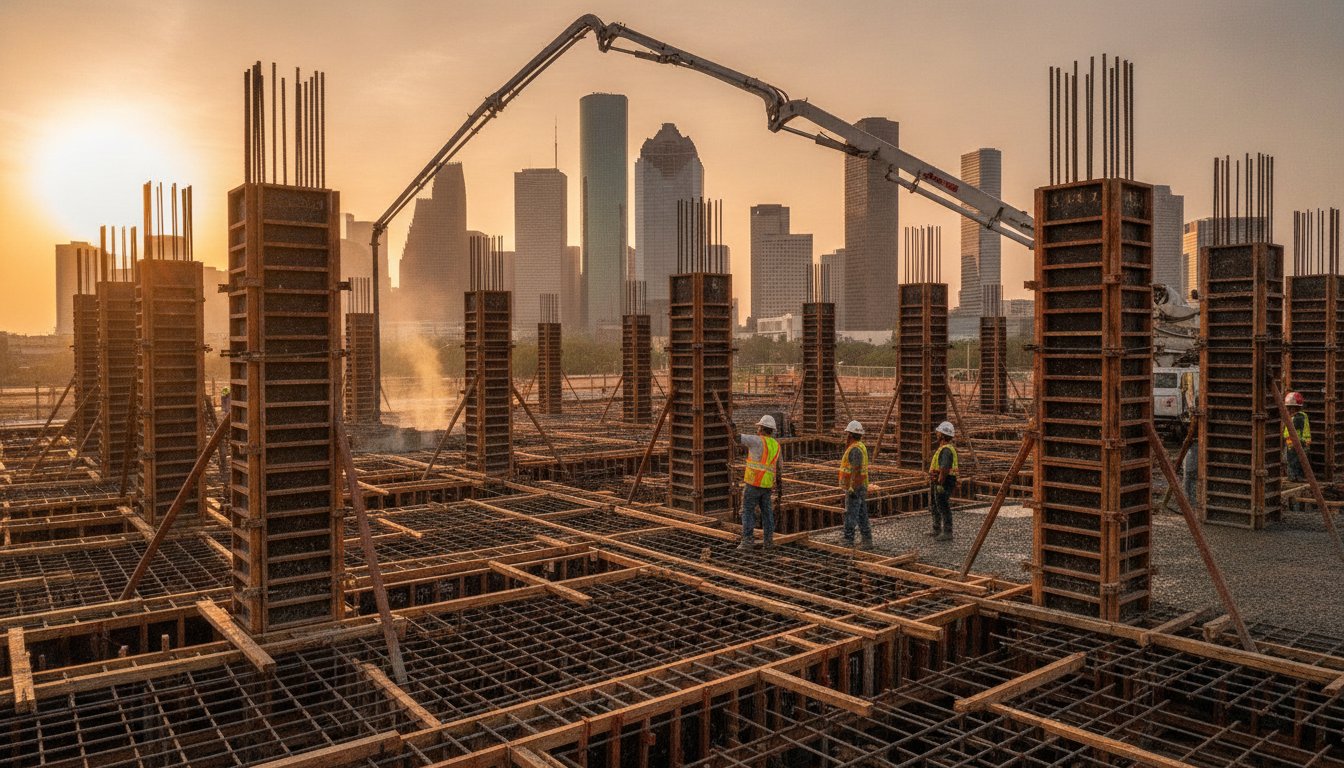
The structural integrity of a Houston high-rise isn't determined solely by the strength of its columns, but by the precision of the transition from raw earth to the finished pour. For developers looking toward 2026, the complexity of structural cast-in-place concrete Houston projects requires more than just a standard contractor; it demands a partner who understands the deep-rooted relationship between soil and structure.
It's a reality that Houston’s expansive clay soil, often called gumbo, remains a constant threat to foundation stability, frequently causing movement that leads to costly long-term repairs. You've likely experienced the frustration of fragmented communication between site prep and structural teams, which inevitably results in uncoordinated schedules and project delays. These gaps in management don't just waste time; they compromise the reliability of the entire build.
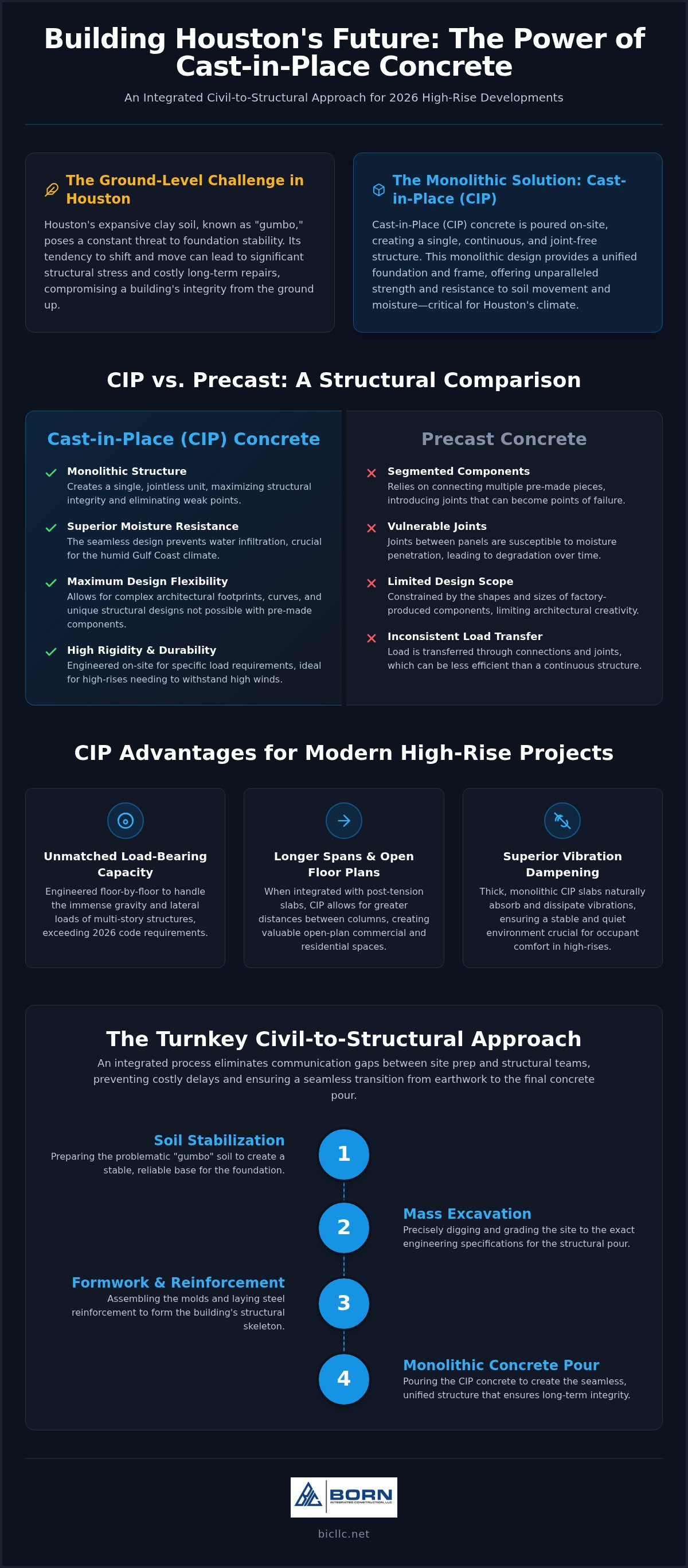
This article explores why cast-in-place concrete remains the gold standard for Houston commercial developments and how an integrated civil-to-structural approach ensures long-term integrity. We'll examine the latest 2026 building codes, the benefits of a monolithic foundation, and the methods used to achieve maximum load-bearing capacity for complex multi-story structures.
Key Takeaways
- Understand why monolithic construction is the preferred solution for meeting 2026 Houston building codes and supporting the load requirements of high-rise structures.
- Compare the durability of cast-in-place foundations against precast alternatives, specifically regarding joint integrity in the Gulf Coast's humid climate.
- Discover how integrated soil stabilization and mass excavation create the essential groundwork for successful structural cast-in-place concrete Houston developments.
- Explore the technical advantages of incorporating post-tension slabs within a CIP framework to achieve longer spans and increased load-bearing capacity.
- Learn how a turnkey civil-to-structural approach eliminates project delays by bridging the gap between site preparation and concrete pouring.
Understanding Cast-in-Place Concrete for Houston Commercial Developments
Cast-in-Place (CIP) concrete is a structural method where the material is poured directly into formwork on the construction site. Unlike modular components, this approach creates a monolithic structure. In the context of structural cast-in-place concrete Houston projects, this means the foundation and frame act as a single, continuous unit. As we look toward 2026, the demand for high-density commercial developments in the Houston metro area has made CIP the preferred choice for engineers who prioritize structural continuity and longevity. This method allows for a seamless transition from the foundation to the vertical elements of a building, ensuring that the entire load-bearing system is unified.
The Process of Site-Poured Structural Concrete
The workflow begins with the precise assembly of formwork, which acts as the mold for the liquid concrete. Once the forms are secured, steel reinforcement is laid according to specific engineering tolerances. The final pour creates a seamless bond that eliminates the joints commonly found in other construction methods. When evaluating Precast concrete vs. cast-in-place, the monolithic nature of site-poured concrete offers superior moisture resistance. It's a critical factor in Houston's humid climate, as it prevents water from infiltrating the structural core. Additionally, CIP allows for maximum architectural flexibility, enabling developers to execute complex footprints that pre-fabricated parts simply can't accommodate.
Why Houston Developers Prioritize CIP in 2026
Current market trends for 2026 show a significant shift toward mixed-use developments that utilize structural podium slabs. These projects often feature retail or parking on the lower levels with residential or hotel units above. This vertical complexity requires the unmatched load-bearing capacity of structural cast-in-place concrete Houston solutions. The durability of CIP is also a primary consideration for high-rise residential towers and hotel structures along the Gulf Coast. These buildings must withstand intense weather patterns and high wind loads. By opting for site-poured concrete, developers ensure their assets meet the updated 2026 safety and quality standards, including the latest ACI CODE-318-25 requirements for structural reinforcement and seismic provisions.
Success in these large-scale builds depends on more than just the material itself. It requires a disciplined management of the details, from initial site preparation to the final cure. Developers often review our past projects to see how this technical precision translates into enduring commercial infrastructure that stands up to the unique challenges of the local environment.
Structural Advantages of CIP Concrete in High-Rise and Mid-Rise Projects
Cast-in-place concrete offers the highest degree of structural rigidity available for vertical expansion in urban environments. In the context of structural cast-in-place concrete Houston developments, this rigidity translates to superior load-bearing capacity that is engineered specifically for the site's unique demands. Engineers have the flexibility to adjust reinforcement densities and concrete PSI levels floor-by-floor. This ensures the structure can handle the specific gravity and lateral load requirements inherent in tall buildings without the limitations of fixed-size pre-fabricated components.
Beyond pure strength, thick CIP slabs provide exceptional vibration-dampening qualities. This is a critical factor for commercial high-rises where occupant comfort depends on a stable, quiet environment. When integrated with post-tension slabs, the CIP framework allows for significantly longer spans between supports. This design freedom eliminates the need for excessive columns, creating the expansive, open floor plans that are highly valued in modern office and residential layouts. Maintaining these high standards requires strict adherence to OSHA requirements for cast-in-place concrete, particularly regarding shoring stability and formwork safety during the critical curing phase.
Podium Slabs and Mid-Rise Structural Framing
Podium decks serve as a structural transfer level, allowing developers to build wood-frame or light-gauge metal residential units above a heavy concrete base. Professional podium slab construction is essential for mixed-use success in Houston, as it facilitates open-concept retail or parking spaces on ground floors while meeting strict fire-separation codes. These multi-story building foundations must be engineered to distribute the massive weight of the upper floors evenly across the site's footprint, preventing the differential settlement that often plagues lesser systems in Gulf Coast soils.
High-Rise Foundation Slabs and Vertical Integrity
For skyscrapers, the foundation mat requires specialized mass-pour techniques to manage the thermal stresses generated during the hydration of large concrete volumes. High-strength concrete mixes are utilized for vertical columns and shear walls to ensure the building maintains its vertical integrity against lateral wind loads. A monolithic pour ensures that the foundation and structural core function as a single, unbreakable unit, which is the primary factor in the structural longevity of Houston skyscrapers. If you're planning a complex multi-story development, you should learn more about our integrated approach to ensuring long-term structural stability.
CIP vs. Precast: Selecting the Foundation for Houston Parking Garages
Selecting between cast-in-place and precast methods for structured parking involves more than just comparing construction timelines. It's a technical decision that impacts the facility's lifecycle. For structural cast-in-place concrete Houston parking garages, the monolithic nature of the build serves as a primary defense against the region's intense humidity. While precast systems rely on sealants and connectors at every joint, a cast-in-place structure eliminates these potential failure points. This unified construction prevents moisture from reaching the internal reinforcement, significantly reducing the risk of corrosion and spalling over decades of use.
In downtown areas where lots are often irregular or constrained by existing infrastructure, the flexibility of site-poured concrete is unmatched. Prefabricated components often require standard dimensions that don't always align with tight urban footprints. CIP allows for a custom-engineered solution that maximizes every square foot of available space. This efficiency doesn't just improve the parking count; it translates into long-term maintenance savings. Owners of CIP structures face fewer costs associated with joint maintenance, waterproofing membrane replacements, and structural grout repairs.
When to Choose CIP for Structured Parking
Developers often see a better return on investment with CIP garages when the project requires a high degree of integration with adjacent structures. If a garage is part of a luxury hotel or a Class A office design, the aesthetic flexibility of CIP allows for seamless architectural finishes. Beyond aesthetics, the fire-resistance ratings inherent in structural cast-in-place concrete Houston designs are naturally superior. The dense, continuous mass of the concrete provides a robust barrier that meets stringent safety codes without the need for additional fireproofing treatments.
Precast Foundation Considerations
While precast systems offer rapid assembly for the upper levels, they're only as stable as the ground-level support. Even when a developer chooses a precast garage, high-quality cast-in-place foundations and footings remain a non-negotiable requirement. These foundational elements must be engineered to handle the concentrated point loads of heavy precast columns. We ensure these sub-structures are poured to exact tolerances, providing the stability required for modular assembly. You can view examples of our garage foundation work on our projects page to see how we bridge the gap between civil prep and vertical construction.
Integrated Site Prep: Soil Stabilization and Mass Excavation for CIP Success
The performance of structural cast-in-place concrete Houston depends entirely on the stability of the subgrade. In this region, the high concentration of expansive clay, known as Houston gumbo, presents a significant risk to structural integrity. Without proper intervention, this soil expands and contracts with moisture changes, applying immense pressure to foundations. This is why professional paving stabilization is critical for Texas soil. By treating the ground before the pour, we ensure the monolithic slab remains level and resistant to the cracking that often occurs on poorly prepared sites. A CIP structure is only as good as the soil stabilization beneath it, as the foundation must act in concert with the earth to support the building's total weight.
Managing Houston’s Expansive Clay
We utilize a combination of chemical and mechanical stabilization techniques to neutralize the reactive properties of local clay. Chemical additives like lime or fly ash are integrated into the soil to reduce its plasticity and swelling potential. This process creates a rigid, moisture-resistant platform that supports the weight of multi-story structures. Mass soil excavation must be precisely managed during this phase. If the excavation depth or slope is incorrect, water retention issues can develop beneath the future structure, leading to foundation heave. Our approach adheres to 2026 standards for subgrade preparation, ensuring that the moisture content of the soil is stabilized and tested before the first formwork is ever placed. Meticulous documentation of these tests provides developers with the confidence that their foundation meets the latest municipal reinforcement requirements.
The Turnkey Civil Advantage
Hiring a single contractor to manage both detention ponds and structural slabs creates a more cohesive project timeline. When the same team handles mass earthwork and concrete construction, there is a natural alignment of goals and technical specifications. Underground utility installation must be meticulously coordinated with structural cast-in-place concrete Houston foundation pours to prevent post-pour conflicts. If these systems aren't mapped correctly during the civil phase, the structural slab may require invasive and expensive modifications later. Integrated civil solutions serve as the elimination of scheduling gaps between site prep and concrete, providing a seamless transition that protects the project's budget and deadline. This unified management style ensures that every phase of the build, from the initial dig to the final structural cure, is executed with a consistent standard of professional integrity.
To ensure your next development sits on a reliable foundation, learn more about our turnkey civil and structural services and how we maintain stability on challenging sites.
Born Integrated Construction: Your Partner for Turnkey CIP in Houston
Born Integrated Construction (BIC) operates on the principle that structural stability begins long before the first yard of concrete is delivered. By bridging the gap between mass soil excavation and structural cast-in-place concrete Houston projects, we eliminate the operational friction that often leads to budget overruns. Our team manages the entire lifecycle of the build, from initial earthwork and detention pond construction to the final structural cure of high-rise foundations. This integrated model provides a level of operational efficiency that fragmented contracting cannot match, ensuring that every phase of the project adheres to a single, uncompromising standard of quality.
We provide these comprehensive services across a broad geographic reach, including the Houston metro area, Conroe, and the Woodlands. Our familiarity with the specific geotechnical challenges across these regions allows us to provide site-specific solutions that anticipate local soil behavior. Whether the project involves a complex CIP parking structure or a mid-rise podium deck, our goal is to deliver a finished product that stands as a testament to professional stability and disciplined craftsmanship.
Our Commitment to Quality and Safety
Safety on a high-rise or garage construction site is non-negotiable. We implement rigorous safety protocols that meet and exceed current standards to protect our personnel and your structural investment. This disciplined approach extends to our business practices; integrity translates to transparent bidding and consistent performance from the initial handshake to the final pour. For a deeper look at the core values that define our organization, visit our About BIC page.
Planning Your 2026 Houston Project
Successful developments in 2026 will require early-stage collaboration between developers and structural partners. By involving us during the planning phase, you can optimize site preparation and structural planning before mobilization begins. This foresight is essential for meeting the load-bearing requirements of modern commercial infrastructure while managing the logistical complexities of urban builds. To begin the process, developers can request a project-based concrete construction fee tailored to their specific technical scope. When you're ready to break ground on a structure that requires structural cast-in-place concrete Houston expertise, contact Born Integrated Construction for your CIP project.
Securing the Future of Houston’s Vertical Infrastructure
The success of commercial development in the Gulf Coast relies on a structural foundation that can withstand environmental pressures and the rigorous demands of high-density use. We've explored how a monolithic approach to structural cast-in-place concrete Houston provides the necessary load-bearing capacity and moisture resistance for 2026 standards. By integrating civil site work with structural pouring, developers can eliminate the scheduling gaps that traditionally lead to project delays.
Our commitment to professional integrity ensures that every project, from mid-rise podium slabs to complex CIP parking structures, is built on a stabilized subgrade engineered for Houston’s unique soil. We prioritize safety and operational efficiency to deliver results that meet the highest technical specifications. When you choose a partner who manages the transition from mass excavation to the final structural cure, you're investing in the long-term viability of your asset.
Partner with Born Integrated Construction for Your Next CIP Project to ensure your development is established on a foundation of reliability and expert craftsmanship. We look forward to building the next generation of Houston infrastructure with you.
Frequently Asked Questions
What is the difference between cast-in-place and precast concrete?
Cast-in-place concrete is poured directly into formwork on the construction site, creating a monolithic structure. Precast concrete is manufactured in a factory and transported to the site for assembly. While precast offers speed, cast-in-place provides superior moisture resistance and architectural flexibility. It eliminates the joints where leaks or structural failures often begin, which is a critical consideration for the humid environment of the Gulf Coast.
Why is cast-in-place concrete better for Houston soil?
Houston’s expansive clay soil, frequently called gumbo, is prone to significant shifting during moisture cycles. The monolithic nature of structural cast-in-place concrete Houston allows the entire foundation to act as a single, rigid unit. This uniformity helps distribute structural loads more effectively and resists the differential settlement that causes cracking. It remains the most reliable method for ensuring the long-term stability of heavy commercial and high-rise developments.
How much does a commercial CIP foundation cost in Houston?
Pricing for structural foundations is determined by the project's valuation and the specific engineering requirements of the site. Factors such as rebar density, the volume of the pour, and the necessity for soil stabilization all impact the final cost. Because structural work requires higher tolerances than standard flatwork, developers should consult with a contractor to obtain a project-specific fee that reflects the 2026 local material rates and labor standards.
Do I need soil stabilization before pouring a concrete slab?
Soil stabilization is a non-negotiable step for any commercial concrete project in the Houston area. Treating the subgrade with chemical additives like lime or utilizing mechanical compaction minimizes the swelling potential of the clay. Without proper stabilization, the ground beneath the slab will move, leading to structural instability and surface cracking. Establishing a firm, moisture-resistant platform is the only way to protect the integrity of the finished concrete pour.
Can Born Integrated Construction handle both excavation and structural concrete?
Born Integrated Construction specializes in a turnkey approach that covers both civil site work and structural concrete. Our capabilities include mass soil excavation, detention pond construction, and the pouring of structural cast-in-place concrete Houston foundations. By managing the transition from dirt work to the final structural pour, we eliminate the scheduling gaps and communication errors that often occur when multiple contractors are involved in the early stages of a build.
What are the benefits of a monolithic concrete pour for high-rises?
A monolithic pour creates a continuous structural frame without the seams or cold joints found in modular construction. This provides superior lateral load resistance, which is essential for skyscrapers facing high wind pressures. Additionally, the dense mass of the concrete offers excellent vibration-dampening qualities, creating a quieter environment for occupants. This unified structural system ensures maximum durability and meets the rigorous safety requirements of the 2026 building codes.
How long does a CIP parking garage take to construct?
The construction duration depends on the total square footage and the complexity of the site footprint. A cast-in-place garage requires a methodical sequence of formwork assembly, reinforcement placement, and curing for each level. Although this process is more time-intensive than precast assembly, it results in a more durable structure with lower maintenance costs. The absence of joints reduces the need for frequent waterproofing repairs and structural grout maintenance over the building's lifespan.
Is CIP concrete fire-resistant for commercial buildings?
Structural concrete is inherently fire-resistant and serves as a natural barrier against the spread of flames and heat. It does not require the additional fireproofing sprays or coatings that steel structures often need to meet municipal safety standards. This resistance allows the building to maintain its structural integrity for longer periods during an emergency. For developers of high-density residential or hotel projects, this built-in safety feature provides a significant advantage in both cost and occupant protection.