Mass Soil Excavation Contractor in Texas: Precision Earthwork for 2026 Developments
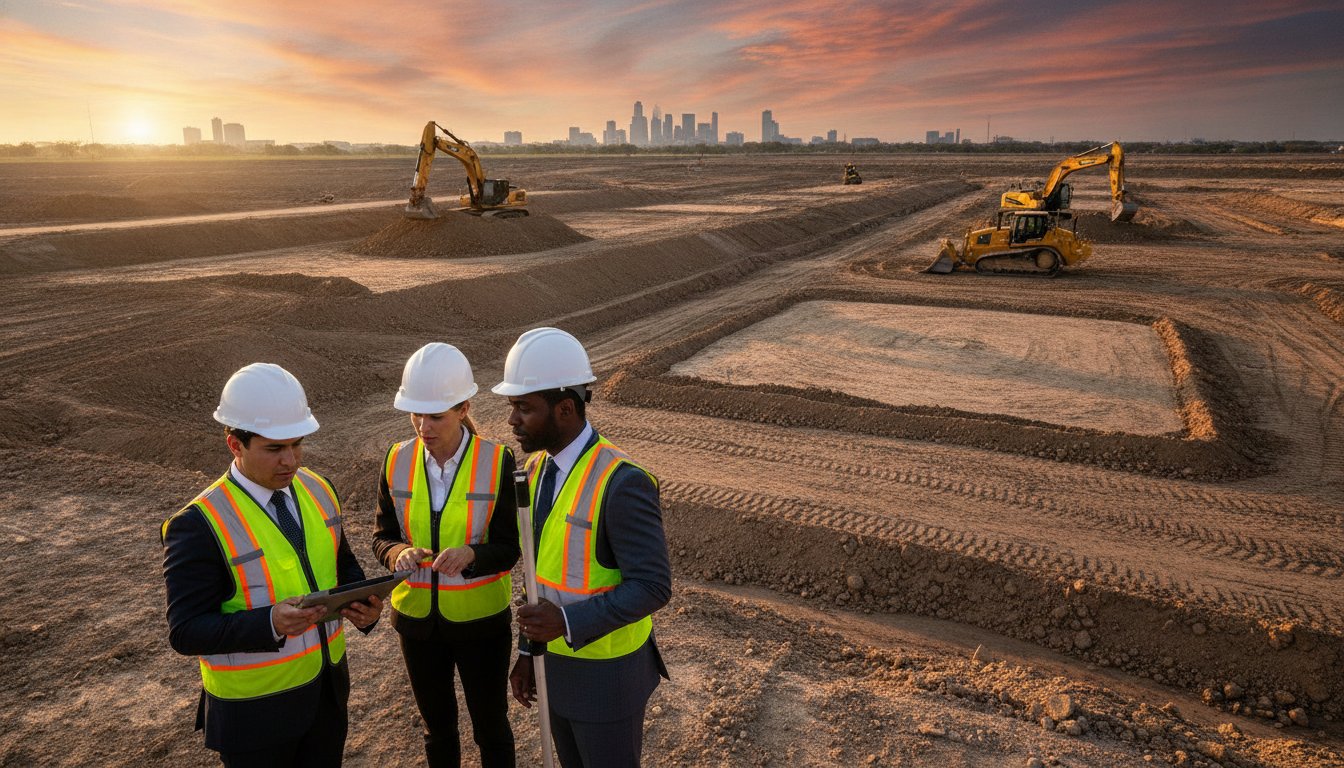
In the high-stakes environment of Texas commercial development, mass excavation is far more than a preliminary dirt phase; it is the fundamental first stage of structural concrete engineering. You understand that a project's long-term viability depends on the precision of the initial earthwork, yet many developers still face unnecessary delays caused by third-party equipment shortages or poor coordination between excavation and utility subcontractors. These inefficiencies don't just waste time. They create risks for soil instability and future foundation cracks that can compromise an entire investment.
By partnering with an integrated mass soil excavation contractor Texas firms trust, you can secure a site that is graded to plan and stabilized for enduring paving durability. This article outlines how professional earthwork and turn-key civil solutions compress project timelines while ensuring full compliance with 2026 Texas environmental and drainage regulations. We will examine the technical standards required for modern developments and the methodical approach needed to manage a project pipeline effectively in a market where the regional backlog now averages nine months. Discover how steadfast operational precision at the start of a project establishes the security your stakeholders require.
Key Takeaways
- Understand why mass excavation serves as the structural foundation of your project, protecting against future foundation cracks and soil instability.
- Learn the 2026 standards for elevation control and how rigorous benchmarks ensure the long-term durability of your site.
- Discover the operational benefits of hiring an integrated mass soil excavation contractor Texas firms rely on to bridge the gap between earthmoving and concrete paving.
- Stay compliant with Texas environmental mandates through a methodical approach to SWPPP implementation and erosion control.
- Explore how turn-key civil solutions streamline project timelines by coordinating mass grading with underground utility installation.
Understanding Mass Soil Excavation for Texas Commercial Sites
Mass soil excavation involves the large-scale removal, movement, or addition of earth to reach a specific sub-grade. It's the invisible backbone of every commercial build. While concrete and steel receive the most attention, the earthwork beneath them dictates the project's long-term viability. A qualified mass soil excavation contractor Texas developers trust doesn't just move dirt; they engineer the site's future. This process serves as the unsung hero of structural integrity, providing the literal foundation upon which all other site work rests.
Industrial mass excavation requires a level of precision and heavy equipment that far exceeds standard residential grading. It involves moving thousands of cubic yards of material to create a stabilized platform for massive warehouses, retail centers, or midrise foundations. The scale of these operations demands a methodical approach to ensure that the site remains graded to plan and stabilized for long-term paving durability. Poor execution at this stage often leads to drainage failures and foundation cracks that are costly to remediate once construction is complete.
The Challenge of Texas Soils: From Clay to Limestone
Texas geography presents unique obstacles that vary significantly by region. In the Houston area, developers contend with "Houston Gumbo," a highly expansive clay that swells and shrinks with moisture changes. Without proper excavation and stabilization, this soil can exert enough pressure to crack heavy-duty concrete paving. Conversely, in the Rocky Hill Country, the challenge shifts to limestone and rocky terrain, requiring different machinery and specialized techniques to achieve the desired sub-grade.
Every successful project begins with rigorous soil testing before the first bucket hits the ground. Understanding the chemical and physical properties of the site ensures the structural integrity of the final build. A steadfast commitment to these early technical details is what separates a professional operation from a standard dirt mover. You can learn more about our approach to these complex site challenges on our about page.
Mass Excavation as a Structural Precursor
Within the civil engineering scope, Earthworks (engineering) establishes the critical path for the entire project schedule. If the sub-grade isn't achieved on time and with absolute precision, every subsequent trade faces delays. In a market where the regional backlog for contractors averages nine months as of 2026, these delays are particularly damaging to your bottom line. Precise sub-grade preparation is non-negotiable for commercial concrete paving. If compaction is improper, the resulting settlement leads to drainage failures and structural cracks. This degrades the long-term infrastructure ROI. Choosing an experienced mass soil excavation contractor Texas provides a sense of security that the foundation is established correctly from day one, protecting your investment for decades to come.
The Mass Grading and Earthwork Process: A 2026 Standard
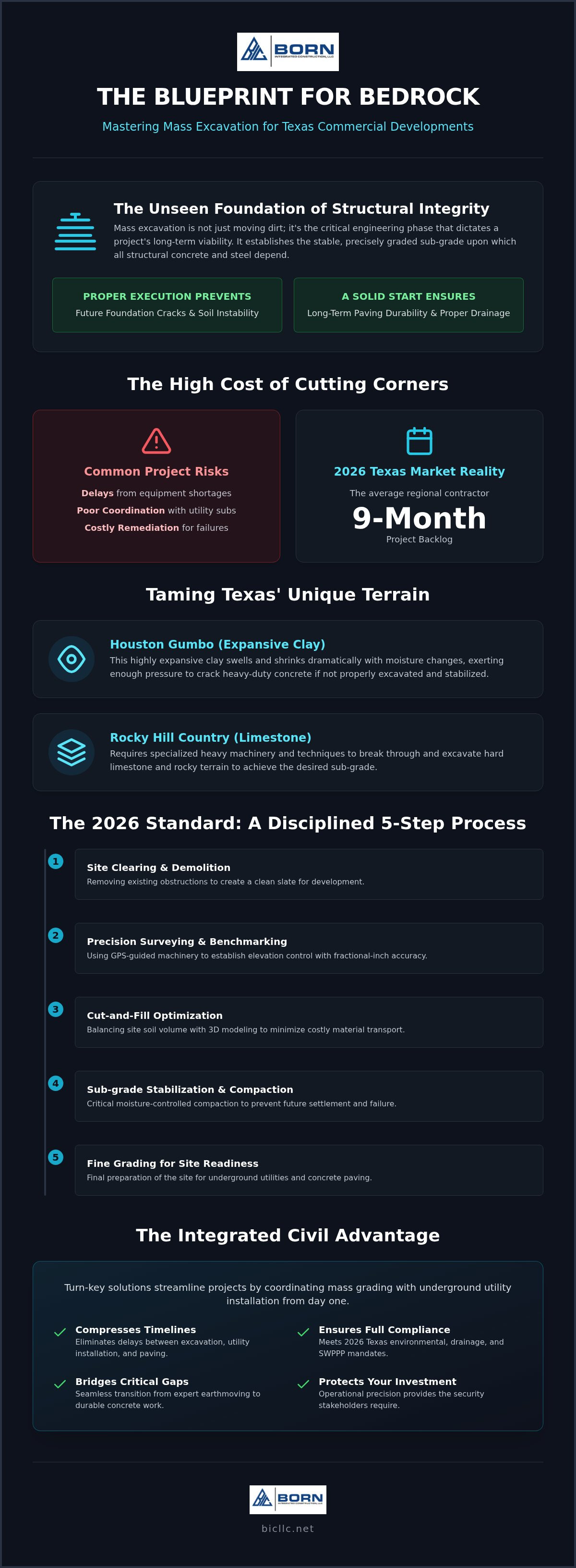
Executing a large-scale project requires a methodical sequence to ensure structural integrity. A professional mass soil excavation contractor Texas follows a disciplined five-step protocol to transform raw land into a buildable site. This process begins with site clearing and the demolition of existing obstructions to provide a clean slate for development. Next, precision surveying establishes corner benchmarks. These benchmarks provide the elevation control necessary for accurate grading, utilizing GPS-guided machinery to achieve tolerances within fractions of an inch.
The third phase involves executing a cut-and-fill plan. This balances the site's soil volume to minimize the need for imported material. Once the rough grade is established, sub-grade stabilization and moisture-controlled compaction begin. This stage is critical for preventing future settlement. Finally, fine grading prepares the site for underground utilities and concrete paving. Each step is a technical execution that requires unwavering consistency to protect the project's long-term viability.
Cut-and-Fill Optimization
Minimizing off-site soil transport costs is a priority for any project manager. Efficient site balancing through 3D modeling allows us to visualize the earthwork before the first machine moves. This technology ensures that soil stockpiles are managed effectively, maintaining site accessibility for other subcontractors. It's a logistical challenge that requires constant oversight and operational precision. By balancing the site internally, we reduce the environmental impact and the costs associated with hauling material across busy Texas corridors.
Compaction and Soil Stabilization
In many parts of Texas, high-plasticity clays demand specialized treatment. Paving stabilization using lime or cement creates a durable, moisture-resistant base. This step is the secret to the longevity of heavy-duty roads and parking lots. We verify all compaction through rigorous testing protocols to ensure the sub-grade meets specific engineering PSI requirements. This methodical approach instills confidence that the infrastructure will withstand the rigors of industrial use. If you're planning a complex development, you can learn more about our standards for site preparation and our commitment to high-quality results.
The Integrated Civil Advantage: Excavation to Concrete
The transition from earthmoving to structural placement represents the most volatile phase of a commercial project. When you separate these scopes between different vendors, you invite logistical friction that often results in "sub-gap" delays. These are periods of inactivity where the site is technically ready for the next phase, but scheduling conflicts or technical misunderstandings keep the concrete crew from mobilizing. Choosing an integrated mass soil excavation contractor Texas developers trust ensures that the team moving the dirt is the same team responsible for the final slab.
This unified approach allows structural concrete knowledge to inform every excavation decision. Our operators understand the precise tolerances required for concrete paving and slab-on-grade work. They don't just clear a path; they engineer a sub-grade that supports the specific PSI requirements of the finished product. An integrated mass soil excavation contractor Texas provides the oversight needed to prevent common civil engineering pitfalls, such as trench failures or utility strikes, because the same management team oversees both the underground infrastructure and the surface grading.
Streamlining the Project Timeline
The Turn Key Civil model manages the entire progression from raw earth to a finished slab. It eliminates the common practice of finger-pointing between separate earthwork and concrete crews when grading doesn't meet specifications. For large-scale residential and infrastructure developments, this model provides a cost-effective solution by reducing the management overhead required to coordinate multiple subcontractors. It's a methodical way to compress the project schedule without sacrificing the craftsmanship that ensures long-term viability.
Managing Underground Infrastructure
Coordinating storm sewer and sanitary line installation during the grading phase is essential for a site's drainage integrity. A major component of this is detention pond construction, which must be executed with precision to manage runoff and comply with Texas environmental regulations. When excavation and utility work are handled by a single partner, domestic water systems and other underground assets are protected during heavy equipment maneuvers. This level of coordination is the only way to maintain a safe, organized job site that delivers consistent value to stakeholders.
Compliance and Site Readiness Checklist for Texas Developers
Maintaining compliance is a technical necessity that protects your project from regulatory fines and environmental liabilities. A steadfast mass soil excavation contractor Texas firms rely on manages these requirements with methodical precision. In 2026, the Texas Commission on Environmental Quality (TCEQ) has increased its focus on the accuracy of Stormwater Pollution Prevention Plan (SWPPP) documentation and the timely stabilization of inactive areas. Proper implementation isn't a one-time event; it requires ongoing maintenance to protect the surrounding habitat and ensure site readiness.
Before transitioning to the structural phase, every developer should verify the following site conditions:
- SWPPP Maintenance: Silt fences, rock filter dams, and inlet protection must be inspected and repaired after every significant rain event.
- Erosion Control: Soil stockpiles and disturbed areas must be stabilized according to TCEQ TXR150000 Construction General Permit standards.
- Basin Verification: Detention and retention ponds must be excavated to exact engineering volumes to comply with municipal drainage requirements.
- Fine Grading: The final sub-grade must be verified against benchmarks to ensure it meets the tolerances required for concrete paving.
Environmental and Drainage Standards
Meeting TCEQ requirements is a baseline, but Texas-sized storm events demand more robust engineering. Detention ponds are designed to manage high-velocity runoff, protecting both your site and the local infrastructure. In 2026, sustainable soil management practices focus on balancing the site to reduce the carbon footprint of hauling material. These standards ensure that your project remains compliant while contributing to the long-term viability of the regional environment. If you're preparing for a new development, you can view our previous civil projects to see these standards in practice.
Safety and Quality Assurance
Born Integrated Construction prioritizes safety in deep excavation and trenching through rigorous shoring protocols and daily site inspections. We don't take shortcuts when lives and infrastructure are at stake. Our team conducts daily equipment maintenance checks to prevent mechanical failures that could cause delays or safety hazards. This disciplined approach ensures that when we reach the final checklist, the site is truly ready for the structural concrete phase. It's a level of thoroughness that instills confidence in every stakeholder involved. For more information on our safety standards, learn more about our team and our commitment to professional excellence.
Born Integrated Construction: Your Texas Site Work Partner
Reliability in the Texas construction market is built on a foundation of substance and proven results. Born Integrated Construction (BIC) operates with a steadfast commitment to integrity, ensuring that every project phase meets our high standards for precision. As a premier mass soil excavation contractor Texas developers depend on, we provide the professional stability required to manage complex civil scopes. Our team serves the major corridors from Houston and Austin to San Antonio and Dallas, bringing local expertise to every job site we manage.
The BIC fleet consists of modern, specialized equipment maintained to rigorous standards for safety and efficiency. These machines are operated by seasoned Texas professionals who understand the nuances of regional soil conditions and environmental mandates. We don't just provide labor; we offer a disciplined partnership focused on the enduring nature of our work. This approach allows us to deliver consistent value while maintaining a safe and highly organized operational environment. Our use of GPS-guided technology ensures that earthmoving is executed exactly to your engineer's specifications.
Our Proven Performance in Texas
General contractors trust BIC because we deliver reliable results for high-rise foundations and heavy-duty commercial roads. In a market where labor shortages and material costs can create volatility, our consistent performance offers a sense of security. We prioritize the technical management of details, ensuring the site is perfectly prepped for structural concrete and paving. Our attentive service and focus on craftsmanship have made us a preferred partner for those who value long-term infrastructure ROI. By coordinating mass grading with utility installation, we eliminate the friction points that typically stall a project. You can see the breadth of our capabilities by exploring our civil project portfolio.
Get Started with Your Site Evaluation
Initiating a partnership with BIC begins with a thorough evaluation of your site's specific requirements. We approach project-based concrete and civil construction fees with transparency, providing a clear understanding of the scope and technical demands. Whether you require site preparation in Conroe, The Woodlands, or the surrounding metropolitan areas, our team is ready to provide a methodical bid for your development. We invite you to learn more about our team and how we maintain high standards across every project we touch. Our grounded approach ensures that your site work is completed on time and within the regulatory requirements of 2026.
Partner with Born Integrated Construction for your next Texas project.
Establishing a Reliable Foundation for 2026 Developments
The success of a 2026 commercial development depends on the technical precision established during the initial earthwork phase. By integrating mass grading with structural concrete and utility installation, you create a seamless transition that protects your project's timeline and long-term viability. This methodical approach ensures that your site is not only compliant with evolving Texas drainage regulations but also stabilized for the heavy-duty demands of commercial infrastructure. Selecting an experienced mass soil excavation contractor Texas provides the professional stability needed to manage these complex civil scopes across the Houston, Austin, San Antonio, and Dallas corridors.
Born Integrated Construction remains committed to a safety-first culture and high-register craftsmanship, delivering consistent value from the first cut to the final slab. Our integrated civil expertise allows us to anticipate site challenges before they cause delays, instilling confidence in every stakeholder involved. We invite you to Request a Turn-Key Civil Bid from Born Integrated Construction to secure a dependable partner for your next site development. We look forward to establishing a lasting foundation for your professional output and ensuring your project's enduring success.
Frequently Asked Questions
What is the difference between mass grading and site excavation?
Mass grading involves the large-scale movement of earth to establish a consistent sub-grade across a wide area, while site excavation typically refers to targeted digging for specific structures like foundations or utility trenches. Mass grading is the macro-phase of earthwork that balances the site's volume. Site excavation is the micro-phase focusing on specific architectural footprints. Both are essential, but mass grading establishes the primary elevation control for the entire development.
How does Texas soil affect mass excavation costs?
Texas soil conditions directly influence the machinery and stabilization methods required for a project. Working with high-plasticity clays in the coastal plains necessitates moisture-controlled compaction and potential chemical additives to prevent expansion. In contrast, the rocky terrain of the Hill Country often requires specialized breaking equipment for limestone. These regional variations dictate the operational hours and material handling strategies, making it essential to partner with a mass soil excavation contractor Texas experts trust for local soil knowledge.
Why is soil stabilization necessary after mass excavation?
Soil stabilization provides a moisture-resistant and load-bearing platform that prevents future foundation settlement. In regions with expansive soils, simply reaching the sub-grade isn't enough to ensure structural integrity. Chemical stabilization using lime or cement alters the soil's physical properties, reducing its shrink-swell potential. This process is critical for the long-term durability of concrete paving and slabs, protecting the infrastructure from the shifting ground conditions common across major Texas corridors.
Does BIC handle detention pond construction alongside mass grading?
Born Integrated Construction provides detention pond construction as a core component of our turn-key civil solutions. We coordinate the excavation of these basins with the broader mass grading plan to ensure proper site drainage and regulatory compliance. This integrated approach allows us to manage runoff effectively during construction while establishing the permanent stormwater infrastructure required by municipal codes. Our team ensures that every pond meets exact engineering volumes to protect the site and surrounding habitat.
How long does a typical mass soil excavation project take in Texas?
A typical project duration depends on the total acreage, the volume of earth moved, and regional weather patterns. Small commercial sites may reach a finished sub-grade in three to five weeks, while large-scale industrial developments can span several months. Our methodical planning and use of a modern fleet help compress these timelines. We prioritize operational efficiency to ensure the site is ready for the structural concrete phase without compromising our safety or quality standards.
What is an "integrated" civil contractor and why does it matter?
An integrated civil contractor manages the entire progression from raw earthwork to finished structural concrete. This model matters because it eliminates the logistical gaps and delays that occur when multiple vendors must coordinate schedules. By choosing an integrated mass soil excavation contractor Texas developers benefit from unified site management. This approach reduces the risk of utility strikes and ensures that the sub-grade is perfectly prepared for the specific requirements of the final concrete paving.
How do you manage erosion control during large-scale excavation?
We manage erosion control through the strict implementation of a Stormwater Pollution Prevention Plan (SWPPP). This includes installing silt fences, rock filter dams, and inlet protection to contain sediment within the site boundaries. Our team conducts regular inspections after significant rain events to maintain these controls and ensure compliance with TCEQ standards. These practices protect local water systems and prevent environmental liabilities, maintaining a clean and organized job site throughout the duration of the earthwork phase.
Does BIC provide mass excavation for residential developments?
Born Integrated Construction provides mass excavation for large-scale residential developments, focusing on the infrastructure and site readiness phases. We specialize in the earthwork required for community roads, detention basins, and foundational pads for multi-family structures. While we don't perform individual residential driveway repairs, our turn-key civil services are ideal for developers building new neighborhoods or high-density housing projects. We bring the same level of professional stability and technical precision to residential infrastructure that we apply to industrial sites.