Commercial Concrete Slab Guide for Texas Developers
A commercial foundation's failure rarely begins with the concrete pour; it starts with a fundamental disconnect between the site's geology and the structural design. In regions like Dallas or Houston, the high plasticity of expansive clay can exert thousands of pounds of pressure against a building's footprint, leading to premature cracking and costly structural compromises. You likely recognize that uncoordinated civil and concrete teams are the primary drivers of project delays and quality gaps. Selecting a structural concrete slab contractor Texas developers trust requires looking beyond the price per square foot to find a partner who understands the synergy between soil stabilization and cast-in-place engineering.
This guide provides a framework for evaluating partners who prioritize high-performance results and long-term structural integrity. You'll learn how to identify firms that offer single-source accountability for everything from mass excavation to the final finish. We'll also cover the technical requirements for ACI compliance and the logistical precision needed for complex mid-rise and high-rise foundations. By the end of this article, you'll have the criteria necessary to secure a foundation that meets the highest standards of professional stability.
Key Takeaways
- Identify the operational risks of uncoordinated site work and how an integrated approach eliminates communication gaps between excavation and concrete teams.
- Evaluate the engineering differences between slab on grade and elevated podium slabs to ensure appropriate load-bearing capacity for diverse commercial applications.
- Understand the critical role of soil stabilization in preventing structural cracking within the expansive clay environments of Houston, Austin, and San Antonio.
- Learn the essential performance metrics for high-rise foundations, including safety protocols and the precise management of concrete curing in Texas humidity.
- Determine how to select a structural concrete slab contractor Texas developers trust for turnkey accountability across mass excavation and complex cast-in-place structures.
Selecting a Structural Concrete Slab Contractor for Texas Infrastructure
Texas commercial growth is currently driven by massive investments in data centers, semiconductor facilities, and high-tech manufacturing. These structures demand foundations that do not just meet minimum codes but exceed them for long-term durability. Identifying the right structural concrete slab contractor Texas offers is a decision that impacts the entire lifecycle of the asset. It requires a partner who brings professional stability to the jobsite and maintains a steadfast focus on project management from pre-construction through the final pour.
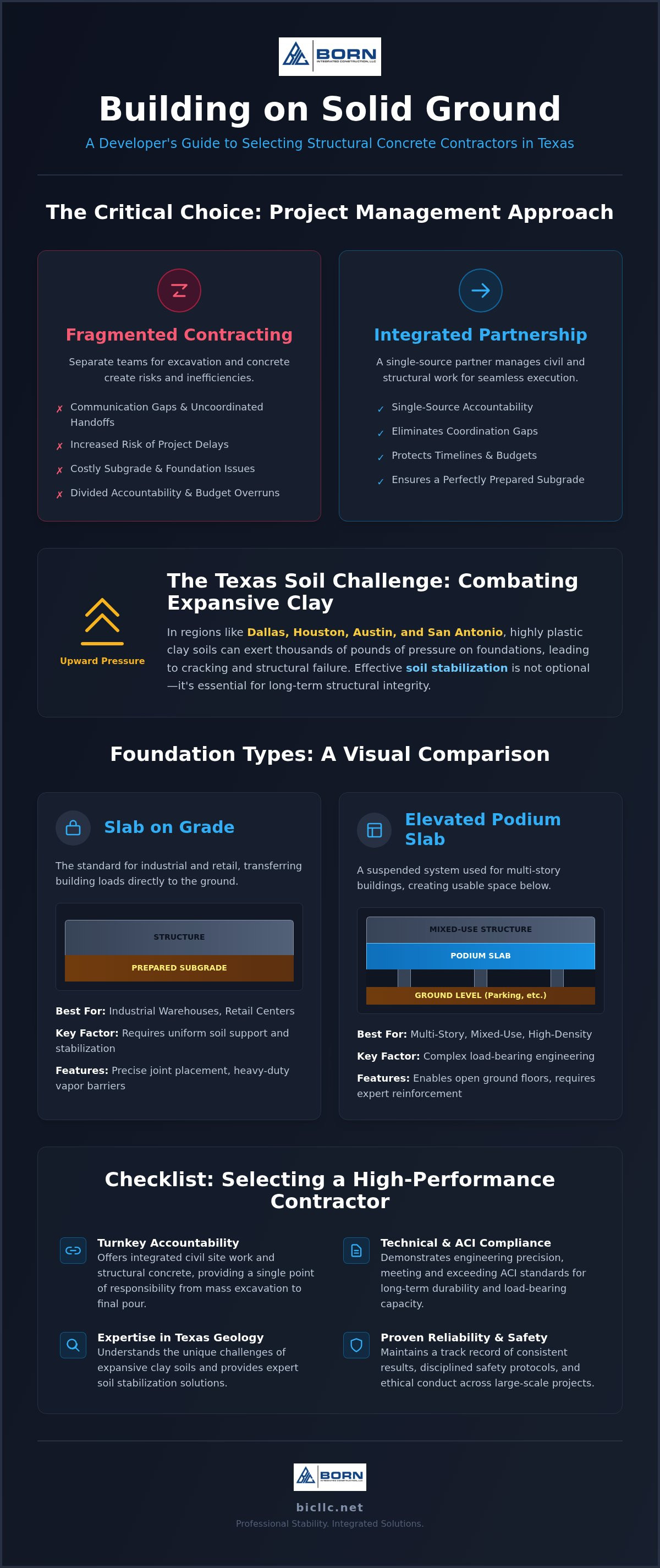
Fragmented contracting is a common pitfall in large-scale developments. When separate firms handle mass excavation and concrete construction, the risk of uncoordinated handoffs increases. This often results in subgrade issues that the concrete team must then address on the fly, leading to delays. An integrated firm eliminates these gaps. By managing both the civil site work and the structural concrete, a single-source partner provides accountability that protects the developer's timeline and budget while ensuring the subgrade is perfectly prepared for the slab.
The Impact of Slab Quality on Long-Term Building Viability
Structural concrete serves as the load-transferring backbone of any commercial development. If a concrete slab is improperly engineered, the resulting deficiencies can lead to multi-million dollar remediation projects. Building viability depends on the precise relationship between concrete thickness, reinforcement placement, and the specific load-bearing requirements of the facility. In regions like Houston or Dallas, where soil movement is a constant threat, these technical details determine whether a building remains stable or develops structural cracking. High standards in craftsmanship ensure that the slab can endure heavy daily use without compromising the building's integrity.
Reliability and Craftsmanship in Large-Scale Foundations
True craftsmanship goes beyond the low bid. It involves ethical conduct in material sourcing and a disciplined approach to safety and equipment maintenance. A contractor's reliability is proven through their ability to deliver consistent results across major Texas metros, from San Antonio to Austin. This consistency reduces liability for developers and ensures that aggressive construction schedules are met without sacrificing quality. Attentive service means that potential issues are identified and resolved before they impact the critical path. You can explore our history of steadfast execution on our projects page to see how we maintain these standards across diverse project types.
Evaluating Structural Varieties: Slab on Grade vs. Podium Slabs
Choosing the appropriate structural system is a decision based on the building's density and its intended load. A structural concrete slab contractor Texas developers trust must be proficient in both ground-supported and suspended systems. While the primary goal is always structural integrity, the engineering requirements for a single-story industrial warehouse differ vastly from those of a multi-story mixed-use development. Understanding these distinctions ensures that the foundation is neither under-engineered for its loads nor unnecessarily costly. Each variety requires a specific approach to load-bearing calculations and reinforcement strategies to maintain professional stability over time.
Slab on Grade: The Standard for Industrial and Retail
Slab on grade foundations are the most common choice for industrial and retail structures where the building's weight is transferred directly to the prepared subgrade. In these applications, durability is paramount. The Portland Cement Association (PCA) notes that the performance of these floors depends heavily on uniform soil support. To maintain high standards in high-traffic environments, we focus on precise joint placement and the installation of heavy-duty vapor barriers. These components prevent moisture migration and control the natural shrinkage of the concrete. For those managing logistics-heavy sites, exploring our insights on commercial concrete paving in Conroe provides further technical depth on heavy-duty infrastructure.
Podium Slabs and CIP Solutions for Midrise Mixed-Use
Urban developments in Texas increasingly utilize podium slabs to maximize land value. A podium deck is an elevated structural slab that supports several levels of lighter-framed construction above it, typically retail or parking. Cast-in-place (CIP) concrete is the preferred method for these structures because it creates a monolithic foundation that offers superior resistance to lateral forces. Post-Tension (PT) slabs are often integrated into these designs. By using high-strength steel tendons to compress the concrete, PT slabs allow for thinner profiles and wider column spacing. This flexibility is essential for modern architectural designs that require open retail spaces or efficient parking layouts.
When evaluating foundation components, developers must weigh the initial costs of precast elements against the long-term benefits of cast-in-place concrete. While precast can offer faster installation in some scenarios, CIP foundations provide a level of structural continuity that's difficult to match. The ability to pour a single, continuous structure reduces the number of joints and potential points of failure. This steadfast approach to construction is particularly valuable in the volatile soil conditions found across the Texas landscape. Engaging an expert podium slab contractor in Houston ensures that these complex elevated systems are executed with the necessary precision. If you're weighing the benefits of different foundation types, reaching out to a dependable partner can clarify the most stable path forward for your specific site.
Key Performance Metrics for High-Rise and Mid-Rise Foundations
As commercial developments scale vertically, the technical demands on the foundation increase exponentially. A structural concrete slab contractor Texas developers partner with must demonstrate more than just technical ability; they must exhibit operational precision in every phase of the project. This is especially true for mid-rise and high-rise structures where the foundation must support immense vertical loads while resisting lateral forces. Success in these high-stakes environments is measured by specific performance metrics that prioritize safety, adherence to engineering standards, and logistical efficiency.
Prioritizing Safety and Risk Mitigation
A grounded safety culture is a prerequisite for any structural concrete project, particularly those involving CIP garages and high-rise foundations. One of the most objective measures of this commitment is the Experience Modification Rate (EMR). A low EMR indicates a history of safe operations and directly correlates with lower insurance premiums and reduced liability for the developer. Meticulous safety training for specialized crews isn't just a regulatory requirement; it's a fundamental part of protecting the project's long-term viability. Operational precision is the disciplined management of concrete chemistry and placement. By maintaining rigorous safety protocols, a contractor ensures that the site remains productive and free from the litigation risks associated with workplace accidents. This focus on reliability is central to how we operate, as detailed on our about page.
Technical Proficiency in Cast-in-Place (CIP) Structures
Managing the logistics of a continuous pour for a large-scale commercial slab requires a level of coordination that few firms can maintain. In the Texas heat, managing concrete curing and leveling becomes a race against time and humidity. Adherence to American Concrete Institute (ACI) standards ensures that the chemical composition and structural reinforcement of the slab meet the necessary specifications for high-rise loads. These standards provide a framework for professional stability, ensuring the structure can withstand the unique environmental pressures of the region.
Technical proficiency also extends to the finished surface. Achieving high-tolerance floor flatness (FF) and floor levelness (FL) is essential for modern commercial spaces, where automated systems or specialized flooring require a perfectly level base. This requires specialized equipment and a team capable of executing complex pours with unwavering consistency. Whether constructing complex retaining walls or deep footings, the integrity of the engineering must be matched by the quality of the execution. Developers seeking a partner with a proven track record of such precision can review our history of successful high-density builds on our projects page. Mobilization efficiency is a core requirement for a structural concrete slab contractor Texas organizations trust to manage multi-phase timelines without sacrificing the steadfast standards required for structural concrete.
The Texas Advantage: Integrating Civil Site Work and Soil Stabilization
Structural failures in Houston and Austin often stem from the ground up, not the concrete down. The expansive clay soils characteristic of the region expand and contract with moisture changes. A structural concrete slab contractor Texas developers trust must treat the subgrade as the most critical component of the build. Without proper stabilization, even the highest strength concrete will eventually succumb to differential settlement. This grounded approach to site preparation ensures that the foundation remains stable throughout the life of the structure.
Integrating civil site work with structural concrete eliminates the communication gaps that often plague large-scale developments. When a single firm manages mass excavation and soil stabilization, they provide a level of accountability that fragmented teams cannot match. This coordination is essential for maintaining aggressive timelines and ensuring that the subgrade is perfectly prepared for the structural pour. By synchronizing these phases, we establish a foundation that is as reliable as the structures it supports.
Soil Stabilization: The Secret to Long-Lasting Slabs
The science of stabilization involves modifying the soil's chemical or mechanical properties to create a level, unyielding base. In Texas, this often involves treating expansive clay with lime or cement to reduce its plasticity index. By creating a predictable subgrade, we ensure the structural concrete performs according to its engineering design. This process is essential for preventing the shifting that leads to surface cracking and structural instability in large-scale commercial foundations. Mechanical stabilization, such as moisture-conditioned compaction, provides additional security against seasonal environmental changes.
Mass Excavation and Detention Pond Integration
Operational efficiency is maximized when mass soil excavation and structural framing are managed by a single partner. This integration allows for the seamless installation of underground utilities, including storm, sanitary, and water lines, alongside the slab schedule. Coordinating these efforts prevents the common delays caused by uncoordinated civil and concrete crews. Managing site readiness also involves the strategic design and placement of detention ponds. These features are not merely regulatory requirements; they protect the site's structural integrity by managing runoff and preventing erosion around the foundation. You can learn more about BIC’s integrated projects to see how we synchronize these complex civil and concrete tasks.
A project's long-term viability depends on a foundation built with operational precision from the first scoop of dirt. To secure a partner who understands the deep-rooted commitment required for Texas infrastructure, contact a seasoned structural concrete professional today.
Born Integrated Construction: Turnkey Structural Solutions
Born Integrated Construction (BIC) operates on the principle that a building's success is inseparable from the integrity of its site preparation. As a premier structural concrete slab contractor Texas developers rely on, we provide a unified approach that spans the entire lifecycle of a foundation. Our footprint covers the primary growth hubs of Houston, Austin, San Antonio, and Dallas, ensuring that local geological challenges are met with proven engineering solutions. We don't just pour concrete; we establish the enduring nature of your professional output through meticulous management and a focus on long-term viability. Our "Born Integrated" philosophy brings a sense of security to complex sites by aligning mass excavation, soil stabilization, and structural framing under one disciplined authority.
Comprehensive Capabilities from Earthwork to High-Rise CIP
Our service suite is designed to handle the multi-faceted complexity of modern commercial and residential builds. Whether the project requires slab on grade, podium slabs, or intricate CIP midrise and highrise foundations, we maintain single-source accountability. This integration is particularly vital when managing the nuances of structured concrete parking garages or cast in place concrete hotel structures. We possess the technical proficiency to execute both precast garage foundations and cast-in-place garage structures, ensuring that the transition from earthwork to structural framing is seamless. Our expertise also extends to specialized applications like thin shell cast-in-place concrete and heavy-duty concrete paving. By offering turnkey civil and structural services, we eliminate the friction points that typically arise when multiple vendors attempt to coordinate subgrade stabilization with concrete construction.
Partnering with BIC for Your Next Texas Development
Engaging our team means choosing a disciplined professional who values substance over style. Our methodical approach to project execution begins with a comprehensive site and structural evaluation that considers every variable from detention ponds to retaining walls. This process ensures that every bid and schedule is rooted in the reality of the site's specific needs, allowing us to maintain the aggressive timelines required in the current market. We prioritize transparency and operational efficiency, providing a steady and predictable experience for our partners throughout the construction process. This steadfast commitment to high standards is what defines our role as a quiet leader and a dependable structural concrete slab contractor Texas developers trust. To understand the principles and ethical framework that guide our work, we invite you to learn more about Born Integrated Construction.
Secure Your Project's Future with Integrated Structural Excellence
The success of a commercial development is determined by the stability of its earliest stages. You've learned that a high-performance slab requires more than just a quality pour; it demands a synergy between soil stabilization and structural engineering. By integrating civil site work with foundation construction, developers eliminate the communication gaps that frequently lead to project delays. Whether you're managing a complex podium deck or a large-scale industrial facility, selecting a structural concrete slab contractor Texas organizations trust is the most critical step toward long-term viability.
Born Integrated Construction offers specialized expertise in CIP garages and high-rise foundations, backed by a steadfast commitment to safety and operational precision. Our integrated approach to earthwork and concrete construction provides a single source of accountability for your most demanding projects. We maintain a consistent presence across Houston, Austin, and San Antonio, delivering foundations built on a legacy of craftsmanship and integrity. Partner with Born Integrated Construction for your next structural project to ensure your development stands on a foundation of professional stability. We look forward to building a lasting legacy with you.
Frequently Asked Questions
What is the difference between a residential and a commercial concrete slab?
Commercial slabs differ from residential ones primarily in their engineering for load-bearing capacity and long-term durability. While a residential slab might support a light vehicle, a commercial slab must withstand heavy machinery and high-traffic volume. These slabs typically utilize a higher PSI concrete mix and more dense reinforcement layouts. A structural concrete slab contractor Texas projects require will ensure the design meets specific industrial standards for thickness and subgrade preparation to prevent structural failure.
How thick should a commercial concrete slab be for heavy-duty industrial use?
Heavy-duty industrial slabs usually range from six to twelve inches in thickness, depending on the specific equipment and storage loads they must support. For example, a warehouse with high-rack storage or heavy forklift traffic requires a thicker profile than a standard retail space. Engineering calculations determine the final depth, often incorporating #4 or #5 rebar to enhance tensile strength. This ensures the slab remains stable under the constant pressure of industrial operations.
Why is soil stabilization critical for concrete slabs in the Houston area?
Soil stabilization is essential in Houston due to the high concentration of expansive clay, often called black gumbo. This soil swells when wet and shrinks when dry, exerting immense pressure on foundations. Without stabilization, the slab would shift and crack as the ground moves. We utilize lime or cement treatments to chemically alter the soil's properties, creating a steadfast base that protects the integrity of the concrete structure against regional environmental changes.
What are the benefits of a podium slab for mixed-use developments?
Podium slabs provide a structural foundation that allows for high-density, mixed-use construction by supporting multi-story wood or light-gauge metal framing over a concrete base. This design is common in Texas urban centers where developers need to integrate retail or parking at ground level with residential units above. It maximizes land value while providing a fire-rated separation between different building uses. These elevated slabs require precise engineering to manage the vertical load transfers safely.
How long does it take for a commercial structural slab to reach full strength?
A commercial structural slab typically reaches its full design strength after 28 days of curing. While the concrete may be walkable within 24 to 48 hours, it hasn't yet achieved the structural integrity required to support full building loads or heavy machinery. We monitor the curing process closely, especially in the variable Texas humidity, to ensure the chemical reaction proceeds correctly and the concrete achieves its specified compressive strength without premature drying.
Can a concrete contractor handle both mass excavation and structural pouring?
An integrated structural concrete slab contractor Texas developers trust can manage both mass excavation and structural pouring. This integrated approach eliminates the common communication gaps between separate civil and concrete teams. By overseeing the earthwork, underground utilities, and the final pour, a single-source partner ensures the subgrade is perfectly prepared and the project stays on schedule. This turnkey civil model provides higher accountability and better long-term results for the foundation.
What is post-tensioning and when is it required for commercial slabs?
Post-tensioning involves placing high-strength steel tendons within the concrete forms and stressing them after the pour to compress the slab. It's required for projects that need thinner slab profiles, longer spans between columns, or additional resistance to expansive soil movement. This technique is frequently used in high-rise foundations and parking garages to enhance structural performance. It allows for more efficient use of materials while maintaining the professional stability required for large-scale commercial builds.
How do you prevent cracking in large-scale Texas commercial concrete projects?
Preventing cracks in large-scale Texas projects requires a disciplined approach to site preparation and material management. We focus on subgrade stabilization to create an unyielding base and use precise joint placement to control natural concrete shrinkage. High-quality vapor barriers and attentive curing methods also play a role in maintaining the slab's integrity. By following ACI standards and using specialized leveling equipment, we ensure the finished product meets the highest standards of durability and craftsmanship.