
CIP Garage Construction in Texas: A Developer’s Guide to Cast-in-Place Excellence
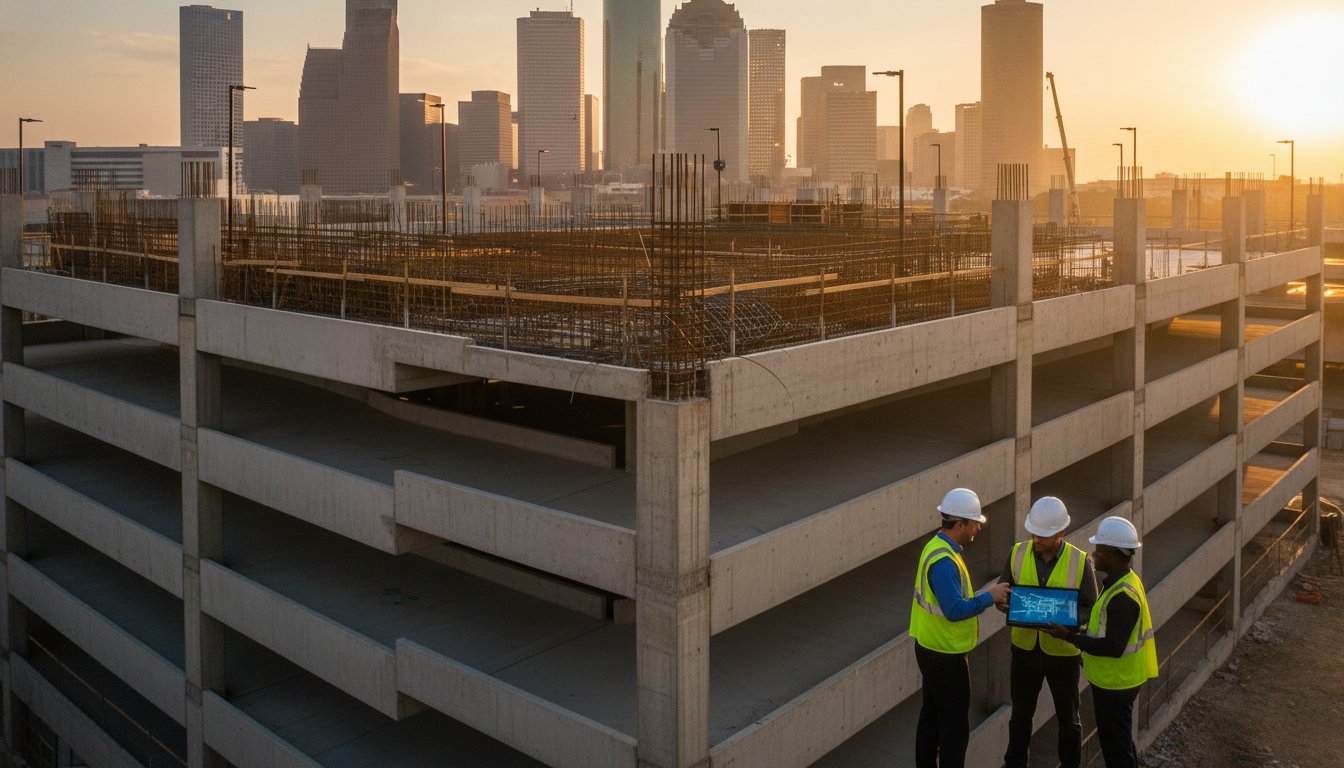
Selecting between precast and cast-in-place concrete for a Texas parking structure isn't just a matter of preference; it's a decision that determines the building's long-term viability against expansive clay. While precast offers certain speed advantages, CIP garage construction Texas provides the monolithic integrity required to withstand the unique stresses of Houston gumbo and other volatile soil environments. You're likely weighing whether the structural adaptability of cast-in-place justifies the investment compared to precast alternatives. It's a critical question for any developer aiming to integrate a parking structure with a mixed-use podium while avoiding the high costs of structural settlement.
We understand that reliability and professional stability are paramount in large-scale civil projects. This guide provides the expert insights you need to manage Texas-specific engineering challenges under the updated ACI 318-25 building code. You'll learn how a single-source contractor for mass soil excavation and structural concrete can streamline your timeline and reduce maintenance overhead. We will examine current cost-efficiency trends for 2026 and the specific technical advantages that make cast-in-place the standard for durability and high-rise integration.
Key Takeaways
- Evaluate the structural continuity and long-term maintenance benefits that define modern CIP garage construction Texas compared to precast alternatives.
- Understand how specialized foundation strategies mitigate the risks of structural settlement in both expansive gumbo clay and rocky Central Texas terrains.
- Discover the logistical advantages of a turnkey civil approach that integrates mass soil excavation with structural concrete to streamline project coordination.
- Gain a comprehensive overview of the construction timeline, from initial site preparation and earthwork to the precise installation of post tension concrete.
- Identify the technical requirements for successfully integrating a monolithic parking structure with complex mixed-use podiums and high-rise developments.
Understanding CIP Garage Construction in the Texas Market
Developing a parking structure in the modern Texas landscape requires a balance between structural permanence and site-specific adaptability. Cast-in-place concrete is a construction methodology where concrete is poured into on-site formwork containing reinforcement, resulting in a single, unified structural framework. In 2026, major urban centers like Houston and Austin are experiencing a significant shift toward CIP garage construction Texas as developers prioritize long-term asset value over initial assembly speed. This resurgence is driven by a need for structures that can withstand the unique environmental pressures of the region while offering a level of architectural sophistication that modular alternatives often lack.
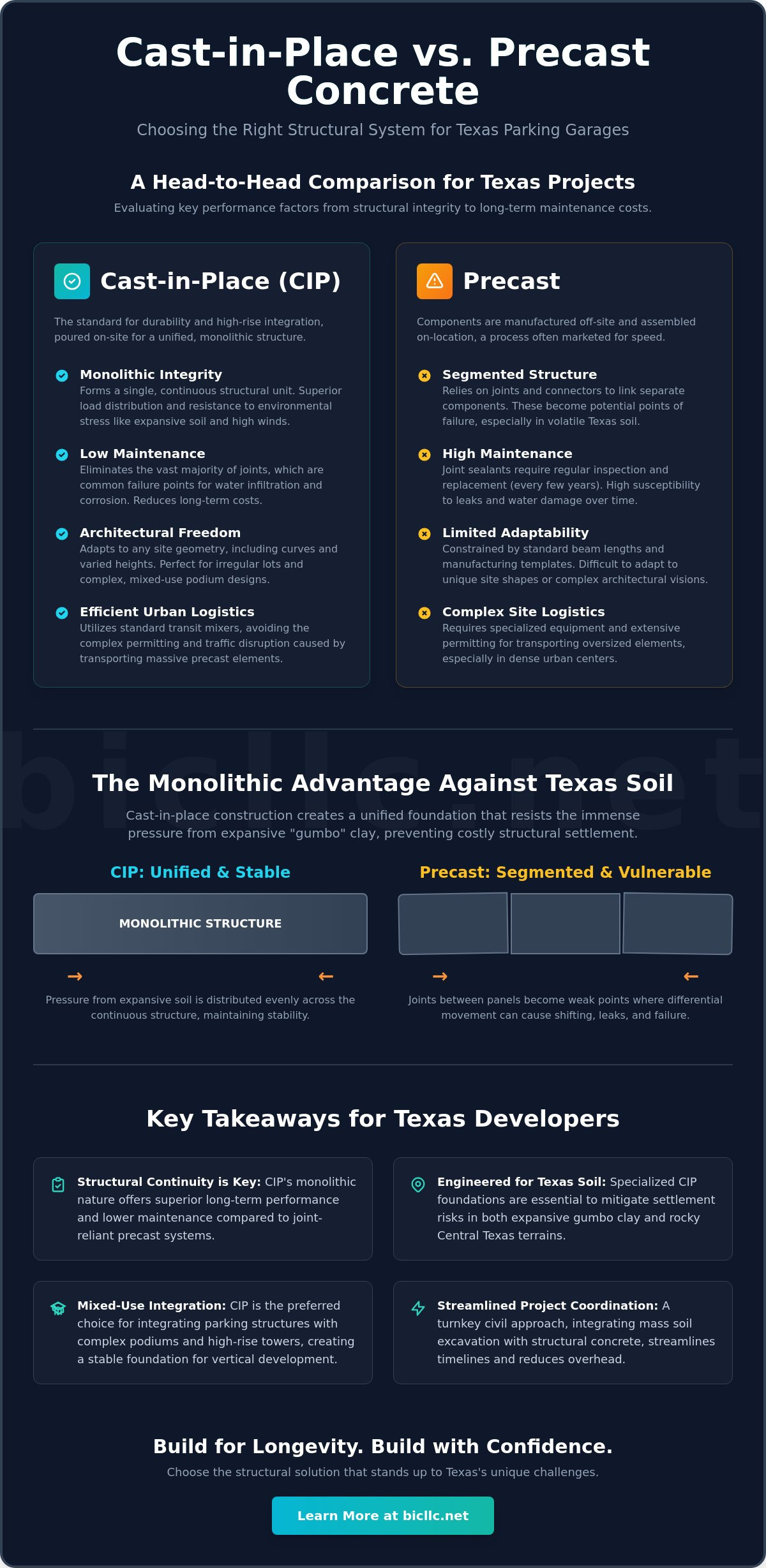
The logistical advantages of on-site casting are particularly evident in dense downtown environments. Transporting massive precast beams through congested city streets often requires complex permitting and specialized equipment that can disrupt local traffic and inflate project budgets. CIP construction utilizes standard transit mixers, allowing for a more manageable delivery schedule within tight urban footprints. This method also provides unparalleled architectural flexibility. Designers can incorporate custom curves, varied floor heights, and integrated planters directly into the structural pour, ensuring the garage complements the aesthetic of the primary development rather than appearing as a utilitarian afterthought.
The Monolithic Advantage for Texas Structures
The primary technical benefit of cast-in-place systems lies in their monolithic nature. Unlike precast structures that rely on joints and connectors to hold separate components together, a CIP garage functions as a continuous structural unit. This seamlessness is vital for effective load distribution and provides superior resistance to extreme Texas weather events, including high-wind conditions and seismic shifts. CIP monolithic integrity is the absence of cold joints in primary load paths. By eliminating these potential points of failure, the structure maintains its rigidity and stability over decades of heavy use. This unified massing is a foundational requirement for buildings that must endure the high-stress environments of the Gulf Coast and Central Texas.
CIP vs. The Growing Demand for Mixed-Use Developments
In 2026, the trend toward high-density mixed-use projects has made CIP the preferred choice for integrated parking. These garages often serve as the structural base for residential or office towers, requiring a level of precision and load-bearing capacity that only on-site casting can provide. CIP garages integrate seamlessly with podium slabs and high-rise foundations, creating a stable platform for vertical expansion. This adaptability is essential when dealing with the irregular lot shapes common in redeveloped downtown areas. While precast systems are constrained by standard beam lengths and angles, cast-in-place concrete can be molded to fit any site geometry, maximizing every square foot of available real estate.
CIP vs. Precast: Evaluating the Best Fit for Your Project
Choosing between on-site casting and off-site manufacturing is a pivotal decision for any Texas developer. While precast concrete is frequently marketed for its rapid assembly, it introduces a reliance on joints and connectors that can become liabilities over time. In contrast, CIP garage construction Texas offers a level of structural continuity that precast simply cannot replicate. This is particularly true for subterranean garages or projects with complex geometric requirements where modular components fail to provide a watertight or seamless finish.
Structural Integrity and Maintenance Profiles
The long-term performance of a parking structure is often measured by its resistance to water infiltration and rebar corrosion. Precast systems rely on hundreds of linear feet of joint sealants that require inspection and replacement every few years. Because cast-in-place systems are monolithic, they eliminate the majority of these potential leak points. Adhering to the Building Code Requirements for Structural Concrete (ACI 318) ensures that these structures are engineered to handle Texas-specific thermal expansion. Intense heat cycles in the South can cause significant movement in large concrete masses, making the unified nature of CIP more resilient against the cracking often seen at precast connection points.
Logistical Feasibility in Urban Texas Centers
Logistics represent a significant risk factor in the Texas construction market. Transporting massive precast beams from a fabrication plant to a job site in Houston or Dallas involves substantial shipping and handling risks. Road vibrations and transit stresses can introduce micro-cracks before a component even reaches the crane. CIP avoids these vulnerabilities by utilizing a just-in-time wet mix delivery. Quality control happens on-site, in real-time, during the pour. This approach removes the need for large staging areas required to store precast inventory. For developers managing tight schedules, partnering with a firm that provides turnkey civil solutions ensures that excavation and concrete work are perfectly synchronized.
While the initial capital expenditure for cast-in-place may be higher due to on-site labor and formwork, the structural viability over a 20-year horizon often proves more cost-effective. Reduced spending on joint maintenance, structural patching, and waterproofing repairs creates a more stable financial profile for the asset. For projects where the garage serves as a foundation for a larger mixed-use development, the added security of a monolithic pour is an investment in the entire building's longevity.
Engineering for Texas Soil: Foundations and Structural Stability
Texas presents some of the most challenging geological conditions in the United States. For developers, successful CIP garage construction Texas relies heavily on a deep understanding of local soil mechanics. In the Houston and Beaumont regions, the presence of expansive gumbo clay creates significant uplift pressure that can compromise structural integrity if not properly mitigated. Conversely, the rocky corridors of San Antonio and Austin demand precision excavation and specialized anchoring. Addressing these variations early in the design phase is essential to ensure a structure remains stable over its intended lifespan.
Beyond the primary structure, the integrity of transition points is equally critical. Implementing proper paving stabilization in garage entrance and exit ramps prevents the cracking and shifting often caused by heavy vehicular loads on variable soils. These ramps are high-stress areas where the transition from the flexible soil to the rigid garage structure must be managed with technical precision. Failure to stabilize these zones often results in premature pavement failure and increased maintenance costs for the property owner.
Foundation Slabs and Soil Stabilization
Stabilizing the site before the first pour is a non-negotiable step in Texas civil work. Depending on the geotechnical report, this often involves mass soil replacement or chemical stabilization using lime or cement to modify the clay's molecular structure. In North Texas, the use of post-tensioned slabs is a standard practice to counteract soil movement. These systems use high-strength steel tendons to keep the concrete in a constant state of compression. Soil stabilization prevents differential settlement in multi-level structures by creating a uniform bearing surface that resists seasonal moisture fluctuations. This process ensures that the foundation slab provides a reliable base for the vertical structural concrete elements that follow.
Subterranean Challenges in High-Water-Table Zones
Coastal Texas developments often require subterranean parking to maximize density, but high water tables introduce the risk of hydrostatic pressure. Engineering watertight CIP walls for these environments requires meticulous formwork and specialized admixtures to reduce permeability. It's not just about the walls; it's about the entire site ecosystem. Effective water management involves coordinating mass excavation with integrated drainage systems and detention ponds. This holistic approach ensures that the foundation remains dry and the structural concrete isn't subjected to constant moisture, which could lead to long-term rebar corrosion. By integrating earthwork and structural concrete through a single-source provider, developers can ensure these complex systems work in harmony from the ground up.
The CIP Construction Process and Timeline Management
The construction of a cast-in-place structure is a methodical progression that demands disciplined management of both site conditions and material science. Successful CIP garage construction Texas projects follow a five-phase lifecycle that begins with mass soil excavation and utility relocation. Once the earthwork is stabilized, the focus shifts to phase two: the precise installation of formwork and reinforcement. This stage involves the placement of rebar and post-tensioning tendons, which serve as the internal skeleton of the structural concrete. Phase three is the pour itself, a high-stakes logistical operation where concrete delivery must be continuous to ensure monolithic integrity.
Following the pour, phase four involves curing and the critical act of tensioning the internal cables once the concrete reaches a specified compressive strength. Only then can the formwork be stripped to allow for vertical progression. The final phase covers the finishing of flatwork and the integration of mechanical, electrical, and plumbing (MEP) systems. This structured approach ensures that every level of the garage meets the high standards required for long-term durability. It's a process that doesn't allow for shortcuts if the goal is a building that lasts for generations.
Managing the Pour: Precision and Efficiency
Critics of on-site casting often point to weather as a primary disruptor, but modern material science has largely mitigated these risks. We utilize specialized admixtures to manage curing times effectively, even in the high humidity of the Texas Gulf Coast. These chemical components prevent the mix from setting too quickly in the heat, allowing for a consistent finish across the entire slab. Quality control protocols are strictly enforced on-site, including regular testing for slump and compressive strength to verify that every batch meets engineering specifications. Safety remains the highest priority during multi-level structural concrete work, with rigorous standards for fall protection and formwork stability.
Timeline Optimization Strategies
Reducing the duration between project milestones is essential for maintaining capital efficiency. One of the most effective ways to accelerate a schedule is by utilizing high-early strength concrete, which allows for faster formwork cycling and tensioning. Additionally, a turnkey civil approach reduces the friction that often occurs when coordinating separate excavation and concrete trades. By managing detention pond construction early in the timeline, site runoff is controlled, keeping the workspace clear even during the seasonal rains common in Houston and Dallas. This level of organizational transparency allows developers to move from the foundation to the final slab with unwavering consistency.
Partnering with Born Integrated for Your Texas Garage Project
Born Integrated Construction operates on the principle that structural excellence begins well beneath the surface. For developers managing CIP garage construction Texas, the traditional model of hiring separate contractors for earthwork and structural concrete often creates unnecessary friction and risk. We eliminate this fragmentation by offering a turnkey civil solution that encompasses everything from mass soil excavation and detention pond construction to the final structural slab. This integrated approach ensures that the geotechnical preparation is perfectly aligned with the requirements of the structural pour from day one.
In 2026, the construction market demands a high degree of operational precision to manage rising input costs and labor constraints. Our commitment to reliability is reflected in our established vendor relationships, which secure a consistent supply of high-quality materials for large-scale, continuous pours. We prioritize safety and professional stability, ensuring that every project is executed with a focus on long-term asset viability. This methodology doesn't just save time; it provides a level of craftsmanship and consistency that fragmented teams often struggle to achieve.
Single-Source Responsibility for Developers
The transition from site preparation to structural concrete delivery is a frequent source of project delays. When a single partner manages the underground utilities, paving stabilization, and the podium slab, the risk of communication breakdown is virtually removed. This continuity is especially critical for mixed-use developments where the parking structure must integrate flawlessly with residential or office foundations. Our team ensures that the quality established during the mass excavation phase carries through to the precision required for post tension concrete installation. We maintain a steadfast focus on the enduring nature of the professional output we provide.
Proven Results Across the State
Our footprint extends across the Texas "Golden Triangle" and into the state's most active metropolitan hubs. Whether the project is situated in the expansive clay of Houston or the rocky terrain of Austin, we bring localized expertise to every CIP garage construction Texas project. We focus on creating enduring foundations that reflect our pride in craftsmanship and a steadfast sense of duty to our partners. This disciplined approach to execution and meticulous management of detail defines our role as a seasoned expert in the field. We lead through proven results and unwavering consistency in every pour.
Contact Born Integrated Construction for a consultation on your 2026 CIP garage project.
Securing the Long-Term Viability of Your Texas Development
Successful CIP garage construction Texas requires more than just pouring concrete; it demands a disciplined integration of geotechnical engineering and structural precision. We've explored how monolithic systems provide the necessary resilience against expansive soils and how a turnkey approach eliminates the logistical friction between excavation and structural delivery. These foundations are the literal and figurative base for the high-density mixed-use developments defining our state's urban growth. By prioritizing structural continuity and operational efficiency, developers can ensure their assets remain stable and low-maintenance for decades.
Born Integrated Construction brings specialized expertise to midrise and high-rise foundations across all major Texas metropolitan corridors. Our ability to manage both turnkey civil site work and complex structural concrete ensures that your project transitions seamlessly from mass excavation to the final podium slab. We remain committed to the enduring nature of our work and the professional stability of our partnerships. Request a Project Proposal from Born Integrated Construction to establish a dependable foundation for your next parking structure. We look forward to delivering a result that reflects our shared commitment to excellence and durability.
Frequently Asked Questions
What are the primary benefits of CIP garage construction for Texas developers?
The primary benefits of cast-in-place systems include superior monolithic integrity and structural durability. Unlike modular systems, CIP garage construction Texas creates a seamless framework that distributes loads more effectively and resists water infiltration. This methodology also allows for greater architectural flexibility, enabling designers to maximize irregular urban footprints where transporting large precast components is logistically impossible. It's a steadfast choice for developers who prioritize long-term asset value.
How long does a typical cast-in-place parking garage take to build?
Construction timelines vary based on project scale and site complexity. While the on-site assembly of formwork and reinforcement requires a methodical progression, it avoids the shipping delays and specialized permitting often associated with precast beams. Utilizing high-early strength concrete and disciplined schedule management allows for efficient vertical progression. For many developers, the reliability of a predictable on-site schedule outweighs the logistical risks of transporting massive precast components through Texas traffic.
Can CIP garages be built on expansive clay soils like those in Houston?
Cast-in-place concrete is highly effective on expansive gumbo clay because of its unified structural mass. By utilizing post-tensioned slabs and comprehensive soil stabilization, the structure can better withstand the significant uplift pressures found in Houston and Beaumont. A monolithic pour eliminates the joints that typically fail when soil shifts, ensuring the building remains stable. This approach provides a reassuring level of security for structures built on volatile geological foundations.
Is cast-in-place concrete more expensive than precast for parking structures?
The initial capital expenditure for cast-in-place structures can be higher due to the intensive on-site labor and formwork required. However, developers must consider the long-term structural viability and reduced maintenance overhead. CIP systems have significantly fewer joints to seal and repair, which lowers the lifetime cost of the asset. When integrated with a mixed-use podium, the added structural permanence often justifies the initial investment by providing a more stable foundation for vertical development.
What is the difference between a podium slab and a standard garage foundation?
A podium slab serves as a structural transfer deck that supports a different building type, such as wood-frame residential or steel-frame office space, above the parking levels. While a standard garage foundation is designed solely to support the weight of the parking structure, a podium slab must manage complex load transitions from the vertical tower above. This requires precise engineering and high-strength structural concrete to ensure the integrity of the entire multi-use building.
How does Born Integrated manage site preparation and excavation for garages?
We utilize a turnkey civil approach that integrates mass soil excavation with structural concrete delivery. By managing the site preparation and earthwork in-house, we ensure the foundation environment is perfectly stabilized before the first pour. This includes chemical soil modification and the construction of detention ponds to manage site runoff. This single-source responsibility removes the coordination gaps that often occur between separate excavation and concrete contractors.
What maintenance is required for a CIP parking structure in the Texas climate?
Maintenance for these structures is generally lower than precast alternatives because of the lack of connection joints. Owners should focus on periodic inspections of drainage systems and the application of surface sealants to protect against chloride penetration. Because CIP is engineered to handle Texas-specific thermal expansion, it's less prone to the structural cracking seen in modular systems. Consistent, unhurried maintenance ensures the structure remains a dependable asset for its entire service life.
Does Born Integrated provide utility installation along with garage construction?
Yes, our turnkey civil services include the installation of underground utilities and detention systems alongside garage construction. This integrated model allows for better coordination between the building's structural elements and its essential infrastructure. By managing everything from earthwork to the final slab, we provide a more organized and transparent construction process. This ensures that utility relocation and placement don't interfere with the critical path of the structural concrete work.