Commercial Retaining Wall Trends in Conroe: Engineering for 2026 and Beyond
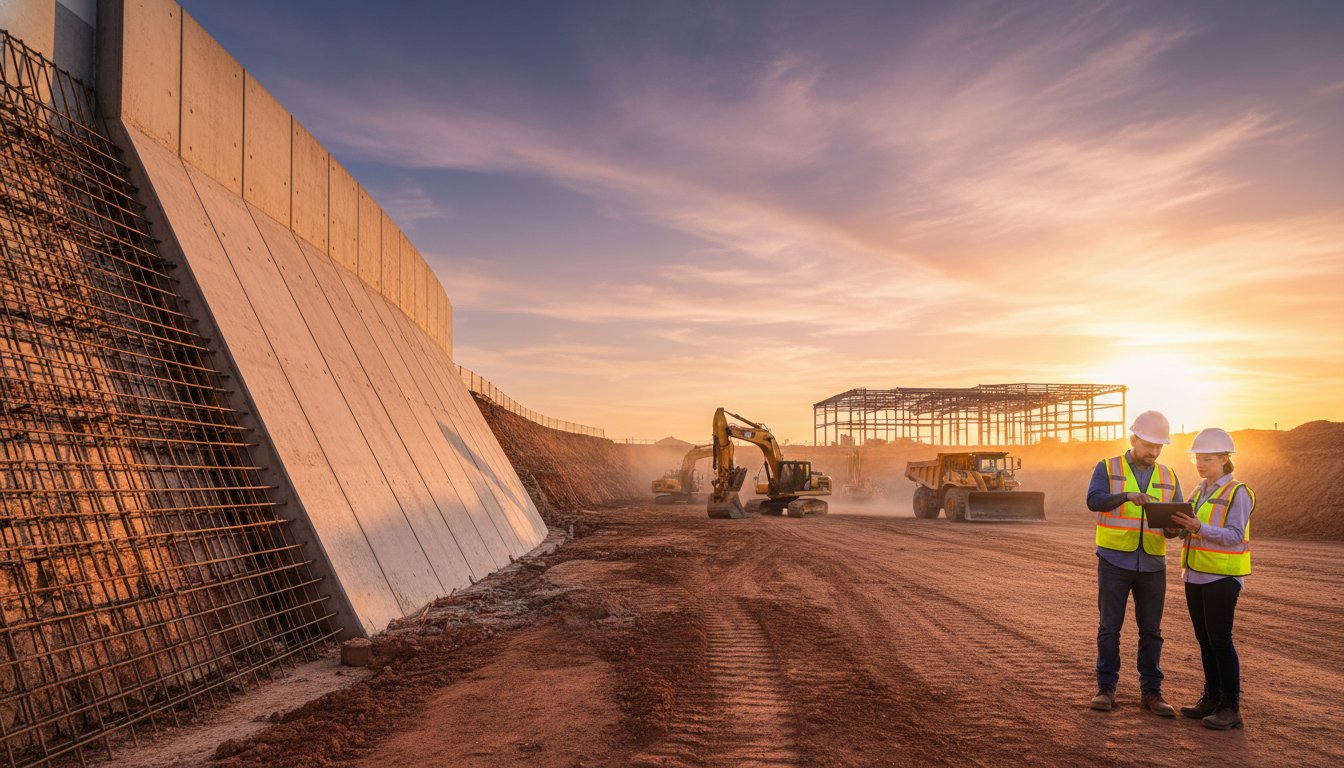
A retaining wall in Montgomery County is no longer a secondary landscape feature; it's a critical structural foundation for site-wide civil integrity. You've likely seen the consequences of failing to account for the relentless expansion of Texas clay or the complexities of local drainage mandates. Coordinating between a separate excavation team and a concrete crew often creates friction that delays projects and risks structural longevity. As a professional commercial retaining wall contractor Conroe developers rely on for precision, we recognize that a wall must do more than hold back earth. It must integrate seamlessly with your detention ponds and utilities while meeting the 50-year structural requirements of modern engineering.
This article explores how integrated civil site work and updated regulatory standards are redefining commercial construction in 2026. You'll learn how to navigate the City of Conroe’s OpenGov permit portal and the latest fee schedules updated on November 13, 2025. We'll also examine the technical shift toward turn-key earthwork and structural concrete solutions that ensure your project remains compliant with 2009 International Codes and local amendments. Discover how a methodical approach to engineering and meticulous management of details create a lasting foundation for your commercial investment.
Key Takeaways
- Learn why the shift toward high-capacity structural concrete is essential for meeting the rigorous demands of rapid commercial expansion in Montgomery County.
- Understand the critical role of soil stabilization and advanced drainage engineering in mitigating the structural risks posed by expansive Texas clay.
- Evaluate the advantages of partnering with a commercial retaining wall contractor Conroe that provides integrated earthwork and structural concrete services.
- Discover how "Turn Key Civil" solutions improve operational efficiency by coordinating mass soil excavation with final structural wall footings.
- Gain insights into maintaining compliance with the latest 2026 Conroe building codes and the city's streamlined digital permitting requirements.
The Evolution of Commercial Retaining Walls in Conroe Infrastructure
The infrastructure of Conroe is undergoing a fundamental transformation. As Montgomery County experiences rapid commercial expansion, the role of site-retaining structures has shifted from simple perimeter borders to vital structural assets. Retaining walls are no longer just about holding back dirt; they're about reclaiming valuable land. In high-density developments, every square foot of usable acreage matters. By utilizing taller, high-capacity structural concrete walls, developers can create flat building pads on sloped terrain that would otherwise be lost to grading. This shift requires a sophisticated approach to geotechnical reporting. In 2026, the standards for soil analysis have become more rigorous to account for the unique pressure profiles of multi-story commercial structures.
A seasoned commercial retaining wall contractor Conroe professionals trust understands that these structures are the backbone of site stability. The increased density of North Houston projects means that walls are being pushed to greater heights and higher load capacities. We've moved past the era of decorative stone blocks that merely guide water. Today's projects demand engineered systems that can withstand the lateral earth pressure exerted by heavy machinery and multi-level parking structures. Meticulous planning at the early stages of earthwork prevents the costly remediation of wall "lean" or foundation shifts later in the project lifecycle.
From Aesthetic Landscaping to Structural Necessity
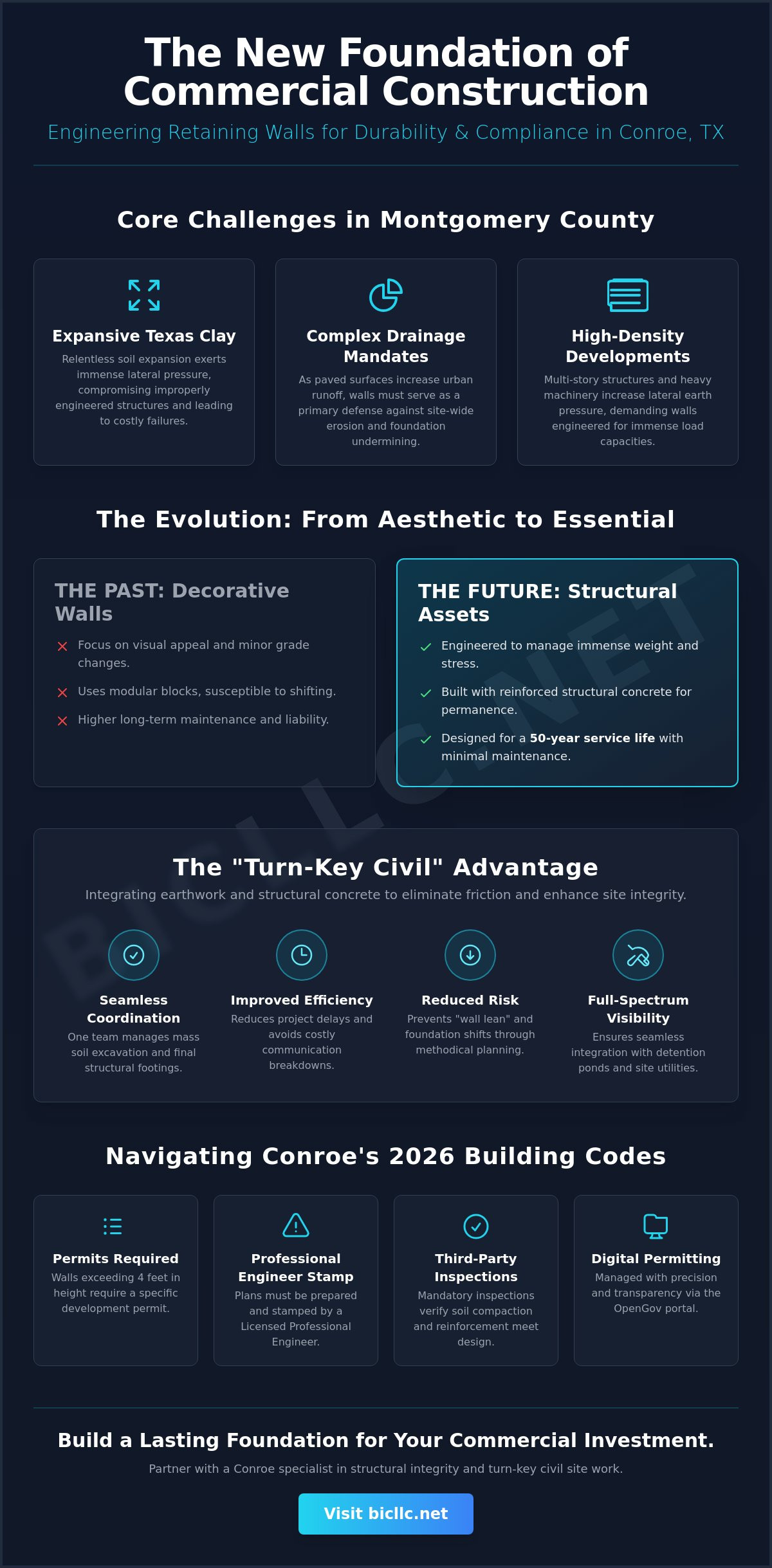
Residential decorative walls focus on visual appeal and minor grade changes. In contrast, commercial-grade structural assets are designed to manage immense weight and environmental stress. Multi-story developments significantly increase lateral earth pressure requirements, necessitating thicker footings and reinforced concrete. Developers prioritize concrete construction services Texas to reduce long-term liability. A failure in a commercial setting doesn't just damage a garden; it threatens the integrity of the entire site infrastructure. Choosing structural concrete over modular units provides the permanence required for 50-year service life standards.
Conroe’s Changing Building Codes and Compliance
Building codes in Conroe have evolved to address the challenges of rapid urbanization. Any wall exceeding four feet in height now requires a specific development permit and plans prepared by a Licensed Professional Engineer. These modern standards emphasize third-party engineering inspections during the construction phase to verify that soil compaction and reinforcement meet the approved design. Additionally, modern walls must account for increased urban runoff. As more surfaces are paved, retaining structures often act as the primary defense against erosion, ensuring that North Houston’s intense rainfall doesn't undermine the foundation of the development. Partnering with a knowledgeable commercial retaining wall contractor Conroe ensures that these regulatory hurdles are managed through the OpenGov portal with precision and transparency.
Structural Engineering Trends: Cast-in-Place vs. Precast Systems
Decorative blocks have their place in suburban aesthetics, but the demands of heavy-duty commercial development in Conroe necessitate a more robust engineering approach. Choosing a seasoned commercial retaining wall contractor Conroe ensures the structure is treated as a foundational element rather than a visual border. Over a 25-year lifecycle, structural concrete walls offer superior value by minimizing maintenance and preventing the structural shifts common in cheaper, gravity-based systems. It's a matter of long-term stability versus short-term savings. Investing in high-capacity systems protects the site’s primary assets from the relentless pressure of shifting soils.
A significant trend for 2026 is the use of precast garage foundations as integrated retaining structures. Instead of building a separate wall and a separate parking structure, engineers are designing the garage's lower levels to serve as the earth retention system. This reduces material costs and site mobilization time. Additionally, post-tensioning techniques are being adapted for vertical retention. By applying tension to high-strength steel cables within the concrete, contractors can build thinner, more resilient walls that resist cracking and soil expansion more effectively than traditional reinforced concrete. For projects requiring maximum durability, structural concrete solutions provide the necessary reassurance for high-density builds.
The Dominance of Cast-in-Place (CIP) for Heavy-Duty Loads
Cast-in-Place (CIP) concrete remains the preferred choice for projects involving heavy machinery or high-rise foundation support. This process involves the meticulous installation of rebar reinforcement within custom forms before the pour. It creates a monolithic structure that distributes lateral earth pressure more effectively than individual blocks. For commercial CIP retaining walls, the concrete mix must typically meet a minimum compressive strength of 3,000 to 4,000 PSI depending on the specific load-bearing requirements of the site. This level of precision is vital for maintaining the structural integrity of the entire development.
Precast and Modular Innovations
Precast systems offer a strategic alternative when project timelines are compressed. These components are manufactured in controlled environments, ensuring consistent quality and rapid on-site assembly. Modern modular systems have evolved significantly, utilizing advanced geogrid reinforcement to handle higher hydrostatic pressures. It's essential to follow Segmental Retaining Wall Best Practices to ensure these systems perform under Conroe's specific soil conditions. Some developers are even exploring "living walls." These systems combine concrete strength with vegetation to balance structural goals with environmental sustainability. Regardless of the system chosen, a commercial retaining wall contractor Conroe must prioritize the meticulous management of drainage to prevent pressure buildup behind the wall face.
Navigating Conroe’s Soil Mechanics and Drainage Challenges
Success for a commercial retaining wall contractor Conroe depends on more than just the strength of the concrete. It requires a deep understanding of Montgomery County’s unique soil mechanics. Expansive Texas clay is a formidable opponent for any structural project. This soil type expands significantly when saturated and contracts during dry periods, creating a cyclic pressure that can easily overwhelm an under-engineered wall. Without proper intervention, this movement leads to wall "lean" or catastrophic failure. It's not enough to build a heavy wall; the foundation must be anchored in a way that accounts for these shifting subterranean forces.
Hydrostatic pressure remains the primary cause of retaining wall failure. When water becomes trapped behind the structure, the weight exerted against the concrete increases exponentially. In Conroe, our seasonal rainfall patterns can deliver intense downpours that saturate the backfill in minutes. Effective drainage is often more important than the wall itself. A wall that cannot "breathe" or shed water will eventually succumb to the immense pressure of the wet earth behind it. Professional engineering must prioritize the movement of water away from the structure to ensure a 50-year service life.
The Science of Soil Stabilization in Montgomery County
Replacing native clay with stable, non-expansive select fill is a critical step in the construction process. This creates a predictable environment for the wall's foundation. We often utilize geogrids and mechanical soil stabilization to reinforce the earth behind the wall, turning the soil itself into a reinforced mass. In many cases, a paving stabilization contractor is required to treat the subgrade before any vertical construction begins. This integrated approach ensures that the entire site, from the parking lot to the retaining structure, remains level and secure against the elements.
Integrating Drainage and Detention Pond Systems
In Conroe, retaining walls often serve a dual purpose as the structural perimeter for commercial detention ponds. These walls must be designed to withstand constant moisture exposure and varying water levels. Designing weep holes and high-capacity French drains is essential to manage the heavy storm cycles common in North Houston. This drainage infrastructure must also be carefully coordinated with underground utility depths. A commercial retaining wall contractor Conroe developers trust will ensure that wall footings don't interfere with existing water lines or electrical conduits, maintaining site-wide operational integrity during and after construction.
Integrated Civil Site Work: The Turn-Key Advantage
The construction industry in 2026 is moving away from the inefficiencies of fragmented contracting. For large-scale developments, the trend toward Turn Key Civil solutions has become a standard for ensuring structural integrity. When a single partner manages both the mass soil excavation and the structural concrete, the risk of miscommunication between separate crews is eliminated. A professional commercial retaining wall contractor Conroe developers trust will oversee the entire logistical chain, from initial grading to the final pour of the wall footings. This approach not only streamlines the project but also significantly reduces site mobilization costs by utilizing the same heavy equipment for multiple phases of the work.
Site-wide logistics require a steady hand and a methodical schedule. Coordinating the timing of earthwork with the installation of retaining walls ensures that the foundation is protected from erosion during construction. It also allows for the seamless integration of concrete paving and slab-on-grade work later in the timeline. By centralizing these responsibilities, developers gain a clearer overview of the project's progress and a more predictable delivery date. For those seeking to minimize operational friction, choosing an experienced Turn Key Civil partner is the most reliable path to a successful build.
Coordinating Earthwork and Structural Concrete
The excavation phase represents the most critical window for determining a retaining wall's success. It's during this time that the subgrade is prepared and the structural footprint is established. Simultaneous mass soil excavation and wall reinforcement allow for precise control over the building site's geometry. This coordination is particularly important for avoiding utility conflicts. When one contractor manages both the wet utilities and the wall footings, the risk of damaging underground lines is minimized. This level of operational precision is a hallmark of a disciplined concrete construction company near Conroe.
Maximizing Site ROI Through Strategic Elevation
Strategic site grading is a powerful tool for maximizing the return on investment for any commercial project. In the sloped terrain often found in parts of Montgomery County, advanced grading allows for more profitable building footprints by creating level building pads. Retaining walls play a vital role here, enabling the construction of level podium slabs on uneven ground. This integrated approach to site preparation ensures that every acre is used to its full potential. By aligning the earthwork with the structural requirements of the walls, developers can accelerate the overall project timeline and move more quickly from the planning phase to vertical construction.
Selecting the Right Commercial Partner for Structural Integrity
Selecting a commercial retaining wall contractor Conroe developers can rely on involves a rigorous evaluation of technical proficiency and professional stability. Integrity and efficiency aren't just buzzwords; they're the foundational metrics that define whether a project meets its 50-year structural requirement or becomes a financial liability. A contractor's Experience Modification Rate (EMR) provides a transparent look at their safety culture. For large-scale infrastructure, a low EMR suggests a disciplined approach to risk management that protects both workers and the developer’s investment. You should ask potential partners about their specific experience with Conroe's 2009 International Codes and their proficiency with the OpenGov permit portal. Consistent performance across multi-phase developments requires a partner who treats a retaining wall with the same precision as a high-rise foundation.
The complexity of modern site work means you can't afford a partner who learns on the job. A seasoned contractor understands the nuances of the permit fee schedule updated on November 13, 2025, and how those costs impact the initial phases of development. Meticulous management of details is what separates a successful build from one plagued by delays. When a firm demonstrates a deep-rooted commitment to high standards, it creates a sense of security for the entire project team. This professional distance and authority are essential when managing the high stakes of commercial concrete construction.
Prioritizing Safety and Professional Stability
Commercial developers must insist on comprehensive insurance and bonding to mitigate the inherent risks of heavy civil work. Professional project management is the bridge between a complex blueprint and a finished structure. It ensures that high-rise foundation schedules remain on track despite the unpredictable nature of Texas weather. Born Integrated Construction delivers reliability through attentive service and established vendor relationships. This stability ensures that material deliveries and labor schedules remain synchronized, even during the most demanding multi-phase builds. We prioritize substance over style, focusing on the enduring nature of our professional output.
The Born Integrated Approach to Conroe Construction
Our commitment to quality extends across every service we provide, from intricate sidewalks to massive CIP parking garages. We believe that a grounded, steadfast approach is the only way to deliver dependable results on a modern job site. By maintaining a steady and predictable cadence in our communication and operations, we act as a dependable partner for the long term. Our focus remains on building lasting foundations that stand the test of time and environmental stress. When you're ready to break ground, partner with a leader in Conroe concrete construction to ensure your project’s structural integrity.
Securing Your Development’s Structural Future
Successful commercial projects in Conroe now demand a higher standard of engineering that merges earthwork with structural concrete. We've explored how the shift toward cast-in-place systems and integrated civil site work provides the stability required for modern infrastructure. Addressing the specific mechanics of Texas clay and managing hydrostatic pressure are no longer optional steps; they're the requirements for long-term project viability. Choosing a seasoned commercial retaining wall contractor Conroe ensures that these complex variables are managed with operational precision from the first excavation to the final pour.
Born Integrated Construction specializes in heavy-duty applications, including CIP garages and high-rise foundations. Our expertise in Montgomery County soil stabilization allows us to deliver results that prioritize safety and professional stability. We're committed to the meticulous management of every detail to protect your investment and ensure your project adheres to the latest 2026 standards. Contact Born Integrated Construction for a Structural Consultation to discuss the specific needs of your upcoming development. We look forward to establishing a lasting foundation for your site.
Frequently Asked Questions
How much does a commercial retaining wall cost per square foot in Conroe?
The total cost for a commercial project is determined by several site-specific variables rather than a simple flat rate. Factors such as the required wall height, the necessity for specialized soil stabilization, and the complexity of integrated drainage systems all influence the final budget. It's best to consult with a commercial retaining wall contractor Conroe developers trust to receive a detailed estimate based on your specific geotechnical report.
Do I need a permit for a commercial retaining wall in Montgomery County?
Yes, any wall exceeding four feet in height requires a building permit in the City of Conroe. Commercial site developments must submit their plans through the OpenGov online portal for review by the Engineering Division. As of May 2026, an administrative processing fee of $200.00 is applied to all commercial plan submittals to cover the initial intake and review process.
What is the best material for a long-lasting commercial retaining wall in Texas?
Cast-in-Place (CIP) structural concrete is considered the most durable material for the challenging Texas environment. Unlike modular block systems, a monolithic concrete pour provides a seamless barrier against soil pressure and moisture. This material choice is preferred for projects requiring a 50-year service life because it resists the shifting forces of expansive clay more effectively than other options.
How does expansive clay soil affect retaining wall design in Conroe?
Expansive clay soil significantly increases the lateral pressure on a wall as it absorbs moisture. To counter this, engineers often specify the removal of native clay and the use of select fill behind the structure. This creates a stable environment that reduces the risk of wall lean or foundation failure during Conroe's intense seasonal rainfall cycles.
What is the difference between a gravity wall and a reinforced retaining wall?
A gravity wall depends on its own weight and mass to hold back the soil. Reinforced retaining walls, however, use steel rebar or geogrid to tie the wall into the earth behind it. For most commercial developments in Montgomery County, reinforced concrete is the standard because it handles the higher load capacities required for parking lots and heavy structures.
How long does it take to install a cast-in-place concrete retaining wall?
Installation timelines vary depending on the scope of the earthwork and the complexity of the reinforcement. A professional commercial retaining wall contractor Conroe typically follows a methodical schedule that includes excavation, formwork, rebar installation, and the pour. Each phase is timed to ensure the concrete cures properly before the wall is subjected to lateral soil pressure.
Can a retaining wall be integrated with a commercial detention pond?
Retaining walls are frequently integrated with commercial detention ponds to maximize the usable footprint of a development. These structures act as the pond’s vertical boundaries, providing structural stability while managing water runoff. Because these walls are in constant contact with moisture, they require specialized waterproofing and robust drainage engineering to ensure they don't succumb to hydrostatic pressure over time.
What maintenance is required for a large-scale structural concrete wall?
Maintenance for structural concrete walls focuses on preserving the integrity of the drainage system. You'll need to periodically clear weep holes of any blockages to prevent hydrostatic pressure from building up behind the concrete. Regular visual inspections for surface cracks or signs of soil erosion at the base are also recommended to ensure the wall remains a dependable asset for decades.