
Detention Pond Construction in Texas: A Comprehensive Guide for Commercial Developers
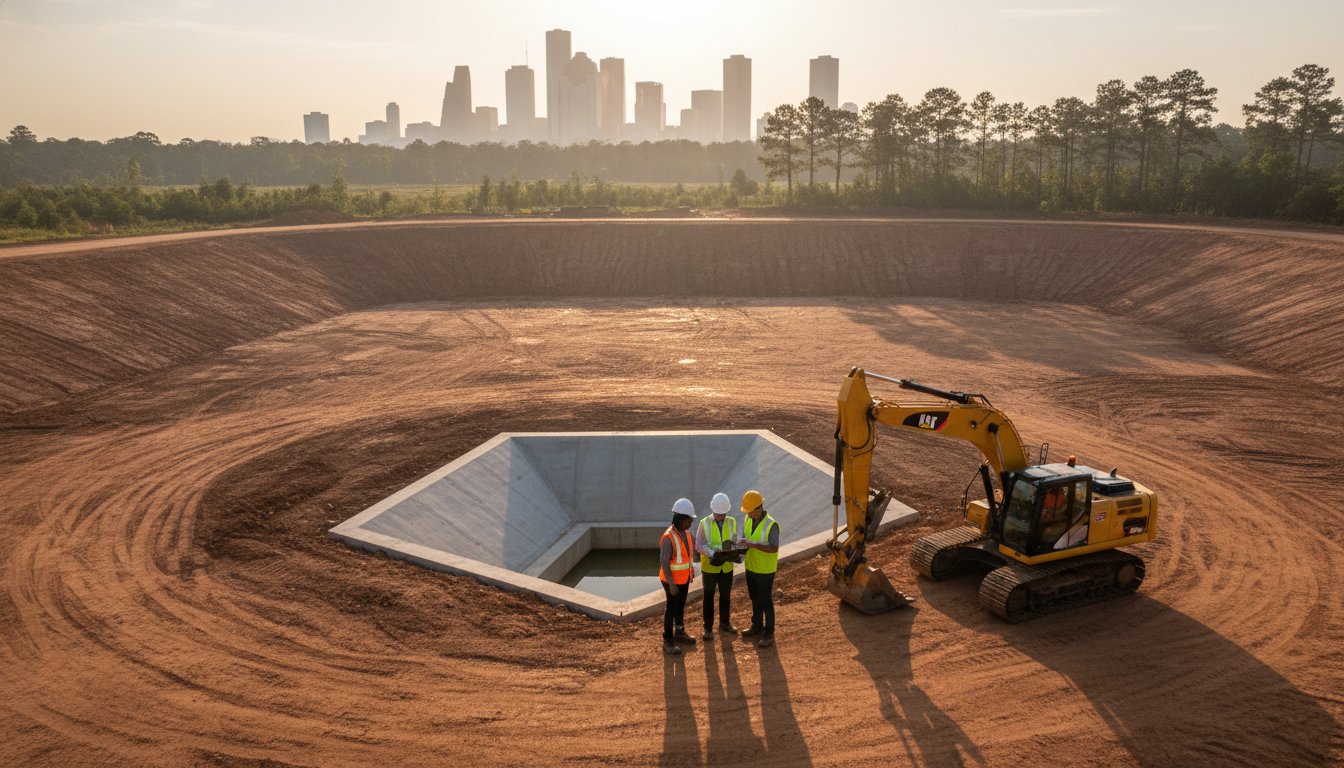
A detention pond is often the most expensive "hole in the ground" a developer will ever commission, yet its value isn't measured by depth alone. True success in detention pond construction Texas is measured by the precision of concrete outfalls and the ability to withstand the volatile hydrology of Southeast Texas. You likely recognize that balancing usable site acreage with the stringent drainage codes of Houston or Conroe often feels like a zero-sum game. It's a complex challenge where soil stability issues can quickly compromise the structural integrity of your entire project.
This guide provides the technical clarity you need to master these requirements, ensuring your site remains both compliant and viable for the long term. We'll examine the critical intersection of mass soil excavation, TCEQ regulatory standards, and the meticulous engineering of concrete inlets that define a high-performing stormwater system. With the TCEQ holding stakeholder meetings in June 2026 to discuss future permit renewals, staying informed on current 2023 Construction General Permit standards is vital. You'll gain the insights necessary to deliver a project that passes inspection and stands as a testament to professional craftsmanship and operational stability.
Key Takeaways
- Recognize the functional requirements of dry basins as primary tools for managing temporary stormwater volume in the current Texas building climate.
- Differentiate between detention and retention systems to optimize site acreage and minimize long-term maintenance obligations.
- Identify the specific roles of the TCEQ, GLO, and local districts like the HCFCD in the approval process for detention pond construction Texas.
- Coordinate the transition from mass soil excavation to the installation of reinforced concrete structures for maximum site stability.
- Protect your investment by treating drainage infrastructure as a permanent structural foundation rather than a secondary utility.
Understanding Detention Pond Construction in Texas Stormwater Management
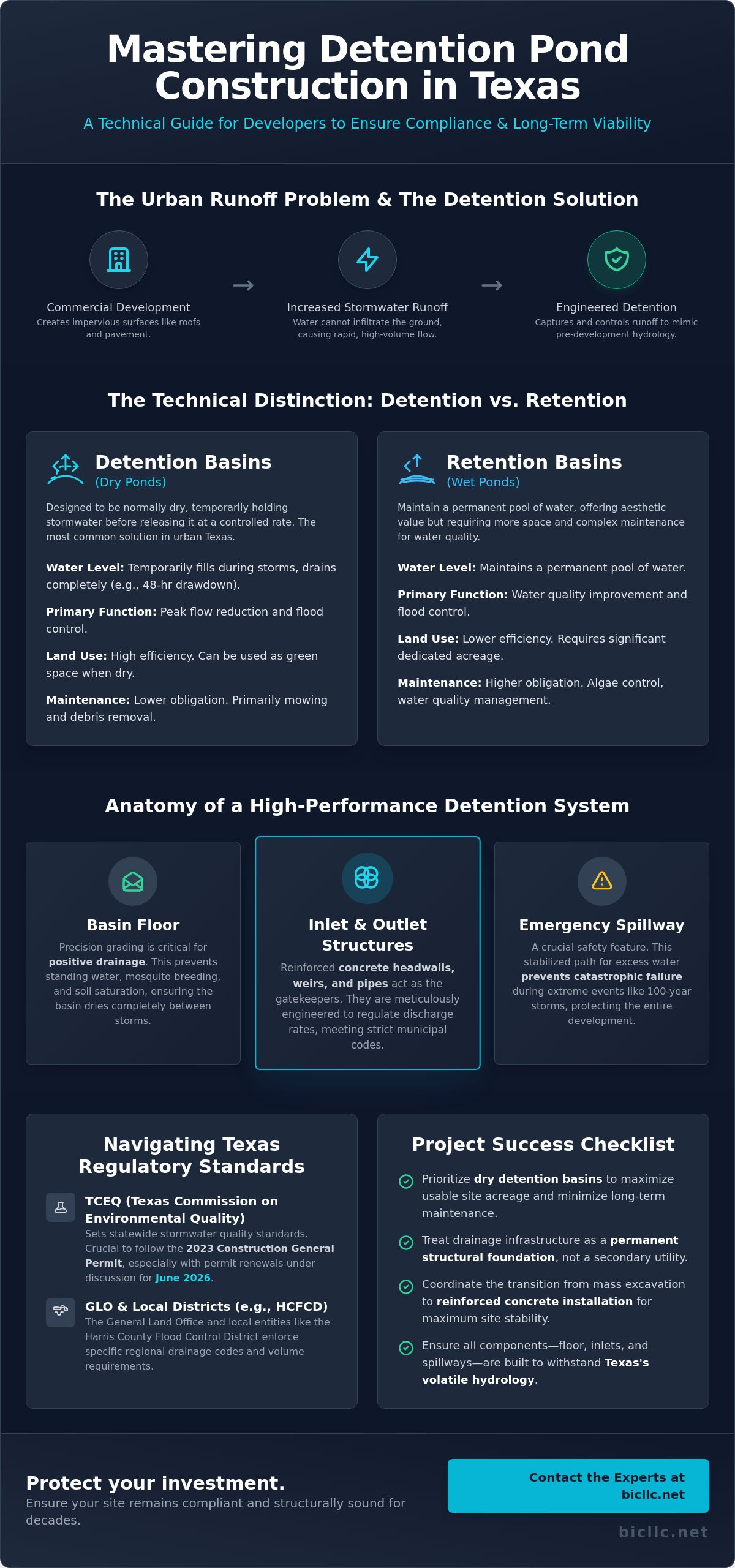
A Detention basin serves as a critical pressure valve for commercial developments across the state. Unlike retention ponds, which maintain a permanent pool of water, these dry basins are designed to remain empty during dry weather. They only fill during storm events, capturing runoff and releasing it at a controlled, pre-determined rate. In the 2026 Texas building climate, where regulatory scrutiny is intensifying ahead of the TCEQ's upcoming permit renewals, the role of these systems is paramount. They provide a disciplined method for peak flow reduction, ensuring that runoff from a new development doesn't overwhelm downstream municipal infrastructure or adjacent properties.
For the commercial developer, choosing a dry detention basin is often a strategic decision regarding land use. While wet ponds might offer aesthetic variety, they require significant acreage and constant maintenance to manage water quality and algae growth. Dry basins allow for a more efficient use of site acreage while meeting the core objective of flood protection. The primary goal of detention pond construction Texas is to mirror the site's pre-development hydrology, preventing the increased volume of water from causing erosion or structural damage downstream.
The Necessity of Stormwater Detention in Urban Texas
The expansion of commercial infrastructure inherently increases impervious surfaces such as concrete paving and building footprints. These surfaces prevent natural infiltration into the ground; this leads to rapid runoff rates that can trigger localized flooding. Robust detention systems address this by capturing water before it leaves the site. This process also helps manage the thermal load of runoff from sun-heated pavement, which protects local ecosystems. Integrating these basins with comprehensive site utility work ensures that every gallon of water is directed precisely where it belongs, maintaining the stability of the surrounding soil and the integrity of the project's foundation.
Key Components of a Modern Detention System
A functional system relies on methodical grading and the installation of durable structural elements. Reliability is built into the basin through several key components:
- The basin floor: It must be graded with precision for positive drainage. This prevents standing water and ensures the basin dries completely between rain events.
- Inlet and Outlet structures: These involve reinforced concrete headwalls and weirs. They act as the "gatekeepers" of the system, regulating the discharge rate to match municipal requirements.
- Emergency spillways: These are essential safety features. They are designed to protect the basin from catastrophic failure during extreme 100-year rain events by providing a stabilized path for excess water.
Success in these projects requires a deep-rooted commitment to high standards. By focusing on the enduring nature of the concrete and dirt work, developers can establish a site that is both compliant and structurally sound for decades to come.
The Technical Distinction: Detention vs. Retention Basins
Selecting the proper stormwater management strategy is a fundamental decision that impacts both the initial budget and the lifelong maintenance profile of a commercial site. In the landscape of detention pond construction Texas, developers typically choose between dry detention and wet retention based on local drainage requirements and available acreage. This choice isn't merely about meeting a code; it's about the enduring viability of the real estate asset and the professional management of environmental risks.
Detention Basins (Dry Ponds)
Dry detention basins are the most common solution for urban and suburban commercial developments. They operate on a temporary storage and metered release mechanism, designed to hold water only during and immediately after a storm. These systems are engineered to drain completely within a specific timeframe, such as the 48-hour drawdown period required in many Harris County jurisdictions. This design creates opportunities for multi-use functionality. When the basin is dry, it can serve as a green space or a landscaped area, allowing the developer to maximize the utility of the site acreage. In commercial hubs like Houston and The Woodlands, these basins provide a disciplined approach to flood control without the complexities of a permanent water feature.
Retention Basins (Wet Ponds)
Retention basins maintain a permanent pool of water, offering a different set of benefits and challenges. They're highly effective for water quality, as they allow for natural sedimentation and biological treatment of pollutants. However, maintaining a permanent water level in the Texas heat requires meticulous planning. Mandatory pond liners are often necessary to prevent seepage into the surrounding soil, which can compromise the stability of nearby detention pond construction Texas projects or building foundations. Property owners must also account for mosquito control, odor management, and the long-term integrity of the pond banks. While these basins can enhance the aesthetic appeal of a corporate campus, they demand a higher level of ongoing operational commitment.
The maintenance requirements for these two systems represent a significant divergence in long-term costs. Dry basins require routine mowing and the periodic removal of sediment from concrete inlets and outlets. Wet ponds, conversely, require aquatic vegetation management and specialized bank stabilization to prevent erosion. Safety and liability also favor dry basins in many commercial settings, as they don't present the same risks associated with permanent open water. The TCEQ Technical Guidance on Best Management Practices provides the essential framework for ensuring these structures meet state standards for safety and performance. Partnering with a team experienced in detention pond construction ensures your project balances these technical trade-offs with professional precision and structural reliability.
Navigating Texas Regulatory Standards and Municipal Codes
Compliance is the bedrock of successful commercial development in the Lone Star State. In Texas, the regulatory environment is managed through a structured hierarchy of state and local agencies. The Texas Commission on Environmental Quality (TCEQ) sets the baseline for stormwater discharge, while the General Land Office (GLO) oversees broader land management and coastal protection. For projects in the Houston metropolitan area, the Harris County Flood Control District (HCFCD) dictates the specific engineering tolerances required to protect the regional watershed. Every project involving detention pond construction Texas must adhere to the fundamental principle of balancing pre-development and post-development runoff rates. This standard ensures that the water leaving the site after construction doesn't exceed the flow rate that existed when the land was in its natural state.
Achieving this balance requires precise calculations and a Professional Engineer (PE) stamped drainage plan. These plans aren't merely suggestions; they're legal documents that guarantee the basin's volume can handle significant rain events without failing. Local jurisdictions won't issue site permits without these verified documents. They serve as the definitive blueprint for both mass soil excavation and the subsequent installation of concrete structures, ensuring the site's long-term viability and safety.
Regional Variations: Houston, Conroe, and The Woodlands
Municipal requirements vary significantly across Southeast Texas. The City of Houston's Chapter 9 code specifies exact detention volumes based on the percentage of impervious cover on the site. In contrast, Montgomery County and Conroe emphasize specific side-slope ratios to prevent erosion in the sandy-loam soils common to those areas. Local soil types dictate whether a basin needs advanced paving stabilization or reinforced retaining walls to maintain its structural integrity. A failure to account for these local geological differences often leads to slope failure or siltation issues before the project is even completed.
Permitting and Inspection Lifecycle
The administrative process begins with the Stormwater Pollution Prevention Plan (SWPPP). For sites disturbing one acre or more, developers must file a Notice of Intent under the 2023 Construction General Permit (TXR150000). As of May 2026, the application fee is $225 for online submissions through the STEERS system. This permit remains active until its expiration on March 5, 2028. Following the physical construction of the pond, the as-built certification process verifies that the finished basin matches the original PE stamped plans. Non-compliance at this stage is costly. It can result in heavy fines or significant delays in receiving a certificate of occupancy, which halts the transition from construction to revenue-generating operation.
The Construction Lifecycle: From Mass Excavation to Concrete Structures
Successful detention pond construction Texas requires a methodical transition from heavy earthmoving to precision structural engineering. This process is not merely about moving dirt; it's an integrated civil discipline that demands the coordination of mass soil excavation with reinforced concrete work. A disciplined progression ensures the basin functions as a reliable structural asset rather than a simple excavation. By following a structured lifecycle, developers can establish a site foundation that maintains its integrity against the hydraulic pressures of Southeast Texas storm events.
Phase 1: Site Prep and Mass Soil Excavation
The initial phase begins with the clearing, grubbing, and stripping of organic material to expose the workable subgrade. Precision is paramount at this stage. Seasoned crews utilize GPS-guided equipment to execute mass soil excavation according to the exact elevations specified in the engineering plans. This technology allows for the creation of consistent side slopes and a basin floor that promotes positive drainage. Managing the logistics of stockpile placement and soil haul-off is essential for maintaining an organized and safe job site, especially on constrained commercial footprints where space is at a premium.
Phase 2: Structural Concrete and Utility Installation
Once the rough grade is established, the focus shifts to the structural core of the system. This stage differentiates a professional build from a basic "cut and fill" operation. It involves constructing reinforced concrete outfall structures, headwalls, and pilot channels that direct flow. These components must be built to withstand high-velocity discharge without eroding the basin floor. Integrating Storm Sewer Installation in Houston is a critical step here. Connecting the basin to the broader municipal system via underground utility ties ensures that the metered release of water occurs exactly as designed. This phase requires meticulous formwork and high-strength concrete to guarantee long-term operational stability.
Phase 3: Stabilization and Final Grading
The final phase focuses on the enduring nature of the basin. Without proper stabilization, the newly excavated slopes are vulnerable to rapid erosion and siltation. Professionals utilize hydro-mulch or rip-rap to secure the soil, depending on the steepness of the grade and the local soil characteristics. Understanding Why Paving Stabilization is Critical for Texas Soil provides insight into how these final layers protect the entire site's infrastructure. The process concludes with the final grading of the basin floor, ensuring it's free of depressions and ready for its first storm event. To ensure your project meets these high standards of durability, partner with a team that integrates excavation and concrete structures with professional precision.
Strategic Site Integration: Why Professional Execution Matters
A detention pond is far more than a required drainage feature; it's a core component of the site’s structural foundation. When detention pond construction Texas is handled with professional precision, it safeguards the entire development against the region's intense hydrological cycles. Choosing a cut-rate excavation approach often leads to expensive failures such as slope erosion, rapid siltation, and the eventual collapse of basin walls. These issues don't just compromise the pond; they can threaten the stability of adjacent concrete paving and building foundations. True site viability depends on a deep-rooted commitment to high standards from the initial mass soil excavation through the final pour of reinforced concrete outfalls.
Professional execution delivers a significant long-term return on investment. A well-constructed, low-maintenance basin reduces the operational burden on the property owner and ensures that the site remains in perpetual compliance with municipal drainage codes. By integrating civil site work directly with concrete paving and utility installation, developers achieve a seamless delivery that minimizes the risk of structural gaps between different project phases. This integrated approach ensures that the dirt work and the structural concrete work as a single, unified system designed for durability.
The Born Integrated Construction Advantage
The advantage of working with a seasoned partner lies in the synergy between mass excavation and structural concrete expertise. Many contractors specialize in one or the other, but infrastructure of this scale requires a master of both crafts. Born Integrated Construction prioritizes safety and integrity on every project, ensuring that every headwall, weir, and pilot channel is built to withstand decades of service. This disciplined approach is particularly vital when navigating the specific geographic challenges of Montgomery and Harris Counties, where soil stability and stringent drainage volumes demand unwavering consistency. We focus on building lasting foundations that reflect a pride in craftsmanship and a focus on enduring results.
Next Steps for Developers and General Contractors
Early-stage contractor involvement is a strategic asset in site planning. By engaging an integrated civil partner during the design review, developers can identify potential soil or drainage conflicts before they become costly field changes. Requesting a comprehensive bid that covers mass excavation, detention ponds, and site utilities allows for a more organized and transparent construction timeline. This methodical approach ensures that every detail of the drainage system is managed with technical proficiency and stays within the established regulatory framework. To begin establishing a reliable foundation for your site, Contact Born Integrated Construction for your next Texas infrastructure project. Our team acts as a dependable partner, delivering the substance and operational precision required for high-stakes commercial developments.
Securing Your Site’s Future Through Integrated Engineering
Establishing a compliant and durable stormwater system requires more than just moving earth. It demands a methodical approach that integrates mass soil excavation with the structural reliability of cast-in-place concrete. By mastering the technical distinctions between basin types and adhering to the rigorous municipal codes of Southeast Texas, you ensure your development remains a viable, high-performing asset. Professional detention pond construction Texas is a commitment to the long-term integrity of your site's foundation, preventing the costly risks of erosion and siltation before they compromise your investment.
Born Integrated Construction acts as a steadfast partner in this process. We specialize in CIP concrete and mass excavation, serving the specific geographic needs of Houston, Conroe, and The Woodlands. Our expertise in complex underground utility installation ensures your project transitions seamlessly from raw land to a fully functional commercial site. Partner with BIC for Professional Detention Pond Construction to deliver a project defined by craftsmanship and operational stability. Your site deserves a foundation built with discipline and proven results.
Frequently Asked Questions
How is detention pond volume calculated in Texas?
Civil engineers calculate volume by comparing pre-development and post-development runoff rates using methodologies like the Rational Method or NRCS procedures. In jurisdictions like Harris County, the system must account for the 100-year storm event to ensure the basin can capture excess volume without overflowing. These calculations are formalized in a PE-stamped drainage plan that dictates the exact depth and footprint required for the site.
What is the difference between a detention pond and a retention pond?
Detention basins are dry systems designed for temporary storage and metered release, typically draining completely within 48 hours. Retention ponds maintain a permanent pool of water at all times. Developers often prefer dry basins for detention pond construction Texas because they offer lower long-term liability and can sometimes serve as dual-purpose green spaces when the weather is dry.
Do detention ponds require a liner in Southeast Texas?
Dry detention ponds generally don't require liners because they're designed to empty between storm events. However, retention ponds often need a clay or synthetic liner to maintain the permanent water level and prevent seepage. Without a proper liner, water can migrate through the soil and compromise the structural stability of nearby concrete paving or building foundations in the region's expansive clay.
How often should a commercial detention pond be inspected?
Property owners should conduct inspections quarterly and immediately following any major rainfall event. These inspections focus on removing silt from concrete inlets and ensuring that outfall structures remain free of debris. Regular checks are essential for maintaining operational stability and ensuring the basin continues to meet the drainage requirements established during the initial permitting and construction phases.
Can a detention pond be built underground in urban areas like Houston?
Underground detention is a common solution in high-density areas where site acreage is at a premium. These systems utilize large-diameter corrugated metal pipes or modular concrete vaults installed beneath parking lots or structures. While the initial construction involves more complex utility work, it allows developers to maximize the usable footprint of the property without sacrificing required stormwater capacity.
What are the fencing requirements for detention basins in Texas?
Fencing requirements are determined by local municipal codes and are usually based on the pond's depth and side-slope steepness. In many Texas cities, a basin requires a six-foot fence if its depth exceeds four feet or if the side slopes are steeper than a 4:1 ratio. These regulations are designed to prevent unauthorized access and protect the property owner from potential safety liabilities.
How does soil stabilization affect detention pond longevity?
Stabilization is the most critical factor in preventing slope failure and basin siltation. Utilizing hydro-mulch or rip-rap protects the earthwork until permanent vegetation can take root. Effective detention pond construction Texas relies on these stabilization techniques to ensure that the basin maintains its design volume and doesn't require premature remedial mass soil excavation due to erosion.
What is an outfall structure and why is it made of concrete?
An outfall structure is the metered release point that controls the flow of water from the basin into the municipal storm sewer. It's constructed from reinforced concrete because this material provides the durability needed to withstand high-velocity hydraulic forces during heavy discharge. Using concrete ensures the structure remains steadfast and functional, maintaining the site's drainage integrity for decades.