The Definitive Guide to Commercial Concrete Construction Services in Texas (2026)
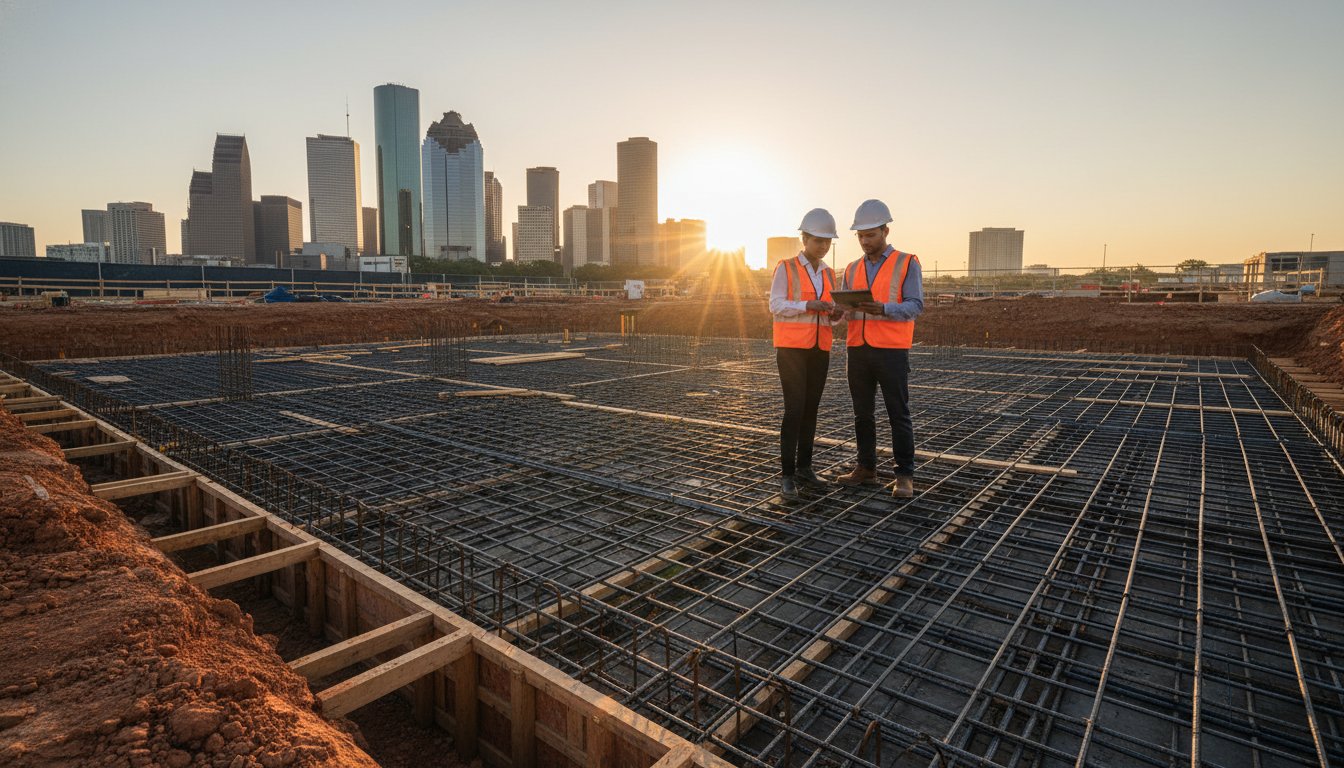
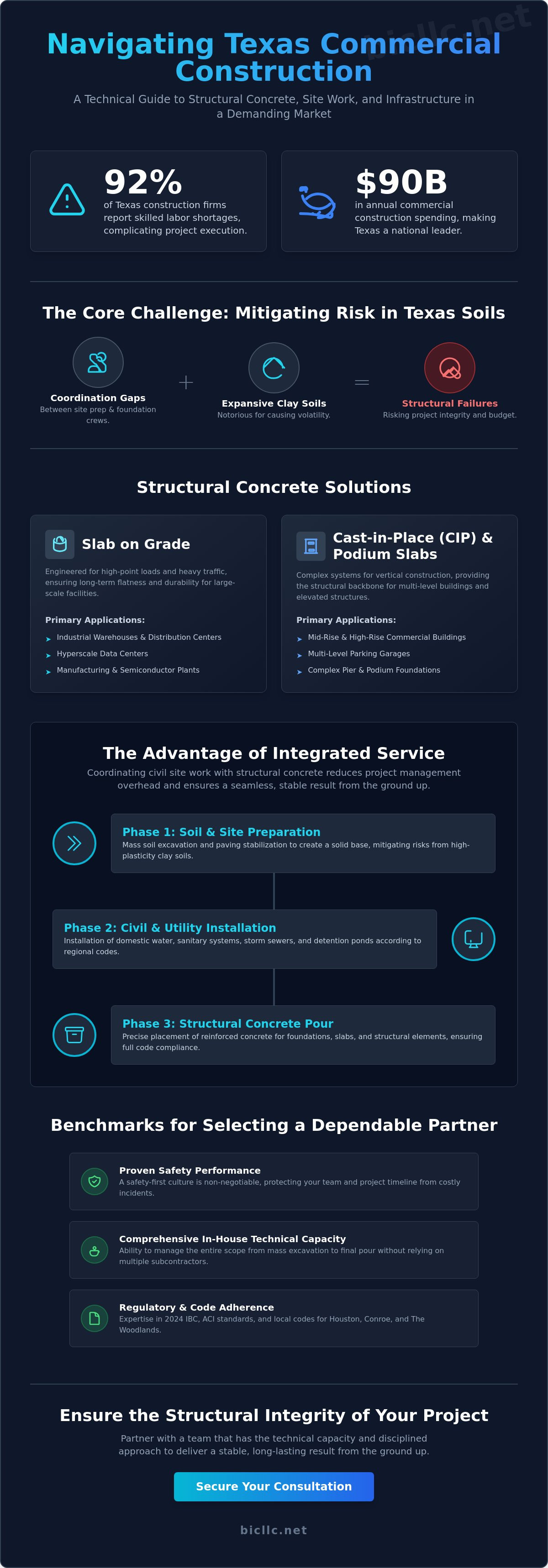
Ninety-two percent of Texas construction firms report difficulty in finding skilled workers, yet the state leads the nation with nearly $90 billion in annual commercial construction spending. For developers and contractors, this labor shortage often exacerbates coordination gaps between site preparation and foundation crews, which can lead to structural failures in the state's notorious expansive clay soils. Securing reliable concrete construction services Texas partners is no longer just about meeting a schedule; it's about ensuring the structural integrity of the project from the first excavation to the final pour.
You recognize that a building's lifecycle depends on a foundation that accounts for both environmental volatility and strict regulatory compliance. This guide provides a comprehensive technical overview of structural concrete, civil site work, and infrastructure requirements for the current Texas market. We'll examine the 2024 International Building Code standards, the complexities of mass soil excavation, and how integrated service models reduce project management overhead while delivering a stable, long-lasting result.
Key Takeaways
- Understand the engineering requirements for concrete construction services Texas to ensure structural stability in volatile soil environments.
- Learn to evaluate the technical differences between Slab on Grade and Cast-in-Place (CIP) systems for industrial and midrise applications.
- Discover how mass soil excavation and paving stabilization mitigate the risks posed by high-plasticity clay soils common across the state.
- Explore the strategic advantages of coordinating structural pours with civil site work, including the installation of domestic water and sanitary systems.
- Identify the essential benchmarks for selecting a dependable partner, focusing on safety performance and comprehensive in-house technical capacity.
Understanding the Scope of Commercial Concrete Construction Services in Texas
Commercial concrete construction is a disciplined, multi-stage engineering process that begins long before the first mixer truck arrives at the job site. In the 2026 Texas market, where annual commercial construction spending has reached nearly $90 billion, the demands on infrastructure have evolved significantly. Standard concrete work is no longer sufficient for the hyperscale data centers, semiconductor plants, and industrial manufacturing facilities driving the state's economic growth. Professional concrete construction services Texas providers must transition from simple material placement to delivering complex, integrated civil solutions that withstand the unique pressures of the local environment.
The distinction between residential-grade work and heavy-duty industrial infrastructure lies in the technical requirements for durability and load-bearing capacity. While smaller projects focus on aesthetics and light use, commercial developments utilize Reinforced concrete to support massive structural loads and maintain long-term stability. This involves a meticulous coordination of mass soil excavation, paving stabilization, and the precise placement of slab on grade or podium slabs. It's a shift from basic material handling to a comprehensive approach that manages everything from detention ponds to the installation of domestic water and sanitary lines.
The Role of the Concrete Contractor in 2026 Developments
General contractors today face a 92% skilled labor shortage across the state, according to industry reports. This reality makes the selection of a specialized structural concrete subcontractor a critical risk-management decision. GCs require partners who bring a safety-first culture and proven operational precision to the site. Reliability in these partnerships ensures the project remains compliant with the 2021 and 2024 International Building Codes, preventing costly structural delays. Project-based fees for this infrastructure are typically structured around the complexity of the civil site work and the technical scope of the structural elements, prioritizing substance and execution over simple cost estimates.
Regional Standards: Houston, Conroe, and The Woodlands
Navigating the regulatory landscape in Harris and Montgomery counties requires deep-rooted local expertise. Developments in Houston, Conroe, and The Woodlands must adhere to specific municipal codes that govern storm sewer systems and detention pond requirements. The local climate also dictates strict curing schedules to prevent premature drying in high humidity or extreme heat. Adhering to Texas-specific civil site work regulations is not optional; it's a fundamental requirement for the long-term viability of the build. Whether managing mass soil excavation or installing retaining walls, a disciplined contractor ensures every phase meets the rigorous engineering standards expected in the Gulf Coast region.
Structural Concrete Solutions: Slab on Grade, CIP Garages, and High-Rise Foundations
High-performance commercial developments require foundations that balance immediate structural necessity with long-term durability. Integrating professional concrete construction services Texas ensures these complex systems are executed according to the highest industry benchmarks. Industrial warehouses, for instance, rely heavily on slab on grade engineering. These slabs must be designed to withstand high-point loads from racking systems and constant forklift traffic, requiring precise reinforcement and vapor barrier installation to maintain floor flatness and levelness over decades of use.
Structural integrity for mid-rise and high-rise commercial structures depends on the strategic use of podium slabs and complex pier foundations. All work must strictly adhere to the Specifications for Concrete Construction provided by the American Concrete Institute to ensure structural safety. Beyond the primary structure, precision flatwork and sidewalk installation are essential for retail and urban centers, where aesthetic consistency must meet ADA compliance and heavy pedestrian load requirements. For developers seeking a partner capable of managing these technical intricacies, structural concrete solutions provide the necessary reliability for large-scale builds.
Cast-in-Place (CIP) Garage Construction
Cast-in-Place (CIP) garage construction is frequently the preferred method for multi-level parking structures in dense urban environments like Houston. Unlike precast systems, CIP garages are formed and poured on-site, allowing for a monolithic structure that offers superior moisture resistance and structural continuity. The process involves complex structural framing and heavy reinforcement to manage the immense load-bearing requirements of urban parking infrastructure. This method provides greater flexibility for irregular site footprints where precast components may not fit efficiently, ensuring a custom fit for every project.
Slab on Grade vs. Podium Slabs
Choosing between slab on grade and podium slabs depends largely on the project's vertical requirements and budget. Slab on grade is the standard for cost-efficient, single-story industrial applications where the earth provides the primary support. In contrast, podium slabs are utilized in mixed-use developments to support multi-story wood or steel frames above a concrete base. It's helpful to define podium slabs as structural transfer levels that distribute weight to the foundation; they act as a rigid platform that allows for a change in construction material or use between levels. This structural versatility is essential for modern urban density.
The Critical Importance of Soil Stabilization and Mass Excavation
Structural integrity in the Texas commercial market is fundamentally tied to the ground beneath the foundation. Southeast Texas is characterized by high-plasticity clay soils that expand and contract significantly with moisture changes. This movement exerts immense pressure on concrete structures, often leading to foundation shifting or surface cracking if the subgrade isn't properly addressed. Professional concrete construction services Texas providers prioritize soil stabilization as a prerequisite for any structural pour, ensuring the longevity of the investment through disciplined site preparation.
Mass soil excavation serves as the primary phase in transforming raw land into a buildable site. It involve moving large volumes of earth to establish structural footings and proper site grading. When dealing with expansive clays, the excavation process must be precise to accommodate the necessary stabilization layers. Effective site work also includes the strategic design of detention ponds and basins. These systems protect concrete paving and building slabs from hydraulic pressure by managing stormwater runoff, a critical requirement for maintaining the structural health of the development over time.
Paving Stabilization Techniques
Paving stabilization is a specialized engineering process that modifies the chemical and physical properties of the soil. In Texas, this typically involves the mechanical injection of lime or cement into the subgrade. This treatment reduces the soil's plasticity and creates a uniform moisture environment, which is essential to minimize swelling. By establishing a rigid, water-resistant base, stabilization significantly extends the lifespan of commercial concrete roads and parking areas. It prevents the subgrade failure that often results in "alligator cracking" or deep structural ruts in high-traffic industrial zones.
Mass Excavation and Detention Pond Construction
Site readiness for heavy-duty concrete loads requires a methodical approach to mass excavation. This phase establishes the topographical foundation for all future civil work, including the installation of storm sewers and sanitary lines. In regions like Conroe, where rapid development meets strict environmental regulations, the construction of detention ponds is a mandatory component of stormwater management. These ponds are engineered to hold excess water during peak rain events, preventing erosion around retaining walls and building perimeters. A disciplined approach to excavation efficiency ensures that the site remains stable and compliant throughout the construction lifecycle.
Beyond the Pour: Civil Site Work and Underground Utility Installation
A building’s structural integrity is inextricably linked to the infrastructure buried beneath it. In the Texas market, the most frequent cause of project delays isn't the concrete pour itself, but the lack of coordination between utility installation and foundation work. When these two phases are treated as separate silos, the risk of technical errors increases. Misaligned tie-ins or improperly compacted backfill for utility trenches can lead to localized soil settlement, which eventually compromises the slab on grade or concrete paving above. Professional concrete construction services Texas providers recognize that a foundation is only as stable as the civil infrastructure supporting it.
The transition from raw site preparation to a finished structural slab requires a methodical progression. This involves the precise placement of domestic water, storm sewer, and sanitary systems before any structural concrete is formed. Managing this workflow under a single point of accountability ensures that every penetration and utility line is verified against the engineering plans. It's a disciplined approach that eliminates the "vendor friction" common in multi-contractor sites, allowing for a steady and predictable construction cadence that honors the project schedule.
Underground Utility Systems
Managing Texas rainfall requires robust storm sewer systems capable of handling rapid runoff. These systems must be installed with precise gradients to ensure effective drainage away from building foundations and detention ponds. Similarly, the placement of sanitary and domestic water lines for commercial sites demands high-register professional precision. Every utility tie-in must be completed and tested before concrete pouring begins. If these systems aren't perfectly positioned, the cost of remediation involves cutting through reinforced concrete, which compromises the structural continuity of the slab.
The Integrated Advantage
Combining site work and concrete services under one operational umbrella provides a significant advantage for developers. Born Integrated Construction manages the "site-to-slab" workflow by ensuring that mass soil excavation, paving stabilization, and utility installation are executed in a logical, overlapping sequence. This integration reduces the time the site sits idle between phases and ensures that the crew preparing the subgrade understands exactly what the concrete crew requires. It’s about building a lasting foundation through unwavering consistency and a deep-rooted commitment to technical proficiency. For projects requiring a disciplined approach to civil infrastructure, integrated site and utility services provide a clear path to operational success.
Selecting the Right Concrete Construction Partner for Your Texas Development
The selection of a partner for concrete construction services Texas projects is a decision that dictates the long-term structural health of a development. In a market where 92% of firms face labor shortages, a contractor’s safety record and Experience Modification Rate (EMR) serve as the most reliable indicators of operational discipline. A low EMR reflects a steadfast commitment to safety and meticulous management of details, which directly translates to fewer delays and lower insurance liabilities for the developer. Reliability in this sector is built on proven results and unwavering consistency rather than speculative promises.
Capacity involves more than just manpower; it requires having the specialized equipment and technical proficiency to handle complex structural scopes in-house. A dependable partner should demonstrate a proven history of managing high-rise foundations, podium slabs, and integrated civil site work without relying on a fragmented chain of subcontractors. This depth of expertise ensures that the project maintains a methodical rhythm from mass soil excavation through the final pour. Assessing a firm's experience with Texas soil conditions is equally vital, as the ability to navigate high-plasticity clay determines the stability of the entire infrastructure.
5 Key Questions to Ask a Concrete Contractor
- Do you have specific experience with CIP garages and high-rise foundations in the local Texas market?
- What specific techniques do you utilize to handle soil stabilization in high-clay regions?
- Can your team manage both the structural concrete and the underground utility scope to reduce vendor friction?
- What is your current EMR rating, and how do you implement your safety-first culture on-site?
- Do you possess the in-house capacity and specialized equipment for mass soil excavation and paving stabilization?
Born Integrated Construction: A Steadfast Partner
Born Integrated Construction operates on a foundation of reliability and professional stability. Our approach prioritizes substance over style, focusing on the enduring nature of our professional output and the meticulous management of every detail. We recognize that developers require more than just a vendor; they need a disciplined partner who values ethical conduct and technical proficiency. By integrating services such as detention ponds, retaining walls, and CIP midrise construction, we provide a single point of accountability that reduces project management overhead and ensures structural integrity.
Our commitment to high standards and long-term structural viability is reflected in every project we establish. We maintain a composed, matter-of-fact delivery, ensuring that our clients have a clear understanding of the technical scope and the principles guiding the work. We focus on building lasting foundations, both literally and figuratively, through operational precision and a strong sense of duty. If your next development requires a partner focused on execution, safety, and consistent value, contact Born Integrated Construction for a project-based consultation.
Building for Longevity in the Texas Infrastructure Market
Establishing a durable commercial structure in Texas requires more than a standard concrete pour. It demands a methodical integration of mass soil excavation, paving stabilization, and precise structural engineering. By addressing the complexities of high-plasticity clay soils and coordinating underground utility installation before the first slab is cast, developers ensure long-term viability and reduce project management overhead. Selecting a partner for concrete construction services Texas is a strategic decision that impacts the safety and structural continuity of your infrastructure for decades.
Born Integrated Construction offers a disciplined approach to large-scale developments. We specialize in CIP garage and high-rise foundations, providing the technical proficiency needed for complex urban parking and vertical infrastructure. Our team combines civil site work and utility expertise with a steadfast commitment to safety and precision across Southeast Texas. We prioritize substance and reliability to deliver results that meet the highest industry standards. It's our duty to provide the professional stability your project requires.
Partner with Born Integrated Construction for Your Next Infrastructure Project to secure a foundation built on proven craftsmanship and operational precision. We look forward to establishing a lasting professional relationship through the successful execution of your next build.
Frequently Asked Questions
What are the main concrete construction services offered in Texas?
Commercial developments require a range of structural and civil capabilities to ensure long-term stability. Professional concrete construction services Texas providers deliver slab on grade, podium slabs, and cast-in-place (CIP) garages for midrise and highrise structures. These services also include essential civil infrastructure such as concrete paving, sidewalks, and retaining walls to provide a complete structural package for the site.
Why is soil stabilization so important for Texas concrete projects?
Texas is known for high-plasticity clay soils that expand and contract significantly with moisture fluctuations. Without paving stabilization using lime or cement, this soil movement can exert enough hydraulic pressure to crack foundations or shift heavy slabs. Stabilization creates a rigid and uniform base that protects the structural viability of the development against the state's volatile environmental conditions.
What is the difference between CIP and precast garage foundations?
Cast-in-Place (CIP) foundations are formed and poured directly on the project site, creating a monolithic structure with superior moisture resistance and structural continuity. Precast foundations are manufactured off-site and transported for assembly. CIP is often preferred for urban multi-level garages where site footprints are irregular or where a high level of structural durability is the primary priority.
Can a concrete contractor also handle underground utility installation?
Integrated contractors manage the installation of domestic water, storm sewer, and sanitary systems alongside structural concrete work. This approach reduces vendor friction and ensures that utility tie-ins are precisely positioned before any slabs are poured. Consolidating these services under a single point of accountability minimizes project delays and prevents technical errors during the site preparation phase.
How does mass excavation affect the timeline of a concrete build?
Mass soil excavation is the critical primary phase that establishes the topographical foundation for all future work. Delays in moving large volumes of earth or failing to properly grade structural footings can stall every subsequent trade on the job site. A disciplined excavation process ensures the site is ready for stabilization and foundation crews, maintaining a steady and predictable construction cadence.
What is a podium slab and when is it used in Texas construction?
A podium slab serves as a structural transfer level that distributes the weight of multi-story frames to the foundation. It's typically used in mixed-use developments where a concrete base supports several levels of wood or steel construction above. This engineering solution allows for diverse building uses, such as retail or parking on the ground level with residential or office space on the upper floors.
How do I choose between slab on grade and more complex foundation types?
The choice depends on the building's vertical requirements, soil conditions, and intended load-bearing capacity. Slab on grade is the standard for cost-efficient, single-story industrial warehouses where the ground provides direct support for the floor. More complex systems, like podium slabs or CIP midrise foundations, are necessary for vertical structures or sites with significant environmental and density constraints.
What regions does Born Integrated Construction serve for commercial projects?
We provide specialized civil and concrete construction services Texas developers rely on throughout the Southeast region of the state. Our primary service areas include Houston, Conroe, and The Woodlands, where we maintain a deep-rooted understanding of local municipal codes and soil conditions. We focus on delivering professional stability and proven results for large-scale infrastructure projects across these key Texas markets.