
CIP Garage Maintenance Guide for Texas Parking Structures
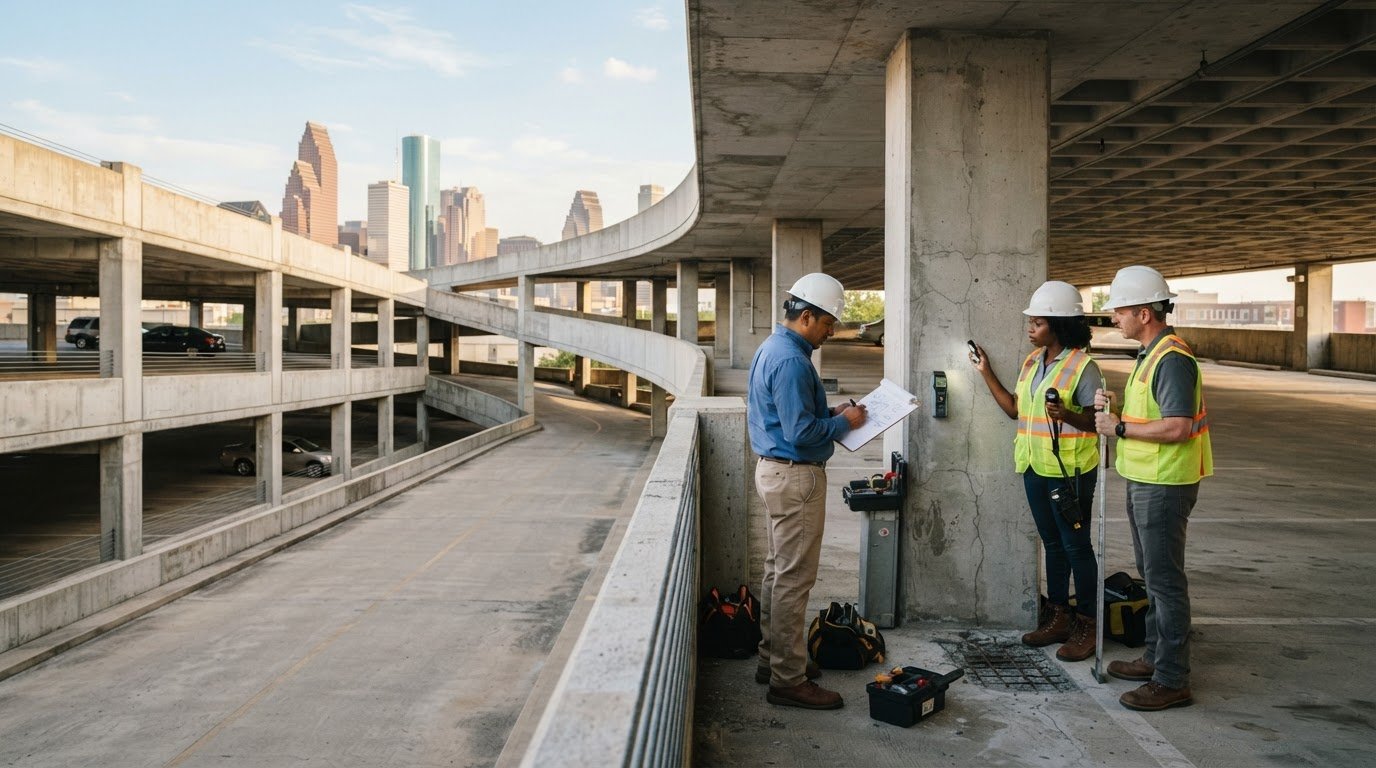
Small changes in a parking garage can carry important clues, but their appearance alone may not show how serious a concern is. For owners and managers, understanding how a structure was built can help frame maintenance decisions. Knowledge from CIP parking structure construction Texas projects provides useful context, but ongoing care depends on consistent observation and clear records.
It’s understandable to wonder which cracks, stains, or signs of water intrusion deserve attention, and when to seek professional evaluation. A repeatable checklist helps you review visible conditions, note changes over time, and organize informed discussions about next steps. This guide covers areas to observe, signs that merit follow-up, and practical ways to document findings. It also explains how construction knowledge can support maintenance planning without replacing an assessment by a qualified professional. With a steady process, you can address concerns thoughtfully and make considered decisions about the long-term care of a cast-in-place parking structure.
Key Takeaways
- Prioritize water management, exposure, use, and construction details when setting maintenance priorities for a cast-in-place garage.
- Walk each level and component systematically, recording the location and appearance of cracks, scaling, spalling, exposed reinforcement, stains, and water intrusion.
- Use a condition’s location, extent, and change over time to decide whether to continue observation or seek qualified professional evaluation.
- Keep a repeatable record of findings, follow-up responsibilities, and updates to support clear maintenance and repair discussions.
- Understanding CIP parking structure construction Texas can help owners frame project planning, but construction capability alone does not confirm inspection or maintenance services.
What CIP Parking Structure Maintenance Covers, and Why It Matters
CIP parking-structure maintenance is the ongoing process of observing, documenting, and managing a cast-in-place garage’s condition after construction. It differs from initial construction, which establishes the structure and its components. Maintenance planning does not assume a visible change has a particular cause. It helps owners track conditions and determine when a qualified professional should review them.
Cast-in-place, or CIP, concrete is formed and placed at the project site. Concrete slabs are one part of this system; the cast-in-situ slabs reference provides a basic explanation of how concrete slabs are formed in place. For a parking structure, useful observations extend beyond broad concrete surfaces to joints, transitions between components, drainage paths, and areas exposed to weather or vehicle use.
These details are worth recording because water movement, exposure, use, and construction detailing can shape what deserves attention. A checklist supports consistent observation and maintenance planning, but it cannot establish whether a crack or stain affects structural performance. Record what is visible, where it is located, and whether it appears to change. Seek qualified evaluation when a condition raises concern about the structure.
How cast-in-place garage construction shapes maintenance planning
Construction knowledge can help owners identify components and interfaces to include in a review. Joints and transitions connect different areas or elements, while drainage paths direct water across or away from surfaces. Exposed concrete can also show changes that are useful to document. These are observation priorities, not proof of a defect. Each garage has its own design, materials, detailing, and use, so adapt a checklist to the property rather than treating it as a universal diagnosis.
Why Texas site conditions belong in the review
Texas properties may experience heat, rain, humidity, and stormwater exposure, but regional context alone does not establish a garage’s condition. The actual setting matters: note where water collects or flows, which surfaces are exposed, and whether use differs across levels or ramps. Verify observations at the property and keep them distinct from general assumptions about the region.
For owners considering CIP parking structure construction Texas projects, construction decisions and future maintenance planning are related, but they are not the same service or task. A practical review can help organize questions and records. If an observed condition appears to affect structural performance, arrange a review by a qualified professional rather than relying on a checklist to assess its severity.
Where to Inspect a CIP Parking Structure for Early Warning Signs
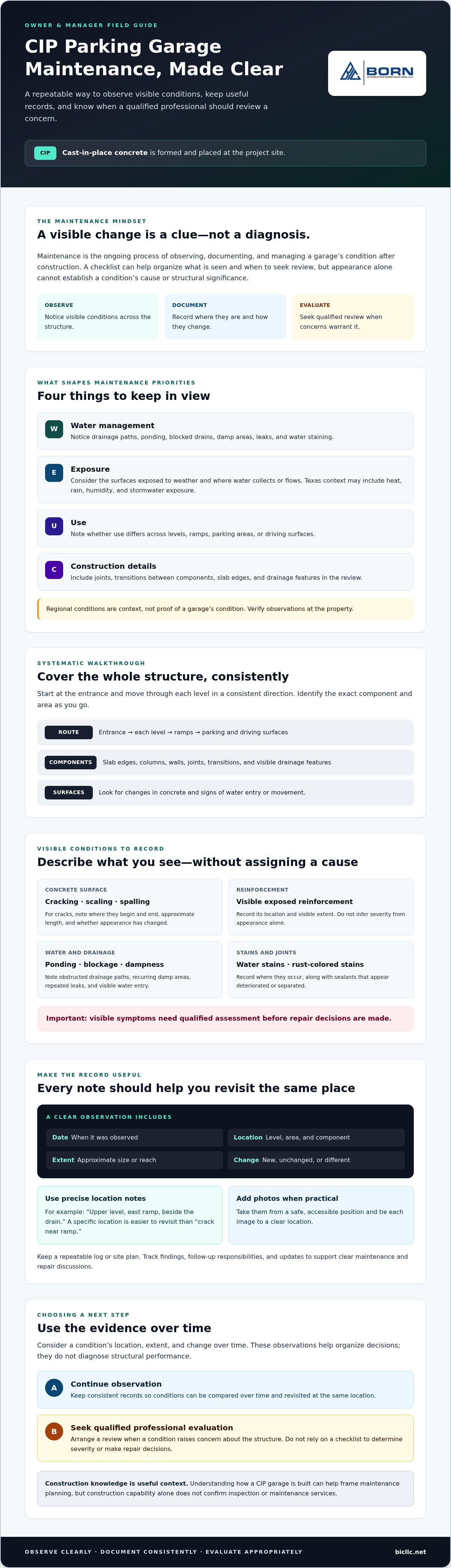
A useful walkthrough is systematic, not a search for one obvious defect. Start at the entrance and move through each level in a consistent direction, noting the exact area and component as you go. Include ramps, parking and driving surfaces, slab edges, columns, walls, joints, transitions, and visible drainage features. A location such as “upper level, east ramp, beside the drain” is easier to revisit than “crack near ramp.”
Use a log or site plan to record what you see. Note the date, location, approximate extent, and whether a condition appears new, unchanged, or different from earlier records. Photos can document visible changes when taken from a safe, accessible position and tied to a clear location. Don’t infer a cause from appearance alone.
Concrete surfaces, joints, and transitions
Review driving surfaces and ramps for visible cracking, scaling, or spalling. Look at slab edges, columns, walls, and transitions for changes in the concrete surface, and record any visible exposed reinforcement. For cracks, note where they begin and end, their approximate length, and whether their appearance seems to have changed since the last record. Don’t classify a crack as structural or harmless without a qualified assessment.
Visible symptoms require qualified assessment before repair decisions are made.
Drainage, water entry, and corrosion indicators
Observe whether drains appear blocked, water is ponding, or a drainage path is obstructed. Note recurring damp areas, repeated leaks, water staining, and sealants that appear deteriorated or separated. At joints and transitions, record the location of visible water entry rather than assuming how it traveled through the structure.
Rust-colored staining and exposed reinforcement are observations to document and flag for appropriate review, not a diagnosis. Compare each finding with prior notes or photographs. New, recurring, or apparently worsening conditions merit follow-up with a qualified professional, particularly if their location or extent raises concern about structural performance.
- Record: Level, component, specific location, date, and visible condition.
- Compare: Check earlier records for changes or recurring water patterns.
- Follow up: Identify who will arrange review and retain any updates with the site record.
This documentation can help owners communicate clearly with qualified professionals and inform discussions about future work. For context on the company’s concrete construction work, see Born Integrated Construction’s project portfolio. Owners considering CIP parking structure construction Texas projects can use consistent condition records to make future project conversations more specific, without treating a walkthrough as a structural assessment.
Routine Upkeep or Professional Repair? How to Assess Observed Conditions
A visible change doesn’t automatically mean repair is needed, and routine cleaning can’t resolve every concern. Separate three steps: housekeeping, observation, and professional evaluation. Housekeeping addresses ordinary cleanliness and site operations. Observation records a condition and checks for change using consistent locations and photographs. Professional evaluation is appropriate when the finding’s location, extent, or progression raises questions about safety or structural performance.
Severity can’t be determined from appearance alone. A small crack in one area may warrant different attention from a changing crack near a joint. Recurring water entry may call for review even if the visible stain seems limited. Use the table to organize follow-up, not as a diagnosis or repair specification.
| Condition | Observation | Suggested follow-up | Responsible party |
|---|---|---|---|
| Minor surface change with no apparent progression | Record location, appearance, and date; take a comparable photo. | Retain in the condition log and monitor according to project guidance or qualified professional advice. | Owner or facility manager |
| Blocked drainage path or isolated ponding | Note where water collects and whether the condition recurs. | Address ordinary housekeeping only under site procedures; flag recurring or unexplained water for review. | Facility manager; qualified professional if concerns persist |
| Changing crack or recurring water entry | Compare current observations with prior records and note the location and extent. | Request qualified professional evaluation before deciding on repair. | Owner or facility manager to arrange review; qualified professional to assess |
| Exposed reinforcement or significant concrete loss | Document the visible area without disturbing it or assigning a cause. | Escalate for qualified evaluation, particularly if structural performance may be affected. | Owner or facility manager to arrange review; qualified professional to assess |
Conditions to document and monitor
Surface marks, limited scaling, or isolated staining are observations to record, not automatic proof that repair is required. Use repeatable photographs from a safe position, a clear location reference, and notes describing what changed or stayed the same. Monitoring frequency should follow project guidance or qualified professional advice, rather than an assumed schedule.
When to request qualified professional evaluation
Seek qualified review for cracks that appear to be changing, recurring water entry, exposed reinforcement, or substantial concrete loss. The significance depends on where the condition occurs, its extent, and how it develops. If immediate site conditions or competent safety direction indicate an area should be restricted, follow that direction. Don’t impose access restrictions based only on an unqualified visual judgment. Evaluation should guide decisions, not promise a diagnosis or repair outcome.
Clear records also help owners prepare for project discussions, including future CIP parking structure construction Texas planning. Construction experience may inform those conversations, but it does not by itself establish an inspection or maintenance service.
A Practical CIP Garage Maintenance Checklist for Texas Owners
A consistent process makes walkthrough findings easier to compare and follow up. Review available records, walk each area in a consistent order, document observations, assign follow-up, and retain updates with the site history. Use project-specific maintenance documents and qualified professional recommendations to guide the process, rather than assuming one schedule fits every garage.
Organize the walkthrough by level, bay, elevation, or another site reference you can use again. Include parking levels, ramps, drainage features, joints, exposed concrete, and accessible structural elements. The purpose is to establish a clear condition record, not to diagnose a problem or decide on a repair based on appearance alone.
What to record during each walkthrough
For each observation, capture the date, precise location, visible condition, and a photograph when it can be taken safely. Compare it with prior records and note whether it appears new, unchanged, recurring, or different. Record weather or water conditions only when they help describe what you observed, such as standing water near a drain. Keep notes and images together under the same location reference.
- Review records: Gather available plans, prior condition notes, photographs, and project-specific maintenance guidance.
- Walk each area: Follow a repeatable route through levels, ramps, joints, drainage features, exposed concrete, and accessible structural elements.
- Document findings: Record visible conditions and comparisons without assigning a cause or severity.
- Assign follow-up: Name the person responsible for routine documentation or arranging qualified review.
- Retain updates: Add follow-up notes and confirmation of completed actions to the same record.
How to prioritize follow-up without guessing at severity
Separate observations that remain in the routine log from conditions referred for qualified assessment. A new or apparently changing crack, recurring water entry, exposed reinforcement, or concrete loss may warrant review, but a checklist alone cannot determine the risk or required response. Where appropriate, ask a qualified professional to assess the condition and advise on next steps.
Keep each action open until the responsible party confirms what was done and provides any relevant update. This creates a traceable record without treating an assignment as proof that a concern has been resolved. Follow the property’s maintenance documents and professional recommendations for monitoring and follow-up. Don’t invent an inspection interval where none has been established.
For owners planning future CIP parking structure construction Texas projects, a well-organized condition history can also help frame project discussions. Review Born Integrated Construction’s concrete project portfolio for context on its confirmed construction work.
Planning the Next Step: Maintenance Records, Construction Expertise, and Texas Projects
Well-organized condition records give owners a clear starting point for conversations with qualified professionals and construction partners. A location-based log, dated photographs, prior observations, and notes on completed follow-up help explain what has been observed without presenting those observations as a structural diagnosis. This context can make discussions more focused when planning future work or assessing how a project may fit the property’s needs.
Maintenance findings don’t automatically mean a garage needs reconstruction or replacement. The appropriate next step depends on the condition and its professional assessment. Construction capability is distinct from inspection or maintenance service. Confirm who is responsible for evaluating existing conditions, defining project scope, and coordinating the work before assuming those responsibilities belong to a construction partner.
When future concrete construction enters the discussion
If owners are considering a new garage or a broader concrete project, recurring planning needs may prompt discussion of construction options. Born Integrated Construction’s confirmed capabilities include CIP garages and structured concrete parking garages. That experience provides relevant project context, but it does not establish that the company inspects or repairs existing structures. The condition record can help clarify project questions; it should not be used by itself to decide that replacement is necessary.
For a closer look at relevant work, review structured concrete project examples. Owners planning CIP parking structure construction Texas projects can use the portfolio as a reference when considering a potential construction partner, while confirming the scope and responsibilities that apply to their specific project.
What to prepare before contacting a construction partner
A concise project brief helps establish what is known and what still needs clarification. Gather available drawings, a description of the proposed scope, site constraints, organized condition records, and the names or roles of people involved in decisions. If a qualified professional has assessed existing conditions, include relevant findings and recommendations rather than substituting informal observations.
- Scope: Describe the intended project or planning need, distinguishing new construction from questions about an existing garage.
- Site information: Organize available drawings and note access, operating, or other known site constraints.
- Condition records: Share dated observations and follow-up history, while identifying any items awaiting professional review.
- Responsibilities: Ask about relevant project experience, safety practices, quality controls, and coordination responsibilities.
These questions help owners assess fit and understand how project responsibilities would be established. For a future CIP garage project, review Born Integrated Construction’s project capabilities as part of your partner research, then confirm that the proposed scope aligns with the company’s offerings.
Keep Your Garage Review Process Consistent
A dependable maintenance process starts with careful observation and clear records. Walk the structure methodically, document visible changes by location, and compare findings over time. Cracks, recurring water entry, exposed reinforcement, or concrete loss should be recorded without guessing at their cause or severity. When a condition may affect safe access or structural performance, seek qualified professional evaluation before making repair decisions.
Organized records also support informed discussions about future work. Understanding CIP parking structure construction Texas projects can help owners frame construction questions, but construction capability does not replace an assessment of an existing garage. Born Integrated Construction’s confirmed offerings include CIP garages and structured concrete parking garages, supported by stated priorities of safety, integrity, efficiency, and quality.
For concrete projects in Texas, including Houston, Austin, San Antonio, Dallas, Fort Worth, San Marcos, New Braunfels, Boerne, Beaumont, Conroe, The Woodlands, and Arlington, review Born Integrated Construction’s concrete construction capabilities and contact the company to discuss a project that fits its offerings.
Frequently Asked Questions
What is CIP parking structure maintenance?
CIP parking structure maintenance is the ongoing care and observation of a cast-in-place concrete garage after construction. Upkeep includes routine housekeeping and attention to site conditions; observation means recording visible changes and comparing them with prior records. Neither step is a structural diagnosis. A qualified professional assesses conditions when their location, extent, or change raises concern. Keeping these roles distinct helps owners plan responsibly without treating every mark or stain as a repair issue.
How often should a concrete parking garage be inspected?
Inspection intervals should follow project-specific maintenance guidance and advice from a qualified professional. There isn’t one schedule that can be recommended for every garage based on the information available here. Owners in Texas, including Houston, Austin, and Dallas, can review project documents and ask a qualified professional to advise on an appropriate frequency for their structure. Consistent observations between professional assessments can help track visible changes, but they don’t replace a professional evaluation.
What signs of concrete deterioration should garage owners document?
Document visible cracks, scaling, spalling, exposed reinforcement, staining, and water intrusion. Also note standing water, blocked drainage paths, recurring damp areas, leaking joints, or sealants that appear deteriorated. Record the location, date, approximate extent, and whether the condition appears different from prior photographs or notes. These are observations, not diagnoses: appearance alone can’t establish the cause or severity. Clear records help a qualified professional understand what was seen and where.
When should a parking structure owner seek professional evaluation?
Seek qualified professional evaluation when conditions appear to be changing, water entry recurs, reinforcement is exposed, or concrete loss is substantial. Prompt review is especially appropriate if an observed condition may affect safe access or structural performance. Document what you see and compare it with earlier records, but don’t use a checklist to determine severity or select a repair. If immediate site conditions or competent safety direction call for restricted access, follow that direction.
Can water leaks damage a cast-in-place parking garage?
Recurring water entry can be a concern and warrants investigation, but a leak alone doesn’t identify its source or establish the extent of any effect on the structure. Note where water appears, whether it recurs, and any associated staining, dampness, ponding, or visible surface changes. Compare those observations with prior records. A qualified professional can assess the condition and advise on next steps; avoid assuming a specific cause or repair from a visible leak alone.
How should a parking garage maintenance checklist be organized?
Organize the checklist around consistent locations, such as level, bay, ramp, or elevation, so observations can be found again. For each finding, record the date, visible condition, approximate extent, and a photograph when safe and useful. Compare it with prior notes, then assign a responsible person for follow-up. Keep updates with the original record and close an action only after completion is confirmed. Use project guidance or qualified advice for monitoring frequency.
Does Born Integrated Construction provide parking garage maintenance or inspections?
The available company information confirms construction offerings, not parking garage maintenance or inspection services. Born Integrated Construction provides CIP garages and structured concrete parking garages, alongside related concrete construction work. Its stated priorities include safety, integrity, efficiency, and quality. Owners in Texas, including Houston, San Antonio, Fort Worth, San Marcos, New Braunfels, Boerne, Beaumont, Conroe, The Woodlands, and Arlington, should confirm project scope and responsibilities directly rather than assume inspection or maintenance is offered.