Commercial Concrete Flatwork Contractor in Houston: The 2026 Guide to Durable Paving
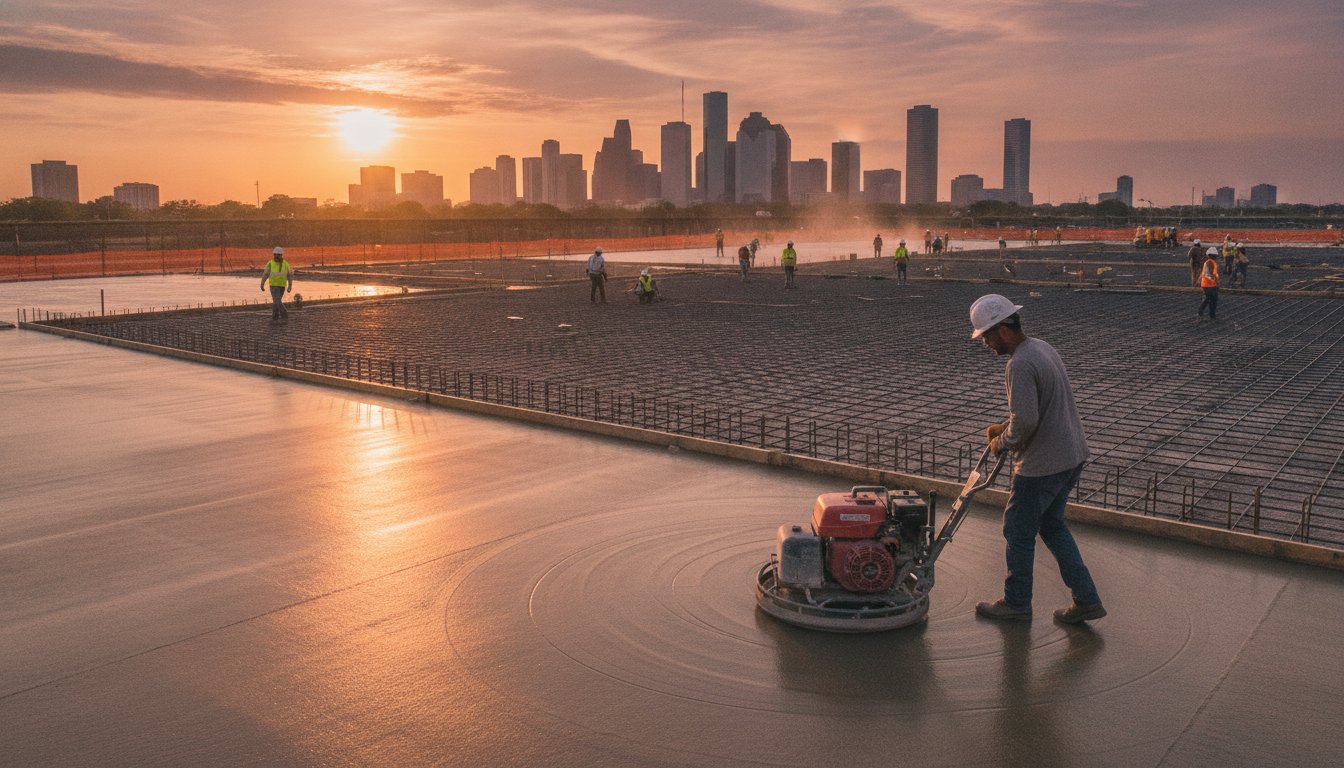
The structural integrity of a commercial development in Houston is determined long before the first yard of concrete is poured. For many developers, the Beaumont clay represents a persistent liability that leads to premature cracking and safety hazards. You've likely seen the results of uncoordinated crews where the paving fails because the site preparation wasn't handled with precision. Selecting the right commercial concrete flatwork contractor Houston offers requires a partner who understands that the subgrade is just as important as the surface.
It's a frustrating reality that minor oversights in stabilization can result in non-compliant surfaces and structural instability. This guide provides a comprehensive look at how integrated civil and concrete solutions ensure your project remains durable and ADA-compliant under the 2021 International Building Code standards adopted for 2026. We'll explore the technical necessity of 5-inch minimum slab thicknesses, the transition to #4 rebar on 18-inch centers, and the operational efficiency gained by using a single turnkey partner for mass excavation and paving. By prioritizing professional stability and meticulous management, you can establish a foundation that stands the test of time and climate.
Key Takeaways
- Understand how Houston’s expansive clay soil impacts paving and why specialized stabilization is required for long-term durability.
- Learn why partnering with a turnkey commercial concrete flatwork contractor Houston can mitigate project delays through integrated earthwork and paving services.
- Identify the 2026 technical standards for reinforcement and mix design necessary to withstand the region’s high humidity and heavy-duty traffic loads.
- Discover the critical criteria for evaluating a contractor’s portfolio and safety certifications to ensure operational precision and site safety.
- Recognize the long-term value of prioritizing structural integrity and ADA compliance from the initial mass soil excavation phase.
Understanding Commercial Concrete Flatwork in Houston
Commercial flatwork encompasses the horizontal concrete surfaces essential for industrial and retail operations, including parking lots, loading docks, and pedestrian walkways. Unlike residential projects, these structures must withstand heavy axial loads and constant industrial traffic. A qualified commercial concrete flatwork contractor Houston relies on must prioritize structural integrity over aesthetics to ensure long-term viability. High-performance paving requires a thorough understanding of different Types of concrete and how they interact with local environmental variables. By focusing on engineering precision, developers can avoid the common pitfalls of premature surface degradation.
The Impact of Houston Clay on Concrete Longevity
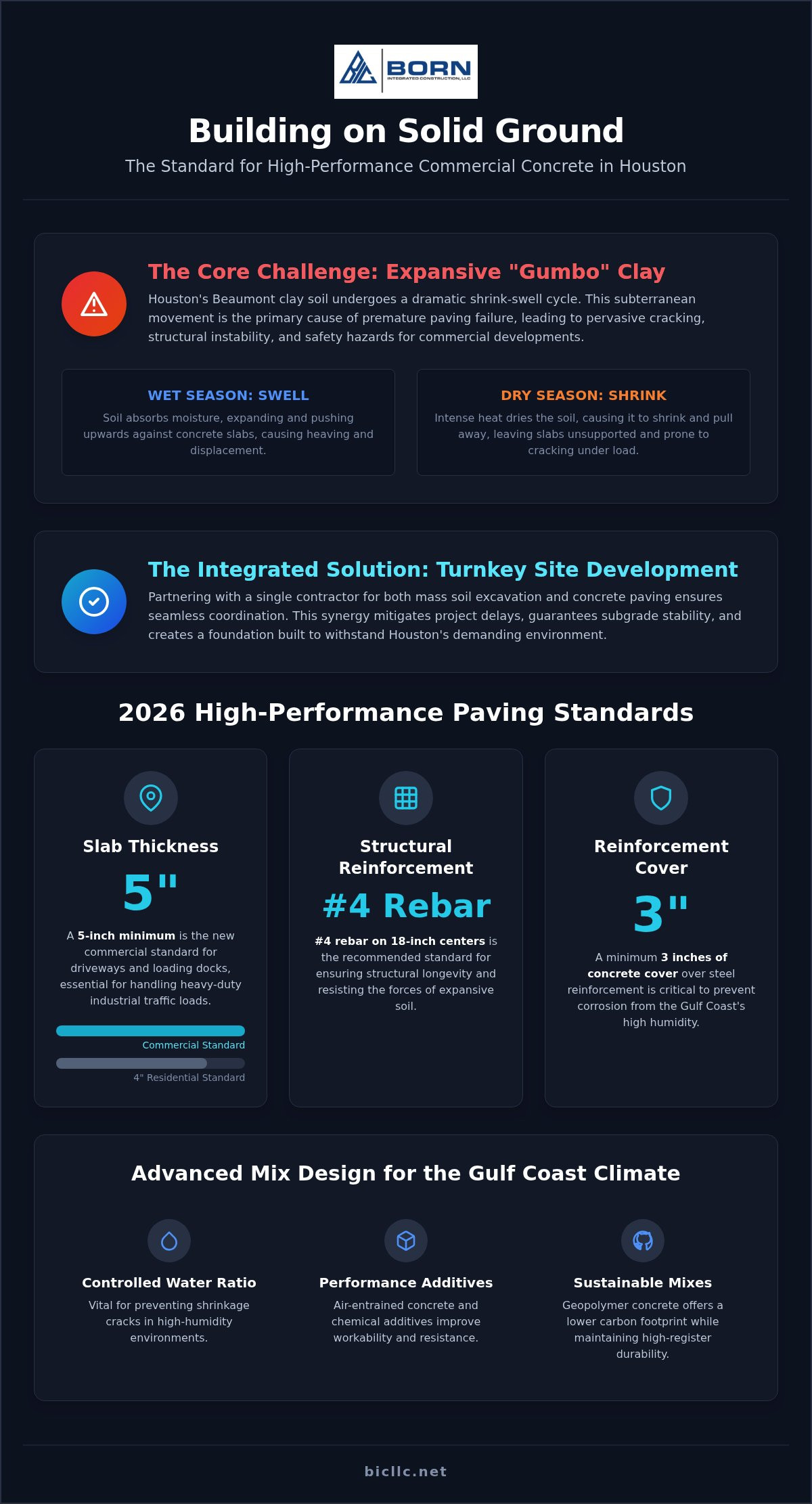
Houston’s Beaumont clay, often called "gumbo," is the primary cause of paving failure in the Gulf Coast region. This expansive soil undergoes a dramatic shrink-swell cycle as it absorbs moisture during heavy rainfall and dries out during intense summer heat. Sub-standard flatwork lacks the stabilization necessary to resist these subterranean shifts, leading to pervasive cracking and vertical displacement. Soil-to-structure synergy is the key to durability. Through integrated civil solutions like paving stabilization and mass soil excavation, we establish a steadfast foundation that protects the concrete from environmental stress and ensures the longevity of the commercial project portfolio.
Core Components of High-Traffic Flatwork
Engineering standards for 2026 emphasize resilience against these local challenges. While residential slabs might suffice with 4 inches of thickness in other regions, Houston commercial standards demand a 5-inch minimum for driveways and loading docks to handle heavy-duty traffic. The role of reinforcement is equally critical. While fiber mesh has its applications, #4 rebar on 18-inch centers is the recommended standard for ensuring structural longevity in Houston's expansive soil. Strategic jointing and expansion strategies are also vital. These controlled breaks allow the concrete to move without creating the jagged, uncontrolled cracks that lead to safety liabilities. Meticulous management of these details ensures that the finished surface remains level and safe for years of continuous use.
Technical Standards for High-Performance Paving
Houston’s climate demands more than standard concrete. Achieving a compressive strength that withstands industrial use requires a meticulous approach to mix design and curing. Choosing a seasoned commercial concrete flatwork contractor Houston ensures that these technical variables are managed with operational precision. Every pour must account for the high humidity of the Gulf Coast, which can interfere with the evaporation rate and lead to surface scaling or internal weaknesses. We prioritize consistency in every batch to ensure the final product meets the rigorous demands of Houston commercial developments.
Optimizing Concrete Mix for Texas Weather
In high-humidity environments, controlling the water-to-cement ratio is vital for preventing shrinkage cracks. We utilize specific chemical additives and air-entrained concrete to improve workability and resistance to heavy axial loads. As we move through 2026, sustainable mix designs like geopolymer concrete are becoming standard for projects with strict environmental goals. These advanced products offer a lower carbon footprint while maintaining the high-register durability required for the region’s specific soil conditions. It's a technical necessity that requires a deep understanding of local material science.
Jointing and Reinforcement Strategies
Proper load transfer in commercial parking lots depends on the precise placement of dowel bars and strategic joint spacing. Calculating joint spacing based on slab thickness prevents the uncontrolled cracking that compromises structural integrity. Adhering to Integrated Pavement Solutions ensures that every layer of the paving system contributes to the overall stability of the structure. We prioritize ensuring at least 3 inches of concrete cover over steel reinforcement to prevent corrosion in our humid climate. This attention to detail is what defines a professional installation.
Surface finishing and curing are the final steps in establishing a reliable surface. We implement early morning pours to manage temperature spikes and apply curing compounds immediately to lock in moisture. This methodical process ensures the concrete reaches its maximum compressive strength without brittle failure. Slip-resistant broom finishes are applied to loading docks and sidewalks to maintain safety standards and ADA compliance. Precise grading during the finishing stage is also mandatory to facilitate proper drainage, which prevents standing water from compromising the subgrade over time. Our commitment to these rigorous technical standards is evident in the successful delivery of our recent industrial projects.
The Integrated Advantage: Site Prep and Flatwork Synergy
Selecting a commercial concrete flatwork contractor Houston developers can rely on involves looking beyond the surface finish. The structural integrity of any horizontal slab is fundamentally tied to the quality of the site preparation. When earthwork and paving are treated as separate, uncoordinated phases, the risk of project delays and subgrade failure increases. We prioritize an integrated approach that views mass soil excavation and paving as a single, continuous process. This ensures the foundation is as steadfast as the concrete it supports.
Mass soil excavation establishes the necessary level base for high-traffic surfaces. In the context of Houston's Chapter 19 floodplain ordinance, this phase also includes the strategic construction of detention ponds. These structures aren't merely regulatory requirements; they're essential for protecting flatwork from the erosion and flooding that often follow heavy Gulf Coast rain events. By managing runoff effectively, we prevent water from undermining the subgrade and compromising the pavement's long-term structural reliability.
Soil and Paving Stabilization Techniques
Houston’s Beaumont clay is notoriously reactive, requiring chemical intervention to establish a predictable platform. We utilize lime and cement stabilization to transform expansive soil into a rigid base that resists the shrink-swell cycle. This meticulous subgrade preparation is detailed in our exploration of Why Paving Stabilization is Critical for Texas Soil. By reducing the risk of future slab settlement, we ensure that sidewalks and parking lots remain ADA-compliant and free of trip hazards for years to come.
Managing Underground Utilities and Drainage
Operational precision requires the seamless integration of storm sewer installation with surface flatwork. If utility coordination is overlooked during the initial earthwork, it frequently leads to pavement saw-cutting after the pour. This unnecessary rework compromises the slab's integrity and creates points of weakness where moisture can penetrate. We ensure that all underground utilities are placed and compacted correctly before the first yard of concrete is delivered. This foresight allows for a proper slope for water runoff across large parking areas, which is a technical necessity for maintaining a safe and durable site. Combining these services under one partner streamlines the schedule and provides the professional stability essential for complex commercial developments.
How to Evaluate a Commercial Concrete Contractor
Selecting a commercial concrete flatwork contractor Houston developers can trust requires a methodical assessment of more than just a line-item bid. In an industry where surface-level results often mask structural deficiencies, you must look for a partner who prioritizes substance and long-term viability. A contractor's ability to manage complex logistical demands while maintaining high technical standards is the hallmark of professional stability. You're looking for a disciplined professional who values the meticulous management of details over rapid, uncoordinated execution.
Prioritizing Safety and Integrity
Liability on a construction site is a significant concern for any developer. A steadfast commitment to safety isn't just a regulatory checkbox; it's a reflection of the organization's core values. When vetting a partner, ask about their safety record and how they maintain ethical conduct within their vendor relationships. Reliable contractors ensure that every crew member is trained to handle the specific risks associated with heavy-duty paving and excavation. Consider asking these specific questions during your vetting process:
- What's your current Experience Modification Rate (EMR)?
- How do you manage safety protocols for integrated civil and concrete crews?
- Can you provide documentation of your current professional liability insurance?
Maintaining high standards for safety and integrity ensures that your project proceeds without the costly delays or legal complications that stem from on-site negligence. You can learn more about our commitment to these principles on the BIC About Page.
Vetting Technical Expertise
Technical proficiency extends beyond simple pouring. For 2026 developments, you need a contractor who understands the complexities of structural CIP midrise construction and the strict requirements for TxDOT right-of-way entrances. These specialized tasks require a level of operational precision that generalists often lack. Reviewing a contractor’s past work is the most effective way to verify this expertise. By examining BIC Projects, you can see how we've delivered consistent value across various commercial sectors. Look for examples of podium slabs, CIP garages, and high-traffic paving stabilization to ensure they can handle your project's specific scope.
Large-scale Texas projects demand a partner with significant logistical capacity. This includes the ability to coordinate mass soil excavation with concrete delivery and the manpower to meet tight deadlines without sacrificing quality. A seasoned commercial concrete flatwork contractor Houston businesses depend on will have the equipment and personnel to manage multiple phases of work simultaneously. If you're ready to partner with a seasoned expert who prioritizes reliability, contact us to discuss your project requirements and ensure your development is built on a lasting foundation.
Born Integrated Construction: Steadfast Concrete Solutions
Born Integrated Construction (BIC) operates as a disciplined partner for developers who seek substance over style. We understand that the enduring nature of a commercial project depends on the meticulous management of every detail from the initial earthwork to the final broom finish. As a seasoned commercial concrete flatwork contractor Houston professionals depend on, we prioritize a methodical approach that eliminates the friction of uncoordinated trades. Our presence in the Houston, Austin, and Dallas-Fort Worth markets allows us to deliver consistent value across the major Texas hubs while maintaining a deep-rooted commitment to high standards.
Turnkey Civil and Concrete Services
The BIC approach consolidates mass soil excavation, underground utilities, and concrete paving under one expert roof. This integration provides a clear hierarchy of importance on the job site, where site preparation and structural paving work in concert rather than in conflict. For General Contractors, this efficiency translates to faster project delivery and a significant reduction in administrative overhead. BIC manages the construction of detention ponds while simultaneously coordinating the paving schedule to ensure seamless site progression. By establishing a level base and managing complex drainage requirements internally, we ensure that the finished flatwork meets the high standards of durability required for 2026 developments.
Long-Term Reliability and Professionalism
We project the image of a steadfast expert because our results are proven through unwavering consistency. Reliability isn't just about the quality of the concrete; it's about the professional stability we bring to every high-stakes infrastructure project. We focus on building lasting foundations, both literally through our structural output and figuratively through the relationships we maintain with our partners. Our commitment to ethical conduct and operational precision suggests a deep-rooted dedication to the standards of the industry. Each project is handled with a serious, reassuring delivery that instills confidence in our clients.
Developers choose us because we act as a dependable partner who values the substance of the work. We don't seek to disrupt the industry with unproven innovations. Instead, we master the craft of execution and safety to deliver a result that withstands the test of time and climate. We lead through proven results and a disciplined work ethic that prioritizes the long-term viability of your investment. If you require a partner who values substance and technical proficiency, Contact Born Integrated Construction for a Project Consult to discuss your upcoming infrastructure needs.
Establishing a Legacy of Structural Integrity
A durable commercial development begins with a commitment to high standards and technical proficiency. We've explored how integrated soil stabilization and precise mix designs are essential for overcoming the challenges of Houston's expansive clay. By prioritizing soil-to-structure synergy, you ensure that every horizontal surface remains a reliable asset rather than a long-term liability. Selecting an experienced commercial concrete flatwork contractor Houston developers trust means choosing a partner who values substance, safety, and operational precision.
Born Integrated Construction remains a steadfast leader in delivering these results across Houston, Conroe, and major Texas hubs. As specialists in CIP and precast foundations, we provide the professional stability required for high-stakes infrastructure. Our expertise in paving stabilization and detention pond construction allows us to manage every variable of the site before the first yard of concrete is placed. It's time to build on a foundation of reliability and proven craftsmanship. Partner with Houston’s Trusted Integrated Concrete Expert to ensure your next project stands the test of time and climate. We look forward to establishing a lasting professional relationship built on consistent value and meticulous execution.
Frequently Asked Questions
What is the difference between concrete flatwork and structural concrete?
Flatwork refers specifically to horizontal surfaces like parking lots, sidewalks, and loading docks that don't support the building's primary frame. Structural concrete involves load-bearing elements such as podium slabs, CIP garages, and midrise foundations. While flatwork focuses on surface durability and drainage, structural concrete must manage complex axial loads and gravity. A commercial concrete flatwork contractor Houston developers hire must understand these distinctions to ensure every component of the infrastructure is engineered for its specific intended weight.
How long does commercial concrete flatwork take to cure in Houston?
Commercial concrete typically achieves enough strength to support foot traffic within 24 to 48 hours. However, heavy vehicle traffic should be restricted for 7 to 14 days depending on the mix design and environmental conditions. In Houston’s humid climate, moisture retention is high, but extreme heat can accelerate surface drying. We utilize curing compounds and methodical timing to ensure the slab reaches its full compressive strength at the 28-day mark without brittle surface failure.
Why is soil stabilization necessary for concrete paving in Texas?
Soil stabilization is a technical necessity in Texas due to the expansive Beaumont clay, which shifts significantly with moisture changes. By incorporating lime or cement into the subgrade, we create a rigid, non-reactive platform for the paving. This process prevents the shrink-swell cycle from causing vertical displacement and premature cracking in the slab. Establishing this stable base is the most effective way to protect the structural integrity of the concrete and avoid costly long-term repairs.
What are the ADA requirements for commercial concrete sidewalks?
ADA compliance for commercial sidewalks requires a maximum cross slope of 2% and a minimum path width of 5 feet. Transitions between different surfaces must be level, and curb ramps must include truncated domes for tactile warnings. Precise grading during the finishing phase is mandatory to meet these federal standards. We prioritize these details during the pour to ensure that your site remains accessible and free of safety liabilities or legal complications related to non-compliance.
Can you handle both excavation and concrete paving for a single project?
We provide integrated civil and concrete solutions that consolidate mass soil excavation and paving under a single point of management. This turnkey approach eliminates the coordination gaps that often lead to project delays and uncoordinated site work. By handling the earthwork, utility placement, and concrete construction simultaneously, we maintain professional stability and operational precision throughout the project. This efficiency allows partners to meet tight deadlines while ensuring the subgrade and surface are perfectly aligned.
How do you prevent commercial concrete from cracking in high-heat environments?
Preventing cracks in high-heat environments requires a combination of early morning pours and specialized mix designs. We apply curing compounds immediately after finishing to lock in moisture and prevent the surface from drying faster than the core. Strategic jointing is also essential to provide controlled relief points for thermal expansion. These methodical steps ensure the concrete maintains its structural reliability even when exposed to the intense temperatures and humidity common to the Texas Gulf Coast.
What is the typical thickness for a commercial parking lot slab?
A standard commercial parking lot slab in Houston requires a minimum thickness of 5 inches to withstand local soil movement and light vehicle traffic. For areas subject to heavy-duty loads, such as loading docks or fire lanes, we recommend a thickness of 6 to 8 inches. As a commercial concrete flatwork contractor Houston businesses rely on, we ensure these specifications meet 2026 engineering standards. This provides the durability necessary for industrial operations and ensures the pavement remains functional.