Commercial Concrete Retaining Wall Contractor Texas: 2026 Engineering Guide
In the Texas construction landscape, a retaining wall is far more than a decorative boundary; it is a critical civil engineering solution designed to counteract the immense lateral pressure of expansive clay soil. You likely recognize that the volatile "Texas Gumbo" beneath your site represents a constant threat to structural integrity, especially when coordination gaps between excavation and concrete crews lead to drainage failures. Selecting a specialized commercial concrete retaining wall contractor Texas professionals rely on is the first step toward mitigating these high-stakes risks.
This guide offers a comprehensive 2026 engineering perspective on mastering soil stabilization, navigating complex municipal drainage regulations, and achieving compliance with the latest ACI and IBC standards. We will explore the technical requirements for high-load industrial walls, the benefits of single-source accountability for site preparation, and the proven methods for long-term mitigation of soil upheaval. By prioritizing technical proficiency and operational precision, you can ensure your infrastructure remains steadfast against the unique geological challenges of the region. This methodical approach establishes a foundation of reliability for every phase of your commercial development.
Key Takeaways
- Understand the engineering strategies required to counteract "Texas Gumbo" expansive clay and prevent structural failure due to lateral soil pressure.
- Evaluate the performance differences between Cast-in-Place (CIP) and segmental systems to select the optimal solution for high-load industrial sites.
- Discover how an integrated commercial concrete retaining wall contractor Texas professionals trust can mitigate risk by coordinating mass soil excavation and structural construction under a single contract.
- Navigate the 2026 regulatory landscape, including updated ACI 318 standards and the 2024 International Building Code adoptions across major Texas markets.
- Identify the benefits of single-source accountability in reducing coordination gaps and ensuring long-term soil stabilization and drainage compliance.
Engineering for the "Texas Gumbo": Retaining Wall Challenges
Retaining walls serve as the primary defense against soil erosion and significant grade changes in commercial site development. In the Texas market, these structures must handle significantly higher loads than residential masonry. A specialized commercial concrete retaining wall contractor Texas developers trust focuses on engineering durability into the foundation. This approach ensures the structure can withstand the unique geological pressures found across the state.
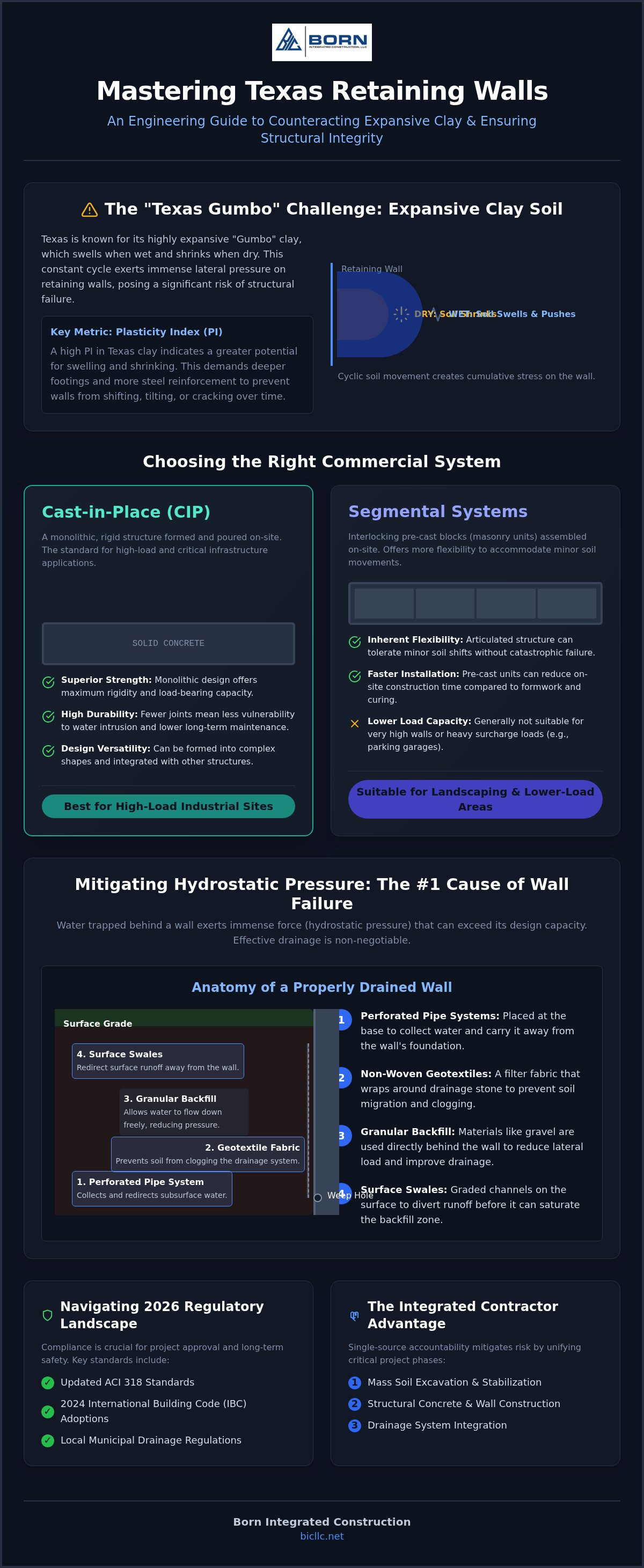
The region is notorious for "Texas Gumbo," a highly expansive clay that swells when saturated and shrinks during dry periods. This volumetric change exerts immense lateral pressure on any vertical structure. While decorative residential walls might rely on gravity alone, commercial projects require structural concrete solutions designed to withstand these cyclic forces. Failure to account for this movement often leads to unsightly cracking or catastrophic structural collapse.
The Plasticity Index (PI) and Wall Stability
The Plasticity Index (PI) is a critical metric for determining how soil behaves under varying moisture levels. High PI values in Texas clay necessitate deeper footings and increased steel reinforcement to prevent the wall from shifting or tilting. Seasonal moisture fluctuations create a "ratchet effect," where soil expands against the wall but doesn't fully recede, leading to cumulative structural stress. This constant movement requires a disciplined approach to foundation design.
Soil stabilization creates a predictable subgrade for wall footings by chemically or mechanically altering the clay's properties. By reducing the soil's ability to swell, contractors can establish a steadfast base that supports the wall's weight and the pressure of the earth behind it. Without this initial stabilization, even the most robust concrete wall remains vulnerable to the shifting ground beneath it.
Managing Drainage and Hydrostatic Pressure
Hydrostatic pressure is the leading cause of wall failure in the commercial sector. When water accumulates behind a structure without an exit path, it exerts a force that can exceed the wall's design capacity. Effective drainage systems utilize weep holes and high-flow drainage composites to channel water away from the backfill. Selecting a commercial concrete retaining wall contractor Texas firms rely on ensures that these drainage components are integrated during the initial earthwork phase.
Integrating these structures with existing storm sewer systems is essential for large-scale developments. This level of civil coordination is similar to the precision required for Commercial Concrete Paving in Conroe, where water management dictates the longevity of the entire site. Proper management of water involves several key components:
- Perforated pipe systems to collect and redirect sub-surface water.
- Non-woven geotextiles to prevent soil migration into drainage stone.
- Granular backfill to reduce the direct load on the concrete face.
- Surface swales to redirect runoff before it reaches the wall's backfill zone.
Cast-in-Place vs. Segmental: Choosing the Right Commercial System
Selecting a wall system involves balancing immediate site requirements with long-term structural integrity. In the local landscape, where soil movement is a constant factor, a commercial concrete retaining wall contractor Texas developers trust must weigh the rigidity of cast-in-place (CIP) against the flexibility of segmental systems. While both serve to hold back earth, their engineering profiles suit different load-bearing scenarios and site constraints.
Structural requirements for multi-level parking garage foundations often dictate the use of high-strength concrete. These structures must support not only the lateral earth pressure but also the dynamic live loads of moving vehicles. Comparing long-term maintenance costs reveals that while masonry units may have lower initial material costs, the monolithic nature of poured concrete often results in fewer repairs over the structure's lifespan.
Structural CIP: The Standard for High-Rise and Infrastructure
CIP walls offer unmatched load-bearing capacity, making them the preferred choice for midrise and highrise developments. Because these structures are poured monolithically, they eliminate the risk of joint separation that can occur in masonry units under heavy lateral loads. This unified construction provides a rigid barrier that's essential for sites with limited space where vertical pressure is extreme.
The stability provided by CIP is often a prerequisite for complex projects, much like the precision required by an Expert Podium Slab Contractor in Houston. These systems aren't just boundaries; they're integral parts of the site's structural skeleton that ensure the safety of the entire development. You can learn more about our commitment to these standards and our approach to complex structural builds.
MSE and Segmental Walls for Large-Scale Grading
Mechanically Stabilized Earth (MSE) and segmental retaining walls (SRW) are frequently utilized in large-scale Texas grading and highway projects. These systems use interlocking dry-cast concrete units combined with geogrid reinforcement to stabilize the backfill soil. The NCMA Design Manual for Segmental Retaining Walls provides the engineering framework for these gravity-based structures, ensuring they meet national safety benchmarks.
- Retail Applications: Often favor segmental walls for their aesthetic variety and speed of installation in non-critical load areas.
- Industrial Sites: Usually demand the durability of CIP to handle heavy equipment vibration and higher surcharge loads.
- Geogrid Reinforcement: Essential for segmental systems, geogrid layers extend into the backfill to create a reinforced soil mass.
- Settlement Tolerance: Segmental walls allow for slight settlement without visible cracking, which is helpful in expansive clay environments.
While segmental walls offer versatility, they require significant horizontal space behind the wall face for geogrid placement. This footprint requirement often makes CIP the only viable option for tight urban sites where every square foot of buildable land is at a premium. A seasoned commercial concrete retaining wall contractor Texas professionals rely on will assess these spatial constraints during the pre-construction phase to prevent costly design revisions.
The Integrated Advantage: Single-Source Civil and Structural Concrete
Project delays often stem from a lack of coordination between separate earthwork and concrete subcontractors. When these scopes are split, general contractors often don't have a clear path to resolution when issues arise regarding subgrade readiness or structural tolerances. Selecting a commercial concrete retaining wall contractor Texas firms trust for turn-key solutions eliminates these administrative and operational hurdles. This integrated approach ensures that site preparation and wall construction are managed as a single, cohesive process.
By consolidating mass soil excavation and structural concrete into one contract, you establish a single point of accountability. This model is particularly effective for high-stakes projects like CIP garages or midrise developments where the foundation's integrity depends entirely on the soil's stability. It's a strategy that prioritizes execution over excuses. Our "Born Integrated" philosophy focuses on the seamless transition from raw site grading to vertical framing, protecting the project's critical path.
Mass Excavation and Soil Stabilization
Stable retaining walls require a foundation built on engineered subgrade rather than native, expansive clay. The process begins with mass soil excavation to remove unsuitable materials, followed by the strategic importation of select fill. In major Texas markets, we utilize lime or cement stabilization to chemically alter the soil's properties, creating a rigid platform for the wall's footings. Integrated civil site work reduces project timelines by 15% by removing the scheduling friction between separate dirt and concrete crews.
Coordinating Wet Utilities and Site Grading
The global stability of a retaining structure can be compromised by poorly timed utility trenching. Excavating for storm sewers or sanitary lines within the wall's zone of influence often leads to settlement or structural shifting. Managing these wet utilities alongside the site grading allows for a synchronized installation that respects the engineering limits of the wall's foundation. This level of coordination is a hallmark of our site readiness strategy, ensuring that every underground component is placed with the wall's long-term viability in mind. You can explore our philosophy of professional stability to see how we manage these complex site interactions.
Every phase of the earthwork is executed with the final structural pour in mind. When the same team that prepares the pad also builds the wall, the risk of misaligned elevations or improper compaction disappears. This steadfast commitment to technical proficiency ensures that the transition from civil work to structural framing is both efficient and reliable.
Compliance and Safety: Navigating 2026 Texas Building Codes
Adherence to evolving building codes is a non-negotiable aspect of commercial site development. While Texas doesn't maintain a single statewide mandate, municipalities are rapidly adopting the 2024 International Building Code (IBC) with local amendments effective throughout 2026. A commercial concrete retaining wall contractor Texas developers trust must possess the technical depth to navigate these varying requirements. This expertise ensures that every structure meets the specific demands of the Authority Having Jurisdiction (AHJ).
Safety in high-risk concrete construction is measured by more than just compliance; it's reflected in a firm's Experience Modification Rate (EMR). A low EMR signifies a disciplined approach to job-site safety and operational precision. In Texas, where walls exceeding four feet in height require a licensed Engineer of Record (EOR), this commitment to safety and engineering oversight is essential for mitigating long-term liability.
ACI Standards and Structural Precision
The ACI 318 standards provide the engineering framework for structural concrete retaining walls. These guidelines dictate the precise placement of reinforcement and the necessity of proper vibration to eliminate voids. Vibration is a critical step that ensures the monolithic integrity of the pour, especially in heavy-duty industrial foundations. Without this attention to detail, the wall's capacity to resist lateral loads is significantly diminished.
Joint spacing plays a vital role in preventing shrinkage cracking within cast-in-place (CIP) structures. By following ACI recommendations for control and expansion joints, contractors can manage the natural stresses of curing concrete. This methodical approach to site work prevents the structural degradation that often follows unmanaged cracking. You can partner with BIC to ensure code compliance and structural excellence on your next project.
Local Permitting in Houston, Austin, and San Antonio
Each major Texas market presents unique regulatory challenges. Austin has transitioned toward stricter environmental regulations and newer IBC standards, requiring meticulous planning for site impact. In Houston, the integration of detention ponds and basin systems is often a prerequisite for retaining wall approval. These structures must function as part of a larger civil ecosystem designed to manage the region's intense storm runoff.
- Austin: Focuses on tree preservation and impervious cover limits alongside IBC 2024 adoptions.
- Houston: Prioritizes drainage integration and flood plain management for all commercial foundations.
- San Antonio: Maintains specific requirements for karst feature protection and Edwards Aquifer recharge zone compliance.
- Safety: OSHA compliance is the baseline, but our steadfast commitment to safety includes continuous field training and rigorous equipment inspections.
Navigating these local nuances requires more than just a general understanding of construction. It demands a partner who is grounded in the specific codes of each municipality. By prioritizing compliance from the pre-construction phase, we eliminate the risk of costly red-tags or project stoppages. This unhurried, deliberate focus on the details is what builds lasting value for our clients.
Born Integrated Construction: Steadfast Retaining Solutions
Reliability in the commercial sector isn't built on promises; it's forged through the consistent delivery of high-quality infrastructure. At Born Integrated Construction (BIC), we embody professional stability by maintaining a grounded and serious approach to every project. As a commercial concrete retaining wall contractor Texas developers have come to depend on, we prioritize substance over style. We understand that the enduring nature of our professional output is the foundation upon which your project's success is built.
Our comprehensive service scope allows us to act as a disciplined partner from the initial mass excavation to the final structural framing. This single-source accountability mitigates the risks associated with coordination gaps and scheduling friction. We've successfully delivered complex retaining solutions across major Texas markets, ensuring that each structure meets the meticulous management of details required for long-term viability. We invite you to view our portfolio of projects to see the breadth of our structural expertise.
Turn-Key Civil and Concrete Capabilities
Our expertise extends beyond simple vertical boundaries to encompass the entire structural skeleton of your development. We specialize in turn-key civil and structural concrete solutions, including slab-on-grade, podium slabs, and CIP garage foundations. This breadth of capability allows us to manage the acts of establishing and maintaining site integrity from the first shovel in the ground. About Born Integrated Construction provides a deeper look into our ethical framework and our commitment to ACI standards. Our core offerings include:
- Mass Soil Excavation: Preparing a stable wall pad through rigorous site grading.
- Structural Concrete: Delivering high-load CIP walls for midrise and highrise projects.
- Detention Ponds: Integrating drainage solutions with retaining structures.
- Paving Stabilization: Ensuring the longevity of site infrastructure through chemical soil treatment.
Partnering with BIC for Your 2026 Development
The BIC process is designed to provide cost-effective, high-quality infrastructure that anticipates the needs of the 2026 development cycle. We don't seek to disrupt; we seek to execute with unwavering consistency and safety. Our steadfast tone reflects a deep-rooted commitment to structural viability, providing a sense of security for general contractors and civil engineers alike. We focus on building lasting foundations, both in the physical structures we pour and the professional relationships we maintain.
Selecting a commercial concrete retaining wall contractor Texas professionals trust means choosing a partner who leads through proven results and technical proficiency. We are ready to help you navigate the complexities of Texas soil and evolving building codes with a methodical, deliberate approach. Contact us today to discuss how our integrated civil and structural concrete solutions can secure the enduring success of your next commercial project.
Securing Your Site Infrastructure for 2026 and Beyond
Building a commercial development in Texas requires more than just pouring concrete; it demands a deep understanding of expansive soil mechanics and rigorous regulatory compliance. By integrating mass soil excavation with structural wall construction, you eliminate the coordination gaps that often lead to project delays. This single-source approach ensures that your infrastructure meets the 2026 IBC and ACI standards from the moment the first shovel hits the dirt.
Born Integrated Construction remains a steadfast partner for developers in Houston, San Antonio, and Austin. Our commitment to professional stability and operational precision provides the security needed for high-stakes industrial and infrastructure projects. When you work with an experienced commercial concrete retaining wall contractor Texas firms rely on, you're investing in the long-term viability of your site.
We invite you to Contact Born Integrated Construction for a Steadfast Retaining Wall Quote and begin establishing a foundation that will stand the test of time. Your project deserves the reliability of a partner focused on substance and execution.
Frequently Asked Questions
When does a commercial retaining wall in Texas require an engineer?
Most Texas municipalities require a permit and a licensed professional engineer's design for any retaining wall exceeding four feet in height. This threshold is standard across major markets like Dallas, Austin, and San Antonio. The engineer ensures the structure can withstand lateral earth pressure and hydrostatic forces. For high-stakes commercial projects, an Engineer of Record (EOR) typically oversees the design to ensure full compliance with the 2024 IBC and local safety regulations.
What is the average lifespan of a cast-in-place concrete retaining wall?
A professionally constructed cast-in-place concrete retaining wall can last between 50 to 100 years. This longevity depends on proper initial engineering and the use of high-strength structural concrete. Unlike wood or certain masonry units, poured concrete offers superior resistance to weathering and soil movement. Regular inspections of drainage systems and weep holes help maintain this lifespan by preventing excessive pressure build-up over the decades, ensuring the structure remains steadfast.
How does Texas expansive clay affect retaining wall design?
Expansive clay, often called "Texas Gumbo," swells when wet and shrinks when dry, creating significant lateral pressure. Designers must account for this movement by implementing deeper footings and increased steel reinforcement. A commercial concrete retaining wall contractor Texas developers trust will often utilize soil stabilization to create a predictable subgrade. This process reduces the "ratchet effect" of soil expansion that can eventually cause structural tilting or catastrophic failure in lesser structures.
What is the difference between a gravity wall and an MSE wall?
Gravity walls rely solely on their massive weight to resist soil pressure, while Mechanically Stabilized Earth (MSE) walls use geogrid reinforcement to create a stable soil mass. Gravity walls are typically made of cast-in-place concrete or massive stone blocks. MSE walls are often more cost-effective for taller structures but require a much larger horizontal footprint behind the wall face. The choice depends on site constraints, available space, and the specific load requirements of the development.
Does Born Integrated Construction handle both excavation and wall construction?
Yes, Born Integrated Construction provides single-source accountability for both mass soil excavation and structural wall construction. We specialize in turn-key civil solutions that eliminate the coordination gaps between separate dirt and concrete crews. This integrated approach allows us to manage everything from underground utility placement to the final structural pour. By controlling the entire process, we ensure that the subgrade is perfectly prepared for the specific load-bearing requirements of the wall.
What are the ACI standards for commercial concrete walls in 2026?
The ACI 318 standards for 2026 focus on structural reinforcement placement, concrete durability, and precise vibration techniques to eliminate voids. These guidelines ensure that structural concrete can handle the specific requirements of midrise and highrise developments. Compliance requires rigorous testing and documentation of concrete strength and steel placement. Following these standards is essential for meeting the latest IBC adoptions and ensuring the long-term integrity of heavy-duty industrial foundations across major Texas markets.
How long does the soil stabilization process take before building a wall?
The soil stabilization process typically takes between three to seven days, depending on the site size and the chemical agents used. This timeframe includes the initial mixing of lime or cement into the clay, followed by a curing period to achieve the desired rigidity. Once the subgrade reaches the specified compaction and stability, the team can begin excavating for footings. This methodical preparation is vital for building a wall that won't shift during seasonal moisture changes.
Can retaining walls be integrated with detention pond construction?
Retaining walls are frequently integrated with detention pond construction to maximize buildable land on tight commercial sites. These walls serve as the pond's perimeter, allowing for deeper water storage within a smaller footprint. This integration requires specialized engineering to handle the unique hydrostatic pressures of a basin. We coordinate the earthwork and concrete pour to ensure the wall functions seamlessly with the site's overall storm sewer and drainage system, maintaining structural integrity.