Concrete Slab Curing Time in Texas Heat: A Commercial Guide
The extreme Texas sun is not merely a weather condition to be endured; it's a chemical catalyst that demands a disciplined approach to moisture suppression to prevent structural failure. You likely recognize the professional frustration of watching a meticulously planned pour succumb to surface cracking or flash setting as the thermometer climbs. While the temptation is often to accelerate the schedule to beat the heat, true operational stability comes from understanding the underlying science of hydration. This guide provides the technical framework to master concrete slab curing time in Texas heat, ensuring your high-strength concrete achieves its full design potential without the risk of plastic shrinkage cracks. We'll examine the critical distinction between drying and curing, establish a reliable loading schedule for heavy machinery, and detail the moisture management techniques necessary for long-term structural integrity. By implementing these seasoned strategies, you can maintain project precision and deliver a finished product that stands as a testament to quality craftsmanship and enduring value.
Key Takeaways
- Identify the critical distinction between chemical hydration and moisture loss to ensure your slab reaches its full design strength.
- Navigate the high-stakes 24-to-72-hour window where managing concrete slab curing time in Texas heat is most essential for durability.
- Implement proven moisture suppression techniques, including wet curing and evaporation retardants, to eliminate plastic shrinkage cracks.
- Adhere to a disciplined loading schedule that requires a three-day minimum for foot traffic to maintain the integrity of the structural surface.
- Recognize how comprehensive pre-pour planning and professional civil site management mitigate the inherent risks of extreme thermal environments.
The Science of Hydration: Why Heat Isn't Always Your Friend
Concrete doesn't simply dry to gain strength; it cures through a specific chemical process. Hydration is the chemical bond formation between cement and water. While it's a common misconception that heat accelerates progress in a positive way, extreme temperatures often compromise the long-term structural integrity of the pour. When moisture evaporates too quickly, the hydration process is interrupted, which results in a disorganized crystalline structure that fails to meet maximum strength requirements. This premature moisture loss leaves the internal matrix of the slab brittle and prone to future failure.
The "Texas Factor" represents a triple threat of high ambient heat, low humidity, and persistent wind. These environmental forces accelerate moisture loss at an alarming rate, often causing the evaporation rate to exceed the bleed rate. Successfully managing concrete slab curing time in Texas heat involves more than just watching a clock; it requires active intervention to keep the slab saturated. High temperatures might trigger a faster initial set, but without disciplined moisture management, the finished slab will likely suffer from reduced durability and increased permeability.
The Risks of Thermal Cracking
Thermal cracking happens when the internal core of the slab remains hot while the surface cools or dries rapidly. This temperature variance creates internal tension that the young concrete cannot withstand. If the surface shrinks faster than the core, map cracking or crazing develops across the face of the slab. The first six hours after placement are the most critical for the slab's future. During this window, the concrete has very little tensile strength to resist the forces caused by rapid surface cooling or uneven temperature distribution.
Flash Set and Workability Issues
Heat significantly narrows the time available for crews to finish the concrete surface properly. Flash set, the premature hardening of the mix, can lead to uneven surfaces and structural weak points if not managed with precision. We often incorporate chemical retarders and other specialized admixtures to maintain workability during the most intense parts of the day. This focus on technical proficiency and operational precision is a hallmark of our work. You can read more about our dedication to high standards and professional stability on our About Us page. Our approach ensures that every project, from podium slabs to heavy-duty paving, meets rigorous quality benchmarks regardless of the climate.
Concrete Curing Timeline for Commercial Slabs
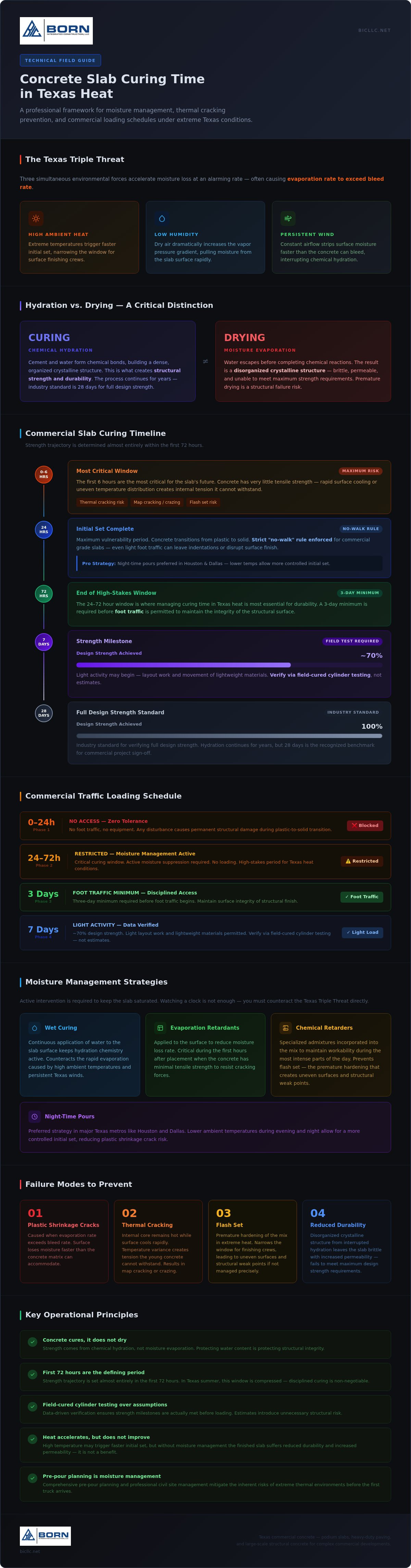
Managing a commercial project schedule requires a precise understanding of the concrete slab curing time in Texas heat. While the hydration process continues for years, the industry recognizes 28 days as the standard for verifying full design strength. However, the trajectory of that strength is determined almost entirely within the first 72 hours. In the Texas summer, this window is compressed by high ambient temperatures, making disciplined adherence to a curing schedule the difference between a high-performing floor and a compromised asset. Establishing a predictable timeline allows for better coordination of follow-on trades and ensures the long-term viability of the structure.
Initial Set: The First 24 Hours
The first 24 hours represent the period of maximum vulnerability. During this phase, the concrete transitions from a plastic state to a solid; any premature disturbance can cause permanent structural damage. We enforce a strict "no-walk" rule for commercial grade slabs during this interval. Even light foot traffic can leave indentations or disrupt the surface finish before the initial set is fully established. Night-time pours are often the preferred strategy in major metros like Houston or Dallas. Starting the process when temperatures are lower allows for a more controlled initial set and reduces the risk of the surface drying before the finishing crew can complete their work.
The 7-Day Strength Milestone
By the seventh day, a properly managed slab typically reaches approximately 70% of its specified design strength. At this stage, many project managers begin to introduce light activity, such as layout work or the movement of lightweight materials. It's essential to verify these gains through field-cured cylinder testing rather than relying on estimates. This data-driven approach ensures that the slab can handle the intended stresses without risk of cracking or surface scaling. You can see the results of this meticulous scheduling in our Project Gallery, which showcases our expertise in executing large-scale structural concrete for complex commercial developments.
While the 7-day mark is a significant milestone, the 28-day threshold remains the professional benchmark for structural certification. Rushing the loading of heavy machinery or permanent structures before this point can lead to long-term deflection issues. For those planning high-stakes infrastructure, partnering with a firm that understands structural concrete construction in extreme climates is vital for maintaining both the project schedule and the required standard of quality. We prioritize these timelines to deliver results that stand as a foundation for long-term operational success.
Moisture Management Strategies in the Texas Sun
Effective moisture management is the cornerstone of structural durability, especially when environmental conditions threaten to deplete the water necessary for hydration. In high-stakes commercial environments, the primary objective is to maintain a saturated state within the concrete matrix to prevent plastic shrinkage. This requires a disciplined approach that begins the moment the concrete is placed. Successfully managing the concrete slab curing time in Texas heat involves selecting the right suppression method based on the specific requirements of the project and the immediate weather forecast. Relying on a single strategy for every site often leads to inconsistent results and compromised surface integrity.
Beyond the choice of curing method, site-side interventions like windbreaks and evaporation retardants play a vital role. On open Texas sites, wind accelerates the evaporation rate significantly, often pulling moisture from the surface faster than it can be replaced by bleed water. Temporary windbreaks can mitigate this risk. Additionally, evaporation retardants applied during the finishing process create a microscopic film that holds moisture in place, buying the finishing crew the time needed to achieve a professional result without adding excess water to the mix. These tools are essential for maintaining operational precision during the most intense summer months.
Wet Curing vs. Liquid Membranes
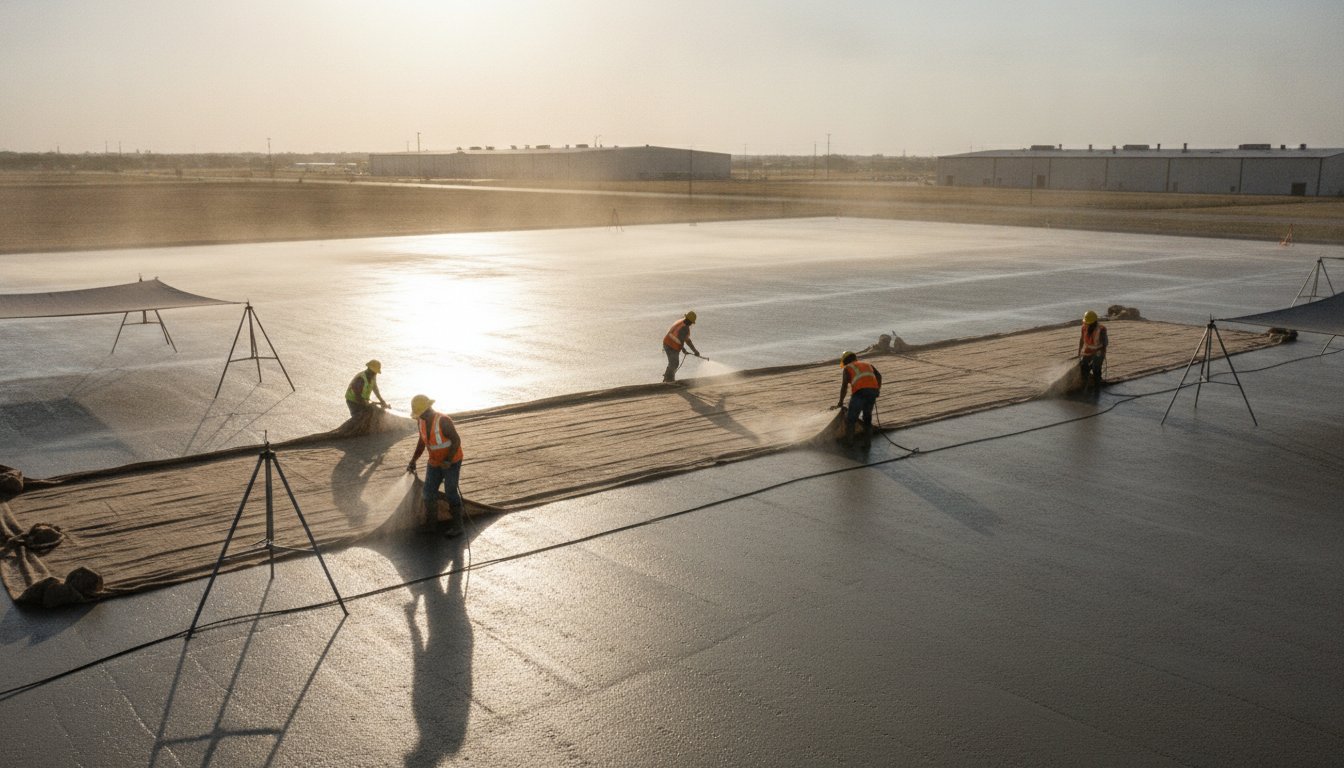
Wet curing, which often utilizes saturated burlap or continuous misting, remains the gold standard for achieving maximum strength. This method provides a cooling effect that helps regulate the internal temperature of the slab. However, it requires constant monitoring to ensure the materials don't dry out. Liquid-forming membranes are a more practical alternative for large-scale concrete paving projects. These chemical compounds create a seal that traps moisture inside the slab. While less labor-intensive than wet curing, liquid membranes must be applied at the correct coverage rate to be effective. If the membrane is applied too thinly or too late, the slab remains vulnerable to the drying effects of the sun.
Regional Humidity: Houston vs. North Texas
The geographic diversity of Texas requires a tailored approach to curing. In the Gulf Coast region, including Houston, high ambient humidity can actually assist in slowing down the evaporation rate, though the heat remains a significant factor. Conversely, the dry heat and persistent winds of North Texas metros like Dallas and Fort Worth create a much more aggressive evaporation environment. These conditions demand more rigorous moisture suppression tactics to ensure the concrete slab curing time in Texas heat doesn't result in surface failure. Our teams operate across Houston, Austin, San Antonio, and Dallas, bringing a deep understanding of these regional nuances to every project. This local expertise allows us to adjust our methods to the specific atmospheric demands of the job site, ensuring a reliable and stable foundation for our clients.
When Can You Load the Slab? Commercial Traffic Guidelines
Determining the exact point at which a surface can support weight is a critical operational decision. In the context of concrete slab curing time in Texas heat, "loading" refers to any external pressure applied to the surface, ranging from a single technician's weight to the immense force of a loaded freight vehicle. Rushing this transition often results in permanent structural deformation or surface scarring that cannot be easily repaired. We prioritize a conservative approach to loading to ensure the long-term viability of every asset we establish.
We maintain strict thresholds based on the intended use of the slab. Light foot traffic is generally permissible after a 3-day minimum, provided the surface has been properly protected. For light vehicles such as passenger cars and standard pickup trucks, a 7-day minimum is required. Heavy construction equipment, freight trucks, and permanent structural loads must wait for the full 28-day cure or until cylinder testing verifies the specific PSI requirements have been met. This disciplined schedule protects the integrity of the finish and the structural core.
Loading Schedules for Heavy-Duty Paving
Prematurely opening commercial roads in Conroe creates a high risk of edge loading. This occurs when heavy weight is applied to the perimeter of a "green" slab before it's gained sufficient tensile strength. Such pressure leads to corner breaks and longitudinal cracking that compromise the entire section. For robust infrastructure, it's vital to coordinate with a team experienced in commercial concrete paving in Conroe to manage these windows effectively. Our teams ensure that every yard of concrete reaches the necessary maturity before it's subjected to the rigors of heavy traffic.
Podium Slabs and Multi-Story Considerations
Elevated podium decks require a different level of oversight due to the complexities of vertical construction. The timing for shoring and re-shoring is inextricably linked to the cure cycle and the ambient temperature. In Houston's high-heat environment, the rate of strength gain must be monitored closely to ensure the structure can safely support the weight of subsequent floors. Our reputation as an expert podium slab contractor in Houston is built on our ability to manage these complex schedules with precision. We verify strength through rigorous testing before any structural loading occurs on elevated levels.
For project managers overseeing high-stakes infrastructure, maintaining a reliable loading schedule is essential for both safety and long-term performance. Contact us today to discuss how our structural concrete construction services can provide the professional stability your next project requires.
Partnering with a Texas Concrete Expert
Managing a high-stakes pour in an extreme environment requires more than just equipment; it requires a partner committed to long-term viability. Failing to account for the concrete slab curing time in Texas heat during the pre-construction phase often leads to costly remedial work or structural compromises. At Born Integrated Construction, we prioritize a disciplined approach that begins long before the first yard of concrete is discharged. Our team understands that every project is an investment in the state's infrastructure, and we treat each slab with the meticulous attention to detail it deserves. By establishing clear protocols for moisture management and thermal regulation, we ensure that your development achieves its full design potential.
Efficiency Through Integrated Services
Our "Turn Key Civil" approach provides a comprehensive solution for developers seeking operational stability. We manage the entire scope of work, including mass soil excavation, paving stabilization, and the final structural concrete placement. This integration allows for a seamless transition between site preparation and paving, which is essential for maintaining the integrity of the subgrade. When one contractor oversees both the earthwork and the concrete construction, the risk of schedule delays or communication gaps is significantly reduced. The result is a more resilient structure and a higher return on investment for the property owner. You can learn more about our commitment to ethical conduct and operational precision on our About Us page.
Get Started on Your Next Texas Development
As a seasoned and authoritative partner, we act as a dependable leader in the Texas construction landscape. We don't seek to disrupt; we focus on execution, safety, and the rigorous management of technical details. This steadfast focus allows us to deliver consistent value across major metros including Houston, Austin, San Antonio, and Dallas. Whether your project involves complex podium slabs or heavy-duty concrete paving, our team has the proven results to back our reputation. We invite you to review our project portfolio to see the breadth of our expertise in managing large-scale commercial infrastructure.
The success of your next project depends on the quality of the foundations you build today. If you're planning a commercial development and require a professional site evaluation, contact us to discuss your specific needs. We'll provide a clear, technical framework to manage the complexities of your site, ensuring that every yard of concrete is cured to perfection despite the challenges of the climate. Let's work together to establish a foundation that stands as a testament to quality craftsmanship and professional stability.
Securing Structural Integrity in Extreme Climates
Mastering the concrete slab curing time in Texas heat is a matter of technical discipline and operational patience. By prioritizing active moisture suppression and strictly adhering to verified loading schedules, you protect the structural core from the thermal stresses inherent to our region. A successful project depends on the seamless integration of safety-first civil site work and precise concrete execution. We bring a steadfast mindset and a deep-rooted commitment to high standards to every development, whether we're delivering structural CIP solutions or complex podium slabs. Our proven performance across major Texas metros ensures that your infrastructure is built to endure the most demanding atmospheric conditions.
We invite you to Request a Consultation for Your Commercial Concrete Project to establish a foundation rooted in reliability and professional stability. With the right technical framework and a seasoned partner in place, your next development will stand as a benchmark of craftsmanship and long-term value. We look forward to delivering the unwavering consistency your vision requires.
Frequently Asked Questions
How does 100-degree heat affect concrete curing time?
High temperatures significantly accelerate the initial set, but they don't necessarily speed up the strength-gain process in a beneficial way. In 100-degree weather, the chemical reaction of hydration occurs so rapidly that the concrete may fail to reach its full design strength. This heat increases the risk of the surface drying before the core can stabilize. Managing the concrete slab curing time in Texas heat requires active moisture suppression to ensure the hydration process continues steadily without interruption.
Can I pour a concrete slab in Texas during the afternoon?
Afternoon pours during a Texas summer are generally discouraged due to peak solar radiation and high evaporation rates. The intense heat makes it difficult for finishing crews to manage the surface before it "flashes" or hardens prematurely. We typically schedule major commercial pours for the early morning or night hours. These cooler windows allow for a more predictable set and provide a more manageable environment for applying curing compounds or wet burlap to the finished slab.
What is the fastest way to cure concrete in hot weather?
There is no safe way to bypass the natural hydration cycle, but you can optimize the timeline by using specialized admixtures and consistent moisture application. Wet curing with saturated burlap is the most effective method for maintaining a steady temperature and preventing moisture loss. While chemical curing compounds offer a faster application process for large-scale paving, they don't provide the cooling benefits of water. The goal is to facilitate a complete chemical reaction rather than rushing the drying process.
When can heavy equipment drive on a new concrete slab?
Heavy construction equipment and freight vehicles shouldn't load a new slab until it reaches its full 28-day design strength. While light foot traffic is often permissible after three days, the concentrated weight of machinery can cause structural failure or deep cracks in "green" concrete. We recommend verifying strength through field-cured cylinder testing before allowing heavy loads. This data-driven approach ensures the slab is structurally mature enough to handle the specific PSI requirements of your commercial operations.
Does high humidity in Houston help or hurt the curing process?
High humidity in regions like Houston and Beaumont can actually assist the curing process by naturally slowing the rate of surface evaporation. This moisture in the air reduces the demand on the slab's internal water, which is essential for proper hydration. However, the accompanying heat still poses a risk for thermal cracking. Even in humid conditions, we maintain a disciplined curing protocol to ensure the slab gains strength uniformly without the surface becoming brittle or permeable.
What are the signs that my concrete slab dried too fast?
The most common indicators of premature drying include map cracking, also known as crazing, and plastic shrinkage cracks across the surface. You might also notice "dusting," where the surface becomes powdery and easily abraded because the top layer didn't hydrate fully. These issues suggest that the concrete slab curing time in Texas heat was compromised by rapid moisture loss. If the surface dries before the chemical bond is complete, the resulting slab will lack the durability required for heavy-duty commercial use.
Are curing compounds better than water curing in the Texas sun?
Water curing remains the superior method for achieving maximum structural strength because it provides both moisture and thermal regulation. However, liquid curing compounds are often more practical for large-scale commercial paving projects in Arlington or Fort Worth where continuous misting is difficult to maintain. These chemical membranes create a seal that traps internal moisture. The choice depends on the project's specific requirements, but both methods require precise application to be effective against the intense Texas sun.
How do I prevent cracks in my new commercial parking lot?
Preventing cracks begins with proper soil stabilization and mass excavation to create a stable foundation. Once the concrete is placed, timing the saw-cut joints correctly and implementing a rigorous curing schedule are the most effective defenses against shrinkage. We utilize a "Turn Key Civil" approach to manage every variable, from the initial earthwork to the final moisture suppression. This integrated strategy ensures that the parking lot remains durable and aesthetically consistent despite the temperature fluctuations common in the Texas climate.